
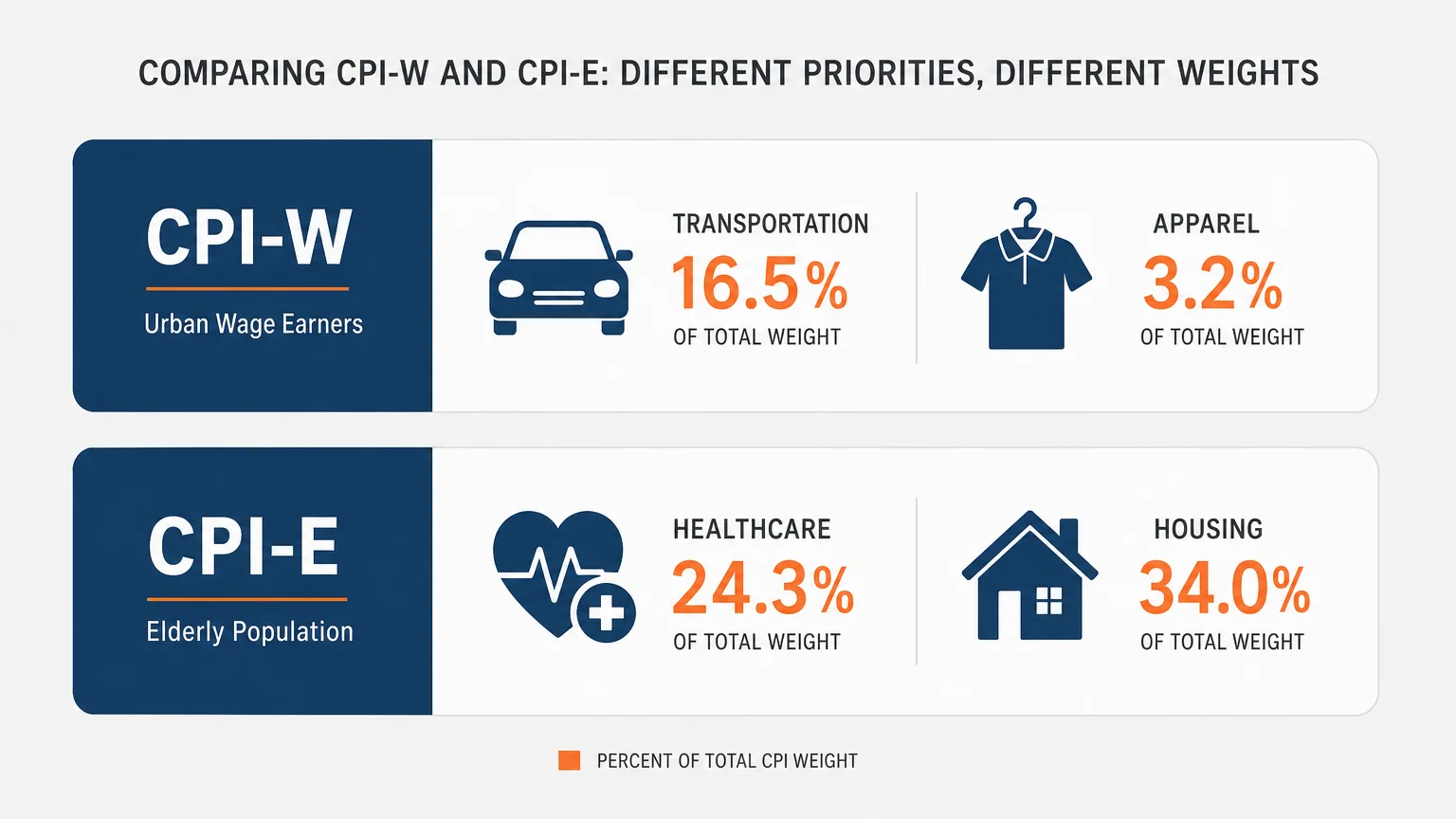
Comparing Inflation Metrics: CPI-W vs. CPI-E
The feeling that the COLA does not accurately reflect senior spending is not just an illusion; it is a structural reality of how the government calculates the adjustment. By law, the Social Security Administration must use the Consumer Price Index for Urban Wage Earners and Clerical Workers (CPI-W).
Senior advocacy groups have lobbied for years to switch the calculation to the Consumer Price Index for the Elderly (CPI-E), which tracks the spending habits of Americans aged 62 and older.
Understanding the difference between these two metrics helps clarify why your cost of living may feel disconnected from your annual adjustment.
| Feature | CPI-W (Current Standard) | CPI-E (Proposed Standard) |
|---|---|---|
| Target Demographic | Urban workers and clerical staff (typically younger). | Americans aged 62 and older. |
| Healthcare Weighting | Lower. Younger workers spend less on medical care. | Significantly higher. Accurately reflects rising Medicare and out-of-pocket costs. |
| Housing Weighting | Moderate. | Higher. Seniors spend a larger percentage of fixed incomes on housing and utilities. |
| Transportation Weighting | Higher. Factors in daily commuting, gas, and vehicle purchases. | Lower. Retirees commute less frequently. |
| Resulting COLA | Often lags behind the actual inflation experienced by retirees. | Historically results in a slightly higher, more accurate benefit increase (typically 0.2% to 0.3% higher). |
Until Congress passes legislation changing the formula, the CPI-W remains the law of the land. You must plan your budget expecting the official adjustment to slightly underrepresent your actual healthcare and housing inflation.