
Finding a retirement haven that balances affordability, lifestyle, and healthcare access feels increasingly impossible as major relocation hubs see their real estate values skyrocket. You do not have to sacrifice financial security to enjoy a fulfilling retirement if you know where to look. Across the country, smaller communities are quietly offering the amenities of much larger cities, including walkable downtowns, outdoor recreation, and top-tier medical facilities, at a fraction of the cost. However, the secret is getting out, and housing markets in these hidden gems are steadily heating up. Moving sooner rather than later can lock in your living costs. Here are seven small towns you should consider relocating to before their home prices spike completely out of reach.
At a Glance: The 7 Rising Retirement Towns
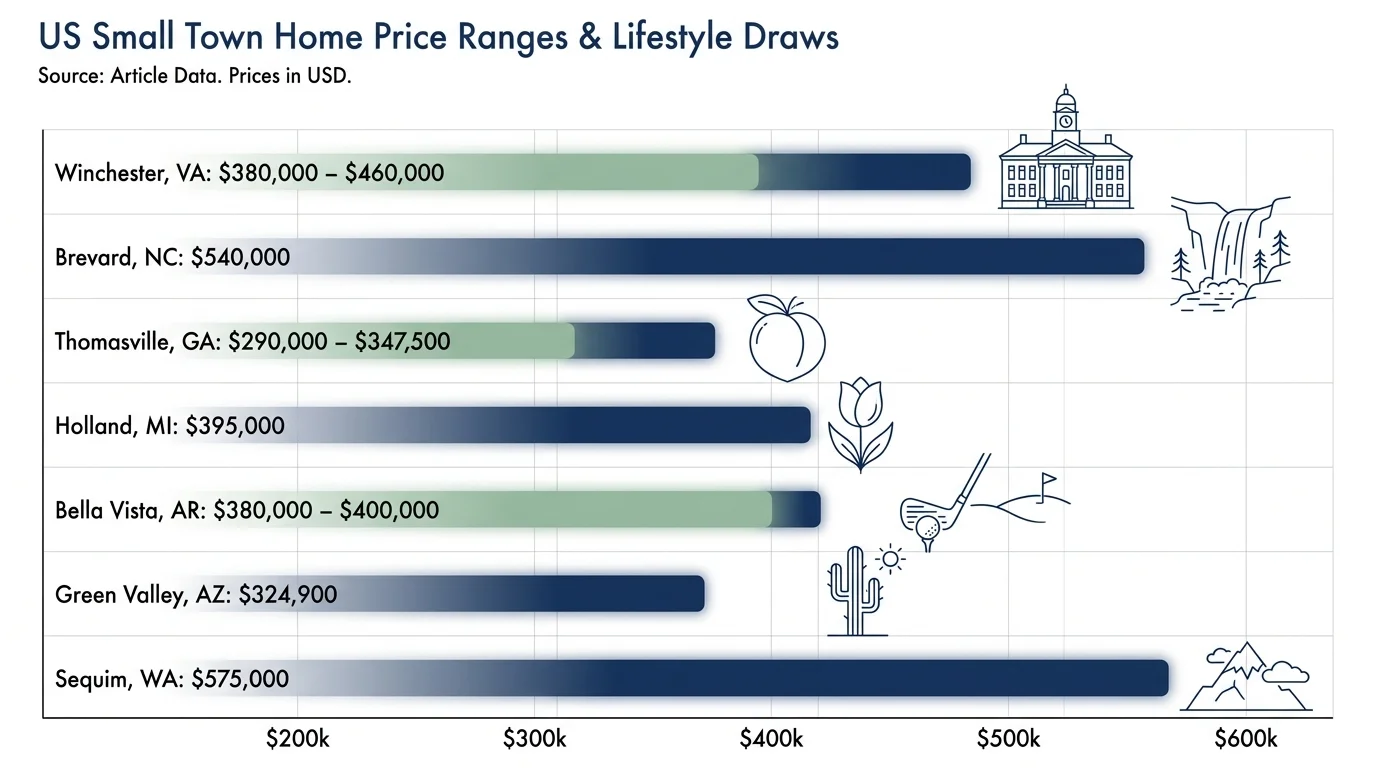
If you want a quick overview of the housing markets across these desirable locations, review this comparison of median home prices and primary lifestyle draws. All housing data reflects market conditions as of early 2026.
| Retirement Town | Median Home Price (2026) | Primary Lifestyle Draw |
|---|---|---|
| Winchester, VA | $380,000 – $460,000 | Historic downtown, commuter-friendly, Shenandoah Valley views |
| Brevard, NC | $540,000 | Mountain trails, hundreds of waterfalls, moderate climate |
| Thomasville, GA | $290,000 – $347,500 | Southern charm, warm winters, extremely tax-friendly |
| Holland, MI | $395,000 | Lake Michigan beaches, local festivals, slower pace |
| Bella Vista, AR | $380,000 – $400,000 | Wooded trails, golf courses, Ozark mountain lakes |
| Green Valley, AZ | $324,900 | Active adult communities, cooler desert elevation, golf |
| Sequim, WA | $575,000 | Coastal mountains, low rainfall, no state income tax |


Why Relocating Makes Sense in 2026
You cannot control national inflation or federal healthcare policy, but you can control your primary living expenses. Relocating to a smaller town drastically reduces your property taxes and daily spending, allowing your fixed income to absorb rising costs elsewhere.
For example, the standard Medicare Part B premium increased to $202.90 per month in 2026. At the same time, the annual Part B deductible rose to $283. If you fall into a higher income bracket, your Income-Related Monthly Adjustment Amount (IRMAA) pushes those healthcare costs even higher. Moving to a locale with lower housing costs frees up your cash flow to comfortably cover these inevitable healthcare hikes.
Additionally, the federal government recently introduced the “Enhanced Deduction for Seniors” for tax years 2025 through 2028. This allows eligible taxpayers age 65 and older to claim an additional $6,000 deduction per person. When you combine massive federal tax breaks with a move to a tax-friendly state, your retirement savings compound significantly.
“When you relocate in retirement, you are not just trading one house for another; you are completely restructuring your balance sheet and your daily cost of living.” — Jean Chatzky, Financial Editor

1. Winchester, Virginia: Shenandoah Valley Value
Winchester sits in the scenic Shenandoah Valley, offering a vibrant alternative to the heavily congested and expensive Northern Virginia suburbs. Retirees flock here because they gain access to rich American history, a walkable Old Town walking mall, and excellent healthcare—without paying Washington D.C. housing premiums.
The median home price in Winchester currently ranges from $380,000 to $460,000. Compared to markets closer to the capital where median prices easily surpass $700,000, Winchester allows you to buy a beautiful single-family colonial or a spacious new-construction townhouse and still keep money in the bank. Virginia also boasts retiree-friendly tax policies; the state does not tax Social Security Administration benefits, which protects your guaranteed monthly income.

2. Brevard, North Carolina: The Land of Waterfalls
If you envision a retirement surrounded by old-growth forests, crisp mountain air, and a tight-knit community, Brevard belongs on your shortlist. Nestled in Transylvania County, this small town sits just 35 minutes southwest of Asheville. It carries the nickname “the land of waterfalls” because hundreds of cascades pour through the nearby Pisgah National Forest.
You pay a slight premium for this natural beauty. The median home price sits around $540,000, making it one of the pricier options on this list. However, demand in Western North Carolina continues to surge, meaning prices will likely escalate further. North Carolina supports retirees through favorable tax rates; the state income tax dropped to a flat 3.99% for 2026, and they do not tax Social Security income.

3. Thomasville, Georgia: Southern Elegance on a Budget
Thomasville delivers the quintessential Southern retirement experience. Imagine spending your weekends exploring a historic downtown filled with brick-paved streets, local boutiques, and exceptional dining. Better yet, imagine enjoying this lifestyle for significantly less than you would pay in Florida or coastal Georgia.
The median home price in Thomasville remains incredibly attractive, hovering between $290,000 and $347,500. Your housing dollar stretches exceptionally far here. You can find historic downtown cottages, modern brick ranches, and properties with acreage at prices that look like they belong in a previous decade. Furthermore, Georgia serves as a major tax haven for seniors. The state exempts Social Security benefits from state income tax and offers a massive retirement income exclusion for residents over age 65.

4. Holland, Michigan: Lakeshore Luxury for Less
Retirees seeking distinct seasons and waterfront living increasingly target Holland, Michigan. Located on the shores of Lake Macatawa and Lake Michigan, Holland balances small-town Midwestern charm with world-class beaches. The town famously hosts the annual Tulip Time Festival, celebrating its rich Dutch heritage.
As of early 2026, the median listing price in Holland sits at a reasonable $395,000. While luxury lakefront properties command much higher figures, you can comfortably secure a three-bedroom home in a quiet, safe neighborhood well below the national average. Michigan recently changed its tax laws to phase out the retirement tax, allowing seniors to deduct a larger portion of their public and private pension income. If you love boating, hiking, and a slower pace of life, Holland offers an exceptional value before the Lakeshore market peaks.

5. Bella Vista, Arkansas: The Outdoor Enthusiast’s Hub
Bella Vista began as a resort and retirement community, but it has rapidly transformed into one of Northwest Arkansas’s fastest-growing towns. Nestled in the Ozark Mountains, the town features multiple lakes, pristine golf courses, and miles of wooded walking and biking trails.
The median listing price in Bella Vista is roughly $400,000. While this represents a significant increase over the past decade, Bella Vista remains a bargain compared to similar recreation-heavy towns in Colorado or Utah. Arkansas does not tax Social Security benefits, and property taxes remain historically low. Because large developers are currently investing heavily in the area’s infrastructure and amenities, buying into Bella Vista now ensures you get ahead of the next wave of price hikes.

6. Green Valley, Arizona: A Desert Haven for Active Adults
If you want guaranteed sunshine, desert landscapes, and a community built exclusively around the senior lifestyle, Green Valley stands unmatched. Located just south of Tucson at an elevation of 2,900 feet, Green Valley enjoys a slightly cooler climate than Phoenix. The area consists largely of deed-restricted active adult communities, meaning you will live alongside peers who share your retirement goals.
Affordability remains Green Valley’s strongest selling point. The median listing price is a modest $324,900. When you compare this to the skyrocketing costs of Scottsdale or Sedona, Green Valley offers the Arizona retirement dream at a steep discount. You gain access to dozens of recreation centers, swimming pools, and golf courses for a fraction of what you would pay elsewhere in the Sun Belt.

7. Sequim, Washington: Pacific Northwest Beauty Without the Rain
Retirees who love the Pacific Northwest often worry about the relentless rain. Sequim solves this problem. Located on the Olympic Peninsula, Sequim sits in the “rain shadow” of the Olympic Mountains. It receives roughly the same annual rainfall as Los Angeles, providing plenty of sunny days to enjoy the nearby mountains and coastline.
Sequim features the highest median home price on our list at $575,000. However, real estate in the Pacific Northwest generally carries a high price tag, and Sequim offers a competitive entry point compared to the Seattle metro area. Washington state notoriously levies zero state income tax, which instantly boosts your take-home pay from pensions, IRA withdrawals, and part-time work. Because homes here sell quickly in a balanced market, waiting on the sidelines could price you out of this unique microclimate.

When DIY Isn’t Enough
Handling a cross-country move while managing your retirement portfolio requires precise calculation. You may need to hire a professional if you face any of the following scenarios:
- You own highly appreciated property: Selling a long-held family home can trigger massive capital gains taxes. A tax professional can help you utilize the Section 121 exclusion or strategize a staged sell-off to minimize your IRS burden.
- You need to navigate the 2026 tax changes: The IRS implementation of the $6,000 Enhanced Deduction for Seniors requires careful income planning. A professional can help you structure your IRA distributions to stay below the phase-out thresholds.
- You require complex healthcare coordination: If you suffer from chronic conditions, you must ensure your new town has in-network specialists. A Medicare broker can verify whether your prospective zip code supports your current Medicare Advantage or Medigap plan.
If your financial picture includes trusts, multiple properties, or complex tax considerations, locate a fiduciary advisor through the Certified Financial Planner Board before signing a real estate contract.

Avoiding Common Errors When Moving for Retirement
Many seniors romanticize small-town living without considering the logistical realities of relocation. Avoid these costly mistakes when planning your move:
- Buying before renting: Never buy a home in a new town based solely on a vacation experience. Rent a short-term property for at least three months. Experience the town during its worst weather season, navigate the grocery stores, and test the drive to the nearest major hospital.
- Ignoring healthcare networks: Small towns rarely possess level-one trauma centers or specialized oncology wards. If you require specialized care, map the exact distance from your potential new home to the necessary medical facilities.
- Forgetting to calculate travel costs: Moving away from your family means you must budget for travel. If the small town lacks a nearby regional airport, your travel expenses—and the expenses of your children coming to visit—will consume a large portion of your retirement budget.
Frequently Asked Questions
Does moving to a cheaper state affect my Social Security payments?
No. Your federal Social Security benefit amount remains exactly the same regardless of where you live in the United States. However, moving can affect your net income if you move from a state that taxes Social Security to one of the majority of states that do not.
Should I wait for interest rates to drop before buying a retirement home?
Trying to time the mortgage market rarely works in your favor. If interest rates drop significantly, buyer demand generally floods the market, driving home prices up and sparking bidding wars. If you find a home that fits your budget today, you can purchase it now and refinance later if rates improve. You can verify current mortgage trends and educational resources through the Consumer Financial Protection Bureau (CFPB).
Will my Medicare Part B or Part D premiums change if I move?
Your standard Medicare Part B premium ($202.90 in 2026) is set at the federal level and does not change based on your zip code. However, if you use a Medicare Advantage (Part C) plan or a standalone Part D prescription drug plan, your premiums and network coverage will almost certainly change when you move to a new county or state. You must notify Medicare of your address change to trigger a Special Enrollment Period.
Your retirement should be a period of relaxation and financial confidence, not constant worry over rising property taxes and unattainable housing costs. By targeting smaller, amenity-rich towns before they hit the mainstream radar, you secure a high quality of life without draining your portfolio. Take the time to visit these locations, run the numbers with a trusted advisor, and make a proactive choice about where your next chapter unfolds.
This is educational content based on general retirement planning principles. Individual results vary based on your situation. Always verify current benefit amounts, tax laws, and eligibility with official sources.
Last updated: February 2026. Retirement benefits, tax laws, and healthcare costs change frequently—verify current details with official sources.