
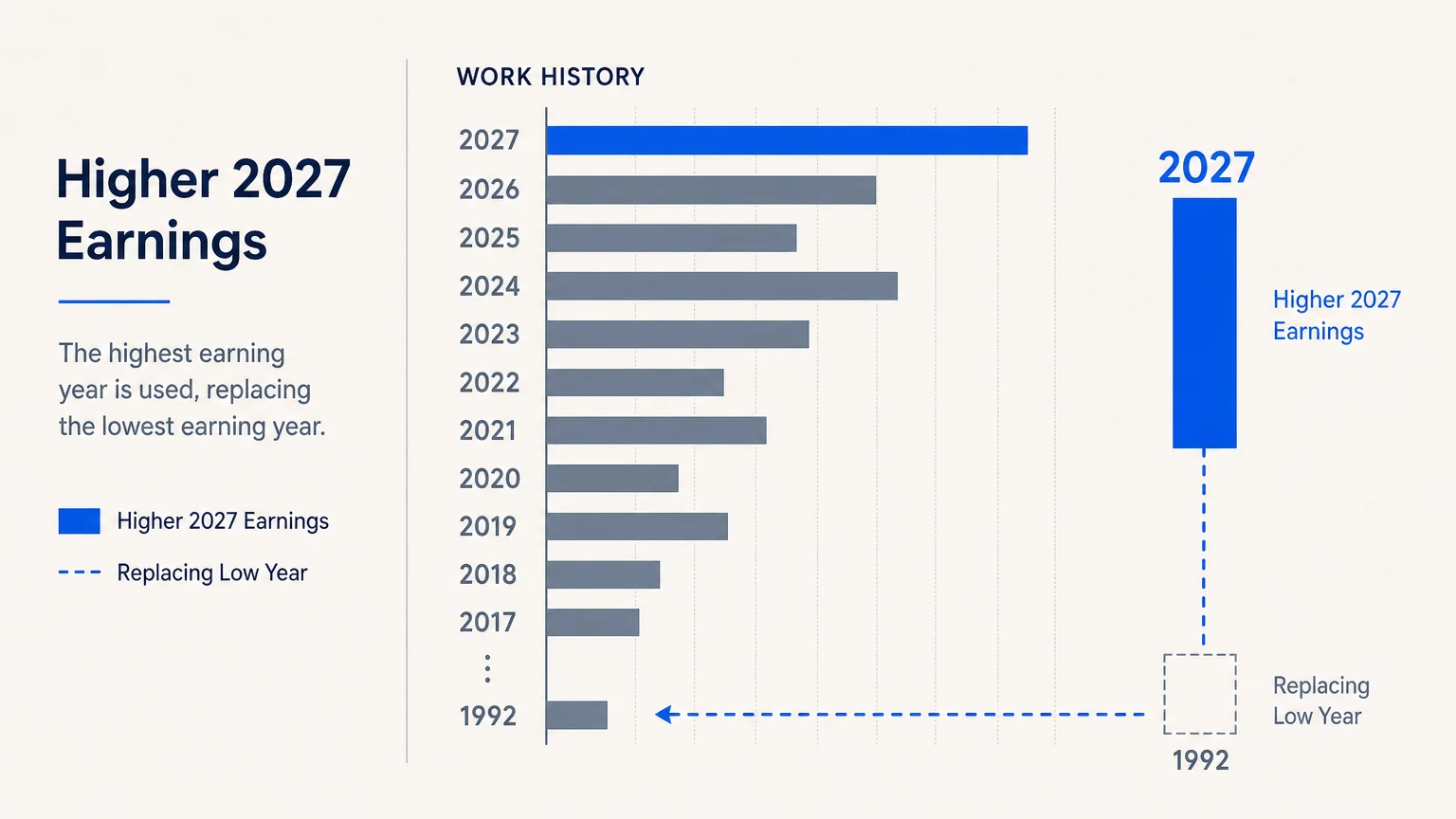
7. Replacing a Low-Earning Year on Your Record
The SSA calculates your primary insurance amount based on your Average Indexed Monthly Earnings (AIME) over your 35 highest-earning years. If you do not have a full 35 years of work history, the SSA fills the missing years with zeros, which drags down your lifetime average.
If you continue to work while collecting benefits in 2026 or 2027, you are still paying Social Security payroll taxes. The SSA reviews your earnings record every year. If your current earnings are higher than one of the lowest years currently used in your calculation—or if your current earnings replace a zero year entirely—the SSA automatically recalculates your benefit.
This recalculation always works in your favor. If your recent work history boosts your 35-year average, you will see a permanent, automatic increase in your Social Security check. You do not need to file any special paperwork to receive this bump; the SSA processes it automatically when your earnings are reported.