
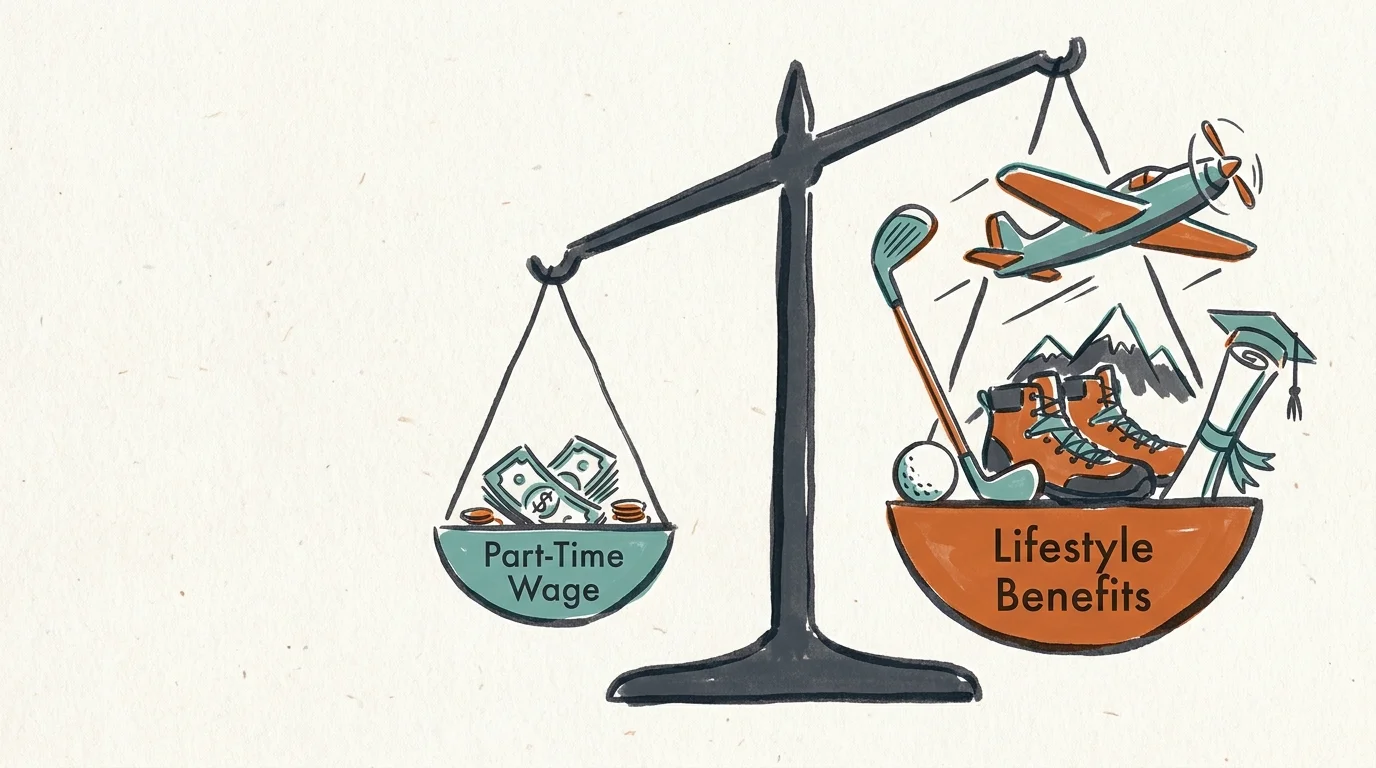
Retiring doesn’t mean you must stop working entirely, especially when a strategic part-time job offers lifestyle benefits that far exceed the hourly paycheck. Earning a modest wage while scoring free access to expensive hobbies, travel, and entertainment allows you to protect your retirement savings without sacrificing the experiences you love. Rather than taking just any part-time gig to fill the hours, savvy retirees target specific roles designed around their interests to unlock thousands of dollars in hidden perks. Whether your goal is to travel the world, golf every week, or take college courses, matching your post-career employment to your bucket list is one of the smartest ways to fund an active, fulfilling retirement.
How Part-Time Work Upgrades Your Retirement Lifestyle
For many Americans, stepping away from a lifelong career creates a sudden void in daily structure and social interaction. While full-time leisure sounds ideal, the reality is that hobbies cost money, and boundless free time can quickly strain a fixed income. Taking a part-time job solves multiple retirement challenges simultaneously: it provides a routine, creates social connections, adds a steady stream of supplementary income, and crucially, subsidizes your lifestyle.
The smartest retirement jobs operate like a membership card to the activities you already enjoy. Instead of paying retail prices for flights, greens fees, or concert tickets, you trade a few hours of your week to access these experiences for free. This strategy allows you to preserve your investment portfolio and stretch your Social Security benefits further, all while staying physically active and mentally engaged.

“You are not defined by your work, no matter what it is or was. You are defined by who you are, how you live, and the love and respect you show to yourself and to others.” — Suze Orman, Financial Expert

1. National Park Campground Host
If your retirement dream involves touring the country in a recreational vehicle, campground hosting is one of the most lucrative ways to offset your travel expenses. The National Park Service, state park systems, and private campgrounds rely heavily on seasonal hosts to manage their grounds.
Camp hosts greet visitors, answer questions, enforce quiet hours, and perform light maintenance like tidying up fire pits or restocking restroom supplies. In exchange for your time—typically 20 to 30 hours a week—you receive a free campsite with full utility hookups.
Private RV parks often pay an hourly wage on top of the free site, while government parks might offer the site purely on a volunteer basis. Considering that prime RV sites can cost upwards of $60 to $100 per night, securing a free spot for an entire season saves you thousands of dollars in lodging expenses, allowing you to live in some of the country’s most beautiful destinations for pennies on the dollar.

2. Airline Gate Agent or Customer Service Representative
Travel routinely ranks as the number one retirement goal for older Americans, but the rising cost of airfare can quickly deplete a travel budget. Working part-time for a major airline is the ultimate hack for globetrotting retirees.
Airlines offer their employees, and often their spouses and eligible dependents, standby flight benefits. This means you can fly for free—or for the cost of nominal taxes and fees—on any flight that has empty seats. Many airlines only require part-time employees to work 16 to 20 hours a week to qualify for these comprehensive travel perks.
Jobs range from handling baggage on the tarmac to working the ticket counter, staffing the customer service desk, or assisting passengers in premium lounges. While the shifts can be early in the morning or late at night, the payoff is unparalleled. You can wake up on a Tuesday, check the flight loads, and jump on a plane to Hawaii, London, or Rome without paying a dime for the ticket.

3. Golf Course Marshal or Starter
Golf is a notoriously expensive hobby. Between greens fees, cart rentals, and equipment, a dedicated golfer can easily spend several hundred dollars a month. Becoming a golf course marshal, starter, or pro shop attendant completely eliminates this financial burden.
A starter manages the tee sheet and ensures groups tee off on time, while a marshal drives the course to ensure groups maintain a proper pace of play and follow course etiquette. The work is low-stress, keeps you outdoors, and surrounds you with people who share your passion for the game.
The primary perk is complimentary access to the course. Depending on the club, working just one or two shifts a week grants you free rounds of golf, complimentary use of the driving range, and substantial employee discounts on apparel and equipment in the pro shop. For a retiree playing three times a week, this job pays for itself in waived fees alone.
4. Event Venue Usher or Ticket Taker
If you love live entertainment but hate the exorbitant ticket prices and service fees, working at a local arena, theater, or stadium is a brilliant solution. Venues constantly need reliable staff to scan tickets, guide guests to their seats, and manage crowds during events.
Ushers are usually permitted to watch the concert, play, or sporting event once the initial rush of seating is over. You get paid an hourly wage to essentially attend world-class performances.
Because events take place primarily in the evenings or on weekends, the scheduling is incredibly flexible. You can often pick and choose which events you want to work, allowing you to tailor your schedule around your favorite sports teams or touring musicians. It is an excellent way to stay culturally engaged and social without spending a fortune on entertainment.

5. University Adjunct Professor or Campus Staff
Colleges and universities are vibrant, stimulating environments, making them ideal workplaces for retirees seeking intellectual engagement. You do not necessarily need a Ph.D. to work on a campus; universities hire part-time administrative staff, library assistants, tour guides, and adjunct instructors with extensive professional backgrounds.
The perks of working in higher education extend far beyond the paycheck. Most institutions offer employees free or heavily discounted tuition, allowing you to audit classes, learn a new language, or study history purely for the joy of learning.
Additionally, campus employees gain access to top-tier university facilities, including state-of-the-art fitness centers, massive library networks, and free entry to guest lectures and collegiate sporting events. It is an immersive environment that keeps the mind sharp and provides intergenerational social connections.

6. Specialty Retail Associate
While general retail can be grueling, working part-time at a specialty store aligned with your hobbies offers tremendous financial advantages. Retirees frequently take jobs at hardware stores, craft supply chains, outdoor outfitters, or culinary boutiques specifically for the employee discount.
If you plan to spend your retirement renovating your home, a 20 percent discount at a major home improvement retailer translates to massive savings on lumber, appliances, and tools. If you are an avid hiker or camper, working at an outdoor retailer provides deep discounts on expensive performance gear.
These roles allow you to share your decades of personal expertise with customers. Selling gardening supplies is not a chore when you have spent your entire adult life cultivating award-winning gardens. You get to talk about your passions all day, collect a paycheck, and fund your hobbies at wholesale prices.

7. Fitness Center Instructor or Front Desk Staff
Maintaining physical health is critical to enjoying a long, active retirement. Gym memberships, personal training, and boutique fitness classes can cost anywhere from $50 to over $200 a month. Working a few hours a week at a local gym, yoga studio, or community recreation center waives those fees entirely.
Retirees often find work managing the front desk, coordinating scheduling, or even teaching specialized classes. If you have a passion for wellness, getting certified to teach water aerobics, beginner yoga, or senior mobility classes is incredibly rewarding.
Along with a free membership, fitness center employees usually receive discounts on personal training sessions, spa services, and athletic apparel. Furthermore, embedding yourself in a health-conscious environment naturally encourages you to prioritize your own fitness journey.

The 2026 Social Security Earnings Limit
Before you accept a part-time job, you must understand how your wages interact with your Social Security benefits. If you have already reached your Full Retirement Age (FRA), you can earn as much money as you want without any penalty or reduction to your monthly benefit.
However, if you claim Social Security before your Full Retirement Age and continue to work, the Social Security Administration imposes an earnings limit. Earning too much will cause the SSA to temporarily withhold a portion of your benefits. In 2026, the earnings limits are higher, allowing early retirees to earn more before triggering a reduction.
| Your Age in 2026 | Annual Earnings Limit | Benefit Reduction Rule |
|---|---|---|
| Under Full Retirement Age (All Year) | $24,480 | $1 withheld for every $2 earned over the limit |
| Reaching Full Retirement Age (During 2026) | $65,160 | $1 withheld for every $3 earned over the limit (Applies only to months prior to your birthday) |
| Already Reached Full Retirement Age | No Limit | No benefits withheld, regardless of income |
It is crucial to note that withheld benefits are not permanently lost. Once you reach your Full Retirement Age, the SSA recalculates your benefit amount upward to account for the months your checks were reduced. Still, unexpectedly losing your monthly check because you picked up too many shifts at the golf course can cause short-term cash flow problems.

Common Mistakes to Avoid When Taking a Retirement Job
While the perks of part-time work are enticing, retirees frequently stumble into a few predictable traps. Keep these pitfalls in mind as you browse job listings.
- Ignoring the Combined Income Tax Trap: The wages from your part-time job increase your overall Adjusted Gross Income. According to the Internal Revenue Service, if your “combined income” exceeds $25,000 for an individual or $32,000 for a married couple, up to 50 percent of your Social Security benefits become taxable. If your combined income exceeds $34,000 (individual) or $44,000 (couple), up to 85 percent of your benefits become taxable. Earning a small wage for free perks is great, but make sure the extra income does not push your untaxed Social Security benefits into a taxable bracket.
- Underestimating Physical Demands: Standing on a concrete floor for six hours at a retail job or handling heavy luggage as an airline agent takes a toll on the body. Be deeply realistic about your physical stamina. A job is not worth a free flight if it leaves you with chronic back pain.
- Letting the Job Dictate Your Life: You retired for a reason. Do not let a part-time job slowly morph into a full-time obligation. Be firm about your availability from day one. If the employer demands mandatory weekend overtime or holiday shifts that conflict with your family plans, be willing to walk away.

Professional vs. Self-Guided: Managing Job Income and Taxes
Working in retirement introduces new variables to your financial plan. Depending on your age and income sources, managing the tax implications of a new job can either be straightforward or highly complex.
When to Take a Self-Guided Approach:
If you are past your Full Retirement Age and your primary income sources are modest, you can likely manage your part-time wages without professional intervention. Tax changes implemented in recent years heavily favor seniors. For instance, the 2026 standard deduction for a single filer age 65 or older includes the base deduction, an age-based bonus, and a temporary senior deduction, allowing you to shield over $24,000 of income from federal taxes entirely. If your part-time wage and Social Security keep you well below taxable thresholds, you can confidently proceed on your own.
When to Hire a Professional:
Consult a Certified Public Accountant (CPA) or financial advisor if you fall into any of the following scenarios:
- You are under Full Retirement Age and your part-time income will exceed the $24,480 earnings limit in 2026. A professional can help you budget for the impending Social Security benefit withholding.
- You are subject to Required Minimum Distributions (RMDs) from your traditional IRAs or 401(k)s. Combining RMDs, Social Security benefits, and part-time wages can instantly push you into a higher tax bracket and trigger Medicare premium surcharges (IRMAA).
- You want to utilize part-time income to execute advanced tax strategies, such as living off your wages while converting your traditional IRA funds into a Roth IRA.
“Always pay taxes at the lowest rates—even if that means paying before they’re required.” — Ed Slott, CPA and IRA Expert

Closing Thoughts
A retirement job should never feel like a dreaded obligation. When approached strategically, part-time work is a powerful tool to protect your nest egg, expand your social circle, and fund the adventures you spent decades dreaming about. By seeking out roles that offer high-value perks like free travel, complimentary golf, or waived tuition, you effectively increase your hourly compensation without increasing your tax burden.
Take some time to write down your top three retirement hobbies. Then, look for local businesses, venues, or organizations that cater to those interests. With a little creativity, you can find a role that makes your transition into retirement not just financially secure, but deeply enjoyable. You have earned the right to work strictly on your own terms.
The information in this guide is meant for educational purposes. Your specific circumstances—including income, savings, health coverage, and goals—may require different approaches. When in doubt, consult a licensed professional.
Last updated: May 2026. Retirement benefits, tax laws, and healthcare costs change frequently—verify current details with official sources.