
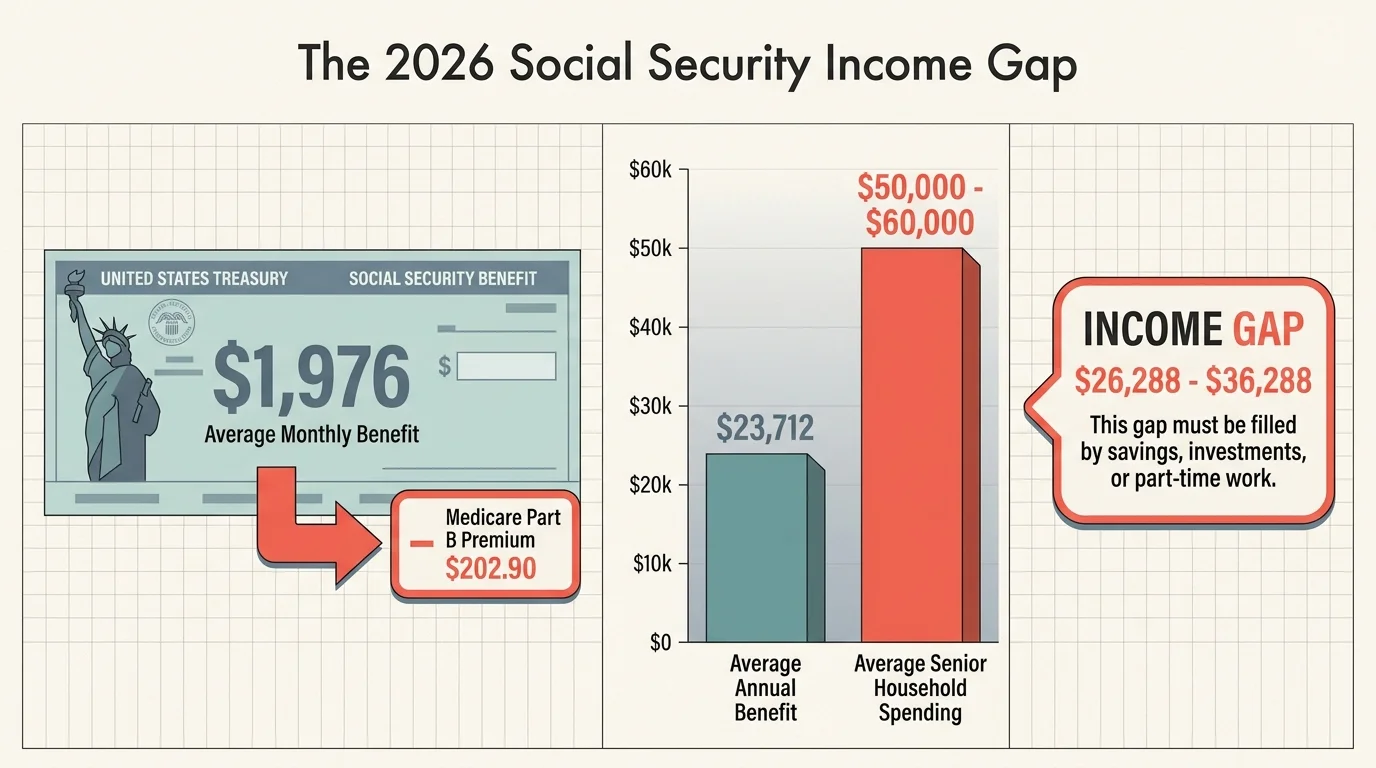
Stretching your fixed income is the most critical challenge you face when leaving the workforce, especially when the average Social Security benefit in 2026 provides roughly $1,976 a month. Relocating to a more affordable market allows you to instantly reduce your largest expenses—housing, taxes, and healthcare—without sacrificing your quality of life. By choosing a city with a lower cost of living and favorable tax laws, you keep more of your hard-earned money in your pocket. The eight retirement towns detailed below offer excellent healthcare access, vibrant communities, and median housing costs well below the national average. Discover where your monthly benefits can stretch further and provide the financial peace of mind you deserve.

The Math Behind Your Social Security Check in 2026
When you transition from a salary to a fixed income, every dollar takes on renewed importance. Following the cost-of-living adjustments, the Social Security Administration reports that the average retired worker receives approximately $23,712 per year. This figure rarely covers the full scope of housing, food, transportation, and medical expenses. According to recent Bureau of Labor Statistics data, the average household headed by someone 65 or older spends between $50,000 and $60,000 annually. This leaves a massive income gap that you must fill using your personal savings, pensions, or part-time work.
Healthcare costs further erode your purchasing power. In 2026, the standard Medicare Part B premium rose to $202.90 per month, and the annual deductible climbed to $283. Because these premiums are typically deducted directly from your Social Security payments, your actual take-home benefit is lower than the gross amount reported. By relocating to an area where housing and daily goods cost significantly less, you create immediate breathing room in your monthly budget. Downsizing your home in an affordable city often allows you to eliminate your mortgage entirely, drastically reducing your baseline expenses.

“Do not save what is left after spending, but spend what is left after saving.” — Warren Buffett, Investor and Philanthropist

How Tax Laws Supercharge Your Savings
Housing costs dictate a large portion of your retirement budget, but tax efficiency plays an equally vital role in making your money last. Moving to a state with favorable tax policies can save you thousands of dollars annually. Nine states currently levy zero income tax, and many others offer generous exemptions specifically for Social Security benefits and pension income.
At the federal level, your location and lower living costs can help you maximize incredible tax advantages. For tax year 2026, the Internal Revenue Service set the baseline standard deduction at $16,100 for single filers and $32,200 for married couples filing jointly. The IRS also provides an additional standard deduction for taxpayers aged 65 and older—amounting to an extra $2,050 for singles and $1,650 per qualifying spouse for joint filers. Furthermore, under the recently enacted One Big Beautiful Bill Act, eligible seniors can claim a temporary bonus deduction of $6,000 per person between 2025 and 2028, provided their modified adjusted gross income remains below $75,000 for singles or $150,000 for couples.
When you stack these deductions together, a qualifying married couple over 65 could shield up to $47,500 of their income from federal taxes in 2026. By choosing a low-cost retirement town, you can comfortably keep your total income and withdrawals under these thresholds, allowing you to live practically tax-free.

1. Midland, Michigan
Midland consistently earns high marks for retirement livability, landing the top spot in the 2026 U.S. News rankings for the best places to retire. Situated near the base of Michigan’s Saginaw Bay, this community offers a brilliant mix of affordability, excellent healthcare facilities, and highly favorable retiree tax policies. Michigan has spent recent years phasing out its retirement tax, meaning more of your pension and retirement account withdrawals stay in your bank account.
The city operates as the world headquarters for Dow Chemical, which has heavily funded local infrastructure and arts programs over the decades. You gain access to an impressive 110-acre botanical garden, the scenic Pere Marquette Rail-Trail, and 80 well-maintained public parks without paying a premium. Because everyday living expenses remain remarkably controlled, your monthly Social Security payments can easily absorb your utility bills, groceries, and local entertainment.

2. Knoxville, Tennessee
Tennessee features some of the most retiree-friendly tax laws in the nation, including zero state income tax. Your Social Security checks, pension payouts, and IRA withdrawals are completely safe from state-level taxation. Knoxville takes this financial advantage further with a cost of living that runs 8.2 percent below the national average. You can find a median home priced around $360,000, significantly lower than the $426,000 median found in nearby Nashville.
Tucked near the foothills of the Great Smoky Mountains, Knoxville gives you spectacular outdoor recreation and a vibrant, walkable downtown area. The presence of the University of Tennessee provides residents with continuous access to cultural events, collegiate sports, and lifelong learning programs. Knoxville proves that you do not have to isolate yourself in a rural town to find affordable living.

3. Augusta, Georgia
Georgia stands out as an incredibly welcoming state for seniors, offering substantial tax deductions on retirement income. Depending on your exact age, Georgia allows you to exclude up to $65,000 of retirement income per person from state taxes. Augusta maximizes these state-level benefits with a local cost of living that sits roughly 13 percent below the national average.
Homeownership is highly attainable here; recent data shows median home prices hovering around a very affordable $172,000. For retirees looking to stretch a $2,000 monthly Social Security check, housing costs like these are a game-changer. You also gain access to a warm climate, top-tier medical facilities, and the historic charm of a mid-sized Southern city. Whether you prefer golfing, volunteering, or strolling along the scenic Savannah River, Augusta lets you maintain an active lifestyle without draining your savings.

4. Tulsa, Oklahoma
If you want robust cultural amenities alongside basement-level housing costs, look no further than Tulsa. The overall cost of living here is a staggering 16 percent below the national average, making it one of the most cost-effective mid-sized cities in the country. Renters can frequently find comfortable apartments for under $900 a month, while homebuyers enjoy real estate prices that pale in comparison to coastal cities.
Tulsa does not feel like a town where you have to compromise. It features a thriving arts district, expansive outdoor spaces like the award-winning Gathering Place park, and an incredibly friendly community. Roughly 17 percent of Tulsa’s population is over the age of 65, meaning you will find a strong peer group and a well-established infrastructure of senior services and medical care.

5. Brownsville, Texas
Texas boasts zero state income tax, making it a perennial favorite for cost-conscious retirees. Brownsville, located at the southernmost tip of the state along the Gulf Coast, recently secured the number four spot on the U.S. News list of most affordable places to retire. The city offers a tropical, sunny climate, allowing you to enjoy nearby beaches on South Padre Island year-round.
With median home prices near $276,000 and monthly rents frequently falling under $800, Brownsville ensures your fixed income covers far more than just the bare necessities. The city offers a surprisingly rich cultural scene heavily influenced by its proximity to Mexico, resulting in fantastic culinary options and vibrant local festivals. Everyday goods and groceries are heavily discounted here, meaning your routine spending will drop the moment you arrive.

6. Youngstown, Ohio
When rock-bottom housing prices are your absolute top priority, Youngstown delivers unmatched value. With a median home price hovering near an astonishing $137,000 and median rent around $700, your Social Security check holds massive purchasing power in this Midwestern hub. For retirees who want to eliminate their mortgage entirely using the equity from a previous home sale, Youngstown is hard to beat.
Though it carries an industrial reputation, the city actually offers a beautiful local park system. Residents frequently enjoy the 5,000-acre Mill Creek MetroParks, which features lakes, hiking trails, and gorgeous botanical gardens. You also gain access to local symphonies, the Butler Institute of American Art, and community-driven events that provide a high quality of life on a shoestring budget.

7. Huntsville, Alabama
Alabama boasts some of the lowest property taxes in the United States, and it completely exempts Social Security benefits from state income taxation. Huntsville combines these financial perks with a booming, highly educated local economy. The cost of living here runs 5.8 percent below the national average.
Often called the “Star of Alabama” due to its rich aerospace history and the presence of the U.S. Space and Rocket Center, the city provides high-quality healthcare networks, fantastic restaurants, and a well-maintained infrastructure. Retirees flock here because they get the modern amenities of a forward-thinking tech hub paired seamlessly with traditional Southern affordability.

8. Fargo, North Dakota
While the winters undeniably require a heavy coat, Fargo compensates with incredible economic stability and rock-bottom living costs. The cost of living for retirees sits 9.4 percent below the national average, with median home prices hovering right around $309,000. Fargo boasts an exceptionally low crime rate, world-class medical facilities, and a tight-knit community feel.
Recent economic data indicates that a single person can often cover their annual expenses here on roughly $30,000 a year. This means a standard Social Security benefit coupled with very modest portfolio withdrawals provides a highly comfortable lifestyle. If you enjoy a distinct change of seasons and value community safety and healthcare access over year-round sunshine, Fargo is a spectacular financial choice.

Pitfalls to Watch For Before You Move
Relocating in retirement offers massive financial benefits, but the process requires careful research. You must evaluate the complete picture of your new destination to ensure it aligns with your long-term needs. Avoid these common traps:
- Hidden Tax Burdens: A state with no income tax might compensate by charging exorbitant property or sales taxes. Texas, for example, has no state income tax but carries some of the highest property tax rates in the nation. Always calculate your total estimated tax burden before buying a home.
- Healthcare Availability: Rural, ultra-cheap towns sometimes lack specialized medical care. As you age, proximity to high-quality specialists becomes paramount. Ensure your new location has highly rated hospitals that accept Medicare and are within a reasonable driving distance.
- Social Isolation: Moving thousands of miles away from friends and family saves money on housing, but it can cost you your emotional support network. Factor in the travel costs required to fly back and visit loved ones when building your new budget.
- Climate Mismatches: Do not commit to a location with brutal summers or harsh winters without spending an extended amount of time there during its most extreme season. Rent an Airbnb for a month in August in Texas or February in North Dakota before signing closing papers.
Frequently Asked Questions
What is the average Social Security benefit in 2026?
Following the latest cost-of-living adjustment, the average monthly Social Security retirement benefit is approximately $1,976. However, your exact benefit depends heavily on your 35 highest-earning years and the age at which you claimed benefits.
How much is the Medicare Part B premium for 2026?
The standard Medicare Part B premium for 2026 is $202.90 per month, and the annual deductible is $283. These premiums are typically deducted directly from your Social Security check, meaning you must budget based on your net benefit, not your gross benefit.
Does my state tax Social Security benefits?
The vast majority of states do not tax Social Security benefits. States like Texas, Tennessee, Florida, and Nevada have no state income tax at all. Other states specifically exempt Social Security income even if they tax other forms of retirement withdrawals.
How do I find a community with a low cost of living but good healthcare?
Look for mid-sized cities or college towns. Areas anchored by universities or major regional hospitals often feature excellent medical networks and cultural amenities while maintaining housing costs well below the national average. Organizations like AARP frequently publish livability indexes that cross-reference affordability with healthcare access.
Finding a location that honors your budget without compromising your lifestyle is entirely possible with careful research. Take the time to visit these cities, run the tax calculations based on your specific income streams, and prioritize your access to healthcare. By relocating strategically, you empower yourself to live a vibrant, stress-free retirement on your own terms.
The information in this guide is meant for educational purposes. Your specific circumstances—including income, savings, health coverage, and goals—may require different approaches. When in doubt, consult a licensed professional.
Last updated: May 2026. Retirement benefits, tax laws, and healthcare costs change frequently—verify current details with official sources.