
Choosing where to retire involves more than just finding favorable tax rates and good healthcare; it is about creating a lifestyle that keeps your family connected. When you relocate to a destination packed with attractions, outdoor adventures, and engaging activities, your new home becomes the ultimate vacation spot. Instead of begging your children to bring the grandchildren for a quiet weekend, you will find them eager to visit a place where theme parks, beaches, or interactive museums are just minutes away. By selecting a retirement location with multi-generational appeal, you build a natural magnet for family travel and create lasting memories without the stress of constantly packing your own bags.

The Rise of Multi-Generational Travel
Retirement today looks drastically different than it did a generation ago. Modern retirees prioritize active living, travel, and deep family connections. According to recent travel trend surveys from AARP, approximately 70% of adults aged 50 and older prioritize travel, and a growing portion of that travel focuses on family. In fact, a major trend taking hold in the travel industry is “skip-generation” travel—vacations where grandparents take their grandchildren on a trip, leaving the parents at home.
When you live in a destination that doubles as a vacation hotspot, you make skip-generation bonding effortless. You provide the accommodations, the local expertise, and the fun, while giving your adult children a much-needed break from daily parenting duties. The financial benefit is significant as well; rather than paying for expensive hotel rooms and rental cars every time you want to see your family, your primary expense becomes simply enjoying the local attractions together.

1. Orlando, Florida — The Theme Park Capital
If you want absolute certainty that your grandchildren will clear their schedules to visit you, relocating near Walt Disney World, Universal Studios, and SeaWorld is a foolproof strategy. Orlando consistently ranks as one of the top family travel destinations globally, making it a powerful draw for grandkids of all ages.
Beyond the rollercoasters and character meet-and-greets, Orlando offers a robust lifestyle for active adults. You can explore the peaceful walking trails of Harry P. Leu Gardens, visit the Orlando Science Center with younger grandkids, or enjoy the vibrant restaurant scene in Winter Park.
From a financial planning perspective, Florida has long been a haven for retirees. The state levies no individual income tax, meaning your pensions, 401(k) distributions, and Social Security Administration (SSA) benefits remain completely untouched at the state level. Additionally, Florida offers a homestead exemption and the “Save Our Homes” assessment limitation, which helps protect permanent residents from sudden, drastic spikes in property taxes.

2. Myrtle Beach, South Carolina — Coastal Fun on a Budget
In July 2025, the US Census Bureau identified Myrtle Beach as the fastest-growing metropolitan area in the country for residents aged 65 and older. The massive influx of retirees is no accident; Myrtle Beach combines an incredibly affordable cost of living with world-class amenities that appeal directly to families.
Your grandchildren will love the 60 miles of continuous beachfront, the 200-foot Myrtle Beach SkyWheel, and Ripley’s Aquarium. Older grandkids can join you for a round of golf on one of the area’s dozens of championship courses, while younger ones will enjoy the endless mini-golf options and water parks. The Myrtle Beach Boardwalk provides a lively, safe environment for evening strolls and family dinners.
South Carolina is highly tax-friendly for retirees. The state does not tax Social Security benefits, and it offers generous deductions on other retirement income. Residents aged 65 and older can deduct up to $15,000 of eligible retirement income from their state taxes. Furthermore, homeowners over 65 who have lived in the state for a full year qualify for a homestead exemption that shields the first $50,000 of their property’s fair market value from local property taxes.

3. Colorado Springs, Colorado — Outdoor Adventures for Active Families
For families who prefer hiking boots to beach sandals, Colorado Springs offers an unparalleled active lifestyle. Nestled at the base of the Rocky Mountains, this city provides a stunning natural playground that encourages kids to put down their screens and explore the outdoors.
You can spend your weekends guiding the grandkids through the towering red rock formations at Garden of the Gods, or ride the broad-gauge cog railway to the summit of Pikes Peak. The Cheyenne Mountain Zoo—the highest zoo in America—allows children to hand-feed giraffes while overlooking the city. If your family enjoys mountain biking, rock climbing, or winter sports, Colorado Springs serves as an ideal basecamp.
Financially, Colorado operates on a flat state income tax rate. While the state is one of the few that still taxes Social Security benefits for certain income brackets, it offers a generous pension and annuity subtraction. For residents aged 65 and older, this subtraction shields a significant portion of retirement income from state taxation. However, you must carefully budget for housing, as the real estate market in Colorado Springs has become increasingly competitive.

4. San Antonio, Texas — Culture, River Walks, and Theme Parks
San Antonio blends deep historical roots with major modern attractions, creating a rich, culturally immersive environment for visiting families. The city moves at a slightly slower, more relaxed pace than other major Texas hubs, making it an ideal retirement landing spot.
The famous San Antonio River Walk features miles of pedestrian pathways lined with restaurants, shops, and lush landscaping—perfect for an evening boat ride with the family. For daytime thrills, San Antonio hosts both Six Flags Fiesta Texas and SeaWorld. You can also provide your grandkids with engaging educational experiences at the Alamo, the Witte Museum, and the highly interactive DoSeum.
Like Florida, Texas is one of the nine states with no individual state income tax. This keeps your retirement account withdrawals and Social Security benefits safe from state taxation. However, Texas generates its revenue through high property taxes and sales taxes. To offset this, Texas law provides homeowners aged 65 and older with an additional homestead exemption and a ceiling on school district property taxes, ensuring your primary tax burden remains predictable as you age.

5. Williamsburg, Virginia — Living History and Rollercoasters
Williamsburg captures the imagination of both history buffs and thrill-seekers, making it an incredibly balanced destination for multi-generational families. The town is famous for Colonial Williamsburg, a sprawling living-history museum where actors in period costumes demonstrate 18th-century trades and daily life. It is an educational experience that feels like a giant, interactive playground for children.
When the grandkids need an adrenaline rush, you are just a few miles away from Busch Gardens Williamsburg, repeatedly voted one of the most beautiful theme parks in the world. The area also offers easy access to the beaches of Virginia’s coastline and the scenic Colonial Parkway.
Virginia presents a moderate tax environment for retirees. The state does not tax Social Security benefits. While it does tax pensions and traditional IRA distributions, Virginia provides an age deduction for taxpayers aged 65 and older. The amount of this deduction depends on your birth year and adjusted gross income, so consulting a tax professional before establishing domicile is highly recommended.

6. San Diego, California — Beaches, Zoos, and Perfect Weather
If your retirement budget allows for a higher cost of living, San Diego delivers an unmatched coastal lifestyle. The near-perfect, year-round weather means you never have to worry about a family visit being ruined by rain or snow.
San Diego is uniquely equipped to entertain children. The world-renowned San Diego Zoo and San Diego Zoo Safari Park are must-visit attractions. Balboa Park houses dozens of museums, beautiful gardens, and street performances. Just a short drive north, LEGOLAND California provides an entire theme park dedicated to younger children. Throw in miles of family-friendly beaches like La Jolla Shores, and your home will become the most coveted vacation destination in your family.
The financial reality of California requires careful planning. The state has some of the highest income tax rates in the nation, though it does fully exempt Social Security benefits from state taxation. Property values are steep, but California’s Proposition 13 limits the annual increase of assessed property value, which helps protect long-term homeowners from being priced out of their neighborhoods by skyrocketing property taxes.

7. Branson, Missouri — Heart-of-America Entertainment
Nestled in the picturesque Ozark Mountains, Branson is often called the ultimate family entertainment hub of the Midwest. It combines a highly affordable cost of living with attractions that rival major coastal cities.
The crown jewel of Branson is Silver Dollar City, an 1880s-themed amusement park that features world-class rollercoasters alongside demonstrations by master craftsmen. The city is famous for its live music and comedy shows that appeal to all ages. For outdoor recreation, Table Rock Lake offers hundreds of miles of shoreline for boating, fishing, and swimming.
Branson represents excellent value for retirees. Housing costs fall significantly below the national average. On the tax front, Missouri recently eliminated its state income tax on Social Security benefits, joining the majority of states in providing this critical relief to older adults. The overall cost of daily living—from groceries to healthcare—makes Branson an appealing option for retirees who want maximum entertainment value without draining their portfolios.
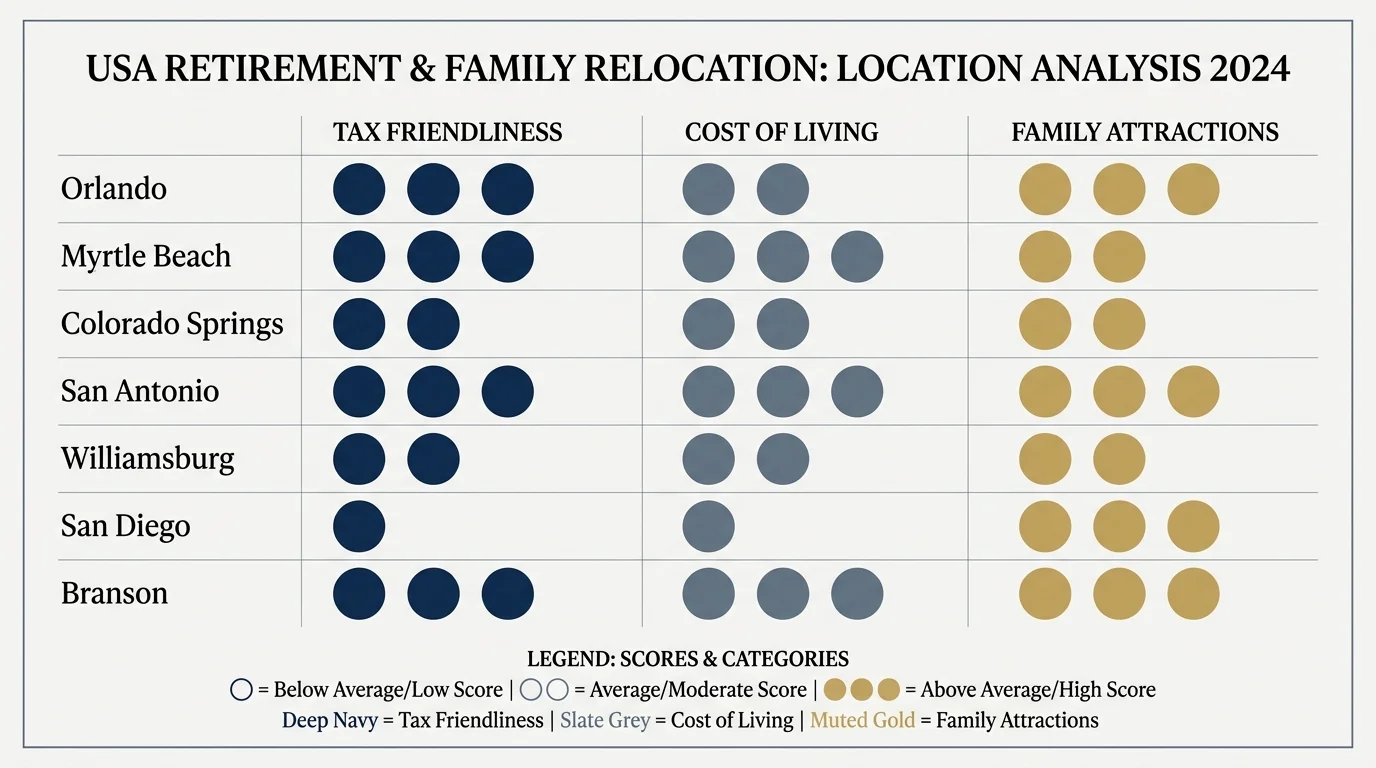
Comparing the Costs and Lifestyle
To help you evaluate these family-friendly destinations, review this comparison of their primary attractions and state-level tax policies.
| Destination | Primary Grandkid Attractions | State Income Tax Status | Social Security Tax |
|---|---|---|---|
| Orlando, FL | Disney World, Universal, SeaWorld | No state income tax | Exempt |
| Myrtle Beach, SC | Beaches, Boardwalk, SkyWheel | Has state income tax | Exempt |
| Colorado Springs, CO | Garden of the Gods, Pikes Peak | Flat state income tax | Taxed for some brackets |
| San Antonio, TX | River Walk, Alamo, Theme Parks | No state income tax | Exempt |
| Williamsburg, VA | Colonial History, Busch Gardens | Has state income tax | Exempt |
| San Diego, CA | Zoos, Balboa Park, LEGOLAND | High state income tax | Exempt |
| Branson, MO | Silver Dollar City, Lakes, Shows | Has state income tax | Exempt |

How Relocating Impacts Your Financial Plan
Moving across state lines in retirement involves complex financial logistics. You must update your entire financial foundation to align with the laws and tax codes of your new home state.
“A big part of financial freedom is having your heart and mind free from worry about the what-ifs of life.” — Suze Orman, Personal Finance Expert
Establishing a new domicile requires more than just purchasing a house. You must formally sever ties with your previous state to avoid being double-taxed. This involves registering to vote, obtaining a new driver’s license, registering your vehicles, and establishing relationships with local doctors and banks. If you fail to formally establish your new domicile, your previous high-tax state may attempt to audit you and claim you still owe them income taxes.
Your healthcare coverage requires immediate attention when you move. If you use Original Medicare supplemented by a Medigap policy, your coverage travels with you nationwide. However, your Medigap premiums may change based on your new zip code. If you use a Medicare Advantage plan, moving out of your plan’s service area triggers a Special Enrollment Period (SEP). You will have a limited window to use Medicare.gov to find and enroll in a new plan that covers your new local doctors and hospitals.
Finally, your estate plan must be reviewed. Wills, trusts, and powers of attorney are governed by state law. An estate plan drafted in New York may not function exactly as intended under Texas or Florida law. You must hire a local attorney in your new state to review and update your advance directives and beneficiary designations.

When DIY Isn’t Enough
While many retirees manage their moves independently, certain scenarios require professional intervention to prevent costly mistakes:
- Mid-Year Tax Transitions: Moving between a high-tax state and a no-tax state in the middle of the calendar year requires filing part-year resident tax returns. A Certified Public Accountant (CPA) ensures you allocate your income correctly and do not overpay.
- Medicare Network Evaluations: Finding a new primary care physician and specialists in an unfamiliar city is stressful. A licensed, independent Medicare broker can cross-reference your specific prescription drugs and preferred healthcare systems to match you with the optimal local plan.
- Liquidating Real Estate Portfolios: If you are selling a highly appreciated primary residence and moving to a lower-cost market, you must navigate capital gains taxes. A fee-only financial planner can help you reinvest the surplus cash efficiently into your portfolio.
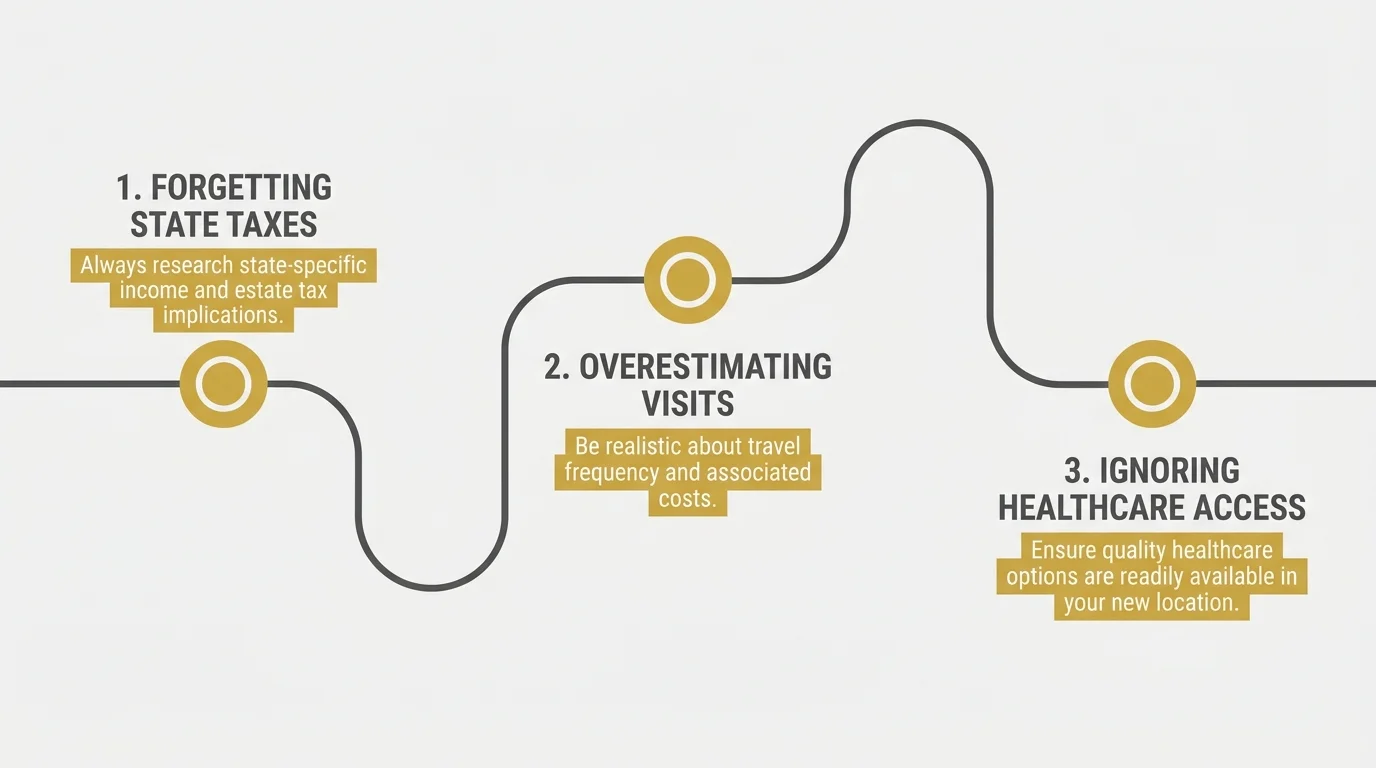
Avoiding Common Errors
The excitement of retiring near an amusement park or the beach can sometimes cloud practical judgment. Protect your retirement timeline by avoiding these frequent relocation traps.
Moving without a trial run. Visiting a tourist destination for a week in the spring is very different from living there year-round. Rent an apartment or home in your target city for three to six months during the off-season. This trial period allows you to experience the local traffic, weather, grocery stores, and healthcare accessibility without committing hundreds of thousands of dollars to a mortgage.
Overestimating visitor frequency. You might move to Orlando expecting your grandchildren to visit every month, only to realize their school sports and extracurricular activities limit them to two visits a year. You have to live in this new city the other 350 days of the year. Ensure the location offers a lifestyle, social circle, and community amenities that fulfill your own daily needs, independent of family visits.
Ignoring the total tax burden. Do not evaluate a state solely on its income tax rate. States with no income tax must fund their infrastructure through other means, typically resulting in higher property taxes, sales taxes, or vehicle registration fees. Use resources from the Internal Revenue Service (IRS) and local tax assessors to calculate your complete, effective tax rate before making a decision.
Frequently Asked Questions
What is “skip-generation” travel?
Skip-generation travel occurs when grandparents take vacations with their grandchildren, leaving the middle generation (the parents) at home. It allows for direct bonding, creates shared memories, and gives parents a break from childcare responsibilities.
Do all states tax Social Security benefits?
No. As of 2026, the vast majority of states do not tax Social Security benefits. Only eight states currently tax these benefits: Colorado, Connecticut, Minnesota, Montana, New Mexico, Rhode Island, Utah, and Vermont. Check local regulations at USA.gov Benefits, as many of these states offer deductions that minimize the impact for middle-income retirees.
Will my Medicare coverage follow me if I move to a new state?
If you have Original Medicare (Parts A and B), your coverage is valid anywhere in the United States that accepts Medicare. However, if you are enrolled in a Medicare Advantage plan (Part C) or a standalone Part D prescription drug plan, your coverage is restricted to a specific geographic network. Moving outside of this network triggers a Special Enrollment Period, allowing you to select a new plan in your new area.
Planning Your Next Chapter
Relocating for retirement represents a profound opportunity to redesign your daily life. By choosing a destination that offers endless entertainment, outdoor beauty, and rich culture for your grandchildren, you establish a home base that draws your family together year after year. Focus on balancing these exciting family attractions with your own long-term needs, ensuring the local healthcare facilities, tax landscape, and daily cost of living fully support your financial security. Start by booking an extended vacation to your top choice, explore the quiet neighborhoods outside the bustling tourist zones, and visualize your future in a community built for lasting memories.
This article provides general retirement education and information only. Everyone’s financial situation is unique—what works for others may not work for you. For personalized advice, consider consulting a qualified financial professional such as a CFP or CPA.
Last updated: May 2026. Retirement benefits, tax laws, and healthcare costs change frequently—verify current details with official sources.