
You can trade snow shovels for turquoise water and palm-lined beaches without ever applying for a passport. As an unincorporated U.S. territory, the U.S. Virgin Islands lets you keep your U.S. dollars, English-speaking neighborhoods, and Original Medicare coverage.
Still, an island retirement brings steep electricity bills, hurricane preparedness, and unique territorial tax rules. Knowing which island fits your budget makes the difference between daily stress and a relaxing Caribbean retirement.
For most retirees, St. Croix stands out as the top pick across all three main islands. Below, you will see how the islands compare and what your move actually costs.

Why You Can Retire Abroad Without a Passport in the USVI
Many Americans dream of a Caribbean retirement, yet hesitate at the idea of foreign visas, residency permits, and unfamiliar legal systems. Moving to the U.S. Virgin Islands removes those hurdles because the islands fall under the U.S. flag.
According to Visit USVI and U.S. Customs and Border Protection (CBP), U.S. citizens flying or cruising directly from the mainland or Puerto Rico need no passport, visa, or work permit. You simply relocate much as you would when moving to another state.
Airport security rules still apply, so check your wallet before booking flights. Under Transportation Security Administration (TSA) rules effective May 7, 2025, flyers age 18 and older must show a REAL ID-compliant license or another accepted credential like a U.S. passport, passport card, or Global Entry card.
Returning to the mainland also looks slightly different than a typical domestic flight. Travelers flying back from the USVI must clear CBP and USDA agricultural screening at the airport, where returning residents receive a $1,600 per person CBP duty-free exemption.
Keep one border rule in mind if you enjoy island-hopping on weekends. Taking a ferry or boat to the neighboring British Virgin Islands, such as Tortola or Virgin Gorda, requires a valid passport because those islands are a British territory.
Once you land, daily communication and banking feel familiar right away. English is the official language, and the U.S. dollar is the local currency.
One everyday habit will require fresh concentration behind the wheel. The USVI is the only U.S. jurisdiction where drivers travel on the left side of the road while using standard U.S. left-hand-drive cars.
You will also find a well-established community of peers already enjoying island life. Data from the 2020 U.S. Census, reported by the USVI Bureau of Economic Research and the U.S. Census Bureau, puts the territory’s population at 87,146, with a median age of 45.9 years and 21.3% of residents aged 65 or older.
Comparing the Best Places to Retire in the USVI
Spanning 133.73 square miles, the territory offers three main islands with sharply different price tags, terrain, and daily rhythms. Choosing the right fit depends on whether you value quiet space, urban convenience, or untouched national parkland.
| Island | Size and Character | Airport Access | 2026 Housing Snapshot | Best Fit for Retirees |
|---|---|---|---|---|
| St. Croix | About 84 sq mi; largest, flattest, and most laid-back | Commercial jets via Henry E. Rohlsen Airport | Early 2026 medians of $485,000 (homes) and $299,900 (condos) | Budget-conscious retirees seeking space, drives, and community |
| St. Thomas | About 32 sq mi; steep hills, busy cruise port, capital city | Commercial jets via Cyril E. King Airport | $575,000 YTD median; $835,000 October single-family median | Retirees wanting vibrant dining, shopping, and largest hospital access |
| St. John | About 20 sq mi; roughly 60% protected national park | No airport; reached primarily by ferry from St. Thomas | Average 2026 home sales above $1.8 million | Affluent retirees prioritizing seclusion and nature trails |
St. Thomas serves as the commercial heart of the territory, anchored by the capital city of Charlotte Amalie and Cyril E. King Airport. Its steep hillsides offer dramatic ocean views, though traffic around cruise ship ports can feel congested.
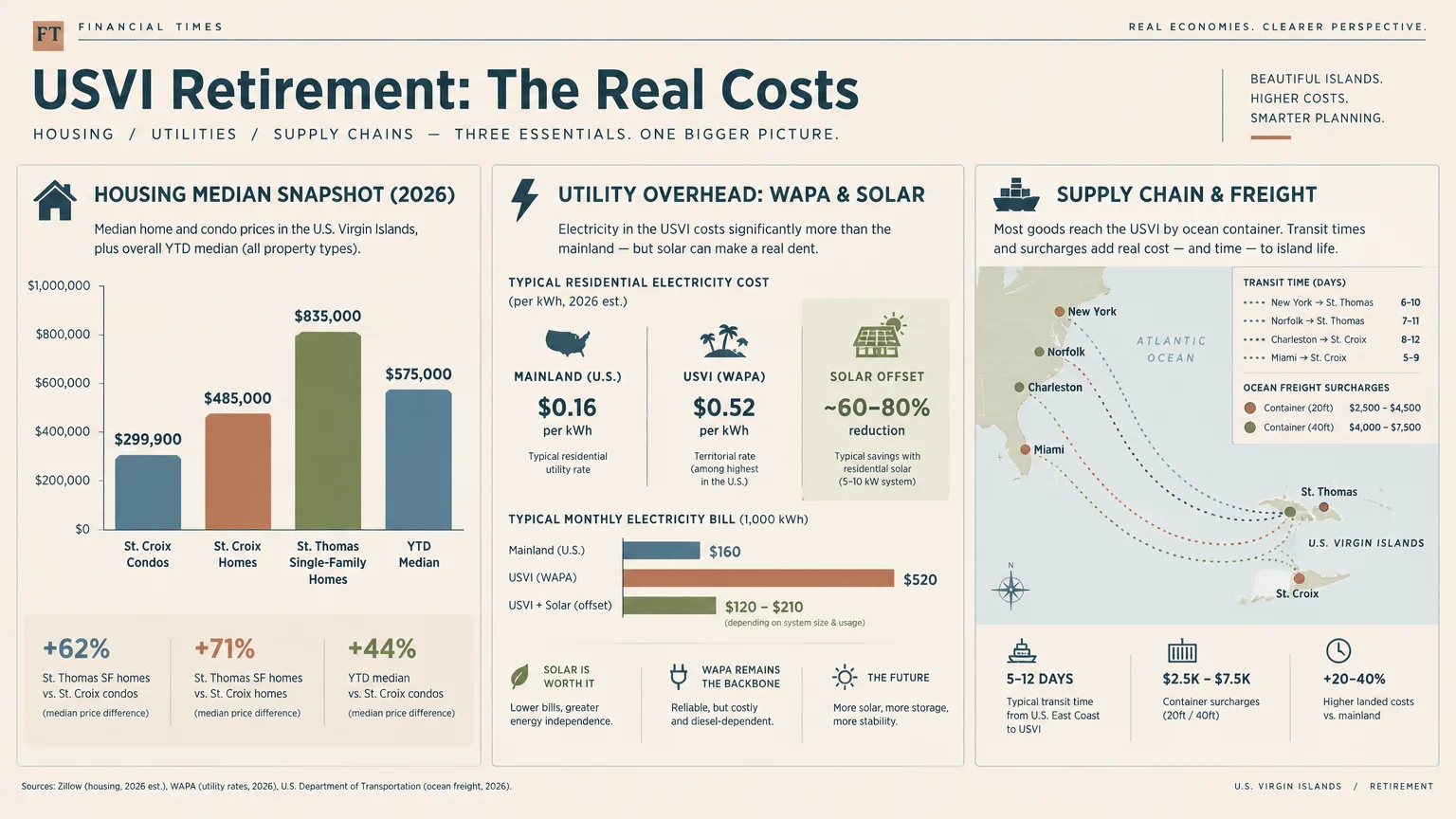
Housing on St. Thomas also demands a larger nest egg than many retirees expect. Early 2026 figures showed an overall median sold price of $450,000, with single-family homes at a $737,000 median and condos at $420,000.
Prices climbed further as the year progressed, according to Coldwell Banker St. Thomas Realty’s October 2026 update. That report tracked a year-to-date median sold price of $575,000—up 9.42% year-over-year—alongside October single-family closings at an $835,000 median and a median of 154 days on market.
Tiny St. John sits just across the water and trades commercial bustle for quiet coves and hiking paths. Roughly 60% of its 20 square miles remains permanently protected inside Virgin Islands National Park.
Because buildable land is severely capped, St. John carries luxury real estate prices. Early-to-mid 2026 home sales averaged more than $1.8 million—roughly $1.83 million over the trailing 12 months—with a June 2026 median listing price near $1.20 million.
St. John also lacks an airport, forcing you to fly into St. Thomas and catch a ferry for every mainland trip. That extra leg adds friction when you need frequent flights to visit family or attend specialist appointments.

Why St. Croix Is the Virgin Islands’ Top Pick for Retirees
When you weigh affordability, mobility, and everyday comfort together, St. Croix earns the top spot for most Americans looking to retire in the U.S. Virgin Islands. At roughly 84 square miles, it offers more room to breathe than St. Thomas and St. John combined.
Its flatter topography matters more as you grow older. While St. Thomas and St. John feature steep, winding switchbacks, St. Croix’s gentler roads make driving, walking, and home maintenance much easier over the long haul.
St. Croix also gives you direct commercial air service through Henry E. Rohlsen Airport without ferry transfers. You can step off a flight from the mainland and reach your driveway in short order.
Best of all, your retirement housing dollar stretches significantly further on St. Croix than anywhere else in the territory. Early 2026 market data placed St. Croix’s single-family median sold price at $485,000 and its condo median at $299,900, while June 2026 overall median listings sat near $399,000.
Active inventory remains healthy enough to give buyers real choices rather than bidding wars. In September 2026, St. Croix carried roughly 631 active listings, with average sold prices of $470,834 for residential homes and $237,556 for condos.
If you plan to finance part of your purchase instead of paying cash, expect higher borrowing costs than historic lows. Realtor.com reported October 2026 average 30-year fixed mortgage rates in the USVI at 7.108%, or 7.152% APR.
Before buying property on any island, rent a home on St. Croix for three to six months during late summer or fall so you can experience off-season humidity, grocery runs, and utility costs firsthand.
Spending a trial season on the ground helps you test neighborhoods like Christiansted, Frederiksted, and the East End before committing capital. You will quickly discover whether you prefer a gated condo near the beach or a standalone home with room for a garden.
Climate, Storm Season, and Daily Infrastructure
Warm weather draws most retirees south, and the territory delivers remarkably steady temperatures every month. Based on 1991–2020 climate normals for Charlotte Amalie, the daily mean temperature averages 81.9°F year-round.
Average monthly highs drift gently from 84.1°F in January to 89.8°F in August, while overnight lows range between 73.5°F in February and 79.6°F in August. Constant trade winds soften the midday sun, especially near the coast.
Still, sunshine comes with a distinct wet season you must plan around. Annual sea-level rainfall averages roughly 50 inches, falling more heavily from July through November, with peak hurricane probability concentrated between August and October.
Smart home selection directly protects your comfort and budget during storm months. Look for concrete construction, impact-rated windows or storm shutters, and elevated lots outside flood-prone guts and coastal surge zones.
You will also learn a new appreciation for water and backup power systems. While the Virgin Islands Water and Power Authority (WAPA) supplies desalinated water to roughly 13,000 customers in major centers, many island homes rely on rooftop rainwater cisterns.
Living off a cistern is straightforward once you adopt simple habits, such as monitoring water levels and scheduling periodic filtration maintenance. Likewise, frequent grid outages prompt many homeowners to install backup generators, battery banks, or rooftop solar panels.
What Island Retirement Actually Costs: Utilities and Shipping
Reasonable property prices on St. Croix can mask how expensive everyday goods and power are across the Caribbean. Because nearly all food, fuel, and building supplies arrive by ship, overall living costs in the USVI run roughly 20% to 40% higher than on the U.S. mainland.
Electricity deserves its own prominent line in your retirement budget. WAPA—regulated by the VI Public Services Commission (PSC)—generates power primarily from imported diesel and propane, with only about 2% to 3% coming from solar per the 2023 USVI Energy Baseline Report.
That fuel dependency drives all-in residential electric costs historically between $0.40 and $0.47 per kilowatt-hour, ranking among the highest rates under the U.S. flag. Rates moved even higher in late 2026.
After holding the Levelized Energy Adjustment Clause (LEAC) fuel surcharge at 22.22 cents per kilowatt-hour, the PSC approved an emergency 3-cent per kilowatt-hour LEAC increase on October 13, 2026 for November and December 2026. That surcharge adds roughly $12 per month for a 400 kWh household or $15 per month for a 500 kWh household.
Moving your belongings to the island also triggers territory-specific fees that catch unprepared movers off guard. Understanding what to ship—and what to buy locally—saves thousands at the port:
- U.S.-made vehicles: Cars manufactured in the United States enter the USVI duty-free, making a domestic SUV or sedan far cheaper to bring than a foreign brand.
- Foreign-made vehicles: Imported foreign cars face up to a 6% duty, or 3.5% if built with foreign parts.
- Household goods: Large imported personal items such as furniture and appliances valued at $500 or more incur a 4% local excise tax.
- Air conditioning habits: Running central air nonstop can double an electric bill, so many retirees cool only bedrooms at night and rely on ceiling fans and ocean breezes by day.
Shopping like a local also cushions your grocery bill over time. Buying seasonal produce at farm stands, leaning on wholesale clubs, and cooking simple meals keeps food spending much closer to mainland norms.
USVI Property, Transfer, and Income Taxes Explained
Higher utility and grocery costs get some welcome relief from remarkably low property taxes. Under USVI Code Title 33, Section 2301 and the USVI Office of the Tax Assessor, real property is assessed at 100% of fair market value, and personal property is not taxed at all.
| Property Category | Statutory Tax Rate | Annual Tax per $500,000 Value |
|---|---|---|
| Residential real property | 0.003770 (0.377%) | $1,885 |
| Unimproved non-commercial land | 0.004946 (0.4946%) | $2,473 |
| Commercial real property | 0.007110 (0.711%) | $3,555 |
| Timeshare real property | 0.014070 (1.407%) | $7,035 |
On top of that low 0.377% residential rate—equal to $3,770 per $1 million of assessed value—primary homeowners can reduce their bill further. Per the USVI Office of the Tax Assessor, eligible residents can claim a General Homestead Tax Credit of up to $400, or up to $650 for Veterans, alongside available Senior credits, subject to a $180 minimum tax.
To claim those credits, you must provide proof of occupancy plus a USVI driver’s license, voter registration, or passport paired with a stamped USVI tax return. Remember to factor closing costs into your purchase price as well.
The USVI charges a tiered Real Estate Transfer (Stamp) Tax at closing: 2% on prices up to $350,000; 2.5% from $350,001 to $1 million; 3% from $1 million to $5 million; and 3.5% above $5 million.
Income taxes follow a distinct territorial framework that requires careful recordkeeping. Per IRS Publication 570 and Internal Revenue Code (IRC) Section 937, the USVI operates a U.S. mirror income tax system using the same federal rates and rules, paid directly to the territory.
You generally qualify as a bona fide USVI resident if you meet three tests during the tax year. You must be physically present in the USVI for at least 183 days, hold no tax home outside the territory, and maintain no closer connection to the U.S. mainland or a foreign country.
Filing mechanics also differ from stateside software returns. Bona fide residents must file Form 1040 on paper—because electronic filing is not accepted—with the Virgin Islands Bureau of Internal Revenue (VIBIR), and they must submit IRS Form 8898 to report the start or end of bona fide residence.
Medicare, Hospitals, and Medical Evacuation Coverage
Healthcare access is often the deciding factor for older adults weighing an island retirement. Fortunately, you do not forfeit your core federal health benefits by moving to St. Croix, St. Thomas, or St. John.
According to Medicare.gov (Medicare & You 2027), the USVI counts as part of the United States for Original Medicare (Part A and Part B). You can visit any doctor or hospital in the territory that accepts Medicare.
However, several federal low-income assistance programs stop at the shoreline. Medicare.gov explicitly notes that Medicare Savings Programs and the Part D Extra Help prescription drug subsidy are not available in U.S. territories, so lower-income residents must check local territorial Medicaid programs instead.
Enrollment timing rules remain just as strict in the islands as on the mainland. Declining Part B when first eligible—without qualifying for a Special Enrollment Period—triggers a permanent monthly late-enrollment penalty, so review your timeline on SSA.gov before retiring.
Acute hospital care across the territory relies on two public hospitals and a community health center:
- St. Thomas: Schneider Regional Medical Center (Roy Lester Schneider Hospital) operates as a 169-bed acute care facility.
- St. Croix: Governor Juan F. Luis Hospital & Medical Center in Christiansted operates 54 staffed beds as a CMS-certified short-term acute care hospital.
- St. John: Myrah Keating Smith Community Health Center provides 24-hour emergency services along with weekday outpatient clinics.
Routine checkups, lab work, and standard emergencies are handled locally, yet complex cardiac, neurological, or trauma care often requires air transport off-island. Patients frequently fly to larger medical hubs in Puerto Rico or Miami for specialized tertiary treatment.
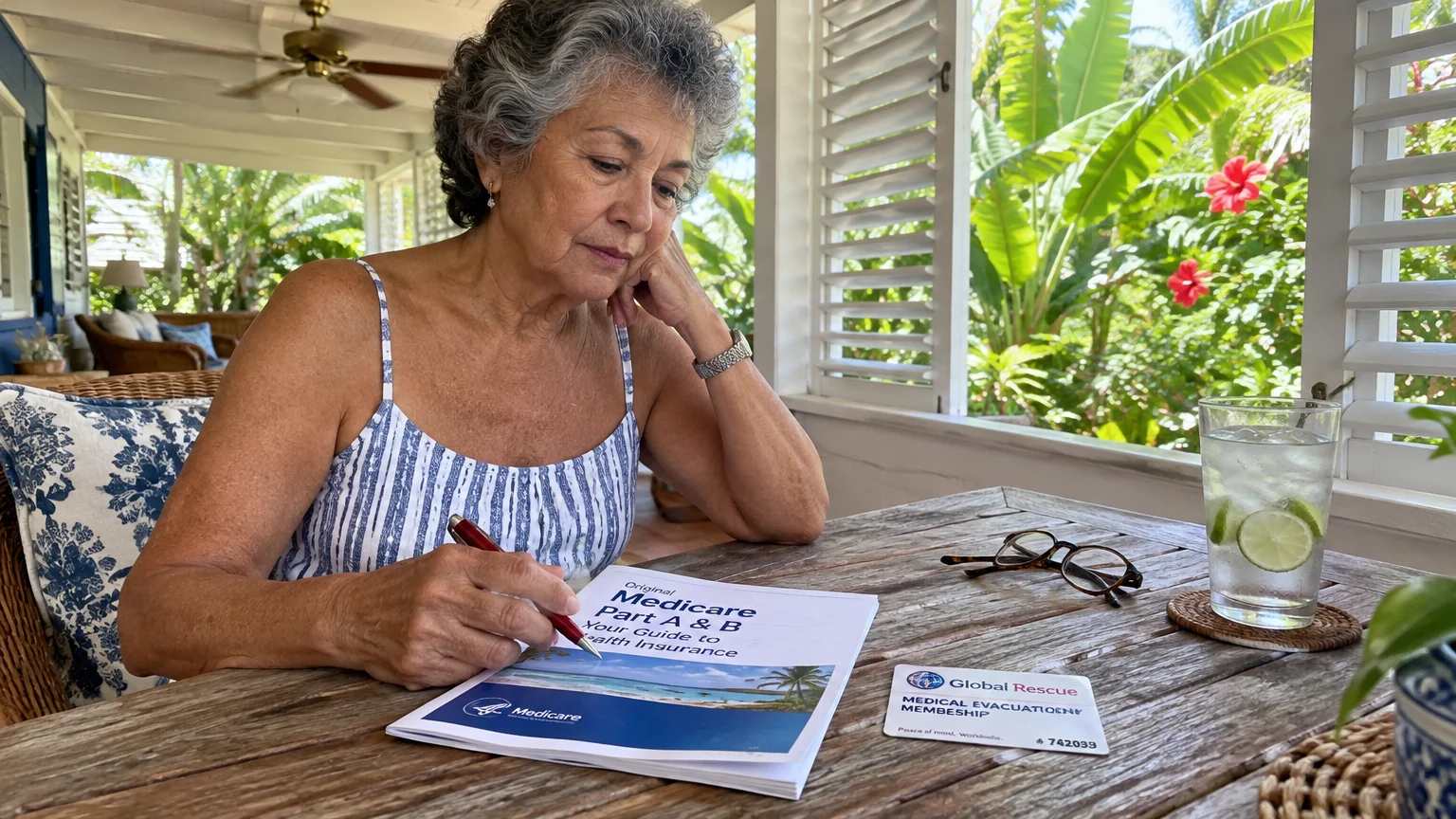
Standard Original Medicare and Medigap plans do not cover routine air ambulance evacuation, which can easily cost $30,000 or more in the Caribbean. Evaluating a dedicated medical evacuation membership or supplemental travel-medical policy should sit near the top of your pre-move checklist.
Pitfalls to Watch For Before You Relocate
Most regrets among new island residents come from rushing the move or assuming mainland conveniences translate automatically. Watching out for these common traps protects both your finances and your peace of mind:
- Buying before testing hurricane season: Skipping a multi-month stay between August and October leaves you unprepared for peak humidity, tropical storms, and slower off-season services.
- Underestimating WAPA bills: Budgeting mainland electric rates instead of $0.40–$0.47/kWh plus fuel surcharges can strain a fixed retirement income.
- Mismanaging the 183-day rule: Spending too many summer months back on the mainland with grandchildren can break your bona fide residency status and complicate VIBIR and IRS filings.
- Overlooking Form 8898: Failing to file IRS Form 8898 when beginning or ending USVI residency can trigger costly compliance headaches.
- Ignoring medical evacuation coverage: Assuming Medicare covers a $30,000+ emergency flight to Miami or Puerto Rico leaves your savings exposed during a sudden health crisis.
- Shipping the wrong car or furniture: Importing a foreign-made vehicle or crates of new furniture triggers avoidable import duties and the 4% excise tax.
Slowing down your timeline by even six months gives you space to avoid every item on that list. Treat your move like a phased transition rather than an overnight leap.
Getting Expert Help
Relocating across territorial tax and healthcare boundaries introduces quirks that general online calculators rarely catch. Consider working with qualified specialists in these four specific situations:
- Establishing bona fide residency: Hire a CPA or tax attorney experienced with IRC Section 937, VIBIR paper Form 1040 filings, and IRS Form 8898 before selling mainland property or shifting IRA distributions.
- Coordinating Medicare and evacuation coverage: Speak with an independent Medicare broker who understands territory network rules, Part D options, and standalone Caribbean air-evacuation policies.
- Closing on island real estate: Retain a local USVI real estate attorney to verify clear title, inspect cistern and solar permits, calculate tiered stamp taxes, and file Homestead Tax Credit paperwork.
- Aligning your overall retirement budget: Consult a fiduciary planner through the Certified Financial Planner Board to stress-test your withdrawal rate against a 20% to 40% cost-of-living premium.
You can also review federal territory benefit rules on USA.gov Benefits if you expect to rely on assistance programs after moving. Getting clear answers up front costs far less than unwinding a tax or insurance mistake later.
Frequently Asked Questions About Retiring in the U.S. Virgin Islands
Do U.S. citizens need a passport to retire in the U.S. Virgin Islands?
No. U.S. citizens flying or cruising directly from the mainland or Puerto Rico do not need a passport, visa, or residency permit, though travelers 18 and older need a REAL ID-compliant ID or accepted credential for TSA airport screening, and you still need a passport for day trips to the British Virgin Islands.
Which U.S. Virgin Island is best and most affordable for retirees?
St. Croix is the top pick for most retirees because it offers the largest land area, flatter roads, direct jet service, and the lowest housing prices. Early 2026 data showed St. Croix medians of $485,000 for single-family homes and $299,900 for condos, compared with much higher prices on St. Thomas and St. John.
Does Medicare cover healthcare in the U.S. Virgin Islands?
Yes, Original Medicare (Part A and Part B) covers care from Medicare-accepting providers in the USVI just as it does on the mainland. However, Medicare Savings Programs and Part D Extra Help are unavailable in the territory, and standard Medicare does not cover routine air evacuation off-island.
How does the 183-day income tax rule work in the USVI?
Under the mirror tax system, you generally become a bona fide USVI resident by spending at least 183 days physically in the territory during the tax year while maintaining no outside tax home or closer connection elsewhere. Bona fide residents file paper Form 1040 returns with VIBIR and submit IRS Form 8898 when starting or ending residency.
Your Next Steps Toward Island Living
Start by verifying that your driver’s license carries the REAL ID star—or renewing your passport—so you can travel smoothly. Next, book a two-week or longer off-season stay on St. Croix to drive its neighborhoods, price local groceries, and tour available condos or homes.
Build a sample monthly budget that reflects WAPA electricity rates, higher shipping costs, and a supplemental medical evacuation policy alongside St. Croix’s low property taxes. With realistic numbers on paper, you can step onto the sand knowing your retirement plan holds up just as well as the ocean view.
This article provides general retirement education and information only. Everyone’s financial situation is unique—what works for others may not work for you. For personalized advice, consider consulting a qualified financial professional such as a CFP or CPA.
Last updated: November 2026. Retirement benefits, tax laws, and healthcare costs change frequently—verify current details with official sources.