
Choosing an ideal retirement haven requires balancing peaceful surroundings with dependable daily security. The latest national safety studies demonstrate that personal protection and community well-being cluster heavily in one specific American region.
If you prioritize quiet neighborhoods, secure roads, and low crime, the northern Atlantic states set the nation’s gold standard. Vermont captures the number one overall ranking, spearheading a historic New England sweep of the safest states.
Understanding these comprehensive safety metrics allows you to make an informed relocation decision. You can protect your physical well-being while safeguarding your hard-earned retirement savings.
The Safest States in America: New England Sweeps the Top Spots
Safety encompasses far more than low rates of street crime. A truly safe community protects your personal property, shields your financial assets, maintains safe roadways, and responds effectively to severe natural disasters.
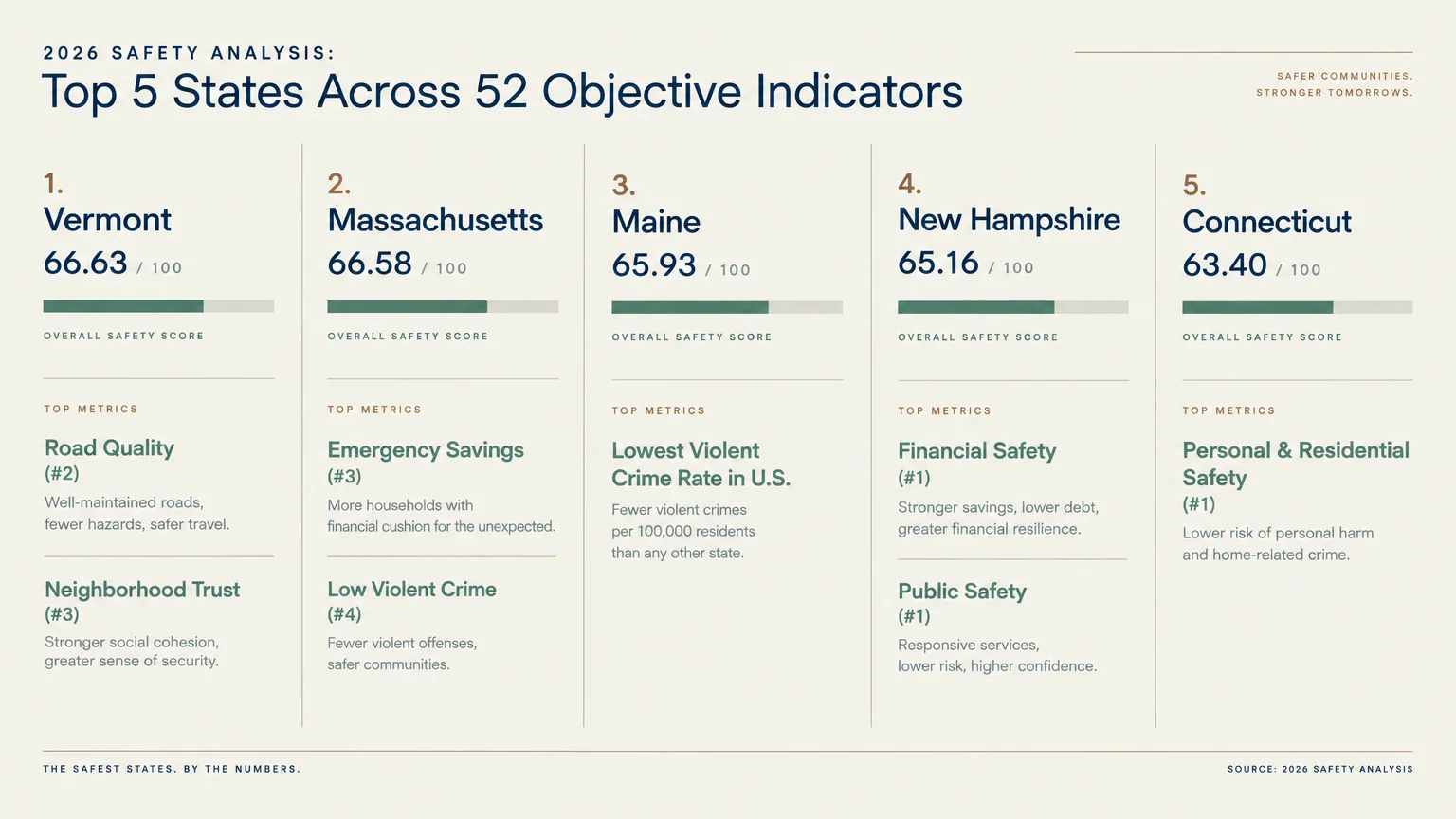
The comprehensive 2026 WalletHub safety analysis evaluated all 50 states across 52 objective indicators. These metrics spanned five core categories: Personal and Residential Safety, Financial Safety, Road Safety, Workplace Safety, and Emergency Preparedness.
New England produced a clean sweep that surprised many relocation analysts. All six New England states earned spots in the national Top 10, capturing five of the top five positions.
Vermont secured the title of the safest state in America with an overall score of 66.63. Massachusetts closely trailed in second place with a score of 66.58, followed by Maine, New Hampshire, and Connecticut.
Outside of the Northeast corridor, only a handful of states demonstrated comparable stability. Utah ranked sixth overall, while Minnesota and Indiana captured spots inside the top ten.
| Rank | State | Total Safety Score | Primary Category Strengths | Retirement Security Factor |
|---|---|---|---|---|
| 1 | Vermont | 66.63 | Road Quality (#2), Neighborhood Trust (#3) | Low property crime and resilient infrastructure |
| 2 | Massachusetts | 66.58 | Emergency Savings (#3), Low Violent Crime (#4) | Top-tier hospitals and climate resilience |
| 3 | Maine | 65.93 | Lowest Violent Crime Rate in U.S. | Peaceful small towns and low burglary rates |
| 4 | New Hampshire | 65.16 | Financial Safety (#1), Public Safety (#1) | Zero state sales tax and low crime density |
| 5 | Connecticut | 63.40 | Personal & Residential Safety (#1) | Excellent residential policing and protection |
| 6 | Utah | 62.73 | Road Safety (#1), Community Health | Modern roadway design and strong civic support |
| 7 | Minnesota | 61.77 | Financial Security, Workplace Safety | High standard of living and social safety nets |
| 8 | Indiana | 60.83 | Road Safety, Low Cost of Living | Affordable housing with dependable public services |
| 9 | Rhode Island | 60.19 | Personal Safety, Coastal Emergency Readiness | Compact geography with rapid medical response |
| 10 | Hawaii | 59.97 | Workplace Safety, Low Property Crime | High life expectancy and tight-knit communities |
These rankings demonstrate that northern states consistently outpace southern and western states in overall protective infrastructure. For retirees seeking stable surroundings, this geographical divide offers practical guidance.
Why Vermont Earned the Nation’s Top Spot
Vermont secured its first-place ranking through exceptional performance across infrastructure and community metrics. The Green Mountain State delivers an environment where older adults face minimal daily disruption.
Road conditions play a vital role in senior independence and mobility. Vermont boasts the second-best road quality in the nation, drastically reducing traffic fatalities and costly vehicle repairs.
Community cohesion also sets Vermont apart from suburban retirement enclaves. Nearly 76% of parents in Vermont report living in safe neighborhoods, marking the third-highest rate across the country.
When neighbors look out for one another, home burglary and petty vandalism rates plummet. You gain peace of mind knowing your property remains secure even when you travel during the winter months.
Economic stability reinforces the state’s secure environment. Vermont maintains an unemployment rate of just 2.7%, fostering steady local economies that support essential community public services.
For retirees, high municipal stability means properly funded volunteer fire departments, rapid emergency response, and dependable snow clearance. You never have to worry about municipal abandonment during harsh winter storms.

Examining the New England Sweep: Massachusetts, Maine, New Hampshire, and Connecticut
While Vermont claimed the top prize, its regional neighbors recorded equally impressive safety records. Understanding their individual strengths helps you match your lifestyle preferences to the right location.
Massachusetts captured the second position nationwide, driven by robust public safety and world-class healthcare access. The state recorded the fourth-lowest murder rate in America and the tenth-fewest mass shootings.
Financial resilience among residents further enhances community stability in the Bay State. Massachusetts ranks third nationally for households holding dedicated emergency savings funds, reducing economic desperation and associated crime.
Maine claimed third place overall while maintaining the lowest violent crime rate in the United States. According to official federal crime statistics, Maine recorded just 100.1 violent offenses per 100,000 residents, far below the national average of 359.1.
You can walk coastal harbors and rural village squares in Maine without the anxiety common to larger metropolitan areas. Local communities maintain a culture of mutual support that deters criminal behavior.
New Hampshire took fourth place overall, earning the title of the safest state in public safety from U.S. News & World Report. Its violent crime rate registered at a remarkably low 107 incidents per 100,000 residents.
New Hampshire also captured the number one ranking for Financial Safety in the WalletHub study. The state levies neither personal earned income tax nor general sales tax, shielding your retirement income from aggressive municipal deductions.
Connecticut completed the regional top-five sweep by ranking first in the nation for Personal and Residential Safety. Strict property protection and comprehensive community policing shield suburban homeowners across the state.
Rhode Island secured the ninth spot, rounding out the regional powerhouse. Its compact geography ensures that seniors live within minutes of hospital trauma centers and emergency personnel.
Beyond Crime Rates: What Holistic Safety Means for Older Adults
Traditional safety discussions focus almost exclusively on violent assault or burglary statistics. When you enter retirement, your definition of safety must broaden to protect your lifestyle and savings.
Financial exploitation represents one of the fastest-growing threats to American retirees. The Consumer Financial Protection Bureau (CFPB) actively tracks fraudulent schemes targeting seniors across various state jurisdictions.
States with high financial safety ratings exhibit stronger consumer protection laws and lower rates of identity theft. They enforce strict oversight against predatory lenders and aggressive contractor scams after storms.
“True financial security is not just about the size of your portfolio; it is about building an environment where unexpected emergencies cannot derail your peace of mind.” — Jean Chatzky, Financial Educator and Author
Roadway engineering forms another crucial safety consideration as your reflexes and night vision change. States like Utah and Vermont prioritize clear road signage, wide shoulders, and well-lit intersections.
Environmental readiness has also become essential for retirement security. Severe climate events can trap older residents in their homes or cause ruinous property damage.
Massachusetts ranked sixth-lowest for per capita losses from climate disasters. States with low disaster vulnerability preserve your home equity and protect you from soaring homeowner insurance cancellations.
Workplace and environmental safety ratings reflect clean air, safe tap water, and well-maintained public buildings. A healthy physical environment lowers your long-term medical expenditures and preserves functional independence.
States Facing the Steepest Safety Challenges
Relocation data shows that thousands of retirees move south each year in search of warmth and lower taxes. Many of these popular retirement destinations rank among the least safe states in the nation.
Mississippi ranked last in the nation at 50th overall, weighed down by high road fatality rates and limited emergency medical access. Louisiana followed closely behind at 49th, plagued by severe property crime and climate vulnerability.
Texas ranked 48th overall, while Florida ranked 47th. Arkansas completed the bottom five at 46th in overall safety scores.
Both Florida and Texas face significant challenges related to severe weather losses and pedestrian traffic fatalities. Dense coastal traffic and severe storm risks drive up auto insurance and homeowner premiums to record levels.
Property crime patterns also reveal sharp geographic disparities across the country. New Mexico recorded the highest property crime rate in the nation at 2,751.1 offenses per 100,000 residents.
Violent crime rates show similar geographic extremes. Alaska recorded 724.1 violent crimes per 100,000 residents, while New Mexico logged 717.1 offenses per 100,000 people.
If you relocate to these regions, you must investigate specific towns and gated communities carefully. Statewide averages often conceal volatile neighborhood conditions that could affect your quality of life.
Historic National Crime Declines: Encouraging Trends for Retirees
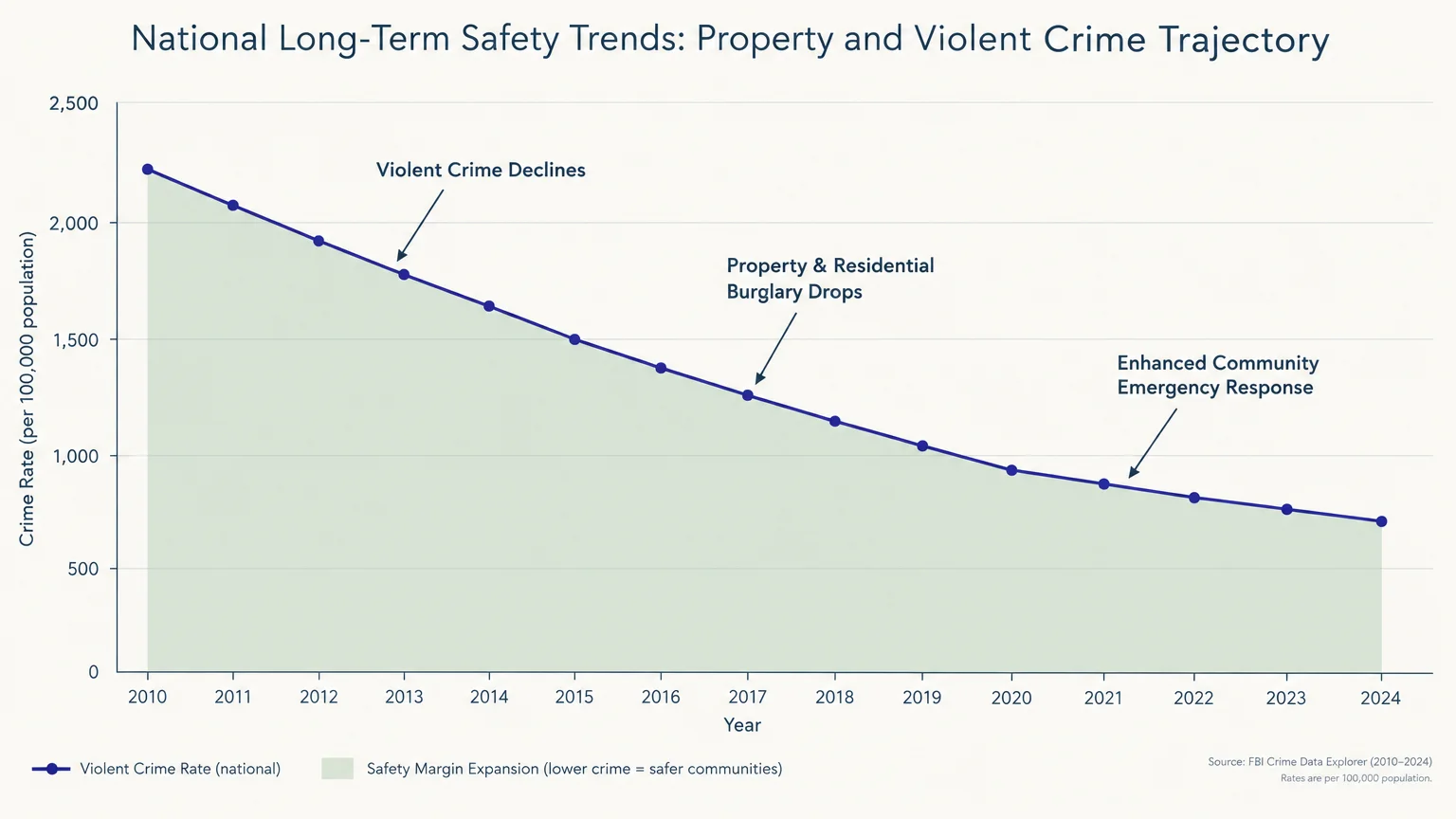
While state rankings highlight geographic differences, the national public safety picture has improved dramatically. Federal crime reports reveal historic progress in personal safety across American communities.
According to the FBI Reported Crimes in the Nation Summary, national violent crime dropped between 9.3% and 9.7% from 2024 to 2025. Property crime declined by an impressive 12.4% over the same period.
The murder rate fell by 18.1% in 2025, marking the largest single-year decline since national recordkeeping began in 1936. This drop tied 1955 and 1956 for the lowest murder rate in recorded American history.
Property crimes that directly impact older homeowners saw steep decreases. Burglary dropped by 15.8%, while motor vehicle theft plummeted by 22.7% across reporting jurisdictions.
Preliminary FBI data through mid-2026 confirms that downward crime trends have continued. Violent crime dropped an additional 8.6%, led by an 18.2% reduction in homicides and a 19.0% decline in robberies.
Property crime continued its slide in 2026, falling another 12.2%. You can retire with greater confidence knowing that communities across the country are growing safer.
Balancing New England Safety with Retirement Costs
Moving to a top-ranked New England state provides unmatched security, but it requires thoughtful financial planning. The northeastern states maintain higher living costs and property taxes than the national median.
Vermont and Connecticut assess significant property tax rates on residential real estate. You must determine whether your fixed income can comfortably absorb municipal property taxes over a multi-decade retirement.
State taxation of retirement income varies sharply throughout the New England region. New Hampshire offers substantial tax relief by avoiding personal earned income taxes and sales taxes entirely.
Before relocating, review state tax policies on retirement withdrawals and pension distributions. You can check federal retirement benefit updates directly through the Social Security Administration (SSA).
If New England costs exceed your planned budget, consider safe midwestern alternatives. Utah ranked sixth overall and Indiana ranked eighth, offering safe streets alongside lower housing prices.
Indiana provides an appealing combination of low property costs and high roadway safety. You can purchase a comfortable home in an established neighborhood without depleting your investment nest egg.
Common Mistakes to Avoid When Choosing a Safe Location
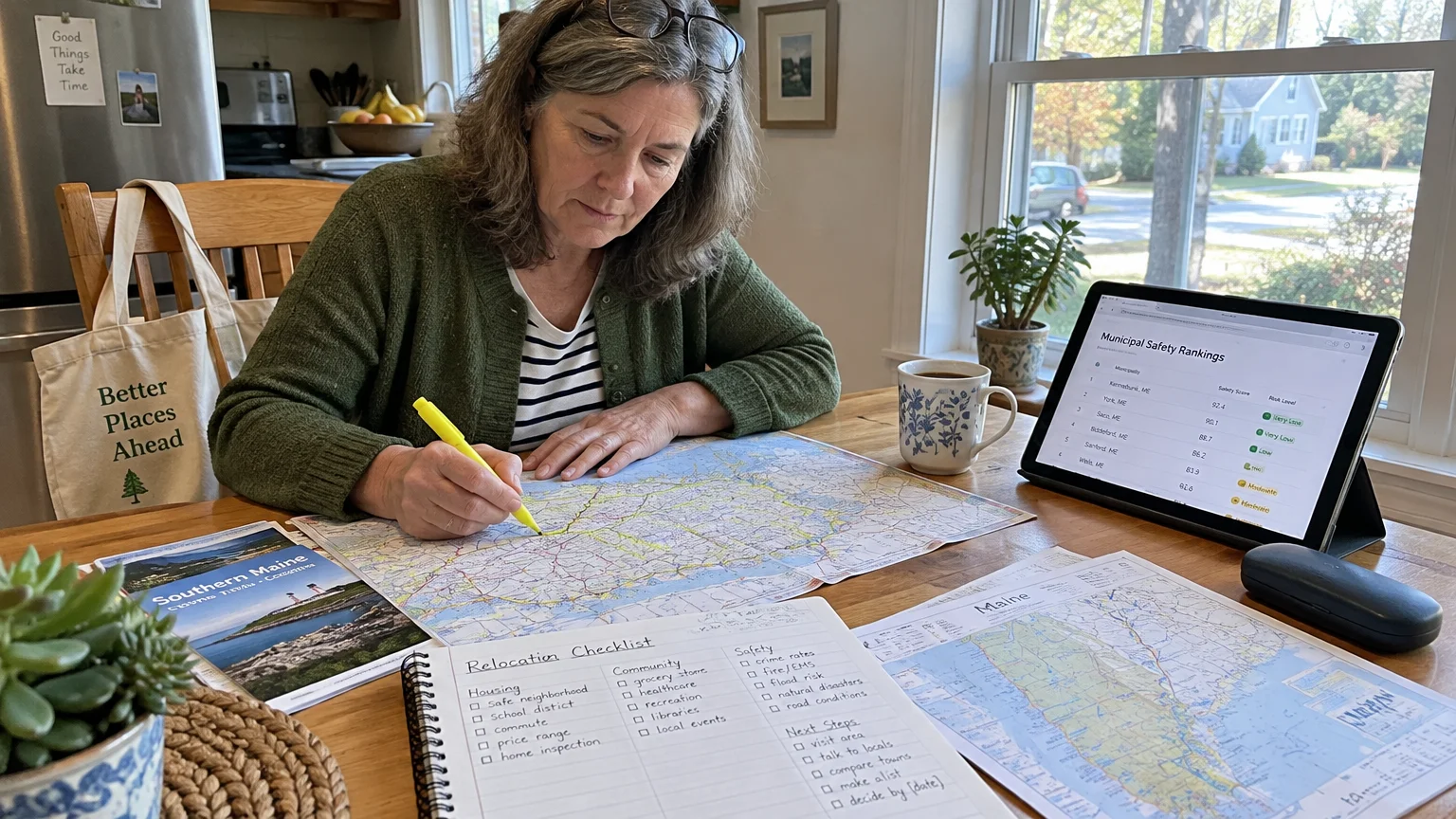
Relocating during retirement involves major life changes and financial commitments. Avoiding common evaluation errors ensures you find a secure community that fits your budget.
- Relying entirely on statewide data: State crime averages cannot tell you what happens on a single street corner. Always research municipal police reports and neighborhood crime maps for specific towns.
- Overlooking natural disaster expenses: A town with zero crime can still experience catastrophic river flooding or storm surges. Verify flood zones and homeowner insurance availability before putting down earnest money.
- Ignoring medical travel times: High personal safety means little if the nearest cardiac hospital is forty-five minutes away. Choose a home situated within a fifteen-minute drive of an accredited emergency room.
- Discounting winter traffic risks: Northern states require driving on icy roadways during winter months. Make sure you feel confident navigating winter weather or choose a community with walkable amenities.
- Neglecting digital fraud protections: Physical deadbolts cannot protect your bank account from online exploitation. Establish two-factor authentication and credit freezes regardless of where you decide to live.
You can discover age-friendly housing resources and neighborhood accessibility standards through the Department of Housing and Urban Development (HUD). Planning ahead protects your physical mobility as you age in place.
Organizations like AARP provide localized livability indexes that evaluate community transit, walkability, and civic engagement. Using these tools helps you evaluate safety from every angle.
Frequently Asked Questions About the Safest Places to Retire
Which state has the lowest violent crime rate in America?
Maine holds the lowest violent crime rate in the United States, recording 100.1 offenses per 100,000 residents according to federal crime data. New Hampshire closely follows with 107 violent offenses per 100,000 residents.
Why did Vermont rank as the overall safest state in the country?
Vermont earned the top spot by excelling across multiple safety categories rather than just crime prevention. It boasts the nation’s second-best road quality, a low 2.7% unemployment rate, and high neighborhood security ratings.
Why do popular retirement states like Florida rank low in national safety studies?
Florida ranks 47th overall because safety metrics include traffic fatalities, severe weather vulnerability, and financial stability. While Florida offers warm weather, high pedestrian crash rates and rising property insurance claims drag down its score.
What non-crime factors should retirees check before moving?
Retirees should evaluate hospital drive times, emergency response capabilities, road conditions, and severe weather risks. Checking home insurance rates and local municipal budgets reveals how well a community protects its residents.
Taking Action for a Secure Retirement
Achieving total peace of mind in retirement requires aligning your physical surroundings with your financial security. The data proves that Vermont and its New England neighbors provide America’s most protective environments.
Spend a few weeks visiting prospective towns during different seasons before buying a home. Speak with local emergency responders and neighbors to get an authentic feel for community life.
This is educational content based on general retirement planning principles. Individual results vary based on your situation. Always verify current benefit amounts, tax laws, and eligibility with official sources.
Last updated: November 2026. Retirement benefits, tax laws, and healthcare costs change frequently—verify current details with official sources.