Recent political rhetoric from Capitol Hill has reignited alarm over Social Security’s financial health. Lawmakers often trade fierce talking points, but you need to know how these statements actually affect your retirement checks.
The core debate centers on the projected 2032 trust fund deadline. Despite sensational headlines, reserve depletion does not mean the program will suddenly stop issuing monthly benefits.
Separating legislative posturing from legislative reality allows you to make confident decisions for your retirement. Here is what congressional remarks actually mean for your wallet.
The 2032 Trust Fund Deadline: Separating Myth from Math
According to the Social Security Administration Board of Trustees (2026), the Old-Age and Survivors Insurance (OASI) Trust Fund faces reserve exhaustion in late 2032. The Congressional Budget Office independently projects depletion within fiscal year 2032.
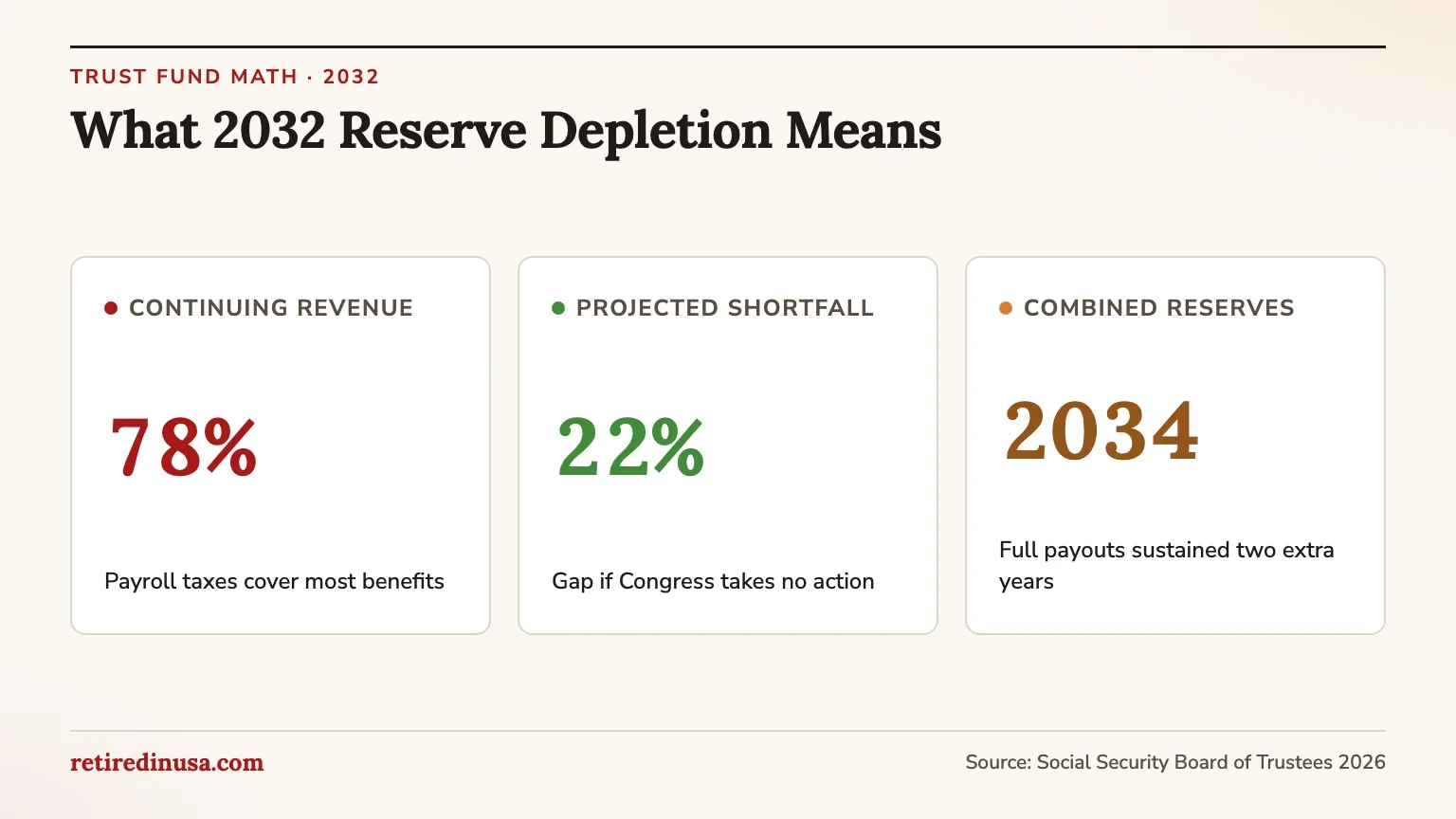
Depletion does not mean the program runs out of money. Ongoing tax receipts will still cover approximately 78% of scheduled benefits, leaving a 22% shortfall if Congress takes no action.
Meanwhile, the Disability Insurance Trust Fund remains solvent past 2100. Combining both reserves would sustain full payments until 2034, when continuing revenue would cover 83% of scheduled outlays.

Decoding Capitol Hill Remarks and Leadership Posturing
Recent debates flared after leaders addressed mandatory spending growth. When questioned on national debt pressures, the House Speaker noted that mandatory programs operate on autopilot and will require fiscal adjustments.
The House Speaker Social Security remarks sparked swift pushback across both parties. Leadership quickly clarified that upcoming plans will target administrative waste and fraud rather than reducing earned benefits.
Similar tensions erupted during a Senate Budget Committee hearing examining program solvency. Outgoing committee leaders faced intense scrutiny after using provocative rhetoric to describe program finances before clarifying their stance.
With the incoming 120th Congress narrowly divided, unilateral overhauls cannot pass. Any durable social security reform requires 60 Senate votes, making bipartisan compromise an absolute necessity.
Current Beneficiaries vs. Future Claimants
Capitol Hill speeches rarely distinguish between current beneficiaries and future retirees. In practice, historical reforms almost always protect older Americans while phasing in changes over decades.
When Congress updated retirement rules in 1983, it preserved existing benefits and gradually raised the full retirement age. Current lawmakers across both parties consistently pledge to protect existing checks.
The following breakdown highlights how potential policy updates could affect you based on your current retirement status:
| Retirement Category | Immediate Risk Level | Probable Policy Outcomes |
|---|---|---|
| Current Beneficiaries | Low | Full benefit protection; potential adjustments to future cost-of-living calculations. |
| Near-Term Claimants (Ages 55–66) | Low to Moderate | Preserved base benefits; minimal changes to eligibility thresholds. |
| Future Claimants (Under Age 55) | Moderate to High | Phased increases in full retirement age; modified benefit calculation formulas. |
As outlined above, your exposure to policy adjustments depends primarily on your age. Lawmakers concentrate potential structural shifts on younger workers who have decades to adjust savings strategies.

Legislative Solutions on the Table
Congress has several options to address benefit solvency before 2032 arrives. Legislative solutions focus either on expanding trust fund revenue or modifying the growth trajectory of future payouts.
Bipartisan measures such as the PROMISE Act (S. 4979) aim to create fast-track procedures that guarantee at least 50 years of solvency. Meanwhile, other lawmakers continue advocating for an independent rescue commission.
On the revenue side, proposals frequently seek to raise or eliminate the payroll tax threshold. In 2026, the cap sits at $184,500 before rising to $192,300 in 2027.
“Do not let fear dictate your Social Security claiming strategy. Making permanent retirement decisions based on political headlines often costs you far more than future legislative compromises ever will.” — Jean Chatzky, Financial Educator and Author
Pitfalls to Watch For
Political headlines frequently generate panic that leads retirees into irreversible errors. You can safeguard your financial health by avoiding three common claiming mistakes.
- Filing prematurely out of fear: Claiming at age 62 permanently slashes your baseline monthly check by up to 30% compared to full retirement age.
- Overlooking earnings test thresholds: In 2027, the retirement earnings test withholds $1 for every $2 earned above $25,560 if you claim before full retirement age.
- Assuming zero payouts in 2032: Even under total congressional gridlock, continuous payroll tax revenues ensure the payment of roughly 78% of scheduled benefits.
A recent survey by AARP indicates broad public opposition to abrupt benefit cuts. Lawmakers understand that allowing automatic cuts would trigger severe electoral consequences.
Frequently Asked Questions
Are my benefits safe from immediate cuts?
Yes, your payments remain fully secure. For 2027, benefits increase by 3.6%, lifting the average monthly retired worker check from $2,095 to approximately $2,170.
What happens if Congress misses the 2032 trust fund deadline?
If lawmakers pass no legislation by late 2032, ongoing revenues will cover roughly 78% of scheduled benefits. This scenario represents an administrative backstop rather than a planned policy outcome.
Will Congress actually act before 2032?
Lawmakers historically wait until deadlines force bipartisan action. Because older voters represent a potent voting bloc, Congress will face overwhelming pressure to protect trust fund stability before 2032.
Planning Ahead with Confidence
Focus your energy on elements within your personal control, such as household budgeting and tax-advantaged savings. Monitoring legislative developments objectively helps you navigate retirement with confidence.
The information in this guide is meant for educational purposes. Your specific circumstances—including income, savings, health coverage, and goals—may require different approaches. When in doubt, consult a licensed professional.
Last updated: November 2026. Retirement benefits, tax laws, and healthcare costs change frequently—verify current details with official sources.