
Medicare turns 65 into a high-stakes financial deadline, yet many future retirees assume coverage starts automatically. Missing a single window can trigger a lifelong medicare late enrollment penalty and leave you paying medical bills out of pocket.
Smart medicare enrollment tips protect both your health coverage and your retirement budget before those deadlines arrive. With the right calendar and paperwork, you can avoid costly medicare sign up mistakes and lock in reliable coverage from day one.
Below are four practical strategies covering your initial enrollment period, employer insurance rules, tax traps, and supplemental plans.
Tip 1: Map Your Initial Enrollment Period Before Turning 65
One of the most expensive assumptions pre-retirees make is linking Medicare eligibility to Social Security’s Full Retirement Age. According to the Social Security Administration (SSA), Full Retirement Age is 67 for anyone born in 1960 or later, including workers turning 62 in 2026.
Medicare follows a completely separate clock. Eligibility for Medicare begins at age 65 regardless of your birth year or when you plan to claim retirement benefits.
Because those ages no longer match, many Americans must actively apply for Medicare two full years before claiming Social Security. According to CMS rules, automatic enrollment in premium-free Part A and Part B occurs only if you already receive Social Security or Railroad Retirement Board benefits at least four months before turning 65.
Residents of Puerto Rico face an extra step even when receiving benefits early. CMS automatically enrolls them in Part A only, meaning they must actively sign up for Part B.
If you plan to delay Social Security past 65 to grow your monthly check, nobody will enroll you in Medicare on your behalf. Marking your initial enrollment period on your calendar becomes your first line of defense.
Understanding Your Seven-Month Window
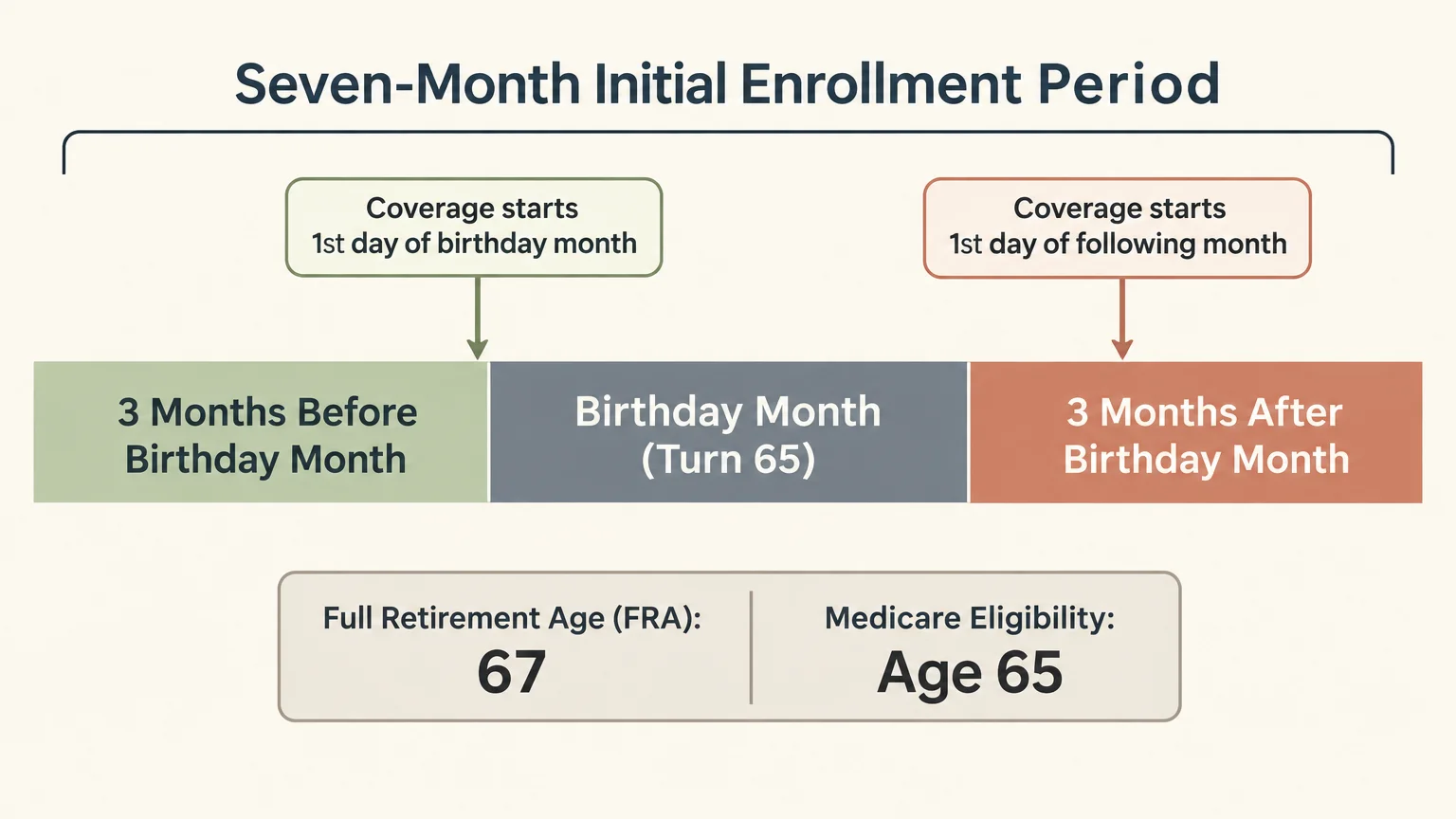
According to Medicare.gov, your Initial Enrollment Period lasts seven full months around your 65th birthday. It opens three months before your birthday month, includes the month you turn 65, and closes three months after your birthday month.
Signing up early within that seven-month window gives you the smoothest transition into coverage. Under simplified federal rules in effect since 2023, coverage always begins on the first day of a calendar month.
- Enrolling during the three months before your birthday month: Your Medicare coverage starts on the first day of the month you turn 65.
- Enrolling during your birthday month: Your coverage begins on the first day of the following month.
- Enrolling during the three months after your birthday month: Your coverage starts on the first day of the month after you submit your application.
Watch out for an obscure calendar quirk if your birthday falls on the first day of any month. Under Medicare.gov rules and federal regulation 42 CFR 407.10, Medicare treats you as turning 65 in the prior month.
For example, if you turn 65 on July 1, Medicare treats June as your birthday month. Your seven-month window shifts earlier—running from March 1 through September 30—and your earliest coverage can begin on June 1.
What Happens If You Miss Your Window
Missing your seven-month window without qualifying employer insurance pushes you into the General Enrollment Period. According to Medicare.gov and SSA.gov, that backup window runs every year from January 1 through March 31.
Thanks to rule updates enacted in 2023, General Enrollment Period coverage starts on the first day of the month after you sign up. Older guides claiming coverage waits until July 1 are outdated, though waiting for January can still leave a dangerous coverage gap.
Worse than the gap is the permanent medicare late enrollment penalty attached to delayed sign-ups. Medicare applies separate surcharges to Part B, Part D, and—for a small group of people—Part A.
According to Medicare.gov, the Part B penalty adds 10% to your standard monthly premium for every full 12-month period you were eligible without qualifying coverage. You pay that surcharge for as long as you keep Part B, which means a lifetime higher bill for most retirees.
Prescription drug coverage carries its own clock. Going 63 continuous days or longer without Part D or creditable drug coverage after your initial window triggers a Part D penalty.
Medicare.gov calculates that surcharge as 1% of the national base beneficiary premium multiplied by your full uncovered months, rounded to the nearest ten cents. That base premium is $38.99 in 2026 and rises to $41.33 in 2027, so your penalty grows alongside future rate increases.
Roughly 99% of beneficiaries pay $0 monthly for Part A hospital insurance because they or a spouse earned 40 or more work quarters. For the roughly 1% who must buy Part A—at $311 or $565 monthly in 2026, rising to $328 or $597 in 2027—delaying adds a 10% penalty payable for twice the years missed.

Tip 2: Verify the 20-Employee Rule Before Delaying Medicare Part B
Working past 65 gives many people a legitimate reason to postpone medicare part b enrollment and avoid paying monthly premiums too early. However, relying on workplace coverage without checking company size is one of the riskiest medicare sign up mistakes you can make.
According to Medicare.gov, you may delay Part B without penalty only when covered by group health insurance from your or your spouse’s current employment at a company with 20 or more employees. At larger employers, your workplace plan remains the primary payer and pays your medical bills first.
The rules flip completely at smaller companies. If the employer has fewer than 20 employees, Medicare typically becomes your primary payer the month you turn 65.
In that small-employer scenario, your workplace health plan becomes secondary coverage. If you skip Part A and Part B at 65, your job-based insurer can refuse to pay claims that Medicare would have covered—leaving you personally responsible for hospital and doctor bills.
Confirm your employer’s exact headcount with your human resources department in writing before your 65th birthday. Also verify whether your job-based drug coverage counts as creditable coverage—meaning it pays at least as well as a standard Medicare Part D plan.
Navigating the Eight-Month Special Enrollment Period
When you stay at a 20-plus-employee company past 65, Medicare grants you an eight-month Special Enrollment Period once work or coverage stops. According to Medicare.gov, that eight-month clock starts the month after active employment ends or the month after group health coverage ends, whichever happens first.
Coverage generally takes effect the first day of the month after Social Security receives your completed application. To protect yourself from late penalties, you cannot simply submit a standard online request without proof.
CMS requires two specific forms to approve your penalty-free Special Enrollment Period:
- Form CMS-40B: Your formal application for Medicare Part B, where you request your desired coverage start date.
- Form CMS-L564: The Request for Employment Information, which your employer’s benefits office must complete and sign to verify your active group coverage dates.
Getting your employer to sign Form CMS-L564 before your final day at work saves weeks of follow-up later. Keep copies of every signed page and upload or deliver both forms together to Social Security.
The COBRA and Part D Trap
Many workers retire at 66 or 67, elect COBRA continuation coverage to bridge a few months, and assume Medicare can wait until COBRA runs out. According to Medicare.gov, COBRA and retiree health plans do not count as coverage based on current employment.
Electing COBRA neither pauses nor extends your eight-month Part B Special Enrollment Period. If you ride out 18 months of COBRA after leaving your job, you will miss your Special Enrollment Period, face a coverage gap until January’s General Enrollment Period, and owe a lifetime Part B penalty.
COBRA coverage also usually terminates once you sign up for Medicare. Check your plan documents carefully before paying COBRA premiums alongside Medicare Part A or Part B.
Even workers who track the eight-month Part B window often stumble over a much shorter deadline for prescriptions. While Part B gives you eight months after losing employer coverage, Medicare.gov rules give you only two full months to join a Part D or Medicare Advantage plan.
Going 63 continuous days or longer without creditable prescription drug coverage after your workplace plan ends triggers a permanent Part D penalty. Always coordinate your Part B and Part D start dates together before leaving work.
| Enrollment Window | Who Qualifies | Timing and Deadlines | Coverage Start Date | Penalty Risk If Missed |
|---|---|---|---|---|
| Initial Enrollment Period (IEP) | Everyone turning age 65 | 7 months (3 before, birthday month, 3 after; shifts 1 month earlier for 1st-of-month birthdays) | 1st of birthday month if early; 1st of next month if during or after birthday month | Lifetime Part B and Part D penalties unless covered by qualifying active employer plan |
| Part B Special Enrollment Period (SEP) | Workers or spouses leaving active 20+ employee group coverage | 8 months after employment or group coverage ends (whichever comes first) | Month after Social Security receives Forms CMS-40B and CMS-L564 | Wait for General Enrollment Period plus 10% Part B penalty per full 12-month delay |
| Part D / Drug SEP | Retirees losing creditable employer prescription coverage | 2 full months after employer coverage ends (no 63+ day gap) | 1st of month after plan receives your enrollment | 1% of base premium ($38.99 in 2026; $41.33 in 2027) per uncovered month for life |
| General Enrollment Period (GEP) | Anyone who missed IEP and has no SEP | January 1 through March 31 each year | 1st day of the month after you sign up | Lifelong Part B surcharge and potential months without coverage |
Tip 3: Stop HSA Contributions Six Months Early and Plan for IRMAA
Tax-advantaged accounts and retirement income strategies can collide unexpectedly with Medicare enrollment rules. One subtle timing error with a Health Savings Account (HSA) can trigger unwelcome IRS tax penalties just as you retire.
Under IRS and Medicare.gov rules, you cannot contribute new money to an HSA once enrolled in any part of Medicare—even premium-free Part A. That rule catches working seniors off guard when they file for Part A or Social Security after turning 65.
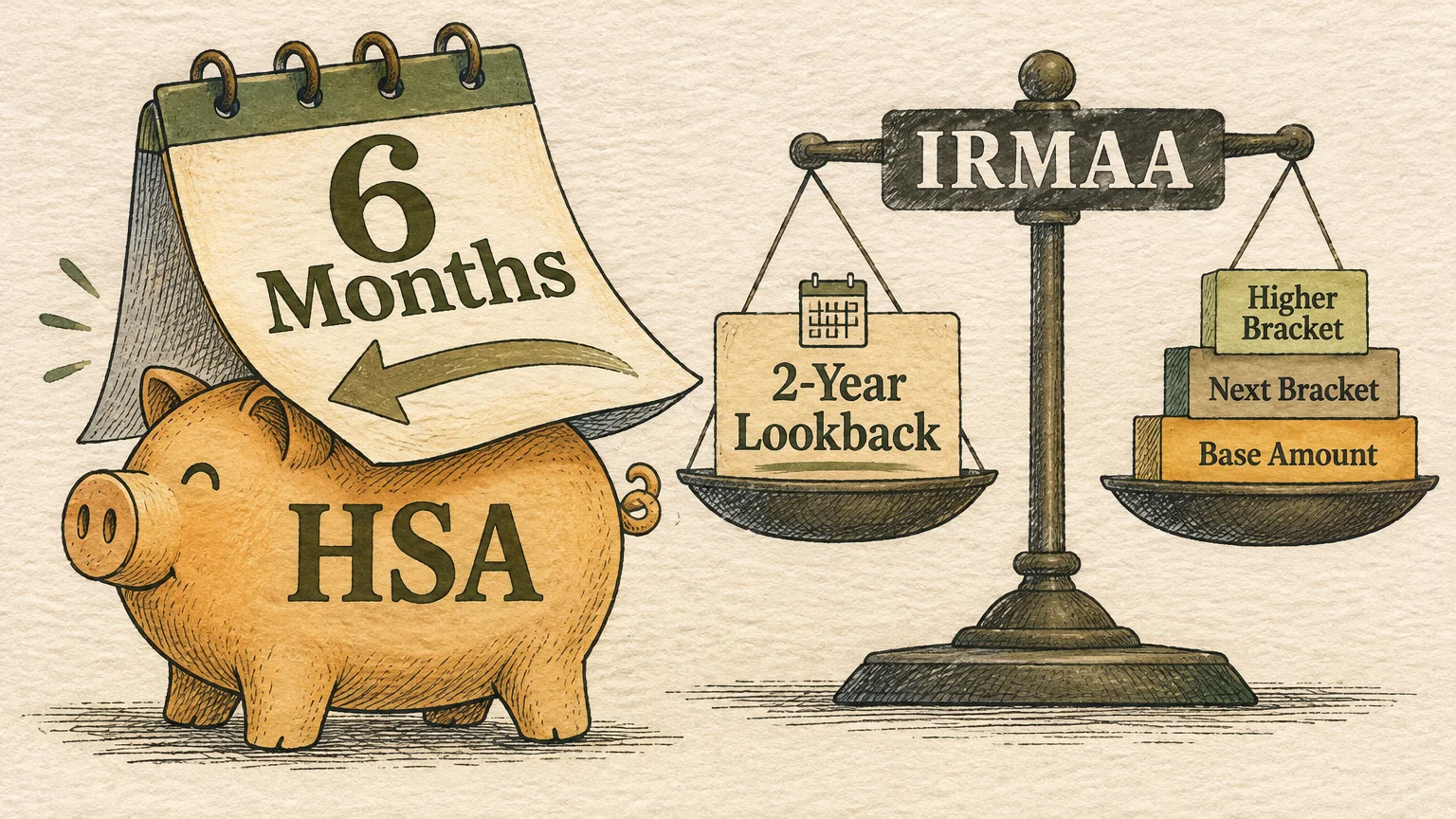
Whenever you apply for Part A or claim Social Security benefits past age 65, Medicare grants up to six months of retroactive Part A coverage. That retroactive effective date never reaches back earlier than the month you turned 65, yet it still voids HSA eligibility during those months.
To prevent excess-contribution penalties from the IRS, stop all personal and employer HSA contributions at least six months before applying for Medicare or Social Security. Remember that you may still spend existing HSA balances tax-free on qualified medical expenses and Medicare premiums—excluding Medigap—even after enrollment.
Budgeting for 2026 and 2027 Medicare Baseline Costs
Accurate medicare enrollment tips also require realistic budgeting for annual rate changes. On November 17, 2026, CMS released the official 2027 Medicare premiums and deductibles taking effect January 1, 2027.
- Part B standard monthly premium: $202.90 per month in 2026, rising $6.50 (3.2%) to $209.40 per month in 2027; Medicare Advantage enrollees pay this premium too.
- Part B annual deductible: $283 in 2026, rising $9 to $292 in 2027; afterward, Original Medicare pays 80% of approved services with no annual cap on your 20% coinsurance.
- Part A inpatient hospital deductible: $1,736 per benefit period in 2026, rising $40 to $1,776 in 2027.
- Part D out-of-pocket cap and deductible: The annual out-of-pocket cap for covered prescriptions is $2,100 in 2026 and rises to $2,400 in 2027, while the maximum standard deductible increases from $615 to $700.
Because Original Medicare places no annual ceiling on your 20% Part B coinsurance, most retirees pair Parts A and B with either a Medigap policy or a Medicare Advantage plan. Factoring those supplemental premiums into your retirement cash flow prevents surprise healthcare shortfalls.
Navigating Higher-Income Surcharges (IRMAA)
High earners face an additional monthly charge known as the Income-Related Monthly Adjustment Amount, or IRMAA. According to CMS and SSA, IRMAA uses a two-year tax lookback—meaning your 2025 Modified Adjusted Gross Income (MAGI) determines your 2027 Medicare surcharges.
Roughly 9% of Part B beneficiaries pay IRMAA surcharges each year. In 2026, surcharges begin when MAGI exceeds $109,000 for single filers or $218,000 for married couples filing jointly.
For 2027, CMS raised those starting thresholds to $112,000 for single filers and $224,000 for joint filers. Depending on your income bracket, total 2027 Part B premiums range from $293.10 to $711.80 per month, plus an extra $15.40 to $96.40 per month for Part D.
Many new retirees get hit with an IRMAA bill based on their final peak-earning years at work. Fortunately, you do not have to accept that surcharge if your income has dropped due to a qualifying life-changing event such as retirement, marriage, divorce, or losing a spouse.
You can appeal the assessment by submitting Form SSA-44 along with documentation of your retirement and updated income estimate to Social Security. Timing Roth conversions or large capital gains carefully before age 63 also helps minimize future two-year lookback spikes.
Tip 4: Protect Your One-Time Medigap Window and Know Annual Calendars
When you first enroll in Part B at age 65 or older, Medicare unlocks a one-time protection that many retirees overlook until it expires. Understanding how supplemental coverage deadlines differ from annual plan switches keeps your long-term healthcare options open.
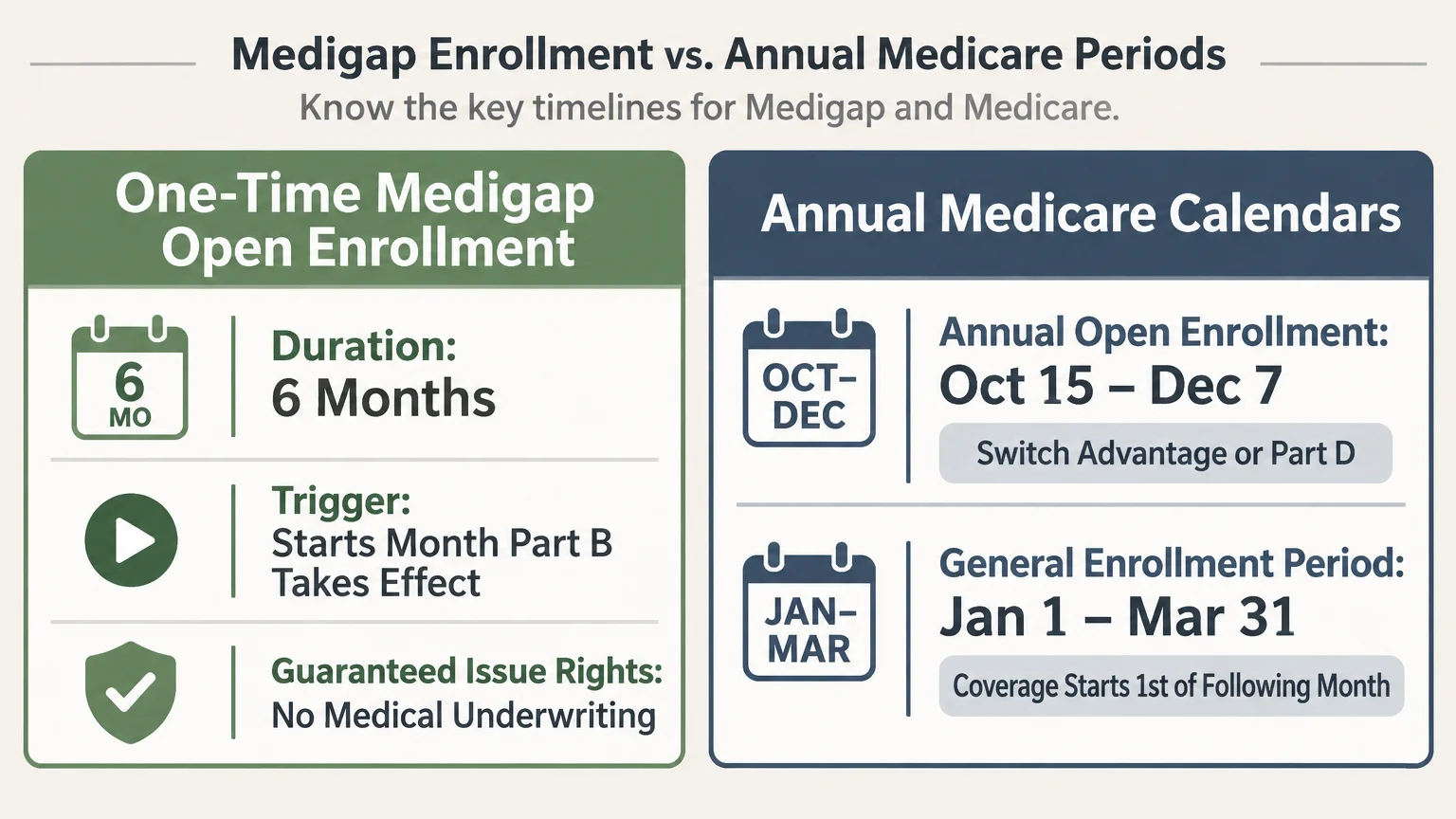
According to Medicare.gov, federal law grants you a single, non-repeating six-month Medigap Open Enrollment Period. It starts on the first day of the month in which you are both age 65 or older and enrolled in Part B.
During those six months, private insurance companies cannot deny you a Medigap policy or charge higher premiums because of pre-existing health conditions. Once that window closes, insurers in most states can use medical underwriting to charge much higher rates—or reject your application outright—unless you hold a federal guaranteed issue right or live in a state with broader consumer rules.
Protecting your one-time six-month Medigap window matters just as much as hitting your Part B deadline, because switching from Medicare Advantage back to Medigap years later is never guaranteed.
Remember one eligibility restriction on older Medigap letters as well. Under federal rules, Medigap Plans C and F are closed to anyone who turned 65 on or after January 1, 2020, making Plans G and N the primary comprehensive choices for newer enrollees.
Distinguishing Annual Medicare Enrollment Windows
Television commercials every autumn blur different Medicare calendars together, leading beneficiaries to assume they can change any policy without consequences. Knowing which window applies to your coverage saves both frustration and rejected applications.
- Fall Medicare Open Enrollment Period (October 15 – December 7): Open to all Medicare beneficiaries for changes taking effect January 1. Plans mail an Annual Notice of Change by September 30, and you can switch between Original Medicare and Medicare Advantage or change Part D plans—yet this window provides zero federal guaranteed-issue rights for Medigap.
- Medicare Advantage Open Enrollment Period (January 1 – March 31): Applies exclusively to people already enrolled in a Medicare Advantage plan. You get one change during this period—either switching to another Advantage plan or returning to Original Medicare and adding a Part D plan, effective the first of the next month.
If you test out a Medicare Advantage plan for several years and later develop a chronic illness that requires out-of-network specialists, returning to Original Medicare during the fall or winter windows is always permitted. However, passing medical underwriting to buy a Medigap policy afterward can become difficult or impossible in most states.
Weighing provider freedom, travel flexibility, and out-of-pocket predictability during your initial six-month Part B window sets your coverage on firm footing. For unbiased help comparing local plans, you can review official tools on USA.gov Benefits or locate free state counseling through the Administration on Aging (ACL) State Health Insurance Assistance Program.
Common Mistakes to Avoid
Even careful planners can trip over fine print when Medicare, workplace benefits, and tax calendars overlap. Watch closely for these recurring traps as your 65th birthday approaches:
- Waiting until age 67 to check Medicare rules: Social Security Full Retirement Age is 67 for younger retirees, yet Medicare still starts at 65.
- Assuming a small employer plan stays primary: Employers with fewer than 20 workers usually require you to take both Part A and Part B at 65 so claims get paid.
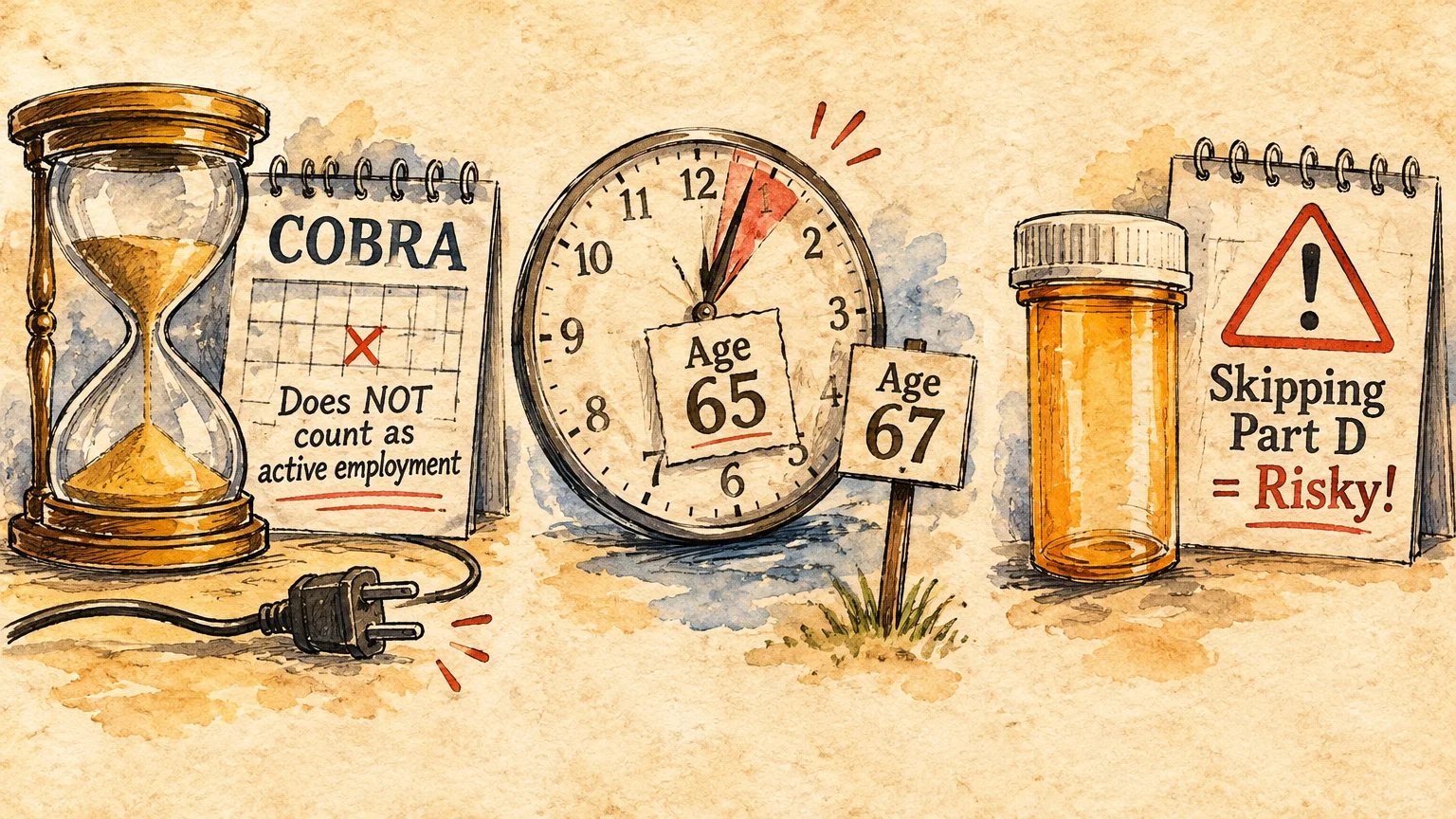
- Treating COBRA like active employment: COBRA never delays your eight-month Part B Special Enrollment Period or shields you from lifetime penalties.
- Overlooking the two-month Part D window: Waiting five or six months after leaving employer coverage to buy drug insurance triggers a lifelong Part D surcharge after 63 uncovered days.
- Forgetting the six-month HSA lookback: Continuing HSA payroll deposits within six months of filing for Part A or Social Security after age 65 creates IRS excess contributions.
- Ignoring the first-of-the-month birthday rule: A birthday on the first shifts your entire seven-month Initial Enrollment Period and earliest start date one month earlier.
- Skipping Form CMS-L564 when retiring late: Applying for Part B after 65 without employer-signed verification stalls approval and risks an incorrect penalty assessment.

Professional vs. Self-Guided
Many retirees complete Medicare enrollment smoothly on their own, while others benefit enormously from tailored guidance. Use these four scenarios to decide whether to enroll solo or bring in specialized help:
- Retiring right at 65 with straightforward health needs (Self-Guided): If you do not have employer coverage past 65, are not funding an HSA, and take common prescriptions, Medicare.gov’s online plan finder and SSA.gov’s application portal usually provide everything you need.
- Working past 65 with an HSA and employer coverage (Professional Guidance): Coordinate with your human resources office for Form CMS-L564, and consult a Certified Public Accountant (CPA) or Certified Financial Planner (CFP) to stop HSA contributions on time and document your retroactive Part A lookback.
- Retiring after high-earning years (Professional Guidance): If your two-year MAGI lookback triggers IRMAA surcharges above $112,000 single or $224,000 joint in 2027, a financial or tax advisor can help prepare Form SSA-44 and structure retirement withdrawals cleanly.
- Comparing complex chronic-care networks or Medigap options (Professional Guidance): When evaluating doctor networks across Medicare Advantage plans versus long-term Medigap premiums, an unbiased SHIP counselor via the National Council on Aging (NCOA) or a vetted independent Medicare broker can map out local carrier rules at no extra policy cost.
Frequently Asked Questions About Medicare Enrollment
What happens if I miss my Initial Enrollment Period for Medicare?
If you miss your seven-month window without qualifying active-employer coverage, you must wait for the General Enrollment Period from January 1 through March 31. Coverage begins the first day of the month after you sign up, and lifetime Part B and Part D late penalties may apply.
Can I keep my HSA if I delay Medicare Part A and Part B past 65?
Yes, provided you have qualifying high-deductible health coverage from an employer with 20 or more employees and delay both Medicare Part A and Social Security. Stop all HSA contributions at least six months before applying for either program to avoid IRS penalties from Part A’s retroactive lookback.
Does COBRA protect me from the Medicare Part B late enrollment penalty?
No, COBRA does not count as health insurance based on current active employment. Your eight-month Part B Special Enrollment Period begins when active work or employer group coverage ends, and delaying Part B until COBRA expires can leave you penalized and uncovered.
How do I appeal higher Medicare premiums after I retire?
If your income dropped because of retirement or another qualifying life-changing event, you can ask Social Security to recalculate your IRMAA using more recent income. Submit Form SSA-44 with proof of your retirement date and an estimate of your lower current-year MAGI.
Building a calm, step-by-step timeline six to nine months before your 65th birthday—or six months before your retirement date—eliminates guesswork and protects your budget for decades. Confirm your employer headcount, mark your HSA stop date, and gather your verification forms early so every Medicare deadline works in your favor.
This article provides general retirement education and information only. Everyone’s financial situation is unique—what works for others may not work for you. For personalized advice, consider consulting a qualified financial professional such as a CFP or CPA.
Last updated: November 2026. Retirement benefits, tax laws, and healthcare costs change frequently—verify current details with official sources.