The IRS just finalized major retirement account changes for 2027, and several updates directly affect how much you can save, deduct, or withdraw. While core IRA contribution caps are holding steady, income phase-outs and tax breaks are shifting in meaningful ways.
Older savers, working retirees, and charitable givers face new reporting codes, higher tax-free transfer limits, and a brand-new federal savings match. Reviewing these updates now helps you protect more of your retirement income.
Here is what changes in January 2027—and the practical moves you can make before year-end.
2027 IRA Contribution Limits and Catch-Up Rules
On November 12, 2026, the IRS issued IR-2026-136 and Notice 2026-66 to set 2027 cost-of-living adjustments across retirement plans. If you were expecting a jump in the base ira contribution limit 2027 rules, the headline number stays put.
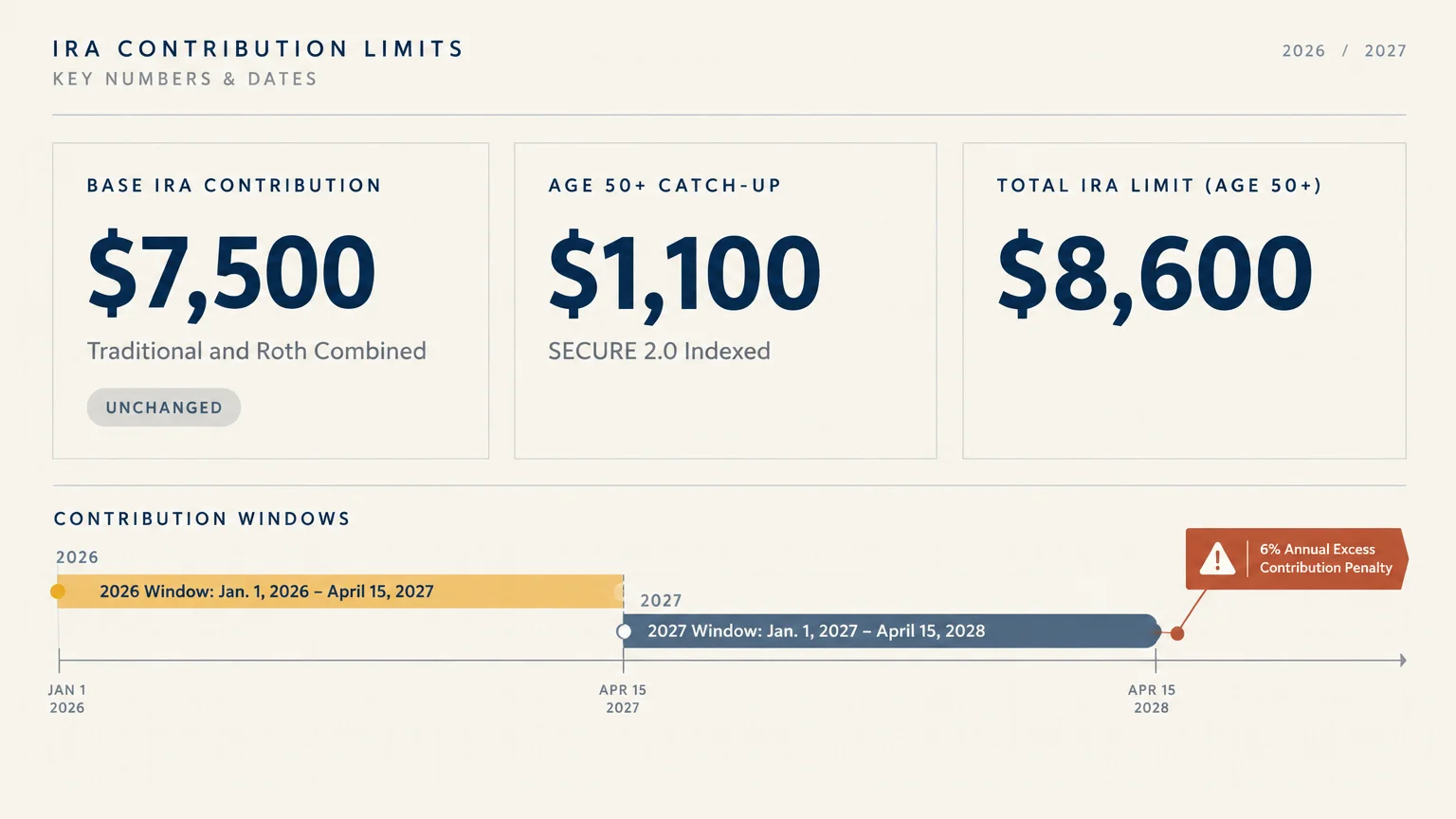
For 2027, your combined annual contribution cap across Traditional and Roth IRAs remains $7,500, unchanged from 2026. If you are age 50 or older, ira catch up contributions also stay flat at $1,100, despite annual inflation indexing under SECURE 2.0.
That puts the maximum total IRA contribution for savers age 50 and older at $8,600 for 2027. You still need taxable earned income—or spousal compensation on a joint return—at least equal to your contribution.
Timing matters just as much as the dollar cap when you fund your accounts. You can make 2026 IRA contributions until April 15, 2027, and 2027 contributions from January 1, 2027 through April 15, 2028.
Always label the correct tax year when sending money between January and April. Per Fidelity and IRS rules, excess contributions left in your account past the tax filing deadline trigger a 6% annual penalty until removed.
| IRA Provision | 2026 Limit | 2027 Limit | Change |
|---|---|---|---|
| Base IRA Contribution (Traditional and Roth combined) | $7,500 | $7,500 | Unchanged |
| IRA Catch-Up Contribution (Age 50+) | $1,100 | $1,100 | Unchanged |
| Total IRA Limit (Age 50+) | $8,600 | $8,600 | Unchanged |
| Contribution Window | Jan. 1, 2026 – April 15, 2027 | Jan. 1, 2027 – April 15, 2028 | Standard calendar window |
Even when contribution limits pause, automating monthly deposits early in 2027 keeps your money compounding longer. You can review contribution basics and compounding tools at Investor.gov before setting your 2027 transfer schedule.
Higher Income Phase-Outs for Traditional and Roth IRAs
While dollar limits stayed flat, inflation pushed income eligibility ranges upward for 2027. Under these irs ira changes, more households can deduct Traditional IRA contributions or fund a Roth IRA directly.
For Traditional IRAs, income phase-outs only apply if you or your spouse are covered by a retirement plan at work. If neither spouse has workplace coverage, you can deduct your full Traditional IRA contribution at any income level.
When workplace coverage applies, the 2027 Modified Adjusted Gross Income (MAGI) deduction ranges expand across every indexed filing status:
- Single or head of household (covered by a workplace plan): Your deduction phases out between $83,000 and $93,000, up from $81,000 to $91,000 in 2026.
- Married filing jointly (contributing spouse covered): Your deduction phases out between $133,000 and $153,000, up from $129,000 to $149,000 in 2026.
- Married filing jointly (contributing spouse not covered, spouse is covered): Your deduction phases out between $250,000 and $260,000, up from $242,000 to $252,000 in 2026.
- Married filing separately (either spouse covered): The range remains $0 to $10,000, because the IRS does not adjust this bracket for inflation.
Direct Roth IRA eligibility also widens in 2027 under IR-2026-136, giving middle- and upper-income savers extra breathing room. Remember that Roth IRA contribution caps apply regardless of whether you participate in a workplace retirement plan.
| Filing Status (Roth IRA Eligibility) | 2026 MAGI Phase-Out | 2027 MAGI Phase-Out |
|---|---|---|
| Single and Head of Household | $153,000 – $168,000 | $158,000 – $173,000 |
| Married Filing Jointly | $242,000 – $252,000 | $250,000 – $260,000 |
| Married Filing Separately | Not inflation-adjusted | Not inflation-adjusted |
If your 2027 income lands inside a phase-out band, estimate your MAGI carefully before funding a Roth IRA. You can always wait until early 2028 to contribute once your final W-2s and 1099s arrive.
The New Saver’s Match Replaces the Saver’s Credit
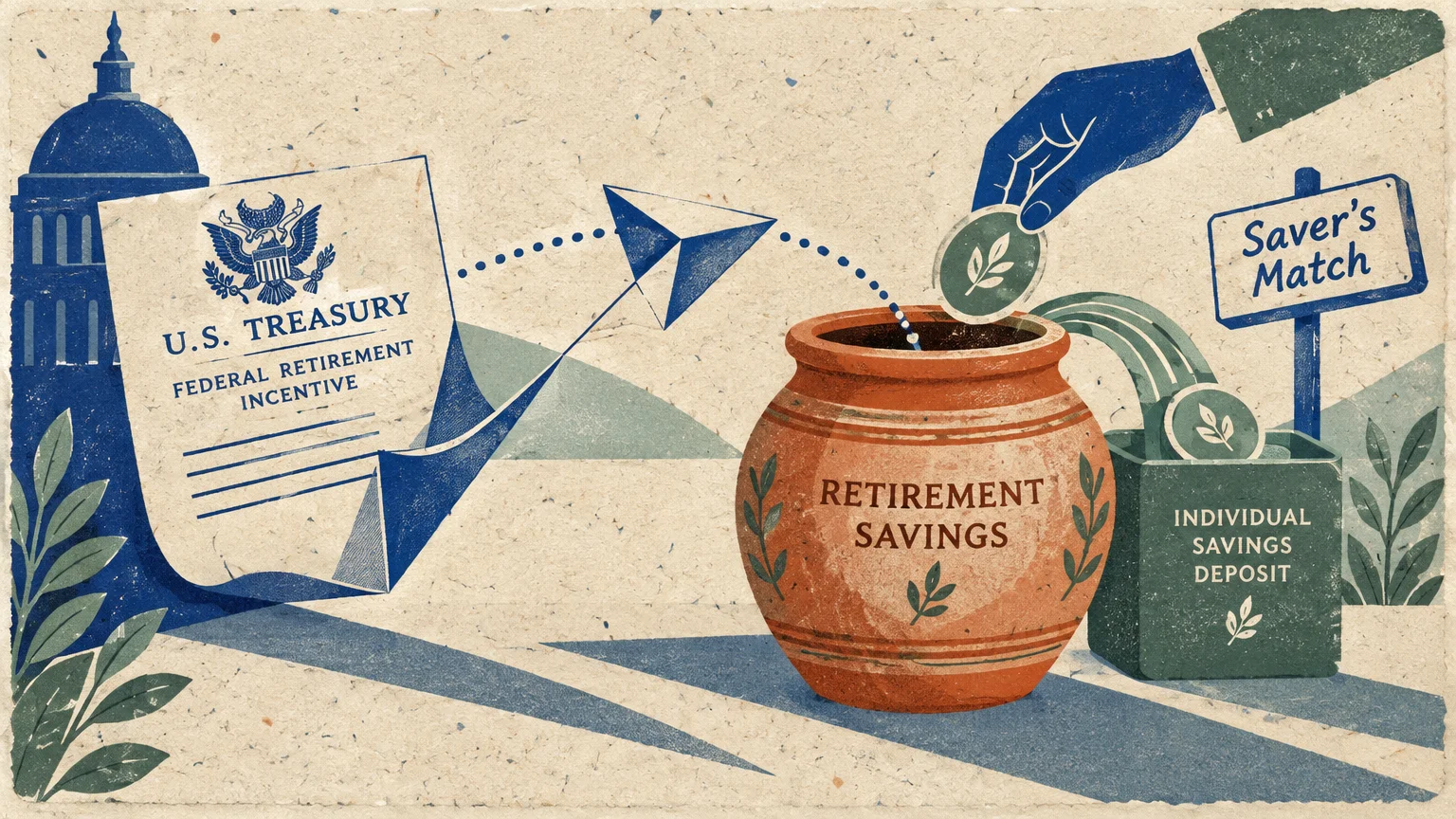
Perhaps the biggest shift in the ira rules 2027 brings is the arrival of the federal Saver’s Match. Established under SECURE 2.0 and IRC Section 6433, this program replaces the old Saver’s Credit for retirement contributions starting in tax year 2027.
Guidance in IRS Notice 2026-48 outlines how the match works when you claim it on 2027 tax returns filed in 2028 using new Form 8880-A. The old Saver’s Credit will survive after December 31, 2026 only for contributions to Section 529A ABLE accounts.
Unlike the nonrefundable Saver’s Credit—which only lowered tax bills for people who already owed income tax—the Saver’s Match sends real money into retirement accounts. Eligible savers receive the match even if they owe $0 in federal income tax.
The U.S. Treasury matches up to 50% of the first $2,000 you contribute per person to an eligible IRA or workplace plan. That creates a $1,000 maximum annual match per person, applied separately to each spouse on a joint tax return.
Your 2027 MAGI determines whether you earn the full match, a partial match, or nothing, based on thresholds published on IRS.gov:
- Single or married filing separately: Full 50% match up to $20,500; partial match from $20,501 to $35,499; zero match at $35,500 or above.
- Head of household: Full 50% match up to $30,750; partial match from $30,751 to $53,249; zero match at $53,250 or above.
- Married filing jointly or qualifying surviving spouse: Full 50% match up to $41,000; partial match from $41,001 to $70,999; zero match at $71,000 or above.
These thresholds will adjust for inflation after 2027. To qualify, you must be at least age 18 by year-end, a U.S. tax resident, not a full-time student, and not claimed as someone else’s dependent.
Crucially, there is no upper age limit for the Saver’s Match. That means working retirees with modest earned income can contribute to an IRA in 2027 and capture free federal matching dollars.
Pay close attention to where the government deposits your match, especially if you prefer Roth accounts. Under IRS.gov and Notice 2026-48 rules, contributions to a Roth IRA or Roth 401(k) earn the match, but Treasury generally deposits the match into a traditional IRA or non-Roth workplace account.
If your earned match is under $100, you may elect to receive it as a refundable tax credit instead. Keep in mind that recent retirement withdrawals during a testing period—the contribution year, the two prior years, and up until your tax filing deadline—reduce your match-eligible contributions.
Expect to hear much more about this program at the start of the year. Under Executive Order 14403, signed April 30, 2026, Treasury is directed to launch TrumpIRA.gov by January 1, 2027 to promote Saver’s Match awareness and facilitate low-cost, diversified IRA options.
Focus on keeping your retirement contributions separate from recent distributions if you qualify for the 2027 Saver’s Match, because taking money out during the testing window can shrink or erase your federal match.
Key 2027 Updates for Retirees: QCDs, QLACs, and RMDs
Even if you stopped working years ago, 2027 brings important updates to how you give from an IRA, defer taxes, and manage Required Minimum Distributions (RMDs). Reviewing these rules early helps you avoid penalties and lower taxable income.
Higher Qualified Charitable Distribution (QCD) Limits and Code Y
If you are age 70½ or older, QCDs remain one of the smartest ways to give to charity without raising your adjusted gross income. Under IRS Notice 2026-66, the annual QCD limit increases to $114,000 per person in 2027, up from $111,000 in 2026.
If you want to fund a split-interest entity—such as a charitable remainder trust or charitable gift annuity—your one-time QCD limit rises to $57,000 in 2027, up from $55,000 in 2026. Once you reach RMD age, properly executed QCDs can satisfy all or part of your annual RMD.
Tax reporting for QCDs is also tightening. The IRS added Code Y—paired with Codes 7, 4, or K in Box 7 or 7a—on Form 1099-R to flag charitable distributions from IRAs.
While Code Y was optional for custodians in 2025 and 2026, analysts at Morningstar and Kitces note that Code Y becomes mandatory starting with 2027 reporting. Even with that new code, you remain solely responsible for verifying charity eligibility and excluding the gift properly on Form 1040.
Higher QLAC Lifetime Cap
Retirees worried about outliving their savings get a higher cap for Qualified Longevity Annuity Contracts (QLACs) in 2027. Under Notice 2026-66, the lifetime QLAC purchase limit rises to $220,000, up from $210,000 in 2026.
Money used to buy a QLAC inside an IRA or workplace plan is excluded from RMD calculations until annuity payments begin, which must occur no later than age 85. That makes QLACs a practical tool for delaying part of your taxable withdrawals while locking in guaranteed later-life income.
RMD Timing and Inherited IRA Rules
Your RMD starting age stays at 73 in 2027, and it is not scheduled to rise to 75 until 2033 for individuals born in 1960 or later. If you turn 73 in 2026 and delay your first RMD until the April 1, 2027 deadline, plan carefully.
Delaying your first payout means you must take two RMDs in calendar year 2027—your 2026 RMD by April 1 and your 2027 RMD by December 31. Taking two withdrawals in one year can push you into a higher tax bracket or increase Medicare surcharges.
Beneficiaries also face strict rules under IRS final RMD regulations issued in July 2024. Most non-spouse beneficiaries of IRAs inherited after 2019 remain subject to the 10-year payout rule, including mandatory annual RMDs in years one through nine if the original owner died on or after their required beginning date.

Workplace Plans, Small-Business IRAs, and Family Accounts
Broad retirement account changes for 2027 extend well beyond personal Traditional and Roth IRAs. If you still earn a paycheck, run a small business, or save for grandchildren, several higher limits deserve a place in your budget.
SEP IRAs and SIMPLE IRAs
Self-employed workers and small-business owners gain bigger tax-deductible room in 2027 under Notice 2026-66. The maximum SEP IRA contribution climbs to the lesser of 25% of compensation or $75,000, up from $72,000 in 2026, while the eligible compensation cap rises to $375,000.
Standard SIMPLE IRA deferral limits increase to $17,500 in 2027, up from $17,000 in 2026. Certain small employers with generally fewer than 26 employees qualify for an enhanced SECURE 2.0 limit of $19,100, up from $18,100.
SIMPLE IRA catch-up limits remain unchanged for 2027. Workers age 50 and older can add $4,000—or $3,850 under certain enhanced SIMPLE plans—while savers ages 60 through 63 keep their $5,250 super catch-up cap.
401(k), 403(b), 457(b), and TSP Plans
Workplace retirement plans receive sizable inflation adjustments in 2027. Standard employee deferrals for 401(k), 403(b), governmental 457(b), and Thrift Savings Plan accounts rise to $25,500, up from $24,500 in 2026.
Standard age 50+ catch-up contributions increase to $8,500, bringing the total employee deferral cap to $34,000. Workers ages 60 through 63 get an enhanced catch-up of $11,750, allowing $37,250 in total employee deferrals, while total combined defined-contribution additions rise to $75,000.
One high-earner rule also shifts upward for 2027 workplace catch-ups under SECURE 2.0 Section 414(v)(7). Workers whose 2026 FICA wages exceed $155,000—up from $150,000—must direct their 2027 workplace catch-up contributions into a Roth account.
Importantly, that mandatory Roth catch-up wage rule applies only to 401(k), 403(b), and governmental 457(b) plans. It does not apply to Traditional IRAs, SEP IRAs, or SIMPLE IRAs, so high earners keep full flexibility on personal IRA contributions.
| Account Type (2027) | Standard Limit | Age 50+ Catch-Up | Ages 60–63 Catch-Up |
|---|---|---|---|
| Traditional & Roth IRA | $7,500 | $1,100 | $1,100 |
| 401(k) / 403(b) / 457(b) / TSP | $25,500 | $8,500 | $11,750 |
| SIMPLE IRA (Standard) | $17,500 | $4,000 | $5,250 |
| SEP IRA | 25% of comp, up to $75,000 | N/A | N/A |
Section 530A “Trump Accounts” and 529-to-Roth Rollovers
Families saving for minors should also track Section 530A “Trump Accounts,” custodial traditional IRAs created under the 2025 One Big Beautiful Bill Act and launched on July 4, 2026. These accounts retain a $5,000 annual contribution cap in 2026 and 2027 before inflation indexing begins.
Up to $2,500 per year of that cap can come from employer contributions, and U.S. citizen children born from January 1, 2025 through December 31, 2028 qualify for a one-time $1,000 Treasury pilot seed contribution. Funds must remain in low-cost U.S. equity index mutual funds or ETFs charging no more than 0.1% annually until age 18, when standard traditional IRA rules take over.
Meanwhile, families with leftover college savings can still use SECURE 2.0’s 529-to-Roth IRA rollover option. The lifetime rollover limit remains $35,000 per beneficiary, subject to the 15-year account age requirement and annual IRA contribution limits.
Pitfalls to Watch For
New rules create fresh opportunities, yet small administrative mistakes can trigger surprise tax bills. Watch out for these five common traps as 2027 approaches:
- Taking two RMDs by accident in 2027: If you turn 73 in 2026 and wait until April 1, 2027 to take your first RMD, you still owe your 2027 RMD by December 31, 2027. Compare your 2026 and 2027 tax brackets before delaying.
- Triggering a Saver’s Match clawback: Taking distributions from a retirement plan during the Saver’s Match testing window—the two prior years, contribution year, and tax-filing period—reduces the contributions eligible for matching Treasury funds.
- Assuming Code Y handles your QCD taxes automatically: Even when your custodian puts Code Y on your 2027 Form 1099-R, tax software and preparers can still misread it. Always verify that your Form 1040 subtracts the QCD from taxable IRA distributions.
- Missing the excess IRA removal deadline: If a raise pushes your 2027 MAGI past the Roth phase-out limit, withdraw or recharacterize excess contributions before your tax filing deadline to avoid the 6% recurring annual penalty.
- Confusing workplace Roth catch-up rules with IRAs: Earning over $155,000 in 2026 FICA wages forces your 2027 401(k) catch-ups into Roth dollars, but you can still make Traditional, SEP, or SIMPLE IRA contributions without that restriction.

Getting Expert Help
Many retirees handle routine IRA contributions on their own, yet certain 2027 rule interactions justify paid advice. Consider meeting a CPA or a fiduciary planner—which you can locate through the Certified Financial Planner Board—in these four situations:
- Managing a double-RMD year or Roth conversion ladder: A tax pro can model whether taking your first RMD in late 2026 beats doubling up in 2027 once Social Security taxes and Medicare premiums are factored in.
- Complying with inherited IRA 10-year payouts: If you inherited an IRA after 2019 from someone already taking RMDs, an advisor can calculate your exact annual Year 1–9 payouts and avoid steep missed-RMD penalties.
- Choosing between a SEP IRA, SIMPLE IRA, and Solo 401(k): Self-employed workers earning variable income can often shelter far more than $7,500 by pairing the right small-business plan with 2027 limits.
- Structuring split-interest QCDs or QLAC purchases: Using up to $57,000 for a charitable trust or $220,000 for a QLAC involves irreversible legal contracts that should align with your estate plan and spouse’s income needs.
Frequently Asked Questions
What is the IRA contribution limit for 2027?
The annual contribution limit across Traditional and Roth IRAs combined remains $7,500 for 2027, unchanged from 2026 under IRS Notice 2026-66. You have from January 1, 2027 through April 15, 2028 to make your 2027 contributions.
Are IRA catch-up contributions changing in 2027?
No, the IRA catch-up limit for savers age 50 and older stays at $1,100 in 2027, bringing your maximum total IRA contribution to $8,600. Although SECURE 2.0 indexed this catch-up for inflation, the 2027 adjustment stayed flat.
How does the new 2027 Saver’s Match work for working retirees?
The Saver’s Match has no upper age cap, so working retirees who meet income limits can earn up to a 50% Treasury match on $2,000 of contributions, or $1,000 maximum. Remember that recent retirement withdrawals during the testing window can reduce your match.
Do high earners have to make IRA catch-up contributions to a Roth IRA in 2027?
No, the mandatory Roth catch-up rule for workers earning over $155,000 in 2026 FICA wages applies only to workplace plans like 401(k)s, 403(b)s, and governmental 457(b)s. Traditional IRAs, SEP IRAs, and SIMPLE IRAs are exempt from that requirement.
Your Next Steps Before 2027 Arrives
Start by checking three items before December 31: verify whether you qualify for a 2026 RMD delay, confirm your 2027 payroll deferral percentages, and map out any charitable QCDs you plan to direct from your IRA. A quick checklist today prevents missed deadlines and unnecessary taxes next spring.
This is educational content based on general retirement planning principles. Individual results vary based on your situation. Always verify current benefit amounts, tax laws, and eligibility with official sources.
Last updated: November 2026. Retirement benefits, tax laws, and healthcare costs change frequently—verify current details with official sources.