
Social Security recipients will receive a 3.6% cost-of-living adjustment in 2027, adding roughly $75 a month to the average retired worker’s check. On paper, that raise looks like welcome breathing room for your household budget.
In reality, five fast-rising retiree bills threaten to absorb most or all of that extra income before you ever spend it. Higher Medicare charges, utility rates, and property expenses rarely wait for your January deposit.
Knowing where your 2027 raise is most vulnerable puts you back in control. You can adjust plans, trim hidden surcharges, and keep more of your benefits working for you.
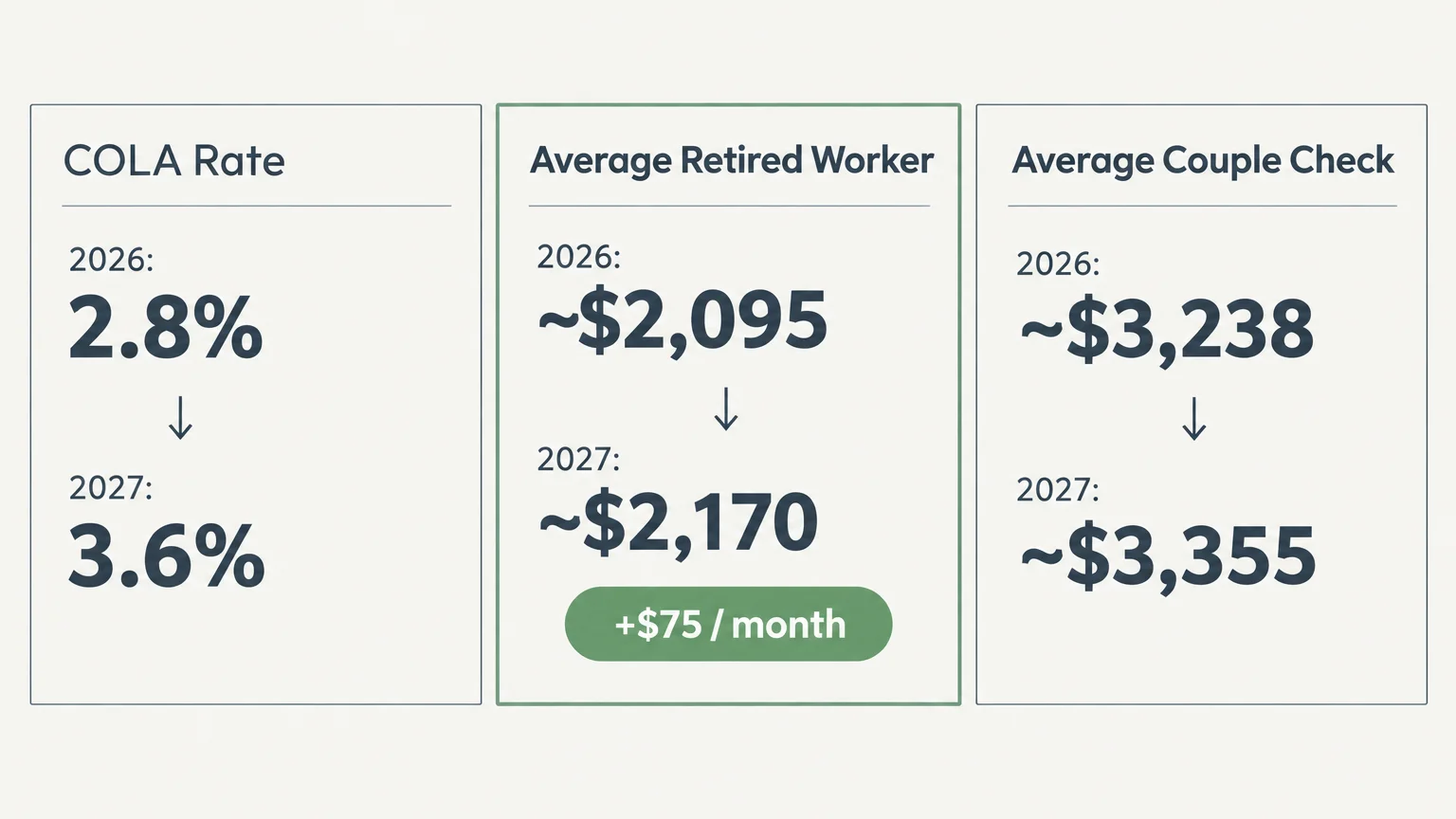
What Your 2027 Social Security Raise Actually Looks Like
On October 14, 2026, the Social Security Administration announced a 3.6% COLA for 2027. That adjustment reflects third-quarter consumer price growth from 2025 through 2026, stepping up from 2.8% in 2026 and 2.5% in 2025.
The raise reaches 76 million Americans across two main benefit programs. Nearly 72 million Social Security beneficiaries see the increase starting with January 2027 payments, while roughly 7.3 million Supplemental Security Income recipients receive theirs on December 31, 2026.
For the average retired worker, monthly benefits climb from about $2,095 to $2,170. Couples who both receive benefits see their combined average check grow from roughly $3,238 to $3,355 per month.
You can view your personalized notice inside your online account in late November 2026, provided you opt into paperless delivery by November 18, 2026. Paper statements mail throughout December 2026.
| Social Security Metric | 2026 Amount | 2027 Amount |
|---|---|---|
| Cost-of-Living Adjustment (COLA) | 2.8% | 3.6% |
| Average Retired Worker Monthly Check | ~$2,095 | ~$2,170 |
| Average Couple Monthly Check (Both Receiving) | ~$3,238 | ~$3,355 |
| Maximum Monthly Benefit at Full Retirement Age | $4,152 | $4,188 |
| Earnings Limit Under Full Retirement Age | Lower prior cap | $25,560/year ($2,130/month) |
| Earnings Limit in Year Reaching Full Retirement Age | Lower prior cap | $67,920/year ($5,660/month) |
| Taxable Maximum Earnings Cap | $184,500 | $192,300 |
Even with a solid percentage boost, the COLA formula relies on the CPI-W index, which tracks spending by urban wage earners. Because retirees spend far more on healthcare and housing than younger workers, your real cost of living often rises faster.
According to Bureau of Labor Statistics figures from autumn 2026, headline CPI-U inflation stood at 3.7% year-over-year in September and rose another 0.4% in October. That ongoing price pressure sets the stage for five bills ready to claim your 2027 raise.
1. Medicare Premiums, Deductibles, and Prescription Drugs
Healthcare charges take the first bite out of your Social Security increase because Medicare premiums come straight out of your monthly check. As of mid-November 2026, the Centers for Medicare and Medicaid Services had not yet finalized official 2027 Part B rates.
However, the June 2026 Medicare Trustees Report projects the standard Part B monthly premium will rise $6.60, moving from $202.90 in 2026 to $209.50 in 2027. The annual Part B deductible is projected to climb from $283 to $292.
Independent analysts warn the final official Part B figure could land even higher once announced. Most enrollees are shielded by the Medicare hold-harmless rule, which prevents Part B dollar hikes from exceeding your monthly COLA dollar increase.
Original Medicare enrollees also received a modest cushion in late 2026. On October 2, 2026, officials announced a one-time $90 Part B rebate for 20.8 million Original Medicare beneficiaries, though roughly 36.1 million Medicare Advantage enrollees and those receiving Medicaid premium assistance do not qualify.
Prescription drug coverage brings bigger confirmed changes for 2027. CMS set the annual Medicare Part D out-of-pocket spending cap at $2,400 for 2027, up from $2,100 in 2026, while the maximum annual deductible jumps from $615 to $700.
Fortunately, covered insulin remains capped at $35 per month per product, and recommended adult vaccines stay at $0. Still, stand-alone Part D premiums face upward pressure because CMS ended its Part D Premium Stabilization Demonstration after 2026.
That temporary subsidy spent $9.8 billion across 2025 and 2026 and shaved roughly $16 per month off the $36 average stand-alone premium. For the 25 million enrollees in stand-alone Part D plans, CMS expects most premiums to rise $10 or less monthly, though some plans could jump more.
Higher-income retirees face another hurdle through Income-Related Monthly Adjustment Amounts, which affect roughly 8% of Medicare beneficiaries. Your 2025 tax return’s Modified Adjusted Gross Income determines whether you owe extra Part B and Part D surcharges in 2027.
- Compare every prescription plan on Medicare.gov before the December 7, 2026 open enrollment deadline rather than letting your current plan auto-renew.
- Check Medicare Advantage options alongside stand-alone Part D, since CMS projects weighted average Advantage premiums to fall over 16% and Advantage drug premiums to drop 38% in 2027.
- Gather your 2025 tax return and watch for CMS’s official 2027 IRMAA brackets so a one-time capital gain does not catch you off guard.

2. Housing Costs, Property Taxes, and Home Insurance
Housing remains the single largest expense in retirement, whether you rent or own your home outright. Bureau of Labor Statistics data cited in November 2026 shows households age 65 and older spent an average of $22,193 on housing in 2024.
That housing burden consumes roughly 36% of total spending after age 65 and climbs to 39% for households age 75 and older. Even paying off your mortgage does not shield you from steep annual increases.
Analysis from Zillow and Thumbtack estimates homeowners with paid-off homes spend $16,566 per year, or $1,380 per month, on property taxes, insurance, and maintenance. Those ownership expenses jumped 32% over five years.
Homeowners insurance has climbed fastest of all, rising 54% over that five-year window. A 2026 NerdWallet analysis found the national median homeowners insurance premium reached $2,490 per year, up 6% from 2025.
Municipal service bills and shelter inflation add steady monthly pressure as well. BLS reported that shelter rose 0.3% in October 2026 after climbing 0.4% in September, while water, sewer, and rubbish collection jumped 4.8% year-over-year through September 2026.
- Contact your county assessor to claim every senior homestead exemption, property tax freeze, or deferral program available in your jurisdiction.
- Shop your homeowners policy across multiple carriers every year, and ask how raising your wind or standard deductible affects your annual premium.
- Review municipal water and trash statements for senior rate discounts, and check your home for silent plumbing leaks that inflate metered bills.
3. Electric Bills, Home Heating, and Gasoline
Keeping the lights on and the house comfortable will cost more in 2027. According to the U.S. Energy Information Administration’s November 10, 2026 outlook, average residential electricity prices are climbing steadily from 17.3 cents per kilowatt-hour in 2025 to 18.17 cents in 2026.
The agency forecasts residential rates will reach 18.68 cents per kilowatt-hour in 2027. Expensive grid upgrades and surging electricity demand from commercial artificial intelligence data centers are driving utility costs higher nationwide.
In fact, commercial electricity sales are forecast to surpass residential sales for the first time in 2026. Recent monthly inflation figures reflect that strain, with BLS reporting the energy index up 0.7% in October 2026 after jumping 5.2% in September.
Electricity prices climbed 0.9% in October alone, even as utility piped gas dipped 0.8%. Meanwhile, drivers faced painful spikes at the gas pump throughout 2026.
Motor fuel prices surged 34.2% year-over-year through September 2026 amid Middle East conflict and Strait of Hormuz disruptions. The Energy Information Administration expects Brent crude oil to hover near $100 per barrel through late 2026 before easing toward $77 in late 2027.
Earlier agency projections estimated retail gasoline averaging $3.84 per gallon in 2026 before moderating to $3.35 in 2027. Even if gas eases somewhat next year, higher monthly electric bills can quickly offset those savings.
- Enroll in your electric company’s budget or levelized billing plan so seasonal heating and cooling peaks do not wreck your monthly cash flow.
- Ask your utility about time-of-use rates if you can run laundry, dishwashers, and electric vehicle chargers during cheaper off-peak hours.
- Check eligibility for federal energy or weatherization assistance through USA.gov Benefits if heating and cooling bills strain your budget.

4. Groceries and Everyday Food Prices
Food inflation cooled briefly over the summer of 2026 before picking up speed again in the fall. BLS data released November 10, 2026 showed overall food prices rising 0.5% in October, with grocery store prices up 0.4% after three nearly flat months.
Restaurant prices climbed 0.5% in the same month. Looking ahead, the USDA Economic Research Service’s October 23, 2026 outlook forecasts all-food prices rising 2.8% in 2026 and 1.7% in 2027.
For groceries bought at the store, USDA projects 2.3% inflation in 2026 and 1.0% in 2027. However, the agency’s statistical forecast interval stretches from negative 5.2% to positive 7.5%, leaving wide room for sudden price jumps.
Headline averages also hide dramatic swings on items retirees buy every week. USDA figures show retail beef and veal prices rising 8.7% in 2026 with the U.S. cattle herd at a 75-year low, masked mostly by egg prices falling 29.3%.
Global supply trends suggest grocery relief is far from guaranteed. The World Bank’s October 28, 2026 commodity outlook projects food commodity prices rising roughly 10% in 2026 and 7% in 2027, while agribusiness economists warn energy and weather costs could lift early 2027 grocery bills.
- Build weekly meal plans around store circulars and rotate away from high-priced beef cuts toward poultry, pork, eggs, or plant proteins.
- Stack store loyalty apps with weekly senior discount days offered by regional grocery chains.
- Trim dining out frequency, since USDA forecasts restaurant prices rising 3.5% in 2026 and 2.8% in 2027—much faster than groceries.
5. Benefit Taxes, Auto Insurance, and Long-Term Care
Your 2027 Social Security raise can quietly increase your federal tax bill under decades-old rules. Under Internal Revenue Code Section 86, between 50% and 85% of your benefits become taxable once your provisional income crosses fixed thresholds.
Single filers hit the 50% tax tier at $25,000 and the 85% tier at $34,000, while married couples filing jointly hit those marks at $32,000 and $44,000. Because Congress never indexed those limits for inflation, a 3.6% COLA can push more of your benefits into taxable territory.
Fortunately, temporary federal relief applies for tax years 2025 through 2028. Adults age 65 and older qualify for an extra senior deduction of up to $6,000 per person—or $12,000 for couples both 65 or older—on top of the standard deduction.
That deduction begins phasing out at $75,000 MAGI for singles and $150,000 for joint filers, disappearing completely at $175,000 and $250,000. Review current filing instructions on IRS.gov to verify how your retirement withdrawals interact with this temporary break.
Other mandatory protection costs are rising right alongside taxes. The November 10, 2026 BLS inflation report recorded another 0.7% monthly jump in motor vehicle insurance in October alongside steady gains in medical care prices.
Long-term care represents the sharpest financial shock of all if health needs change in 2027. The 2025 CareScout Cost of Care Survey puts national median annual costs at $80,080 for an in-home non-medical caregiver working 44 hours a week at $35 per hour.
Assisted living communities carry a national median cost of $74,400 per year, or $6,200 monthly, while nursing homes cost $114,975 for a semi-private room and $129,575 for a private room. Compare those figures to the roughly $60,000 median household income for adults 65 and older reported by AARP in June 2026.
- Coordinate IRA distributions with a tax planner so your Social Security raise does not trigger unnecessary taxability on your benefits.
- Ask your auto insurer about low-mileage discounts and approved defensive driving courses that cut premiums for older drivers.
- Document how your family would fund home care or assisted living before an emergency forces costly decisions.
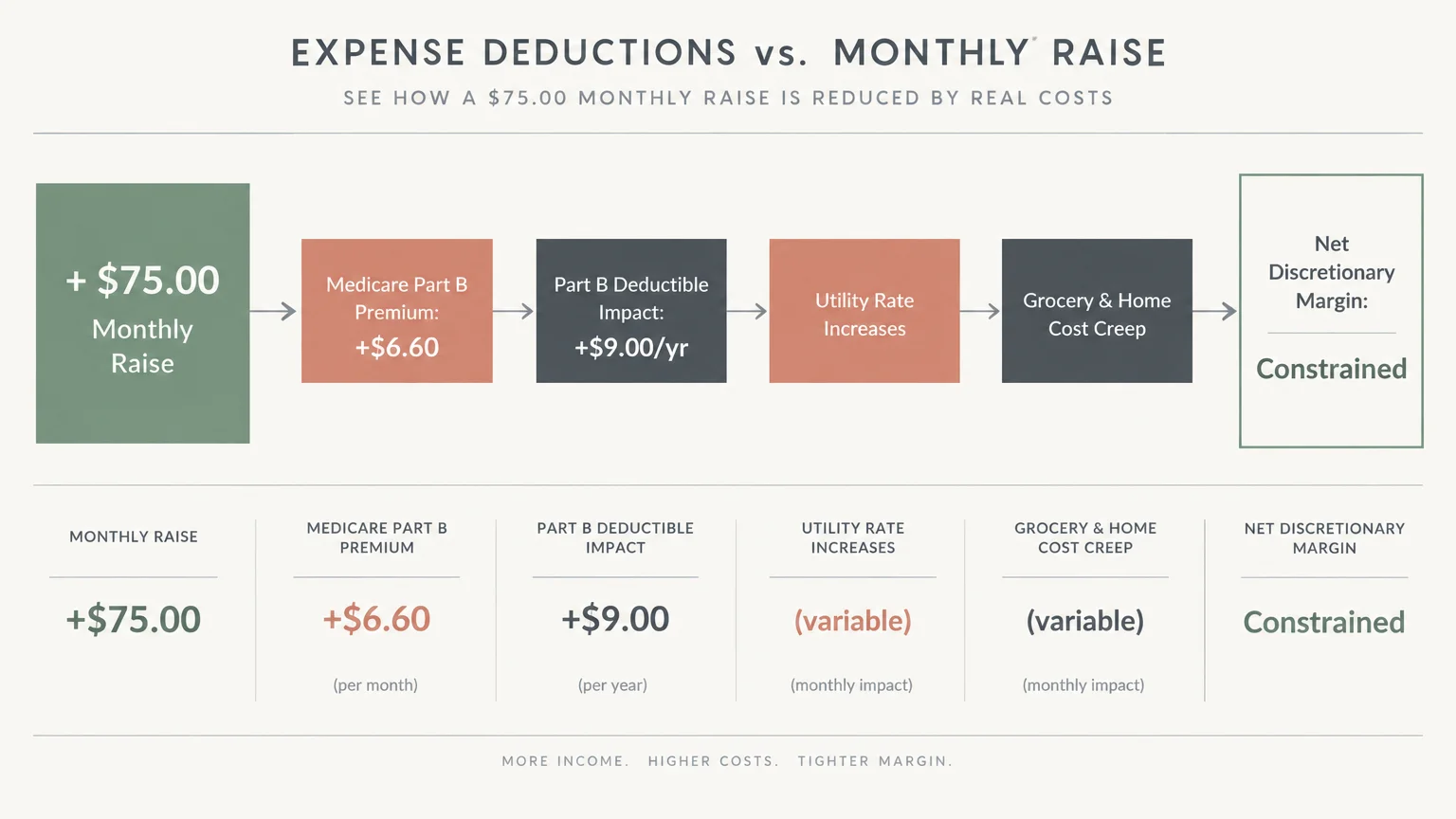
How the Math Adds Up Against a $75 Monthly Raise
When you line up these five spending categories side by side, you can see why a 3.6% raise feels smaller than expected. The table below illustrates how confirmed and projected 2026–2027 cost shifts compare against an average $75 monthly ($900 annual) Social Security increase.
| Retiree Bill Category | Verified 2026–2027 Cost Pressure | Why It Cuts Into Your Raise |
|---|---|---|
| Medicare Part B & Part D | Part B projected +$6.60/mo; Part D up to +$10/mo expected for most stand-alone plans | Deducted straight from checks or drug budgets; Part D cap rises to $2,400 |
| Housing, Taxes & Insurance | Paid-off home costs average $1,380/mo (+32% in 5 yrs); insurance median $2,490/yr (+6%) | Property taxes, insurance, and water/sewer (+4.8% YoY) rise even without a mortgage |
| Electricity & Fuel | Electricity rising from 18.17 to 18.68 cents/kWh; motor fuel +34.2% YoY through Sept 2026 | Grid upgrades and high crude oil keep utility and driving expenses elevated |
| Groceries & Food | Food at home +2.3% (2026) and +1.0% (2027 forecast, up to +7.5% range) | Staples like beef (+8.7% in 2026) and restaurant meals (+3.5% / +2.8%) pressure budgets |
| Taxes, Auto & Care | 50%–85% benefit tax tiers unindexed; auto insurance +0.7% in Oct 2026; LTC $74k–$129k+/yr | Higher checks can push taxable income up while auto and care costs outpace COLA |
Your cost-of-living adjustment protects your gross benefit, not your purchasing power. Keeping more of your 2027 raise requires trimming the fixed bills—like insurance, taxes, and prescription plans—that rise faster than headline inflation.
Your actual net gain depends heavily on your health, location, and housing setup. An enrollee who switches to a lower-cost Part D plan and claims a senior property tax exemption keeps far more than someone facing unshopped insurance renewals.
Pitfalls to Watch For
Small administrative oversights often cost retirees more money than inflation itself. Watch out for these five common traps as 2027 begins:
- Missing the December 7, 2026 Medicare deadline: Letting a stand-alone Part D plan auto-renew after CMS ended its premium subsidy could lock you into higher premiums and a $700 deductible all year.
- Overlooking your 2025 tax return for IRMAA: Because Medicare looks back two years, a large 2025 IRA withdrawal or property sale can trigger 2027 surcharges unless you qualify for a life-changing event appeal.
- Forgetting to adjust Form W-4V withholding: If your 3.6% raise lifts your provisional income over $25,000 single or $32,000 joint, failing to update federal withholding can leave you owing taxes in April.
- Treating a paid-off home as inflation-proof: Skipping annual homeowners insurance comparisons or municipal tax reviews allows $1,380 in average monthly ownership costs to creep higher unchecked.
- Missing the paperless notice cutoff: Waiting past November 18, 2026 to set up online COLA alerts delays seeing your exact net payment until paper statements arrive in December.

Getting Expert Help
While you can tackle grocery planning and utility budgets on your own, several complex financial rules reward professional advice. Consider seeking tailored guidance in these four situations:
- Navigating Medicare drug and Advantage changes: Reach out to your local State Health Insurance Assistance Program through the National Council on Aging for free, unbiased help comparing 2027 Part D and Medicare Advantage options.
- Managing Social Security taxes and IRMAA brackets: Consult a Certified Public Accountant or Certified Financial Planner before taking retirement account withdrawals so you maximize the temporary 2025–2028 senior deduction without crossing tax cliffs.
- Screening for housing, food, or utility relief: Contact your local Area Agency on Aging or use NCOA screening tools to check whether you qualify for property tax breaks, energy grants, or Medicare Savings Programs.
- Planning for potential long-term care expenses: Meet with an elder law attorney or fee-only CFP if your assets are vulnerable to care costs ranging from $74,400 to $129,575 a year.
Frequently Asked Questions
Will Medicare Part B take my entire 2027 Social Security raise?
No, for most retirees it will not. Under the hold-harmless rule, your Part B dollar increase cannot exceed your Social Security COLA dollar increase, and projected Part B hikes of $6.60 per month remain well below the average $75 raise.
When will I find out my exact 2027 Social Security payment?
Personalized COLA notices appear inside your online Social Security account in late November 2026 if you select paperless delivery by November 18, 2026. Paper statements will arrive in the mail throughout December 2026.
Does the temporary senior tax deduction eliminate taxes on Social Security?
It does not eliminate the separate $25,000 and $32,000 provisional income formula, so your COLA can still expose more benefits to taxation. However, the temporary $6,000 per person ($12,000 per couple) senior deduction for 2025–2028 lowers overall taxable income within MAGI limits.
Why are stand-alone Medicare Part D premiums rising in 2027?
CMS ended its temporary Part D Premium Stabilization Demonstration after 2026, which previously trimmed about $16 per month off average stand-alone plans. While most enrollees are expected to see increases of $10 or less monthly, comparing plans before December 7 remains essential.
What can I do right now if my 2027 bills still exceed my raise?
Start by auditing your biggest fixed costs—Medicare Part D, homeowners insurance, and auto insurance—during November and December 2026. Pairing competitive insurance quotes with senior property tax exemptions and utility budget billing often saves far more than $75 per month.
Your 3.6% raise is a helpful starting point, even when rising retiree bills compete for every dollar. Take an hour this week to check your online Social Security notice, compare 2027 Medicare plans before December 7, and claim any senior tax or utility breaks you have earned.
This article provides general retirement education and information only. Everyone’s financial situation is unique—what works for others may not work for you. For personalized advice, consider consulting a qualified financial professional such as a CFP or CPA.
Last updated: November 2026. Retirement benefits, tax laws, and healthcare costs change frequently—verify current details with official sources.