Waiting until age 70 delivers the largest possible Social Security check, yet maximizing monthly income does not guarantee a happier retirement. Many retirees who hold out for those bigger payments later wonder whether the trade-off was worth it.
Delaying benefits can drain personal savings, trigger steep tax bills, and cost you active years when your health is strongest. Understanding why regrets happen helps you weigh guaranteed monthly income against flexibility today.
Before locking in your filing date, examine how break-even math, taxes, spousal rules, and trust fund projections shape your real-world outcome.
The Promise and Reality of Delayed Retirement Credits
Retirement educators often frame age 70 as the gold standard for Social Security timing, and the raw payout numbers show why. Waiting past your Full Retirement Age (FRA) triggers powerful, permanent increases to your monthly check.
Under rules from the Social Security Administration (SSA), FRA is 66 for people born from 1943 through 1954. It rises by two months per birth year from 1955 to 1959, reaching 66 and 10 months for 1959 births, and settles at 67 for anyone born in 1960 or later.
For each month you delay past FRA up to age 70, delayed retirement credits add two-thirds of 1% to your benefit—an 8.0% annual boost. Once you turn 70, those credits stop accumulating.
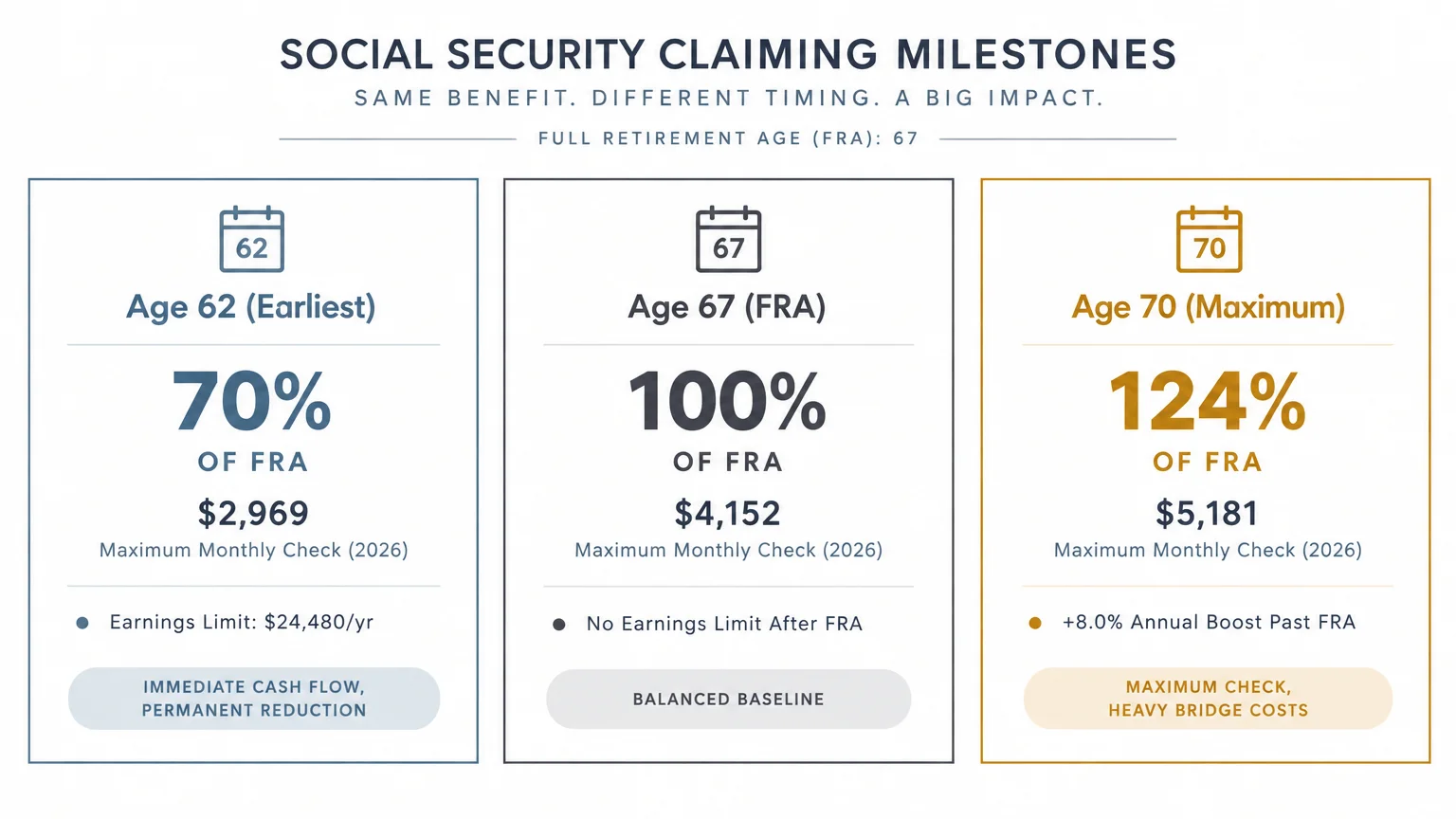
If your FRA is 67, filing at age 62 permanently cuts your benefit to 70% of your FRA amount. Holding out until 70 lifts your payment to 124% of FRA, creating a monthly check roughly 77% higher than claiming at 62.
Workers with an FRA of 66 see a similar gap, collecting 75% of their baseline at 62 versus 132% at 70. Those percentages explain why spreadsheets heavily favor waiting.
Actual dollar figures illustrate how wide that divide looks in 2026. According to SSA data, the maximum monthly benefit in 2026 is $2,969 at age 62, $4,152 at FRA, and $5,181 at age 70 for workers with at least 35 years at the taxable wage ceiling.
In 2027, the FRA maximum rises to $4,188, reflecting wage growth and inflation adjustments. Most retirees earn less than the ceiling, yet the relative gap stays dramatic across income levels.
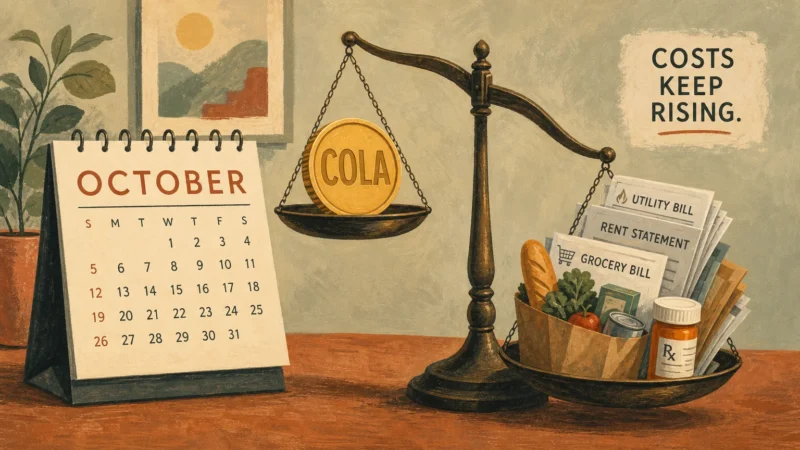
SSA’s Monthly Statistical Snapshot reported an average retired-worker check of $2,092.17 in October 2026. Following a 2.8% cost-of-living adjustment (COLA) in 2026, SSA announced a 3.6% COLA for 2027, pushing that average benefit by roughly $75 per month to about $2,170 in January 2027.
Meanwhile, SSA’s 2026 Annual Statistical Supplement shows retirees aged 70 received an average of $2,274.68 per month at the end of 2025—$2,529.62 for men and $2,024.08 for women. Higher checks look appealing on paper, yet chasing that maximum carries hidden costs.
| Claiming Milestone | Payout Rate (FRA 67) | 2026 Maximum Monthly Check | Earnings Limit Applies? | Primary Trade-Off |
|---|---|---|---|---|
| Age 62 (Earliest) | 70% of FRA | $2,969 | Yes ($24,480/year in 2026) | Immediate cash flow, permanent reduction |
| Age 67 (FRA for 1960+) | 100% of FRA | $4,152 | No limit once reaching FRA | Balanced payout without draining savings |
| Age 70 (Maximum) | 124% of FRA | $5,181 | No earnings limit | Highest monthly income, heavy bridge costs |
Draining Personal Savings During the Bridge Years
Delaying Social Security until 70 rarely means working full-time until your 70th birthday. Most people stop working in their early to mid-60s and fund five to eight bridge years out of their own investment accounts.
Spending down your 401(k), traditional IRA, or brokerage balance to avoid filing early alters your financial safety net. Once those dollars leave your portfolio, they no longer compound or cushion unexpected emergencies.
Survey data highlights how tight retirement budgets actually feel for today’s households. In Schroders’ 2026 U.S. Retirement Survey, 49% of retirees reported higher-than-expected living expenses, and 58% admitted they do not know how long their savings will last.
The same survey revealed that 51% of retirees lack a specific income-drawdown strategy, while healthcare consumes an average of 16% of monthly retiree income. Burning through liquid savings without a clear plan leaves many people anxious by age 69.
Retirees also rely heavily on Social Security for day-to-day bills rather than discretionary extras. The Nationwide Retirement Institute 2026 Social Security Survey found that 68% of beneficiaries use their entire check for monthly living expenses, while only 32% invest a portion.
Similarly, an October 2026 AARP survey showed Social Security serves as the primary income source for half of all recipients. When your portfolio carries the entire load during your 60s, a market downturn creates serious sequence-of-returns risk.
Selling stocks or bond funds during a bear market locks in losses just to buy a larger Social Security check later. Even when markets recover, your smaller portfolio leaves less money for home repairs, long-term care surprises, or family gifts.
Some retirees regret claiming Social Security at 70 because they traded liquid, inheritable wealth for an income stream that dies with them—or with their spouse. You cannot tap a Social Security record for a $40,000 roof replacement or emergency medical bill.

Break-Even Math and Lost Active Years
Financial planners evaluate claiming social security at 70 using a break-even calculation. That math compares the cumulative dollars collected by starting early against the total collected after waiting until 70.
Before accounting for investment returns you might earn or preserve by claiming sooner, the typical break-even age falls between 80 and 82. If you die before that window, claiming early puts more total lifetime cash in your pocket.
National longevity figures suggest many Americans reach—and pass—that threshold, yet averages conceal wide individual differences. According to the CDC’s final 2024 mortality report published in January 2026, U.S. life expectancy at birth reached 79.0 years, split between 76.5 for males and 81.4 for females.
Once you reach age 65, your remaining odds improve considerably. The same CDC report found life expectancy at 65 stood at 19.7 additional years, pointing toward age 84.7 overall, while the 2024 Social Security Trustees Report projected 18.4 years for men and 21.0 years for women at 65.
Still, living to 82 does not automatically make waiting until 70 feel like a victory. Retirement spending rarely moves in a flat line across your 60s, 70s, and 80s.
Many retirees experience high energy and strong mobility in their 60s, allowing them to travel, hike, or keep up with grandchildren. By their early 80s, health limits often curtail ambitious trips even when bigger Social Security checks finally pull ahead.
If delaying until 70 forced you to skip bucket-list experiences at 64 to save cash, the extra $1,000 a month at 83 can feel hollow. Regret often stems from misallocating time and health rather than miscalculating simple arithmetic.
Attitudes toward social security regrets also shift once retirees confront real-world circumstances. While a 2014 Harris and Nationwide survey found 38% of early filers wished they had waited, 2018 research from the Center for Retirement Research and USC showed most early claimers felt satisfied once they factored in health, job changes, and immediate cash needs.
Tax Torpedoes, RMDs, and Medicare Surcharges
Larger age-70 checks do not arrive tax-free, and waiting can unintentionally collide with mandatory retirement account withdrawals. When several income streams stack together in your mid-70s, your effective tax rate can jump sharply.
The IRS taxes Social Security benefits based on combined income, calculated as adjusted gross income plus nontaxable interest plus half of your Social Security benefits. Up to 50% of benefits become taxable once combined income exceeds $25,000 for single filers or $32,000 for married couples filing jointly.
Above $34,000 for individuals or $44,000 for joint filers, up to 85% of your Social Security check faces federal income tax. Those thresholds have never been indexed for inflation, catching millions of middle-class retirees.
Recent legislation added temporary relief without fixing the core formula. Signed on July 4, 2025, the One Big Beautiful Bill Act created a deduction of up to $6,000 per eligible person age 65 or older—or $12,000 for qualifying couples—for tax years 2025 through 2028.
That deduction stacks atop your standard or itemized deduction, yet it phases out by 6 cents per dollar of modified adjusted gross income above $75,000 single or $150,000 joint. Crucially, the law left the 50% and 85% Social Security taxation rules untouched.
Now consider Required Minimum Distributions (RMDs) under SECURE 2.0. Traditional IRAs and 401(k)s force taxable withdrawals starting at age 73 for people born from 1951 to 1959, and age 75 beginning in 2033 for those born in 1960 or later.
Wait until 70 to claim Social Security, and just three to five years later your maximum benefit collides with full RMDs. Together, they can push you into a higher tax bracket and lock in the 85% benefit taxation tier.
Healthcare premiums add another surprise via Income-Related Monthly Adjustment Amounts (IRMAA). Roughly 8% of beneficiaries pay IRMAA surcharges on Medicare Part B and Part D based on modified adjusted gross income from two years earlier.
According to Medicare.gov and the 2026 Medicare Trustees Report, the standard Part B premium is $202.90 per month in 2026 and projected at $209.50 for 2027. Large Roth conversions during your bridge years—or stacked RMDs plus age-70 Social Security checks—can breach IRMAA cliffs and inflate premiums two years later.
Trust Fund Solvency Fears and Policy Uncertainty
Even mathematically sound plans to wait until 70 face growing anxiety over Social Security’s long-term finances. Watching trust fund exhaustion dates creep closer makes some retirees regret leaving early benefits on the table.
The 2026 Social Security Trustees Report, released in June 2026, moved the projected depletion date for the Old-Age and Survivors Insurance (OASI) Trust Fund to the fourth quarter of 2032. That timeline sits one quarter earlier than the 2025 estimate.
If Congress fails to act before reserves run out, ongoing payroll taxes would cover only 78% of scheduled OASI benefits. Current and future beneficiaries alike would face an automatic 22% across-the-board reduction.
Combining the OASI and Disability Insurance funds would push depletion to the third quarter of 2034, still leaving enough revenue for 83% of scheduled payouts. Over 75 years, the actuarial deficit widened to 4.42% of taxable payroll in 2026, up from 3.82% in 2025.
Estimates from the Committee for a Responsible Federal Budget show a 22% cut in 2033 would trim roughly $16,900 per year from a typical newly retired dual-income couple. High-income couples could lose about $22,300 annually, while low-income dual-earner couples would lose around $10,200.
Solvency worries already reshape how workers think about when to claim social security. Schroders’ 2025 U.S. Retirement Survey found that while 70% of non-retired Americans understand waiting raises monthly checks, only 10% plan to hold out until 70, and 44% expect to claim before 67.
In Schroders’ 2026 follow-up, 40% of non-retirees feared Social Security would run dry before they could collect. Similarly, a June 2025 AARP survey showed 49% of respondents who filed earlier than planned acted out of concern that the program is running out of money.
Congress has strong political incentives to prevent sudden cuts, likely through higher payroll taxes, adjusted COLAs, or tax changes. Still, waiting until 70 exposes you to years of policy uncertainty—and potential tax hikes aimed at upper-tier benefits.
Spousal Benefit Rules and Timing Asymmetries
Married couples often assume delaying the higher earner’s benefit to 70 automatically lifts both partners’ payouts. In reality, spousal and survivor rules treat delayed retirement credits very differently.
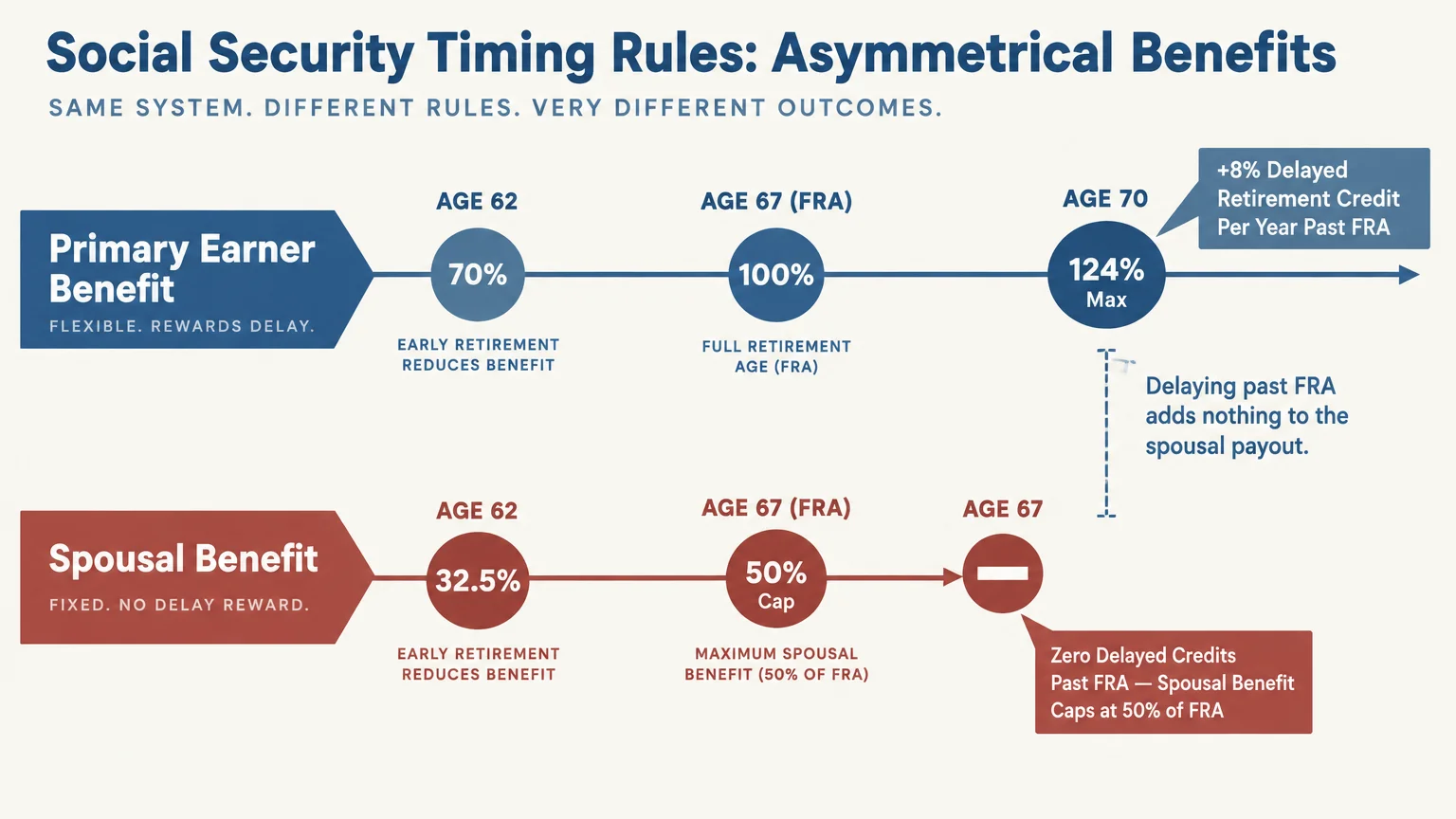
A spousal benefit maxes out at 50% of the higher earner’s FRA benefit, not 50% of their age-70 check. Delayed retirement credits earned between FRA and 70 do not increase a spousal payment while both spouses remain alive.
Furthermore, under the Bipartisan Budget Act of 2015, anyone born on or after January 2, 1954, falls under strict deemed filing rules. You cannot claim a spousal benefit at FRA while letting your own retirement record grow to 70; filing for one triggers both.
Because a lower-earning spouse cannot collect spousal benefits until the higher earner files, delaying to 70 stalls both checks if the lower earner lacks a strong work history. Giving up five or six years of spousal payments rarely gets made up quickly.
Delayed retirement credits do carry one major family advantage: they permanently boost survivor benefits. If the higher earner passes away first, the surviving spouse steps up to the full age-70 payment, including all earned credits and COLAs.
Regret tends to surface when couples wait until 70 purely out of habit without running joint projections. If both partners earned similar incomes or share modest life expectancies, delaying both checks often forfeits tens of thousands of household dollars.
Maximizing a single monthly check makes sense only when it strengthens your entire household balance sheet, protects a surviving spouse, and leaves enough liquid savings for the retirement lifestyle you actually want.
Pitfalls to Watch For
Many frustrations around claiming social security at 70 stem from technical program traps rather than the age-70 math itself. Review these common administrative pitfalls before finalizing your timeline:
- Skipping Medicare enrollment at age 65: Delaying Social Security past 65 means SSA will not enroll you in Medicare automatically. Unless you have qualifying health coverage through active employment, sign up three months before turning 65 to avoid lifelong late-enrollment penalties.
- Misunderstanding the delayed credit payout lag: If you wait until exactly age 70, all delayed retirement credits appear on your very first payment. However, if you change your mind and file between FRA and 70, credits earned during that calendar year are not added until January of the following year.
- Assuming unlimited retroactive payouts: Once past FRA, you can request retroactive benefits only for months after FRA and never for more than six months back. You cannot collect years of missed payments in a lump sum if health news turns bad at age 69.
- Confusing earnings limits after FRA: In 2026, workers claiming before FRA lose $1 in benefits for every $2 earned above $24,480—rising to $25,560 in 2027—and $1 per $3 above $65,160 in the year they reach FRA, rising to $67,920 in 2027. Once you hit FRA, no earnings limit exists, so you never need to delay past FRA solely because you still work.
- Voluntarily suspending benefits without checking family impacts: If you claimed early and suspend benefits between FRA and 70 to earn credits, SSA also suspends any spousal or dependent benefits paid on your record during those months.

Getting Expert Help
Social Security timing interacts with tax brackets, portfolio withdrawals, and Medicare rules in ways basic online calculators miss. Consulting a fee-only planner through the Certified Financial Planner Board or a qualified tax advisor pays off in several specific situations:
- Planning bridge-year Roth conversions: An advisor can map out how much traditional IRA money to convert in your 60s without tripping IRMAA Medicare surcharges two years later or losing the temporary 2025–2028 senior tax deduction.
- Stress-testing portfolio drawdowns: A planner can model sequence-of-returns risk to confirm whether tapping investments from 65 to 70 threatens your long-term liquidity more than taking Social Security earlier.
- Coordinating complex spousal and survivor claims: Couples with wide age gaps, large earnings differences, or prior marriages benefit from software modeling that tests joint break-even ages and survivor income protection.
- Navigating recent law changes and public pensions: Retirees affected by the Social Security Fairness Act of January 2025 or high-income earners approaching the $184,500 wage base in 2026—rising to $192,300 in 2027—need tailored projections to verify updated benefit estimates.
Frequently Asked Questions
Does waiting until age 70 always pay off financially?
No, waiting until 70 only pays off financially if you live past your break-even age—typically 80 to 82—and do not suffer heavy investment losses while funding your bridge years. Poor health, tight cash reserves, or higher tax brackets can turn an age-70 delay into a net disadvantage.
Can you change your mind if you file before or at age 70?
Within 12 months of your first claim, you can withdraw your application once in a lifetime by repaying all benefits received, including any spousal payouts and Medicare deductions. Past FRA, you can also suspend benefits to earn delayed credits up to age 70, though family benefits on your record pause too.
How does claiming at 70 affect your spouse’s Social Security benefit?
Delayed retirement credits between FRA and 70 never increase a spousal benefit while both spouses are living, since spousal checks cap at 50% of the higher earner’s FRA amount. However, those credits permanently increase the survivor benefit your spouse receives if you die first.
Will Social Security really cut benefits by 22% in 2032?
The 2026 Social Security Trustees Report projects OASI reserves will run out in late 2032, leaving payroll taxes able to pay 78% of scheduled benefits unless Congress acts. Historically, lawmakers have stepped in before depletion to adjust taxes or formulas, though exact timing and details remain uncertain.
Making Your Timing Choice With Confidence
Age 70 delivers the highest monthly check, yet the best social security timing balances guaranteed income against savings flexibility, tax efficiency, and the active years ahead of you. Run both single and household projections using your real health outlook and spending needs rather than chasing a maximum figure on paper.
The information in this guide is meant for educational purposes. Your specific circumstances—including income, savings, health coverage, and goals—may require different approaches. When in doubt, consult a licensed professional.
Last updated: November 2026. Retirement benefits, tax laws, and healthcare costs change frequently—verify current details with official sources.