
Retiring abroad lets you stretch your retirement savings in stunning destinations, but leaving the United States fundamentally alters several critical Social Security administrative and tax regulations. While most American citizens can easily collect their earned retirement benefits worldwide, international residency introduces strict foreign work restrictions, mandatory verification mailings, and foreign taxation rules that can unexpectedly freeze or reduce your monthly payments. Knowing which rules change—such as the foreign work test, non-citizen spouse payment suspensions, and country-specific Treasury banking bans—ensures your monthly income continues uninterrupted. Understanding these international cross-border policies allows you to safeguard your hard-earned benefits wherever you choose to establish your new overseas life.
1. The Foreign Work Test Replaces the Standard Earnings Limit
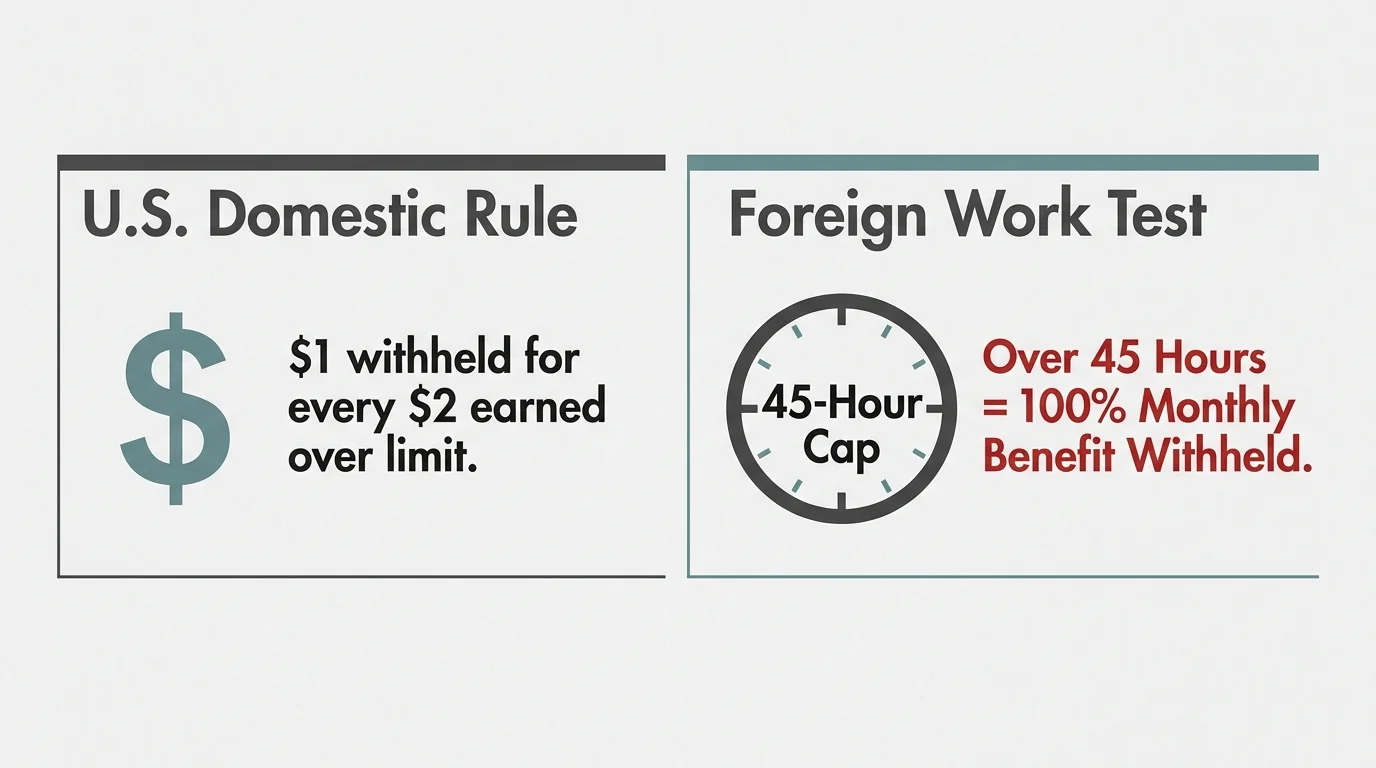
If you retire before your Full Retirement Age (FRA) and continue working within the United States, the Social Security Administration (SSA) applies the standard Retirement Earnings Test. Under domestic rules, the SSA withholds $1 in benefits for every $2 you earn above an annual threshold. When you relocate abroad, however, that familiar dollar-based calculation disappears completely if your employment is not subject to U.S. Social Security (FICA) taxes.
Instead, the SSA enforces the stringent Foreign Work Test. Under this rule, if you work more than 45 hours in a single calendar month in non-FICA-covered employment or self-employment, the SSA withholds your entire monthly Social Security benefit for that month. It does not matter whether you earned $500 or $5,000 during those 45 hours; exceeding the 45-hour cap triggers a complete forfeiture of your check for that monthly cycle.
Consider how this impacts common expat activities:
- Part-time teaching or consulting: Working 12 hours a week at a local language academy abroad totals roughly 48 to 52 hours per month, wiping out 100% of your monthly benefit.
- Running an overseas bed-and-breakfast: Active management hours count toward the 45-hour limit, regardless of whether your enterprise turns a net profit.
- Freelance digital work: If you perform contract work for foreign clients outside the U.S. tax system, every hour spent logging into your client dashboard counts toward your 45-hour monthly threshold.
Once you reach your Full Retirement Age—between age 66 and 67, depending on your birth year—the Foreign Work Test terminates permanently. From that month forward, you can work unlimited hours in any foreign country without reducing your monthly retirement benefits.

2. Treasury Sanctions and Country-Specific Banking Restrictions
While the U.S. government delivers payments to beneficiaries in more than 100 countries through International Direct Deposit (IDD), federal statutory restrictions prevent benefit delivery to specific jurisdictions. The Social Security Administration categorizes these geographic payment limitations under two distinct frameworks: Department of the Treasury sanctions and SSA administrative restrictions.
Under U.S. Department of the Treasury financial sanctions, the SSA cannot route benefit payments to anyone residing in Cuba or North Korea. If you are an American citizen living in either country, the SSA will withhold your monthly checks until you relocate to an approved nation, at which point you can claim your accumulated back payments in full. Non-citizens residing in these countries forfeit those monthly payments entirely.
Additionally, SSA administrative policy restricts payments to seven additional nations:
- Azerbaijan
- Belarus
- Kazakhstan
- Kyrgyzstan
- Tajikistan
- Turkmenistan
- Uzbekistan
To receive payments while living in one of these seven restricted countries, you must qualify for an exception by agreeing to appear in person at the local U.S. embassy or consulate every six months to verify your identity and eligibility. If you do not qualify for an exception, your payments accrue without interest until you move to an unrestricted country.

3. Mandatory “Proof of Life” Reporting via Form SSA-7162
When you live in the United States, the SSA verifies beneficiary vitality through state vital statistics registries, funeral home reports, and inter-agency data exchanges. Because foreign governments do not automatically report deaths to U.S. authorities, the SSA relies on a mandatory physical mailing process known as the Report to Social Security Administration (Form SSA-7162).
Depending on your country of residence, citizenship, and the final two digits of your Social Security number, the SSA mails you Form SSA-7162 (or Form SSA-7161 if you have an appointed representative payee) either annually or every two years. This form verifies your current residential address, marital status, foreign employment hours, and ongoing eligibility.
The response timeline requires prompt action:
- Initial notice: The SSA mails the questionnaire between May and June.
- The 60-day response window: You must sign, date, and return the physical paper form to the SSA processing center in Wilkes-Barre, Pennsylvania, or your regional Federal Benefits Unit (FBU) within 60 days.
- Suspension warning: If the SSA does not log your completed form by early autumn, they issue a second notice.
- Benefit termination: Failure to return the questionnaire by December results in an immediate suspension of your January benefit payment.
International mail delays represent the single largest cause of benefit interruptions for American expats. To resolve a suspension, you must contact your assigned regional Federal Benefits Unit—frequently located inside major U.S. embassies in cities such as London, Frankfurt, Rome, San Jose, or Manila—and submit an emergency signed form.
4. Bilateral Totalization Agreements Coordinate Dual Work Credits
If you split your working career between the United States and a foreign country, you might find yourself in an awkward financial position: lacking the 40 credits (10 years of work) required to qualify for U.S. Social Security, while simultaneously lacking sufficient service years to collect a foreign pension. Alternatively, you might face dual taxation by having both U.S. FICA and foreign social insurance taxes deducted from the same paycheck.
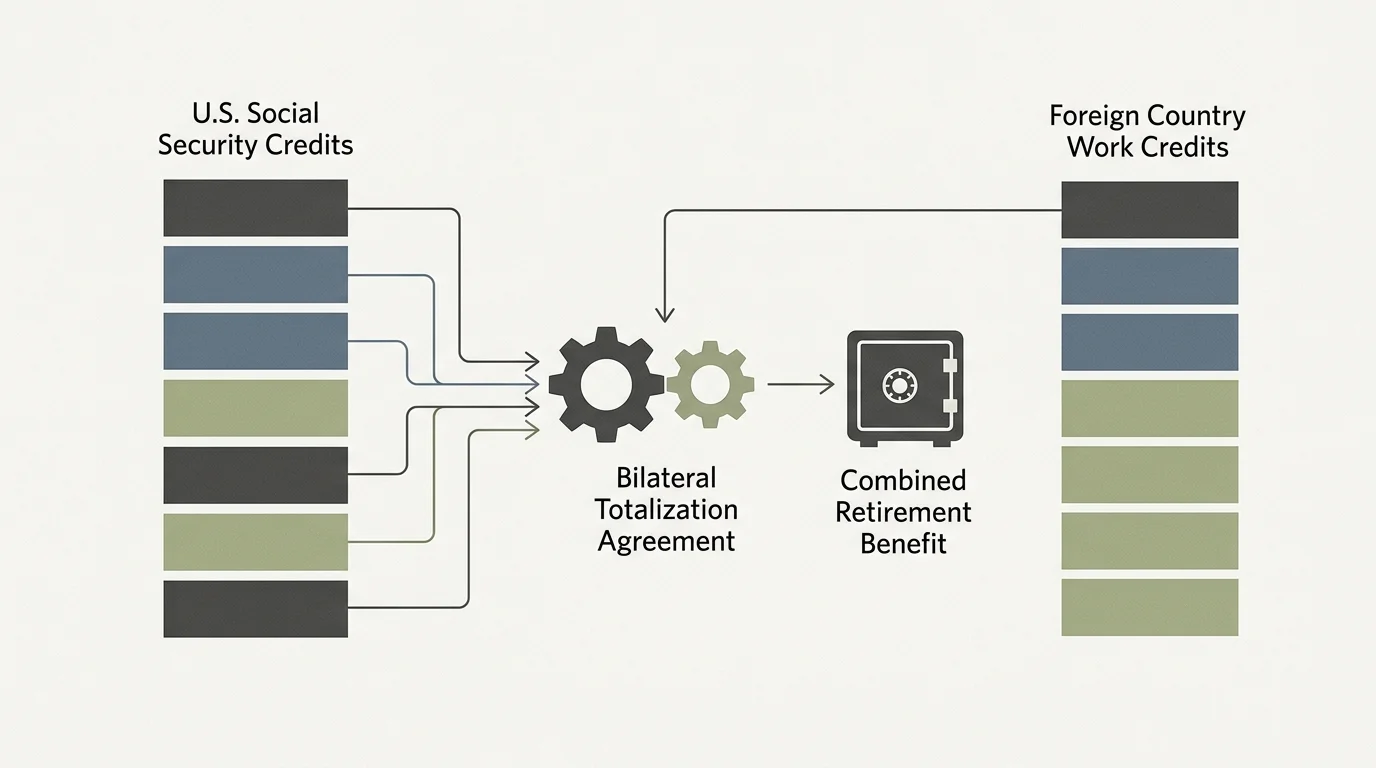
To resolve these cross-border conflicts, the United States maintains formal bilateral Social Security agreements—known as Totalization Agreements—with 30 partner nations. These countries include major retirement destinations such as Canada, the United Kingdom, France, Germany, Italy, Spain, Portugal, Australia, and Japan.
Totalization agreements accomplish two primary objectives:
- Credit combination: If you have earned at least six U.S. Social Security credits (1.5 years of work) but fewer than 40 credits, the SSA combines your foreign work credits with your U.S. credits to establish eligibility for a prorated U.S. benefit.
- Elimination of double taxation: If you work abroad for a U.S. employer or operate as an independent contractor, the treaty determines which social security system covers your wages, ensuring you only pay payroll taxes to one government at a time.
If you retire to a country lacking a Totalization Agreement (such as Mexico, Costa Rica, Thailand, or Panama), you cannot combine your work credits. You must independently meet the full 40-credit U.S. standard to receive retirement benefits.
“Cross-border retirement planning requires precise tax coordination. Failing to understand international treaties and social insurance agreements can trigger double taxation and costly benefit forfeitures that take months to rectify.” — Ed Slott, CPA and Retirement Specialist

5. Nonresident Alien Tax Withholding (The 25.5% Rule)
Your citizenship status dramatically dictates how the Internal Revenue Service taxes your Social Security benefits while you reside outside the United States. American citizens and U.S. permanent residents (green card holders) remain subject to standard U.S. progressive income tax brackets on their worldwide income, calculating taxable Social Security benefits based on their combined provisional income formulas (taxing up to 85% of benefits).
However, if you are a non-U.S. citizen collecting benefits abroad—such as a foreign spouse who worked in the U.S. or married an American worker—the SSA applies the Nonresident Alien (NRA) Tax Withholding. Under federal tax law, the SSA automatically withholds a flat 30% tax on 85% of your gross monthly benefit amount. This creates an effective, automatic withholding rate of exactly 25.5% from every monthly payment.
| Gross Monthly Benefit | Taxable Portion (85%) | Flat NRA Tax (30%) | Net Monthly Payment Received |
|---|---|---|---|
| $1,200.00 | $1,020.00 | $306.00 | $894.00 |
| $1,800.00 | $1,530.00 | $459.00 | $1,341.00 |
| $2,400.00 | $2,040.00 | $612.00 | $1,788.00 |
| $3,000.00 | $2,550.00 | $765.00 | $2,235.00 |
You can reduce or eliminate this 25.5% withholding only if the country where you reside maintains a comprehensive income tax treaty with the United States that exempts Social Security benefits from U.S. taxation (such as treaties with the United Kingdom, Germany, Japan, or Switzerland). To claim this exemption, you must submit Form W-8BEN to the SSA documenting your foreign tax residency.

6. Alien Nonpayment Provisions and the 6-Month Rule
If your spouse, former spouse, or dependent child is not a U.S. citizen, their right to collect Social Security auxiliary or survivor benefits on your earnings record changes dramatically once they step outside American borders. Under the Alien Nonpayment Provisions of the Social Security Act, non-citizen dependents who leave the U.S. face payment suspension after residing abroad for more than six consecutive calendar months.
Once a non-citizen dependent spends six full calendar months outside the U.S., their monthly benefit stops starting in the seventh month. To restart payments, the individual must physically return to the United States and remain in the country for at least one full calendar month (a full 30-day continuous period) before leaving again.
A non-citizen dependent can avoid this 6-month suspension rule if they satisfy one of several statutory exemptions:
- The 5-Year Residency Rule: The foreign dependent lived in the United States as the worker’s spouse, child, or parent for a cumulative total of at least five years (the years do not need to be continuous).
- Treaty Nation Citizenship: The non-citizen holds citizenship in a country with a reciprocal social security treaty with the United States.
- Military Service Connection: The worker on whose record benefits are drawn died during active U.S. military service or received an honorable discharge.
Failing to plan for the 5-Year Residency Rule before moving abroad creates severe financial gaps for foreign-born spouses who relocate to their home country alongside an American retiree.
7. SSI Cancellation and Domestic Medicare Invalidation
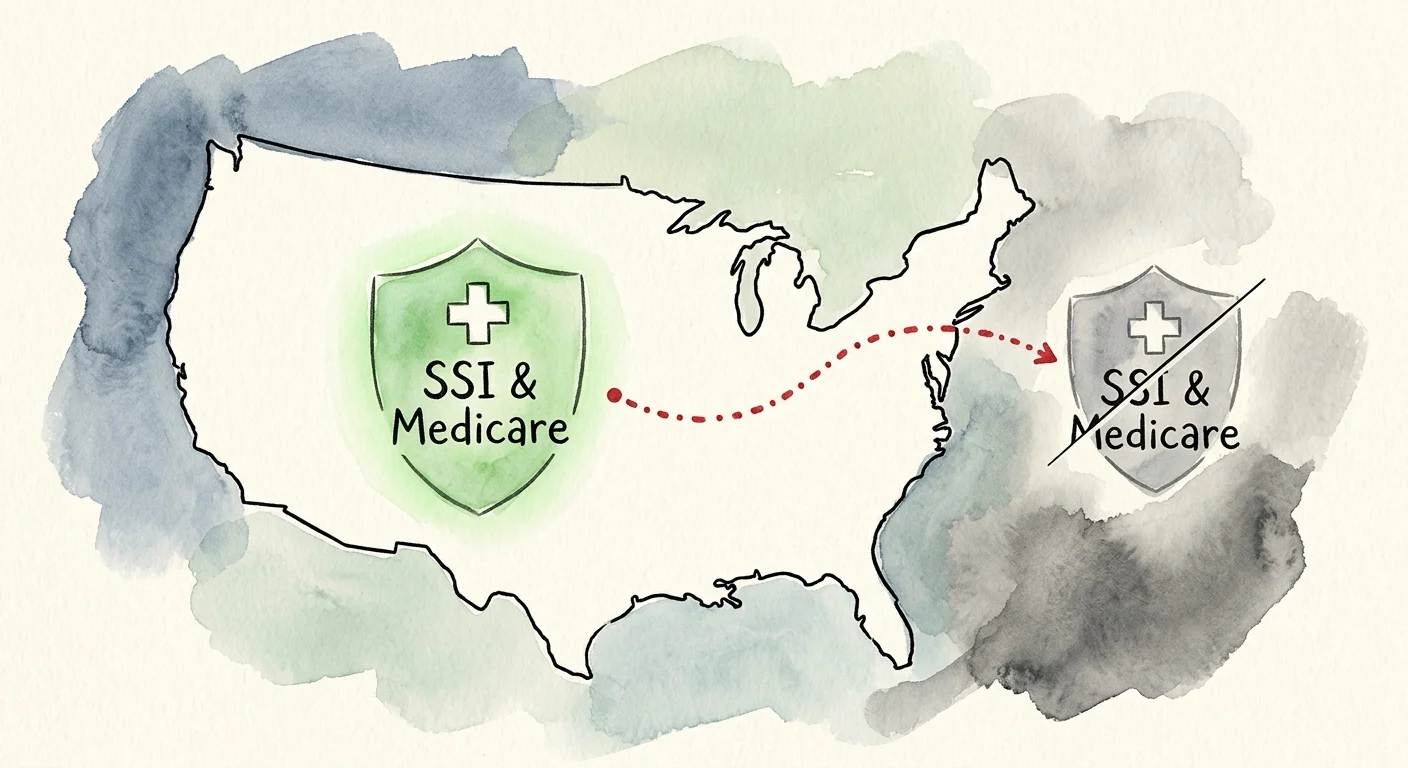
Many retirees confuse Supplemental Security Income (SSI) with Title II Social Security Retirement benefits. While your standard earned Social Security retirement checks travel anywhere in the world, SSI—a needs-based welfare program funded by general Treasury revenues—is strictly non-portable.
Under federal regulations, if an SSI recipient leaves the United States for 30 consecutive days or a full calendar month, their eligibility terminates immediately. You cannot resume SSI payments until you return to U.S. soil and remain in the country for 30 consecutive days. Failing to notify the SSA of an international departure while continuing to cash SSI checks constitutes federal fraud and triggers immediate clawback demands.
Similarly, your healthcare coverage does not cross international borders. Medicare Parts A, B, and D provide zero coverage for medical services, hospitalizations, or prescription drugs received outside the United States and its territories. This reality creates a costly dilemma regarding your Part B premiums:
- Retaining Part B abroad: You continue paying the standard monthly Part B premium ($185.00 base in 2025; verify current annual baseline adjustments) solely to preserve continuous domestic coverage if you return to the U.S. for medical care.
- Dropping Part B abroad: You eliminate the monthly premium deduction from your Social Security check, but if you permanently repatriate to the U.S. later, you face a permanent 10% late-enrollment penalty for every 12-month period you were eligible but unenrolled. You must also wait for the General Enrollment Period to re-apply.
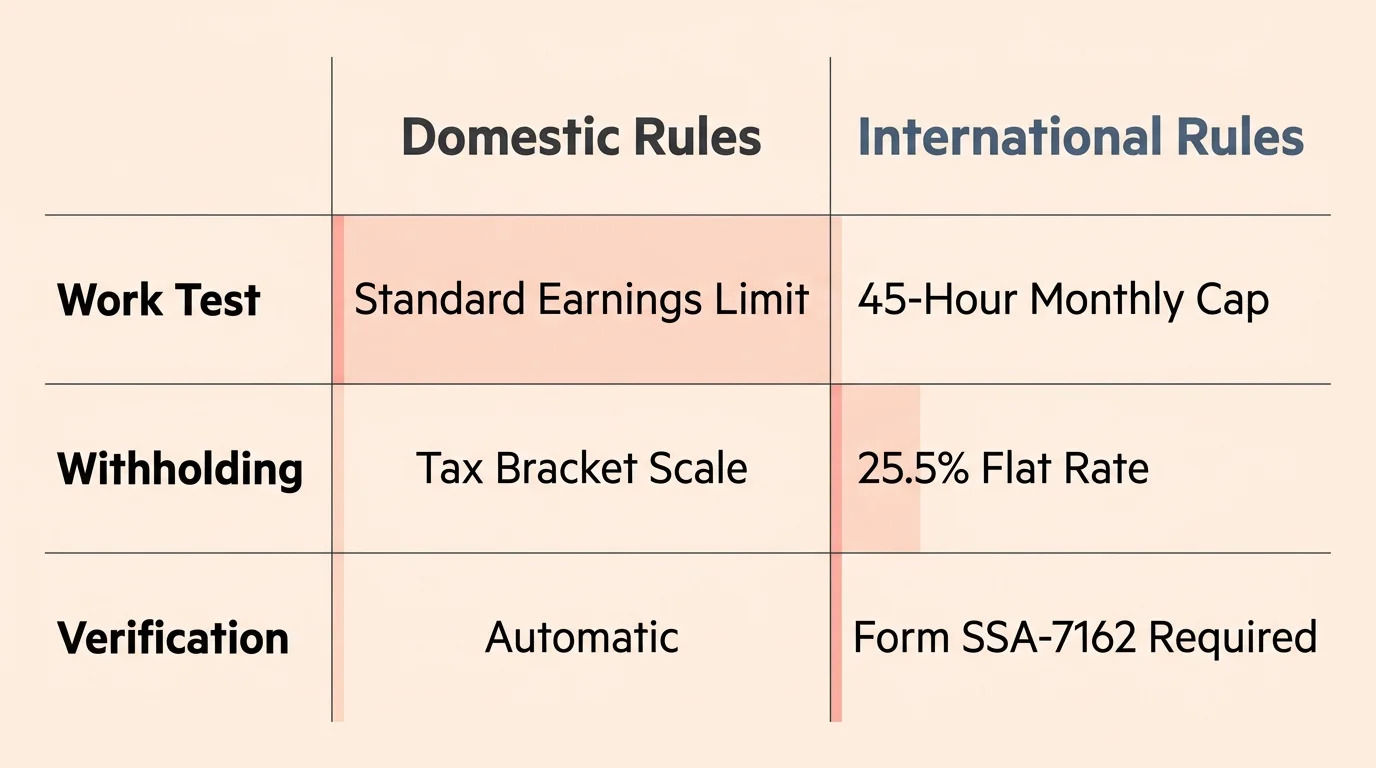
Domestic vs. International Social Security Rules: At-a-Glance Comparison
To help you structure your expat retirement plan, the table below highlights how key operational and tax rules diverge between domestic residency and living abroad.
| Policy Area | Living in the United States | Living Abroad (Expat Status) |
|---|---|---|
| Work Limit Before FRA | Dollar-based earnings test ($1 withheld for every $2 earned above annual limit). | Foreign Work Test (100% of benefit withheld for any month working >45 hours). |
| Proof of Life | Automated via state death registries and federal inter-agency databases. | Mandatory paper Form SSA-7162/7161 returned within 60 days to avoid suspension. |
| Prohibited Countries | None (all 50 states and territories fully supported). | Treasury bans on Cuba and North Korea; severe restrictions across seven Eurasian nations. |
| Non-Citizen Dependents | Benefits continue uninterrupted while residing domestically. | Payments suspended after 6 consecutive months unless meeting 5-year residency rules. |
| Tax Withholding (Non-Citizens) | Subject to standard U.S. resident progressive tax brackets. | Automatic 25.5% flat withholding unless reduced by bilateral income tax treaty. |
| Supplemental Security Income (SSI) | Paid continuously based on financial and asset eligibility. | Permanently suspended after 30 consecutive days spent outside the United States. |
| Medicare Coverage | Full national network coverage under Original Medicare or Medicare Advantage. | Zero coverage for foreign medical treatments; Part B late-enrollment penalties apply if dropped. |

Common Mistakes to Avoid When Collecting Social Security Overseas
Navigating cross-border retirement requires active oversight. Avoiding these frequent missteps protects your financial security:
- Ignoring foreign postal service instability: Assuming Form SSA-7162 will reach your foreign mailbox reliably often leads to frozen checks. Maintain open communication with your regional Federal Benefits Unit and download replacement forms directly if your mailing date passes without receiving the document.
- Taking on local casual employment before Full Retirement Age: Picking up modest consulting gigs or part-time resort work can push you over the 45-hour limit, forfeiting thousands of dollars in annual retirement benefits. Track your billable hours meticulously.
- Canceling Medicare Part B without a long-term repatriation plan: Dropping Part B saves cash in the short term, but an unexpected severe illness that forces you to return home can leave you uninsured and burdened with lifelong late-enrollment surcharge penalties.
- Failing to maintain a U.S. bank account: While International Direct Deposit operates smoothly in many countries, receiving payments in local foreign currency exposes your core income to foreign exchange rate volatility and unexpected transfer fees. Many expats prefer depositing funds into a domestic U.S. bank before transferring money via low-cost international exchange brokers.
- Neglecting host-country tax treaties: Moving to a country without reviewing local tax treatment can lead to double taxation. Some countries tax worldwide Social Security benefits as local taxable income, while others grant complete exemptions under U.S. tax treaties. Consult the Consumer Financial Protection Bureau resources on cross-border money transfers and foreign banking disclosures before finalizing your move.

Professional vs. Self-Guided Overseas Retirement Planning
Determining whether to manage your international retirement independently or hire professional cross-border advisors depends entirely on the complexity of your household, citizenship, and career history.
1. The Self-Guided Route: You can confidently manage your own Social Security affairs if you are a single U.S. citizen (or married to a U.S. citizen), have already reached your Full Retirement Age, have completed 40+ U.S. work credits, and plan to live in an established retirement destination that supports International Direct Deposit. Your primary responsibilities involve submitting Form SSA-7162 promptly and maintaining direct deposit channels.
2. The Professional Advisory Route: You should engage a cross-border Certified Financial Planner (CFP) or international tax CPA if your situation involves any of the following factors:
- Non-citizen spouse or dependents: You need to verify whether your family meets the 5-Year Residency Test or international treaty exceptions to prevent payment suspensions.
- Dual-career foreign work credits: You require assistance navigating a bilateral Totalization Agreement to coordinate pension benefits across multiple national systems.
- Working abroad under Full Retirement Age: You need structural tax advice to ensure foreign business activities or remote contracting do not violate the 45-hour Foreign Work Test.
- Complex foreign tax exposure: You must determine how local tax authorities in countries like Spain, France, or Costa Rica treat your U.S. Social Security checks relative to bilateral double-taxation treaties.
Frequently Asked Questions About Collecting Social Security Abroad
Can the SSA deposit my monthly benefit directly into a foreign bank account?
Yes. The SSA offers International Direct Deposit (IDD) to local bank accounts in more than 100 countries. Payments are converted from U.S. dollars to local currency at prevailing international exchange rates without standard retail banking transfer surcharges. If your country does not support IDD, the SSA can deposit your funds into a U.S. bank account, which you can access internationally using global debit cards or wire transfers.
What should I do if my Form SSA-7162 is lost in the international mail?
If you do not receive Form SSA-7162 by August of your reporting year, do not wait for a suspension warning. Download the official blank form from the SSA website, complete and sign it manually, and mail it via registered tracking directly to your assigned regional Federal Benefits Unit at the nearest U.S. embassy. You can also contact the FBU by email to confirm your active reporting status.
Do I still have to file a U.S. federal income tax return if I live abroad and collect Social Security?
Yes. The United States taxes its citizens on their worldwide income regardless of where they reside. If your combined gross worldwide income (including foreign pensions, investment distributions, and the taxable portion of your Social Security) exceeds the annual standard deduction threshold for your filing status, you must file IRS Form 1040 annually. However, you can utilize tools like the Foreign Earned Income Exclusion (Form 2555) or the Foreign Tax Credit (Form 1116) to prevent double taxation on your non-Social Security income.
Can I return to the United States temporarily for medical procedures if I keep Medicare?
Yes. If you maintain continuous enrollment in Medicare Part A and Part B by paying your required monthly premiums, your coverage activates immediately whenever you receive medical care inside the United States and its territories. Many expat retirees maintain Part B specifically for catastrophic coverage, returning to the U.S. for complex elective surgeries, oncology treatments, or major medical interventions.
Next Steps for Your International Retirement
Moving abroad offers extraordinary lifestyle and financial benefits, but protecting your Social Security requires consistent administrative vigilance. Before booking your one-way ticket, open a my Social Security account online while still on U.S. soil, confirm your total credit count, locate your destination’s regional Federal Benefits Unit, and establish a clear banking and healthcare strategy. Taking these practical steps today ensures your hard-earned benefits arrive smoothly, funding the global retirement you spent decades building.
This article provides general retirement education and information only. Everyone’s financial situation is unique—what works for others may not work for you. For personalized advice, consider consulting a qualified financial professional such as a CFP or CPA.
Last updated: February 2026. Retirement benefits, tax laws, and healthcare costs change frequently—verify current details with official sources.