Overlooking a fourth-quarter financial deadline can wipe out months of investment gains through steep penalties. The final three months of the year contain strict IRS cutoff dates that directly dictate your retirement income.
Missing these cutoff points can trigger excise taxes, disrupt your Medicare premiums, and inflate your taxable income. You must finalize critical withdrawals, charitable gifts, and conversions before custodians close their books on December 31.
Proactive year-end retirement planning shields your hard-earned nest egg from costly compliance errors. Review these eight essential deadlines to keep your savings secure and preserve your financial independence.
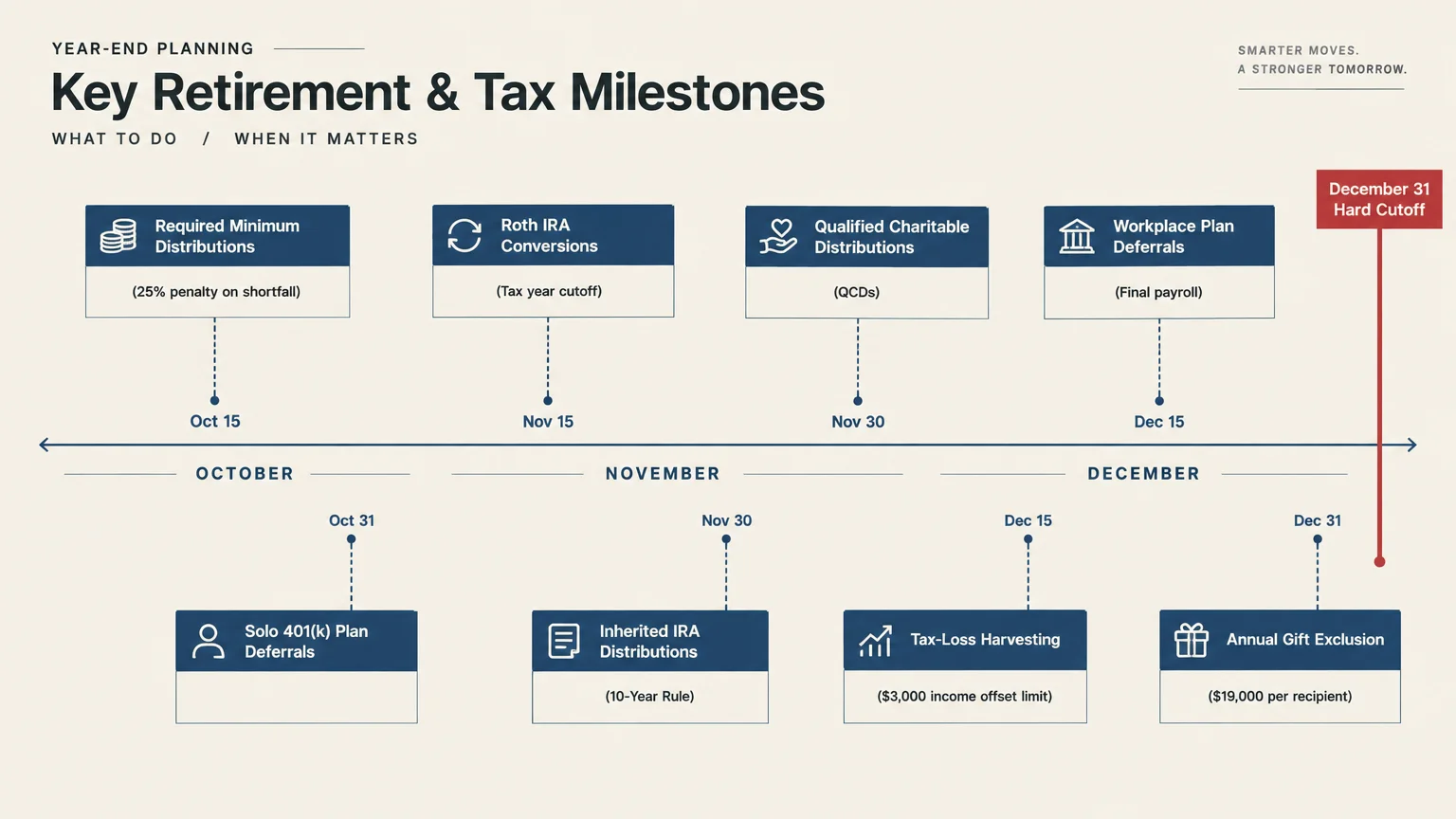
At a Glance: Last-Quarter Retirement Deadlines
The fourth quarter leaves very little margin for administrative delays. Financial institutions often impose internal cutoff dates well ahead of federal deadlines to process your paperwork.
| Retirement Action | Hard Deadline | Consequence of Missing |
|---|---|---|
| Required Minimum Distributions (RMDs) | December 31 | 25% excise tax on the shortfall (reducible to 10%) |
| Roth IRA Conversions | December 31 | Loss of tax-free growth potential for the current tax year |
| Qualified Charitable Distributions (QCDs) | December 31 | Distribution counts as taxable income rather than a tax-free gift |
| Workplace Plan Deferrals (401(k), 403(b)) | December 31 (Final Payroll) | Forfeited tax deduction and lost employer matching contributions |
| Solo 401(k) Employee Deferrals | December 31 | Inability to make elective employee contributions for the tax year |
| Inherited IRA Annual Distributions | December 31 | 25% penalty on required amounts under the 10-year rule |
| Tax-Loss Harvesting | December 31 (Market Close) | Loss of up to $3,000 in ordinary income offsets for the year |
| Annual Gift Tax Exclusion | December 31 | Forfeiture of the annual $19,000 tax-free gifting allowance |
1. Required Minimum Distributions (RMDs)
You must take your annual RMD by December 31 each year from traditional IRAs and 401(k) accounts. According to the Internal Revenue Service (IRS), this mandate applies once you reach age 73.
If you turned 73 this year, you can delay your first withdrawal until April 1 of next year. However, delaying means you must take two distributions in a single tax year, which could push you into a higher bracket.
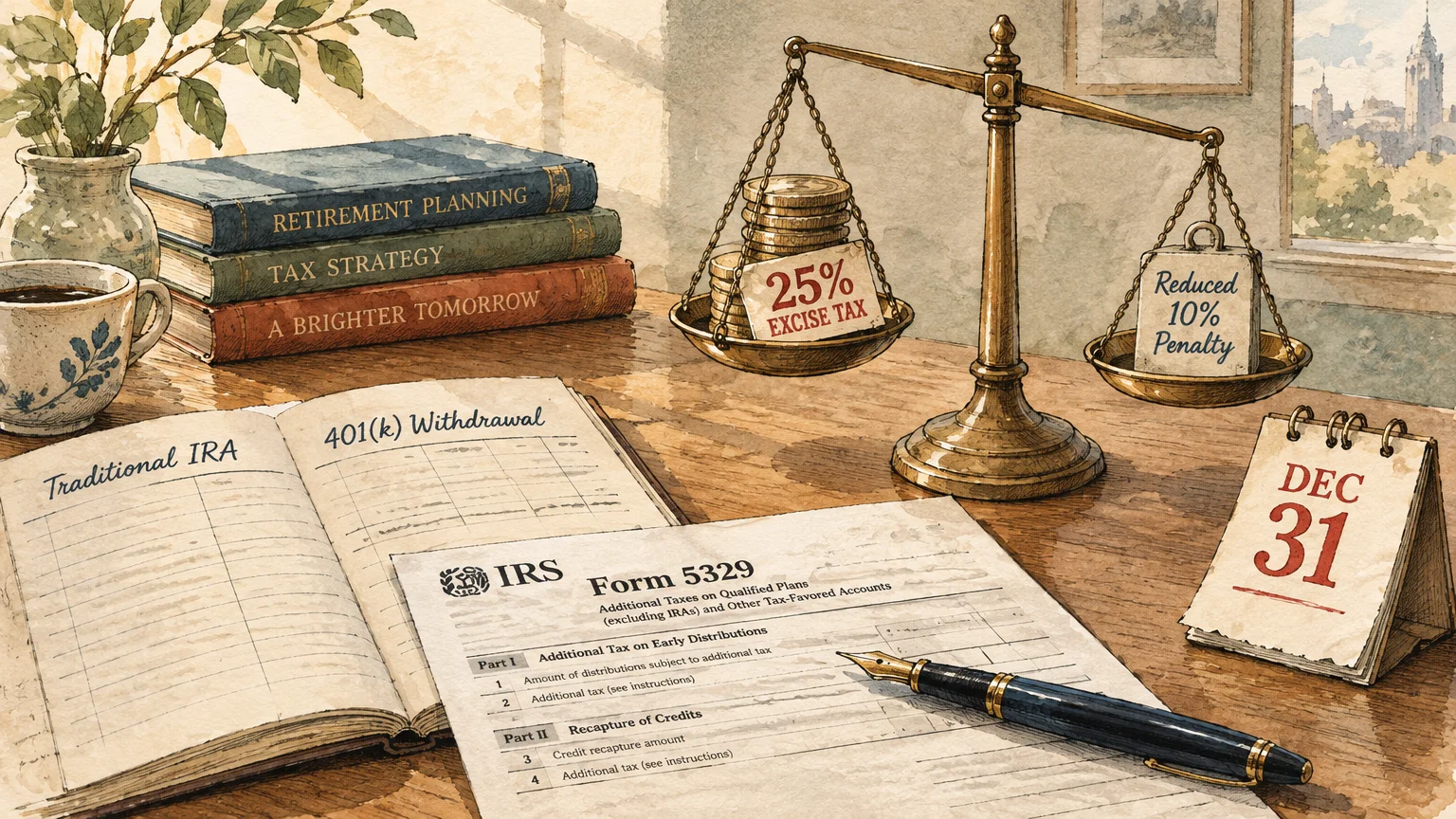
Failing to withdraw the full amount triggers a painful 25% excise tax on the shortfall. You can reduce this penalty to 10% if you correct the error quickly and file IRS Form 5329.
Under SECURE 2.0 rules, designated Roth workplace accounts—such as Roth 401(k) and Roth 403(b) plans—no longer require lifetime RMDs. Traditional workplace accounts and traditional IRAs still require strict adherence to the year-end RMD schedule.
2. Roth IRA Conversions
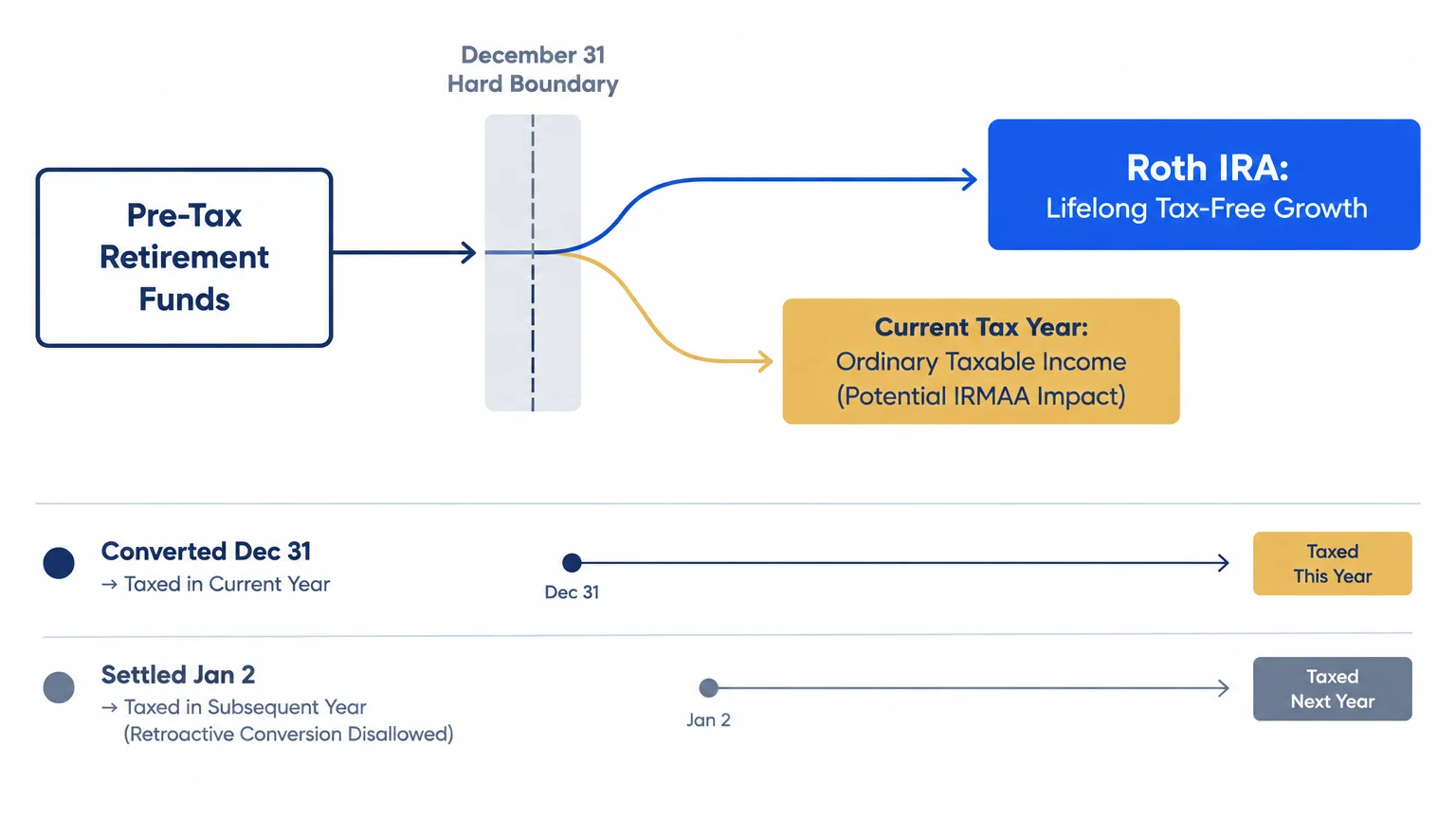
A Roth conversion allows you to move pre-tax retirement dollars into a tax-free Roth account. You must complete this transfer by December 31 for the transaction to count toward the current tax year.
Unlike annual IRA contributions, the tax code does not allow retroactive Roth conversions. If your transaction settles on January 2, the IRS taxes that converted amount in the following calendar year.
Every dollar you convert adds to your ordinary income for the current year. This additional income can unexpectedly raise your tax bracket or phase you out of valuable tax credits.
Higher income also impacts your healthcare costs two years down the road through Medicare.gov IRMAA surcharges. Keep conversions within your current tax bracket to avoid paying inflated Part B and Part D premiums later.
“There is no excuse for missing a retirement deadline when the rules are clearly written. Planning ahead prevents the IRS from becoming your primary beneficiary.” — Ed Slott, CPA and IRA Expert

3. Qualified Charitable Distributions (QCDs)
A Qualified Charitable Distribution allows IRA owners aged 70½ or older to donate directly to qualified 501(c)(3) charities. For 2025, you can donate up to $108,000, rising to $111,000 in 2026.
The funds must leave your IRA custodian and be received or postmarked by December 31. If the charity cashes the check in the new year, the IRS may disallow the deduction for this tax season.
QCDs count toward satisfying your annual RMD without increasing your adjusted gross income. Because the funds bypass your income statement entirely, you protect yourself from higher Medicare premiums and Social Security taxation.
Married couples filing jointly can each execute a QCD from their individual accounts. That allows a combined annual charitable transfer of up to $222,000 for the 2026 tax year.
4. Workplace Retirement Plan Elective Deferrals
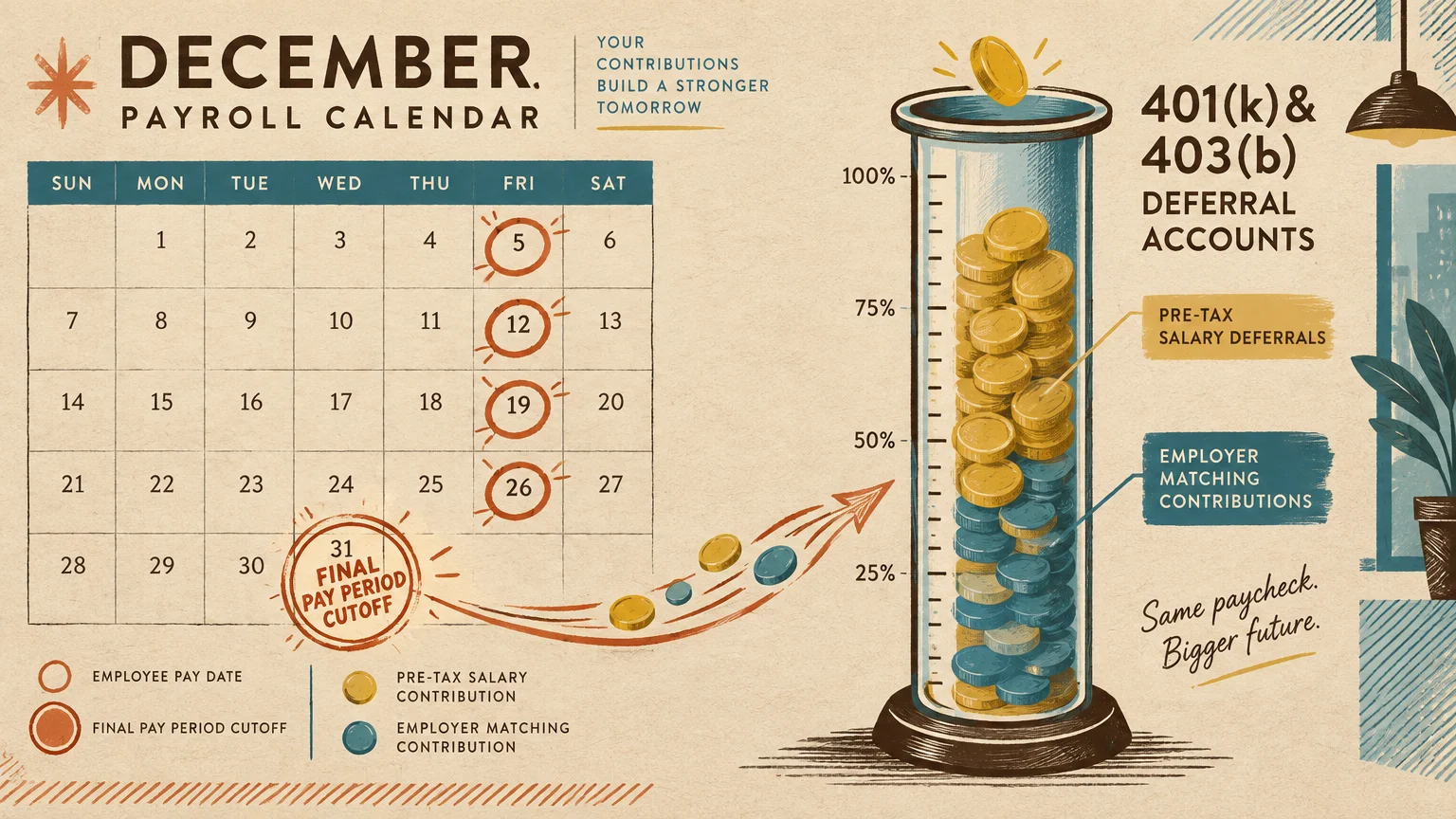
If you participate in an employer-sponsored 401(k), 403(b), or Thrift Savings Plan, your contribution deadline is December 31. These contributions must occur through regular payroll deductions before the calendar year closes.
For 2025, the base elective deferral limit is $23,500, with a $7,500 catch-up contribution for workers aged 50 and older. In 2026, the base limit climbs to $24,500, while the standard age-50 catch-up rises to $8,000.
Workers aged 60 through 63 receive a special “super catch-up” limit of $11,250 in both 2025 and 2026. Starting in 2026, employees with prior-year wages above $150,000 must make all catch-up contributions on an after-tax Roth basis.
Review your final paystubs by late October or November. Adjust your payroll withholding percentages immediately to ensure you capture every dollar of your employer’s matching formula.

5. Solo 401(k) Plan Establishment and Deferrals
Self-employed individuals and small business owners must pay close attention to year-end self-employed plan rules. You must formally establish a Solo 401(k) plan by December 31 to execute employee elective deferrals.
You must also document your employee salary deferral election in writing before midnight on New Year’s Eve. Missing this deadline restricts your retirement savings options to employer profit-sharing contributions only.
The rules set by the SECURE Act grant more flexibility for the employer profit-sharing portion. You can fund the employer side up until your business tax-filing deadline, including extensions.
Setting up your paperwork early prevents last-minute administrative rejections. Custodians face heavy operational backlogs in late December, so open your Solo 401(k) account several weeks ahead.
6. Inherited IRA Distributions Under the 10-Year Rule
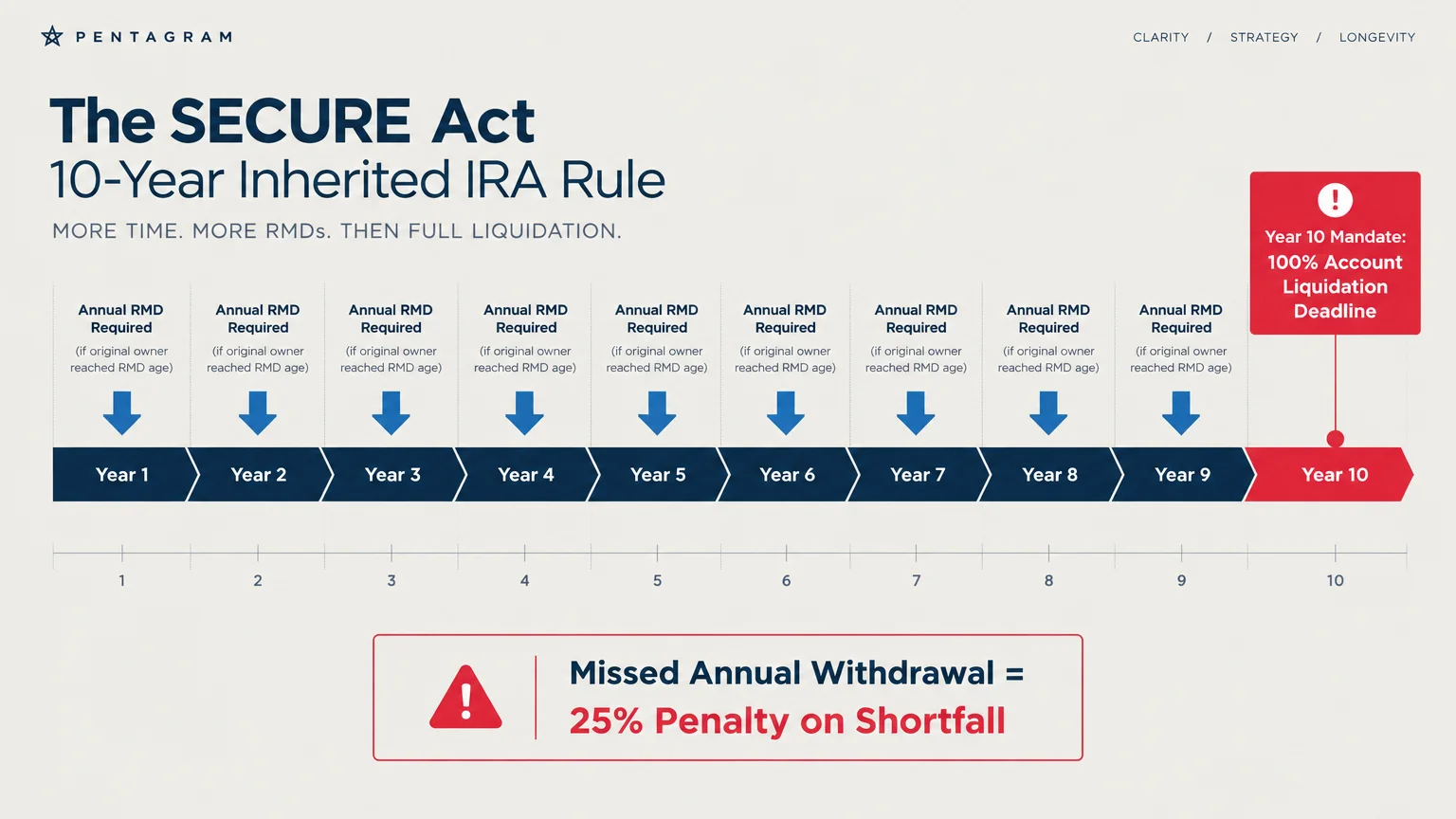
The IRS issued final regulations requiring certain beneficiaries who inherit a traditional IRA to take annual distributions. If the original account owner died after reaching their RMD beginning date, you must take annual RMDs in years 1 through 9.
Each annual distribution must exit the inherited IRA by December 31 of that applicable year. In addition, you must completely liquidate the entire account balance by December 31 of the tenth year following the owner’s death.
Skipping an annual inherited RMD exposes you to the standard 25% shortfall excise tax. Beneficiaries must track whether the original decedent was already subject to required distributions at death.
Carefully monitor your beneficiary accounts to ensure proper distribution codes appear on your tax forms. Consult your custodian to confirm the correct calculation method based on your single life expectancy.
7. Tax-Loss Harvesting for Taxable Portfolios
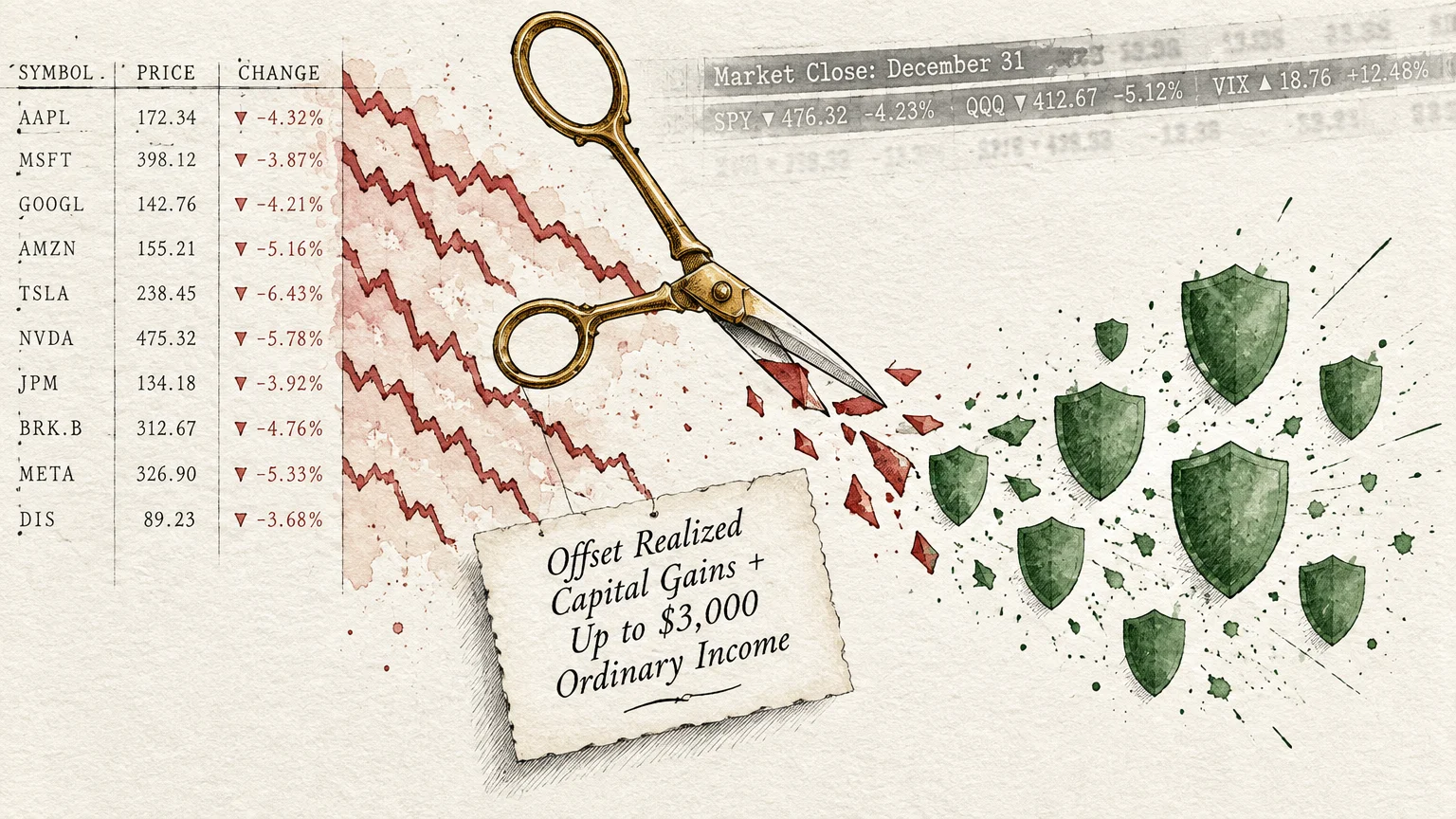
Tax-loss harvesting allows you to sell investments at a loss to offset realized capital gains in your taxable brokerage accounts. You must execute all harvest sales by the final trading day of the calendar year, typically December 31.
If your realized losses exceed your total capital gains, you can offset up to $3,000 of ordinary income. Any remaining net losses roll forward indefinitely into future tax years to offset future investment gains.
Be careful to avoid violating the IRS wash-sale rule when replacing harvested assets. You cannot buy a “substantially identical” stock or fund within 30 days before or after the sale date.
Violating this rule disallows the tax deduction and adds the loss to the cost basis of the new shares. Resources from FINRA emphasize monitoring trades across all your personal and retirement accounts to prevent inadvertent wash sales.

8. Annual Exclusion Gifts to Family and Loved Ones
Gifting wealth to heirs reduces the taxable value of your estate while providing direct financial assistance to loved ones. The federal annual gift tax exclusion stands at $19,000 per recipient for both 2025 and 2026.
A married couple can combine their allowances to give up to $38,000 per recipient without filing a gift tax return. The deadline to complete these transfers is December 31 of the calendar year.
Annual gift tax exclusions operate on a strict “use it or lose it” basis. You cannot carry forward an unused exclusion amount into the subsequent tax year.
Ensure your recipients deposit checks well before December 31 so the transaction clears your bank. If the check clears in January, the IRS counts that transfer against the new calendar year’s limit.
The Crucial April 15 Exception: IRA Contributions
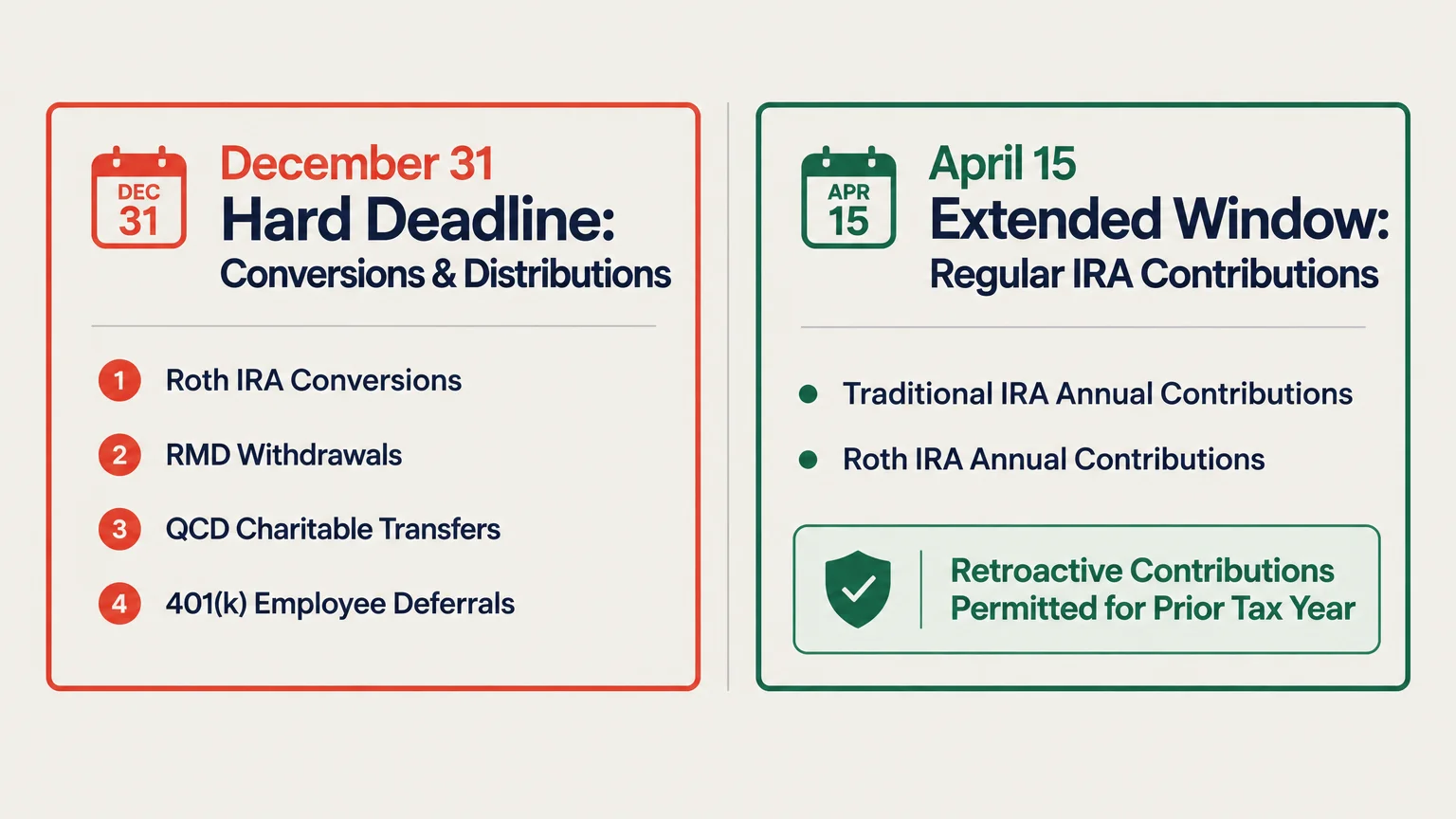
Many savers confuse year-end distribution cutoffs with the deadline to contribute to an IRA. While conversions and RMDs end strictly on December 31, annual IRA contributions follow a different calendar.
You have until Tax Day—typically April 15 of the following year—to make traditional or Roth IRA contributions. This window gives you extra time to calculate your income and determine deduction eligibility.
Do not confuse this flexibility with the hard December 31 deadline for Roth conversions. Conversions must settle within the calendar year, whereas regular contributions can be applied retroactively to the prior tax year.
Educational guidelines from Investor.gov recommend clarifying your intentions with your financial institution. Clearly designate whether an early spring deposit applies to the current or prior tax year.
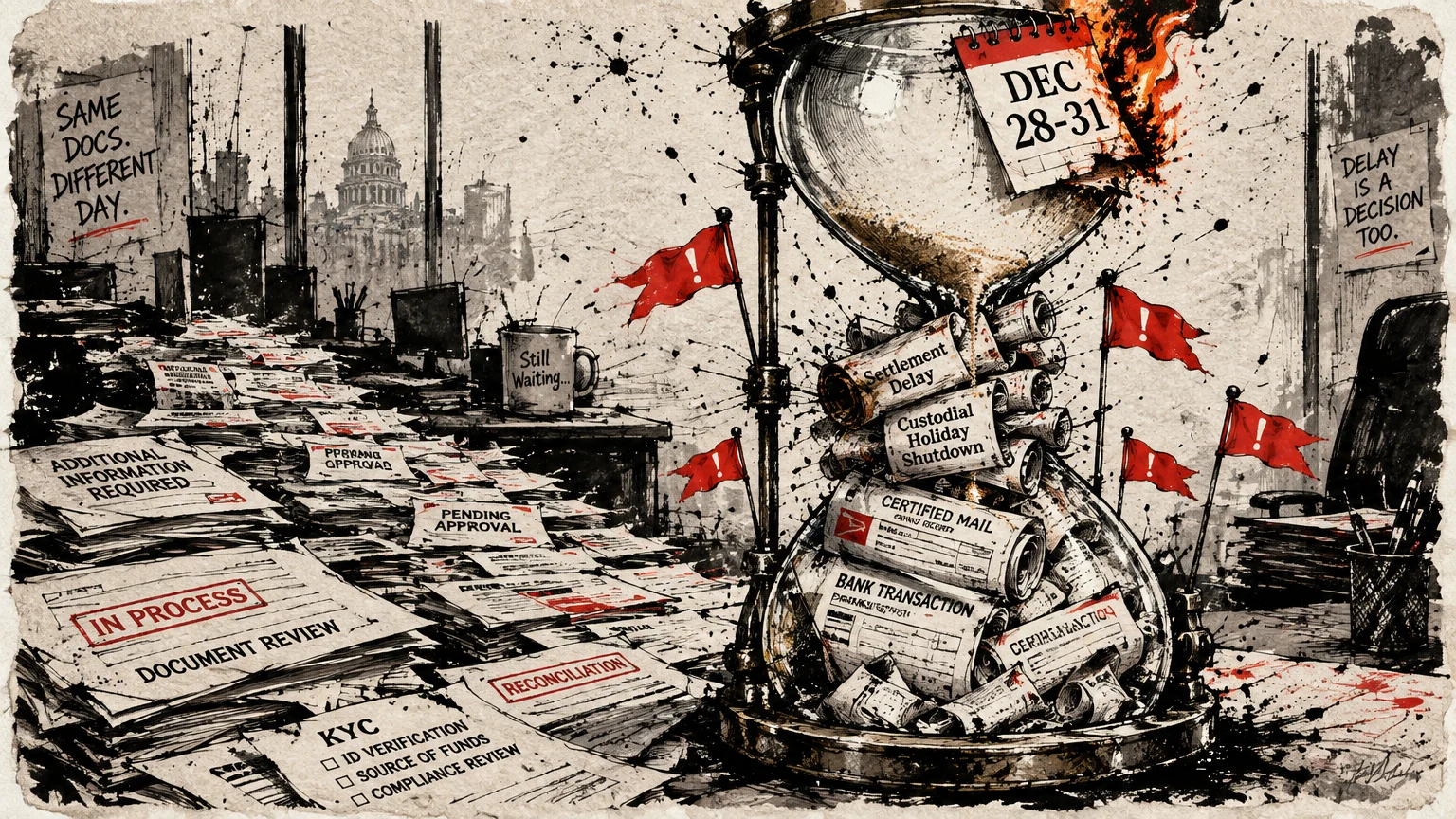
What Can Go Wrong: Year-End Retirement Pitfalls
Procrastination remains the primary culprit behind costly year-end retirement account errors. Waiting until late December leaves you vulnerable to bank processing delays, holiday closures, and paperwork errors.
- Processing Delays: Custodians often enforce transaction cutoffs days before December 31.
- Uncashed Charity Checks: A QCD check mailed on December 30 might not clear in time to count for the current tax year.
- Medicare Surcharges: An oversized Roth conversion can trigger steep IRMAA penalties on your healthcare premiums.
- Inadvertent Wash Sales: Buying back a sold index fund inside a dividend reinvestment plan voids your harvested loss.
Double-check your distribution figures against your prior year-end account statements. Verify that custodians have updated withholding instructions to prevent unexpected tax bills in April.

When to Consult a Professional
Navigating overlapping tax codes requires careful alignment between your cash flow needs and IRS rules. Seeking professional advice ensures you do not inadvertently trigger penalties or push yourself into a punitive tax bracket.
- Complex Beneficiary Estates: When managing multiple inherited IRAs subject to different post-SECURE Act distribution rules.
- Substantial Roth Conversions: When a conversion risks triggering higher Medicare Part B and Part D premiums via IRMAA.
- Charitable Gifting Strategies: When coordinating high-value QCDs across multiple traditional IRA custodians.
- Solo Business Compliance: When structuring employer contributions alongside maximum employee elective deferrals.
A Certified Financial Planner (CFP) or CPA can run multi-year tax projections. Their analysis helps balance immediate deductions against long-term retirement liabilities.
Frequently Asked Questions
Can I undo a Roth conversion if I realize it pushed me into a higher tax bracket?
No, the Tax Cuts and Jobs Act permanently eliminated the ability to recharacterize or undo a Roth conversion. Once your conversion settles, the resulting tax liability remains permanent for that tax year.
What happens if I miss my annual RMD deadline on December 31?
The IRS imposes a 25% excise tax on the amount not withdrawn on time. You can reduce this penalty to 10% by taking the distribution promptly and filing Form 5329 with an explanation.
Do workplace Roth 401(k) accounts still require RMDs in retirement?
No, SECURE 2.0 eliminated lifetime RMDs for designated Roth 401(k) and Roth 403(b) accounts. You can leave funds inside your workplace Roth account without triggering mandatory annual distributions.
Can I write a check to my church on December 31 and call it a Qualified Charitable Distribution?
Only if the check is drawn directly from your IRA account by the custodian and received promptly by the charity. Personal checks funded by regular withdrawals do not qualify for direct QCD tax treatment.
Protecting Your Nest Egg Ahead of the New Year
Year-end retirement deadlines reward prompt, deliberate action. By reviewing your accounts in October and November, you avoid the administrative bottlenecks that plague financial institutions in late December.
The information in this guide is meant for educational purposes. Your specific circumstances—including income, savings, health coverage, and goals—may require different approaches. When in doubt, consult a licensed professional.
Last updated: February 2026. Retirement benefits, tax laws, and healthcare costs change frequently—verify current details with official sources.