
Filing taxes in retirement requires a fundamentally different playbook than your working years. Coordinating your withdrawals, benefits, and deductions as a married couple can save you thousands of dollars annually while protecting your hard-earned nest egg.
A single miscalculation can trigger unexpected taxes on your Social Security benefits or spike your future Medicare premiums. Many retirees simply file their returns on autopilot without realizing how joint rules interact.
Reviewing these ten essential questions before you file your joint tax return ensures you keep more money in your household pocket.
1. Did Both of You Claim the Extra Senior Standard Deduction?
The Internal Revenue Service rewards older Americans with an increased standard deduction once you reach age 65. Many retirees overlook this valuable boost because tax software or preparers fail to confirm birth dates accurately.
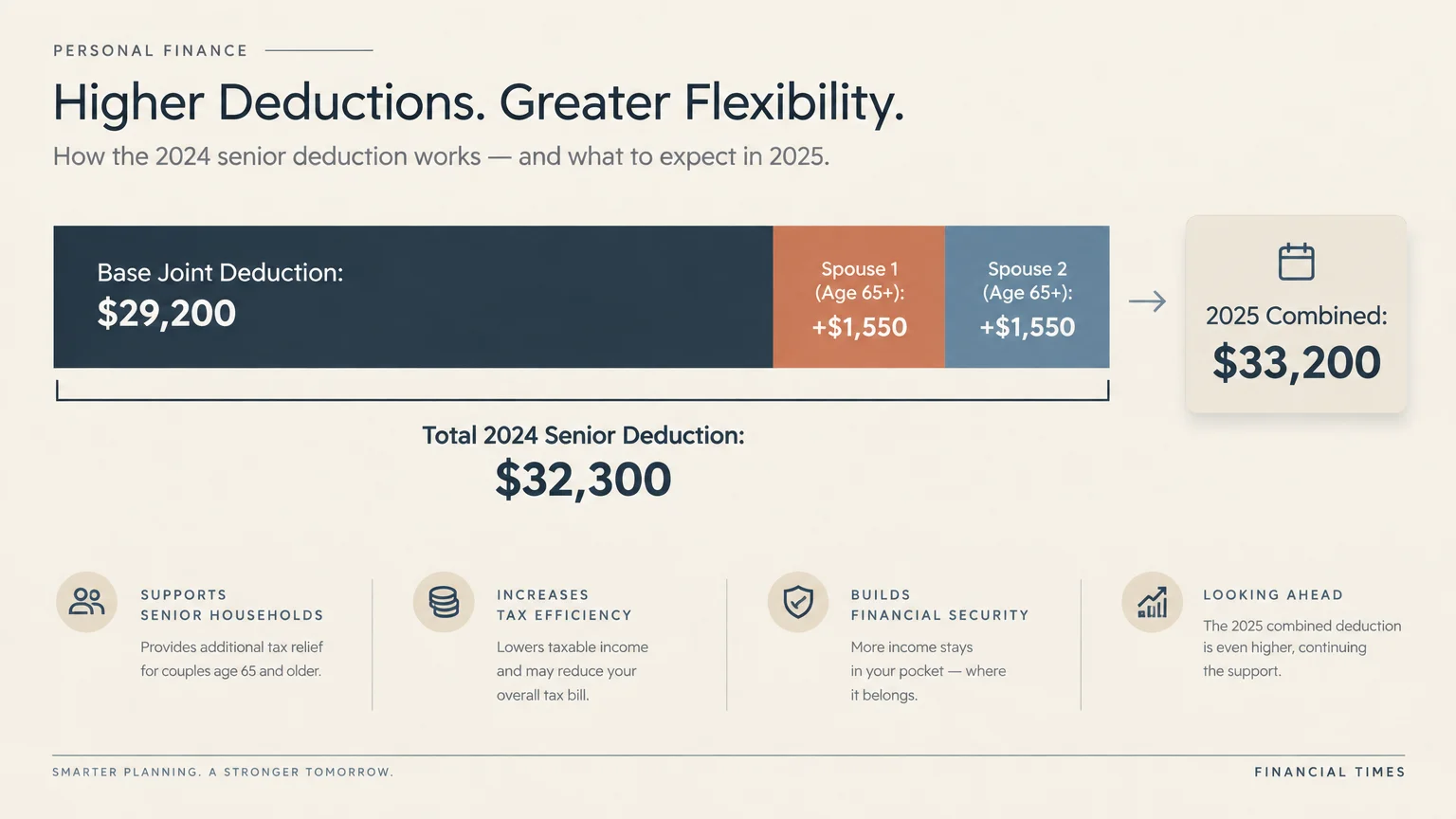
For tax year 2024, the base married filing jointly standard deduction is $29,200. Each spouse aged 65 or older receives an additional $1,550 deduction.
If both spouses qualify, your total 2024 deduction rises to $32,300. For tax year 2025, the base deduction increases to $30,000, and qualifying spouses receive $1,600 each for a combined $33,200 deduction.
You qualify for this extra deduction starting in the tax year you turn 65. The Internal Revenue Service considers you 65 on the day before your birthday, so January 1 birthdays qualify for the prior year.
2. Will Combined Income Make Your Social Security Benefits Taxable?
Combining two retirement incomes frequently pushes your Social Security benefits into taxable territory. The federal government uses a specific formula known as provisional income to determine benefit taxation.
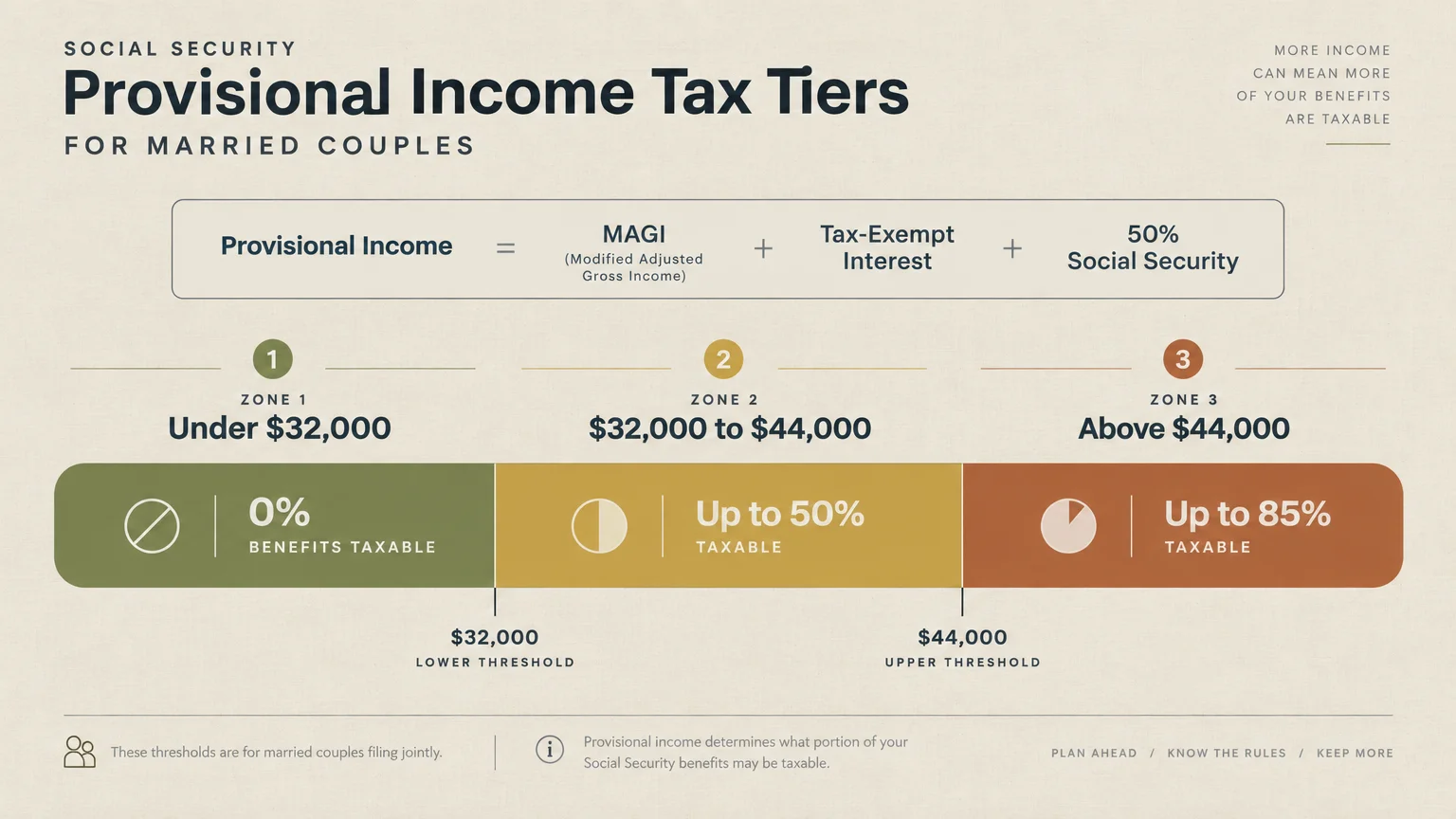
To find your provisional income, add your modified adjusted gross income, tax-exempt municipal interest, and 50% of your combined Social Security benefits.
Congress established the statutory income thresholds in 1984 and never adjusted them for inflation. If your joint provisional income stays below $32,000, your Social Security benefits remain completely tax-free.
Between $32,000 and $44,000, up to 50% of your joint benefits face federal income tax. Once provisional income crosses $44,000, up to 85% of your benefits become taxable according to the Social Security Administration.
3. Does Your Joint Adjusted Gross Income Trigger Medicare IRMAA Surcharges?
High joint retirement income can trigger an expensive surprise through Medicare’s Income-Related Monthly Adjustment Amount (IRMAA). The federal government uses your tax return from two years prior to calculate these mandatory surcharges.
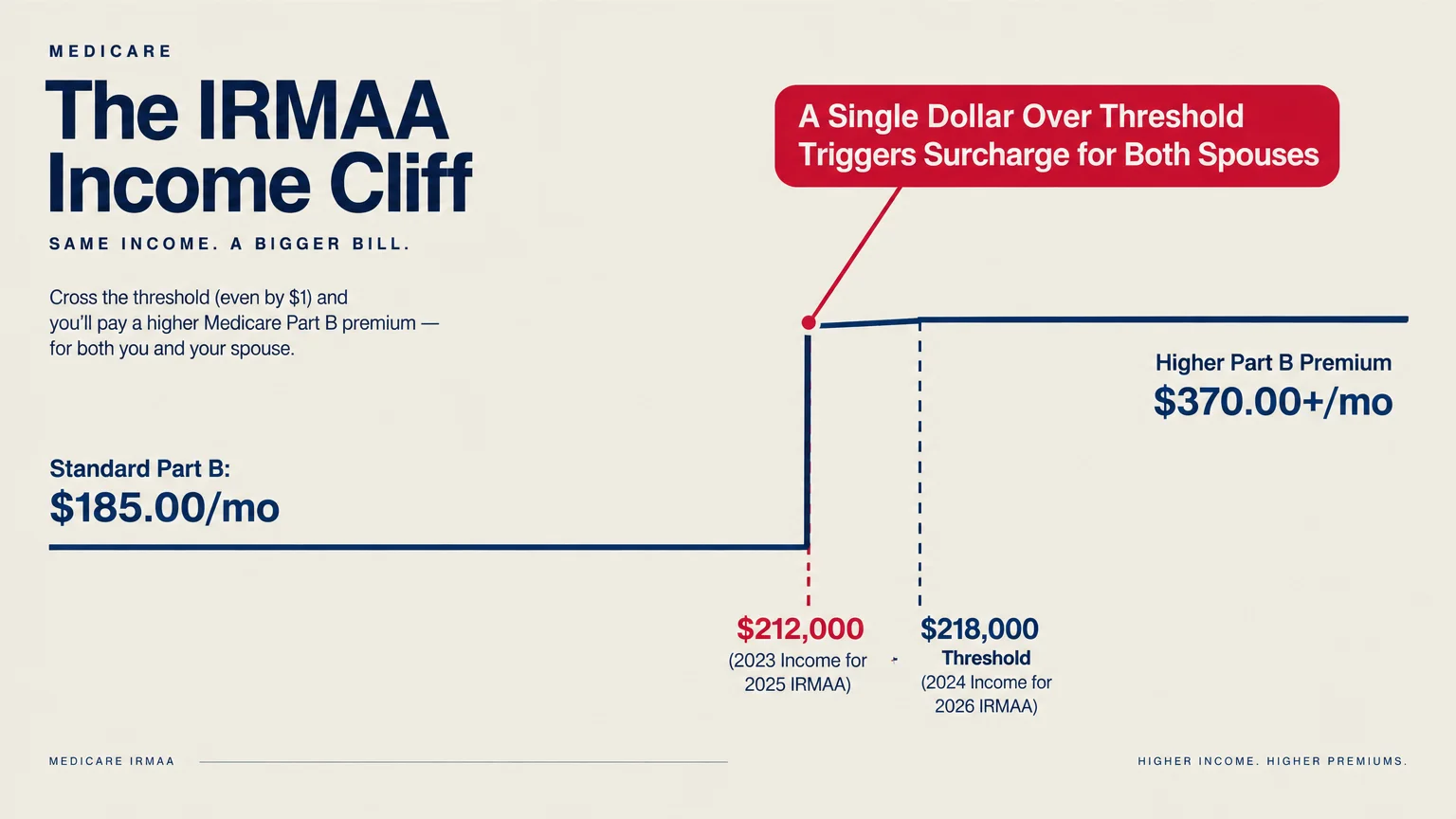
For example, your 2025 Medicare Part B and Part D premiums depend on the income reported on your 2023 return. For 2025, standard Part B coverage costs $185.00 per month according to Medicare.gov.
If your 2023 joint income exceeded $212,000, both spouses must pay monthly surcharges. For the 2026 premium year, IRMAA surcharges begin when joint modified adjusted gross income on your 2024 return tops $218,000.
Crossing a threshold by a single dollar triggers the entire surcharge for both individuals. Careful joint income timing prevents this expensive cliff.
“The best time to pay taxes is when rates are on sale, and right now, tax rates are lower than they may ever be in your lifetime.” — Ed Slott, CPA and IRA Distribution Specialist

4. Have You Met RMD Deadlines for Each Spouse’s Traditional Accounts?
The SECURE 2.0 Act adjusted the rules for Required Minimum Distributions, but each spouse remains individually responsible for their own accounts. You cannot satisfy your spouse’s distribution requirement using funds from your own traditional IRA.
Under current law, individuals born between 1951 and 1959 must begin taking distributions at age 73. Those born in 1960 or later do not face required withdrawals until reaching age 75.
Failing to withdraw the required amount triggers an excise tax of 25% on the shortfall. Correcting the error promptly within the statutory correction window reduces that penalty to 10%.
Fortunately, designated Roth 401(k) and 403(b) employer plans are permanently exempt from pre-death RMDs under SECURE 2.0.
5. Should You Use Qualified Charitable Distributions to Lower Joint AGI?
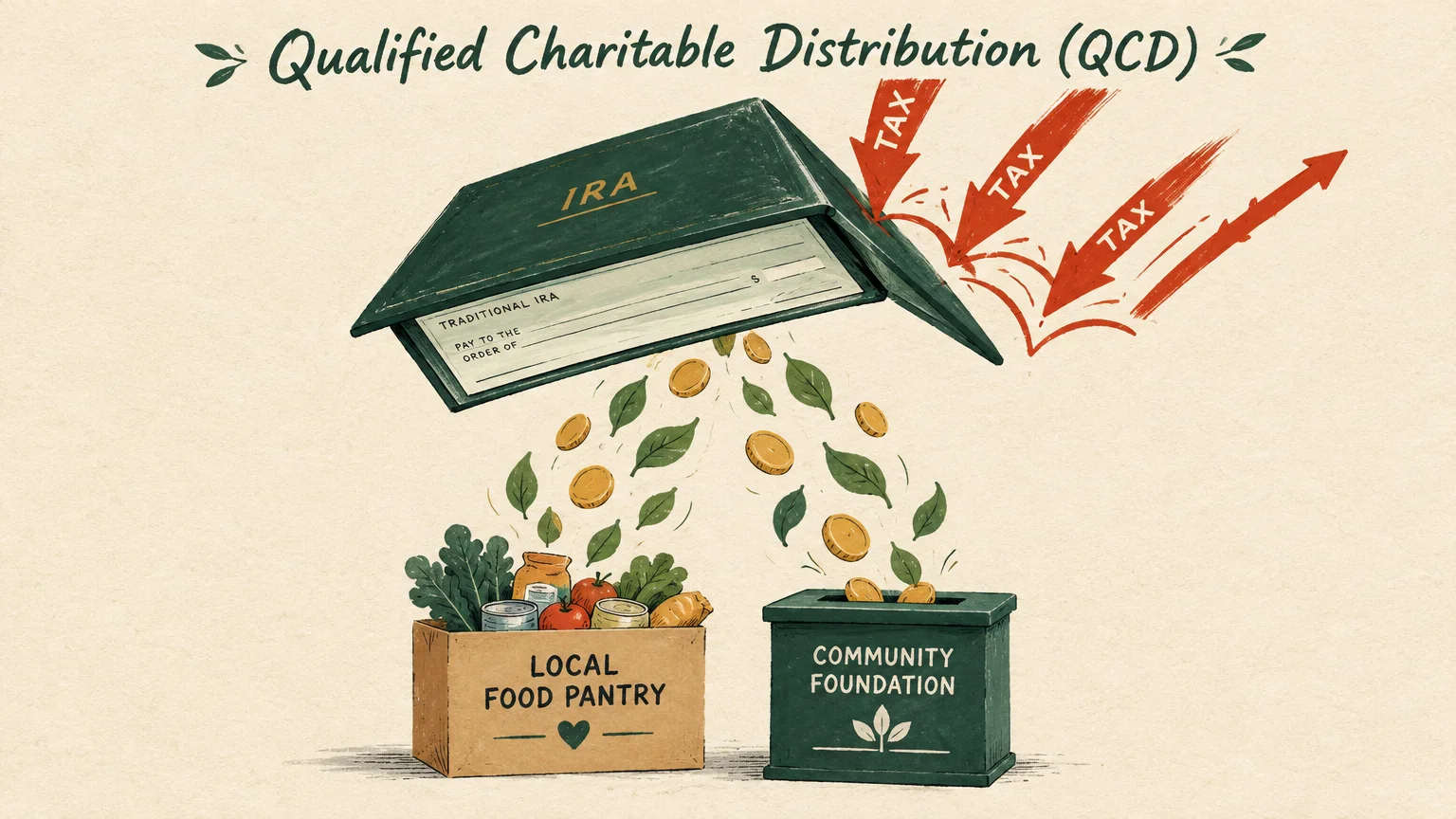
If you support charitable causes and have reached age 70½, Qualified Charitable Distributions (QCDs) offer significant tax advantages. A QCD allows you to transfer funds directly from a traditional IRA to an eligible 501(c)(3) charity.
The transferred funds satisfy your annual distribution requirements without increasing your joint adjusted gross income. Keeping your income lower protects against higher Medicare premiums and Social Security taxation.
For tax year 2024, individuals can transfer up to $105,000 annually. In 2025, that limit increases to $108,000 per person.
Because QCD limits apply per person, a retired couple can exclude up to $210,000 in 2024 and $216,000 in 2025. This technique allows you to claim the high standard deduction while still enjoying charitable tax benefits.
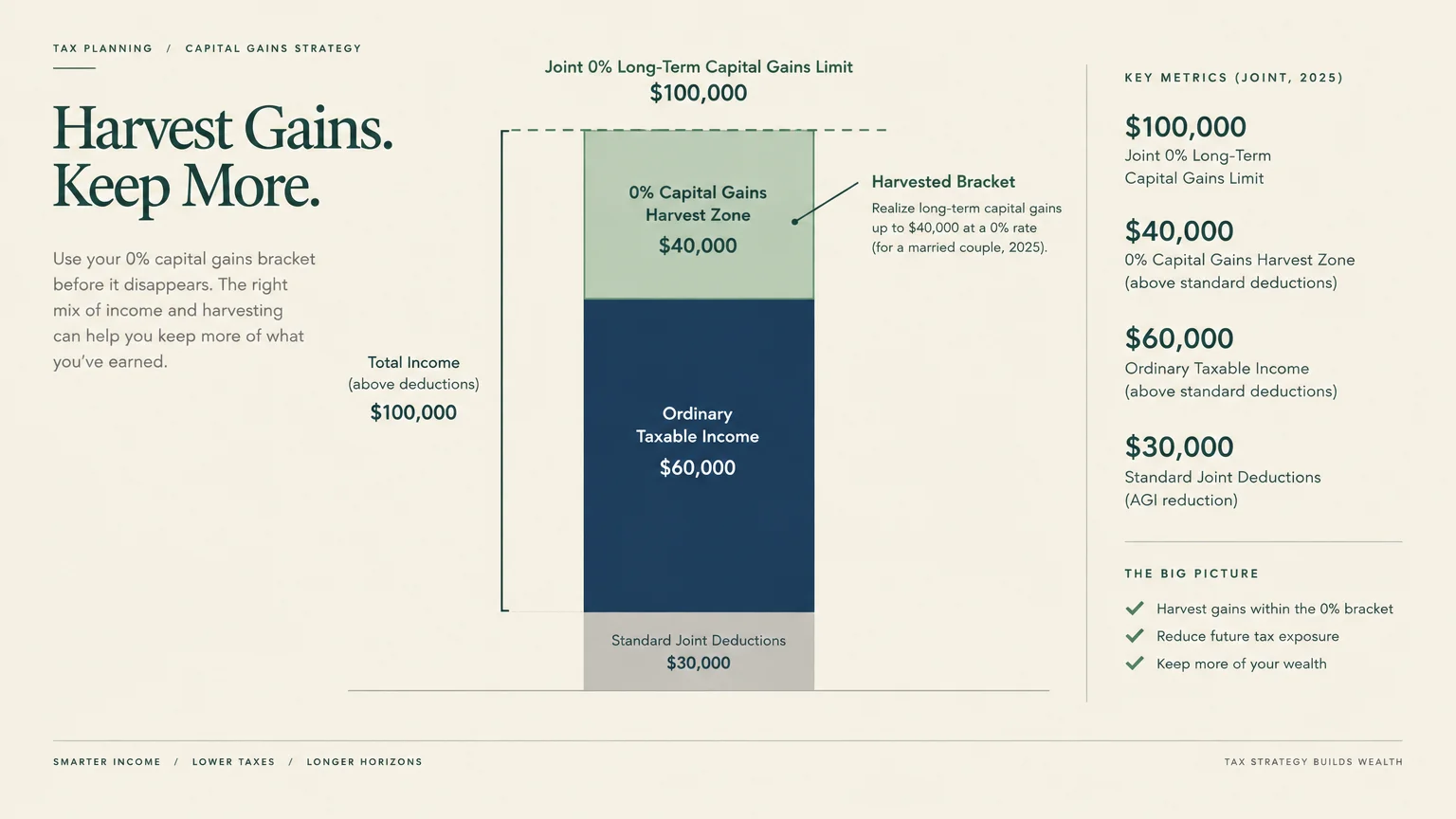
6. Can You Harvest Capital Gains in the Joint 0% Tax Bracket?
Strategic asset sales from taxable accounts can yield completely tax-free cash flow for married retirees. The IRS provides a generous 0% tax bracket for long-term capital gains and qualified dividends.
For tax year 2024, married couples filing jointly can realize long-term capital gains at a 0% rate with taxable income up to $94,050. In 2025, this zero-percent threshold expands to $96,700.
When you combine this threshold with your senior standard deduction, you can realize substantial income before paying capital gains taxes. Harvesting gains during lower-income years lets you reset your portfolio’s cost basis tax-free.
“In investing, you get what you don’t pay for. Costs matter, and taxes are often the single largest cost a retiree faces.” — John Bogle, Founder of Vanguard

7. Does Either Spouse Have Earned Income to Fund a Spousal IRA?
Many couples retire in phases, with one partner leaving the workforce while the other continues working. The non-working partner can continue saving into a traditional or Roth IRA through a Spousal IRA.
To qualify, you must file a joint return, and the working spouse must generate sufficient earned income to cover both contributions. For 2024 and 2025, standard contribution limits remain at $7,000 per spouse.
Individuals age 50 and older can contribute an additional $1,000 catch-up amount each year. This rule allows a couple age 50 or older to shelter up to $16,000 annually from taxes, even if only one spouse works.

8. Would Filing Separately Harm or Help Your Retirement Finances?
Couples often wonder if filing separate returns could shelter one spouse from the other’s high income or medical costs. For retirees, filing separately almost always triggers severe financial penalties.
If you live together at any point during the tax year, your provisional income threshold for Social Security drops to $0. This rule subjects up to 85% of your benefits to taxation starting from the very first dollar.
Additionally, Medicare IRMAA surcharges hit married couples filing separately at drastically lower thresholds. In 2025, separate filers face IRMAA surcharges at just $106,000 of income, compared to $212,000 on a joint return.
| Tax Feature | Married Filing Jointly | Married Filing Separately (Lived Together) |
|---|---|---|
| Base Standard Deduction | $30,000 | $15,000 |
| Social Security 0% Tax Threshold | Up to $32,000 provisional income | $0 (up to 85% taxable immediately) |
| Medicare IRMAA Tier 1 Surcharge | Starts at $218,000 MAGI (2026) | Starts at $109,000 MAGI (2026) |
| 0% Capital Gains Limit | Up to $96,700 taxable income | Up to $48,350 taxable income |
| Spousal IRA Contribution | Allowed with earned spousal income | Disallowed |
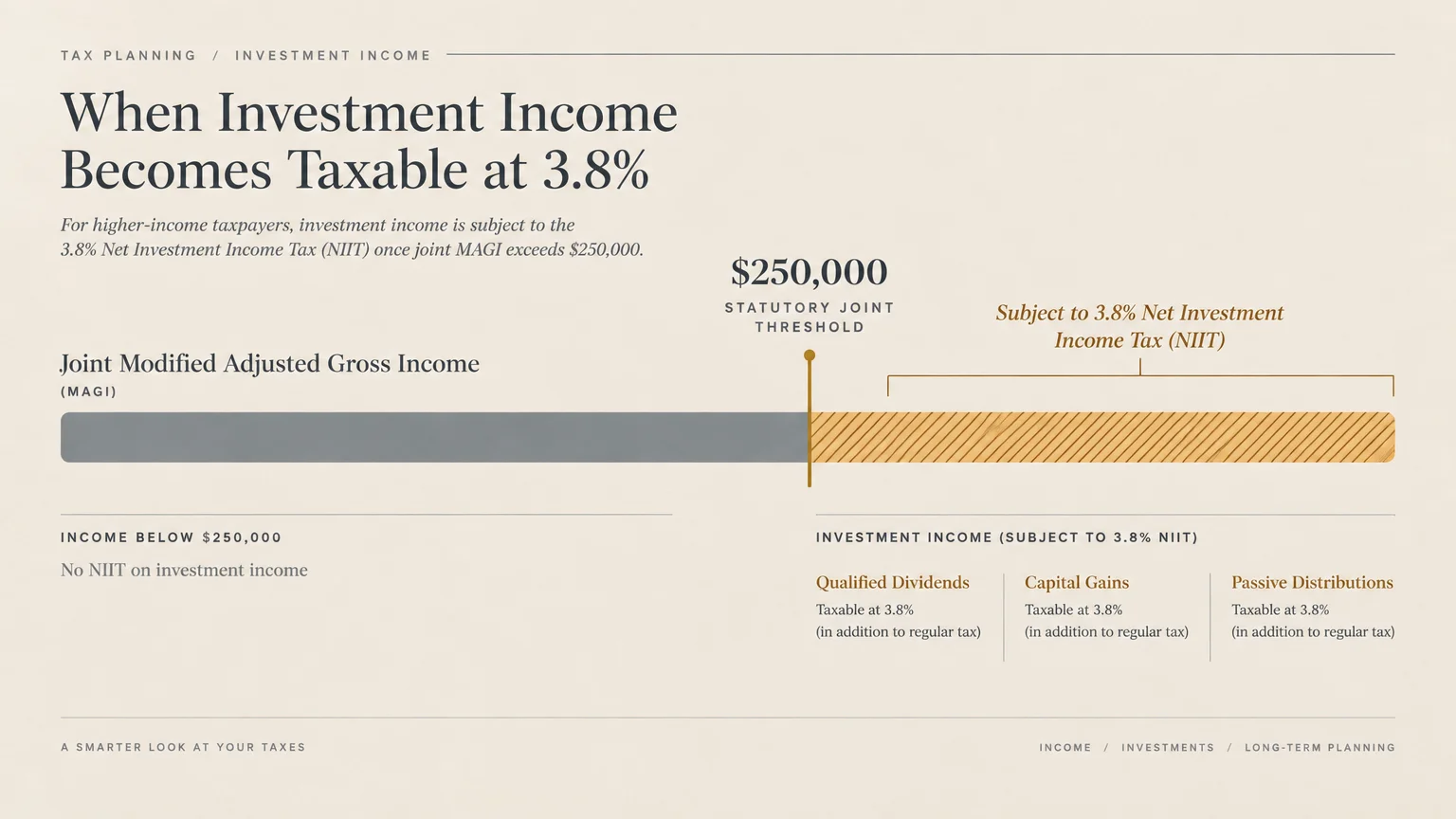
9. Will Portfolio Income Trigger the 3.8% Net Investment Income Tax?
Affluent retirees must monitor their portfolio withdrawals to avoid unexpected surtaxes on investment income. The Net Investment Income Tax assesses a flat 3.8% levy on interest, dividends, capital gains, and rental income.
This surtax applies once your joint modified adjusted gross income tops $250,000. Unlike standard income brackets, Congress did not index this $250,000 statutory limit for inflation.
Large distributions from traditional retirement accounts count toward your total income and can trigger this surtax on your taxable investments. Managing taxable income using municipal bonds or Roth distributions protects your portfolio from this additional tax drag.

10. Have You Prepared for the Impending “Widow’s Tax Trap”?
Joint tax returns provide wide brackets that buffer your combined household income against steep tax rates. When one spouse passes away, the surviving partner must eventually file as a single individual.
The surviving spouse often inherits traditional IRAs and mandatory distributions while losing the smaller of their two Social Security checks. Single filers face tax brackets that are half as wide as married joint brackets.
As a result, the surviving spouse frequently pays higher taxes on less overall household income. Executing strategic Roth conversions while both spouses are alive can significantly soften this future tax burden.

What Can Go Wrong: Critical Tax Filing Traps to Avoid
Navigating taxes in retirement involves coordinating multiple complex rules simultaneously. Overlooking these interactions can create substantial financial headaches for your household.
- Failing to withhold enough federal tax: Unlike paychecks, retirement withdrawals do not automatically withhold correct amounts, leading to unexpected underpayment penalties.
- Aggressive capital gain harvesting: Selling too many appreciated assets can inadvertently push joint provisional income over the Social Security taxation thresholds.
- Ignoring municipal bond reporting: Tax-exempt municipal bond interest remains free from federal income tax, but the IRS includes it when calculating your provisional income and Medicare IRMAA tiers.
- Aggregating distributions across spouses: Withdrawing twice your required minimum distribution from your own account does not satisfy your spouse’s individual RMD requirement.

When to Consult a Professional
Managing taxes as a retired couple requires careful coordination across multiple accounts, asset classes, and government thresholds. Working with a qualified expert helps you navigate complicated tax intersections.
Consider consulting a CPA or Certified Financial Planner if you encounter any of the following situations:
- You plan to execute multi-year Roth conversions while managing Medicare IRMAA thresholds and Social Security taxation.
- One spouse owns complex assets, such as small business equity, commercial rental property, or multi-state real estate.
- Your household incurred significant medical or long-term care expenses that may exceed the 7.5% adjusted gross income deduction threshold.
- You manage complex inherited retirement accounts subject to the 10-year withdrawal rule under the SECURE Act.
Frequently Asked Questions About Joint Taxes in Retirement
Can we file a joint return if my spouse passed away during the tax year?
Yes, the IRS permits you to file as married filing jointly for the full tax year in which your spouse passed away. You qualify for the full joint standard deduction and tax brackets for that calendar year.
Do both spouses need to be 65 to claim the higher standard deduction?
No, each spouse qualifies independently. If only one spouse is 65 or older, you claim one additional deduction amount on your joint tax return.
Are Roth IRA withdrawals reported on our joint tax return?
Qualified Roth IRA distributions are completely tax-free and do not increase your adjusted gross income. However, non-qualified distributions or basis adjustments require reporting on IRS Form 8606.
Does tax-exempt interest count against our Social Security benefits?
Yes, municipal bond interest must be reported on your return and directly increases your provisional income calculation. This interest can cause up to 85% of your Social Security benefits to become taxable.
This article provides general retirement education and information only. Everyone’s financial situation is unique—what works for others may not work for you. For personalized advice, consider consulting a qualified financial professional such as a CFP or CPA.
Last updated: February 2026. Retirement benefits, tax laws, and healthcare costs change frequently—verify current details with official sources.