A sudden demand letter from the Social Security Administration can throw your retirement budget into chaos, especially when the agency claims you owe thousands of dollars due to an administrative miscalculation from years ago. Roughly two million beneficiaries receive these overpayment notices annually, as the government attempts to recover nearly $23 billion in uncollected funds. You do not have to forfeit your benefits or drain your savings immediately upon opening that envelope. Understanding your rights, strict agency deadlines, and repayment flexibility will allow you to challenge the demand, lower your monthly payments, or request a complete waiver without risking your financial independence.

Why Social Security Overpayment Demands Are Spiking
Opening your mailbox to find a formal demand letter for thousands of dollars creates instant stress. To understand why these notices arrive, you must look at how the Social Security Administration processes earnings, benefit calculations, and entitlement changes. Overpayments occur whenever the agency pays you more money than strict statutory rules allow. While that definition sounds simple, the underlying causes behind these errors stem from systemic reporting delays and legacy software tracking systems.
Data from the Social Security Administration (2024) reveals that the agency issued approximately $72 billion in improper payments between fiscal years 2015 and 2022. Today, the agency holds an uncollected overpayment balance of nearly $23 billion. These figures do not represent widespread fraud by retirees; instead, they reflect administrative backlogs, delayed wage updates, and confusing program interactions. The primary triggers for overpayment demand notices include:
- Earnings Test Delays: If you collect retirement benefits before reaching your Full Retirement Age while continuing to work, the agency caps your allowable income. Employers report wages annually through tax filings, meaning the agency often discovers earnings limit overages one to three years after they happen.
- Administrative Miscalculations: Social Security staff members occasionally miscalculate benefit formulas, apply incorrect cost-of-living adjustments, or fail to adjust dual-entitlement benefits when a spouse passes away.
- Government Pension Offset (GPO) and Windfall Elimination Provision (WEP) Adjustments: Beneficiaries who receive state, local, or federal pensions from non-covered employment sometimes experience delayed retroactive benefit reductions when pension records update.
- Delayed Reporting of Life Events: Changes in marital status, living arrangements, or disability recovery status can take months to process, leading to ongoing benefit payouts at former higher levels.
Consider the case of Robert, a 64-year-old retiree who took early retirement in 2023. Robert accepted a part-time consulting job that paid $28,000 over the calendar year. Because he exceeded the annual earnings limit, he should have received reduced monthly benefits. However, the agency did not process his tax documents until late 2025, at which point it issued a demand letter claiming Robert owed $6,400 in overpaid benefits. Situations like Robert’s occur every day across the country.
Decoding the Overpayment Notice: What the Envelope Contains
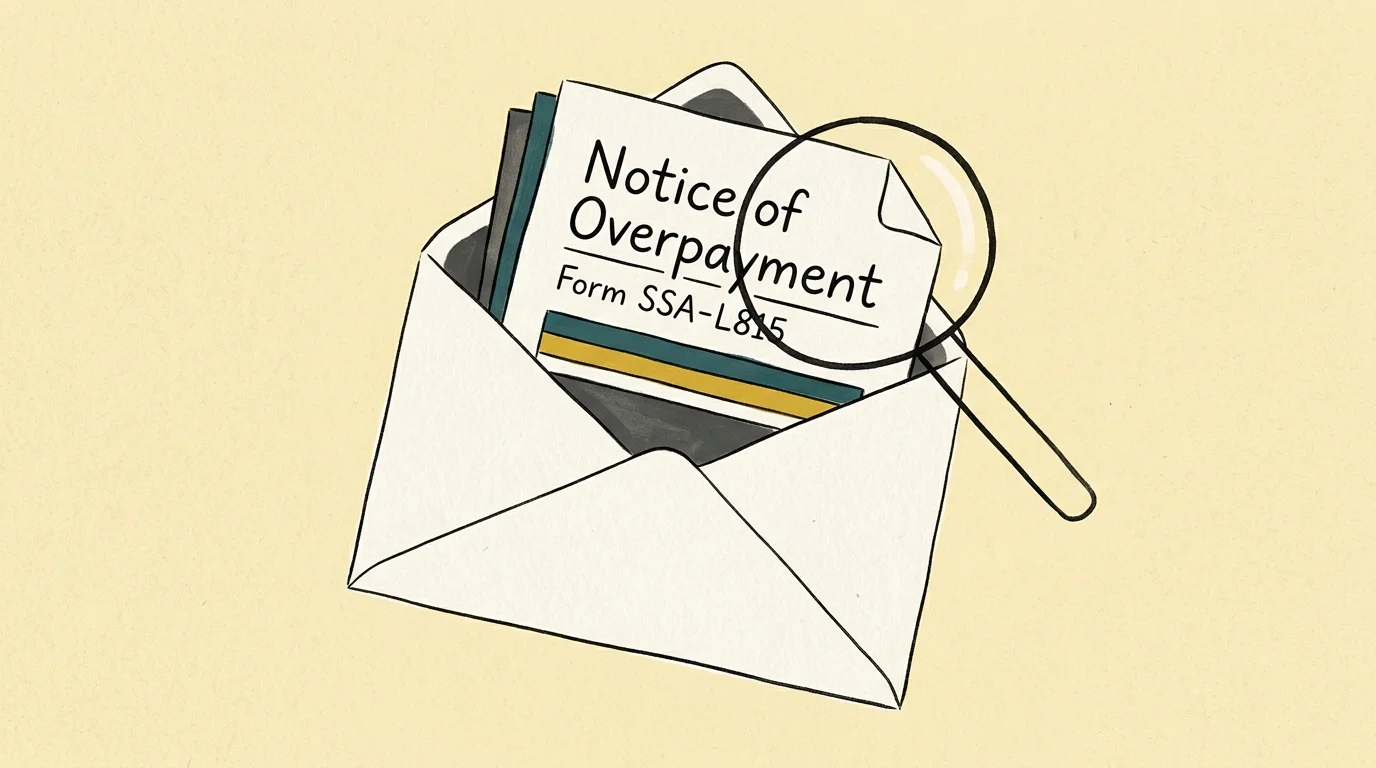
When an overpayment notice arrives, it typically consists of a multi-page document titled Notice of Overpayment (often categorized internally under designations like Form SSA-L815 or SSA-L816). Reading this document carefully provides the foundation for your defense strategy. Do not set the letter aside out of frustration; key deadlines begin ticking the exact day you receive it.
The notice contains four vital pieces of information that govern your next steps:
- The Presumed Total Amount Owed: The gross financial balance the agency claims it paid you incorrectly over a specified timeframe.
- The Direct Explanation of Overpayment: The agency’s stated reason why the overpayment occurred, such as unreported wages, benefit miscalculation, or marital status adjustments.
- The Proposed Withholding Method: The precise monthly benefit deduction the agency plans to implement to recoup the balance.
- Your Legal Appeal and Waiver Rights: Statutory information detailing your right to dispute the claim, request forgiveness, or propose an alternative repayment schedule.
Reviewing these components allows you to determine whether the government made a factual mistake or whether you need to request a formal waiver based on financial necessity.
Crucial Timelines: The 30-Day and 60-Day Rules
Time controls your rights when dealing with Social Security overpayment claims. Missing federal regulatory windows severely limits your options and gives the agency full legal authority to start withholding money directly from your monthly checks.
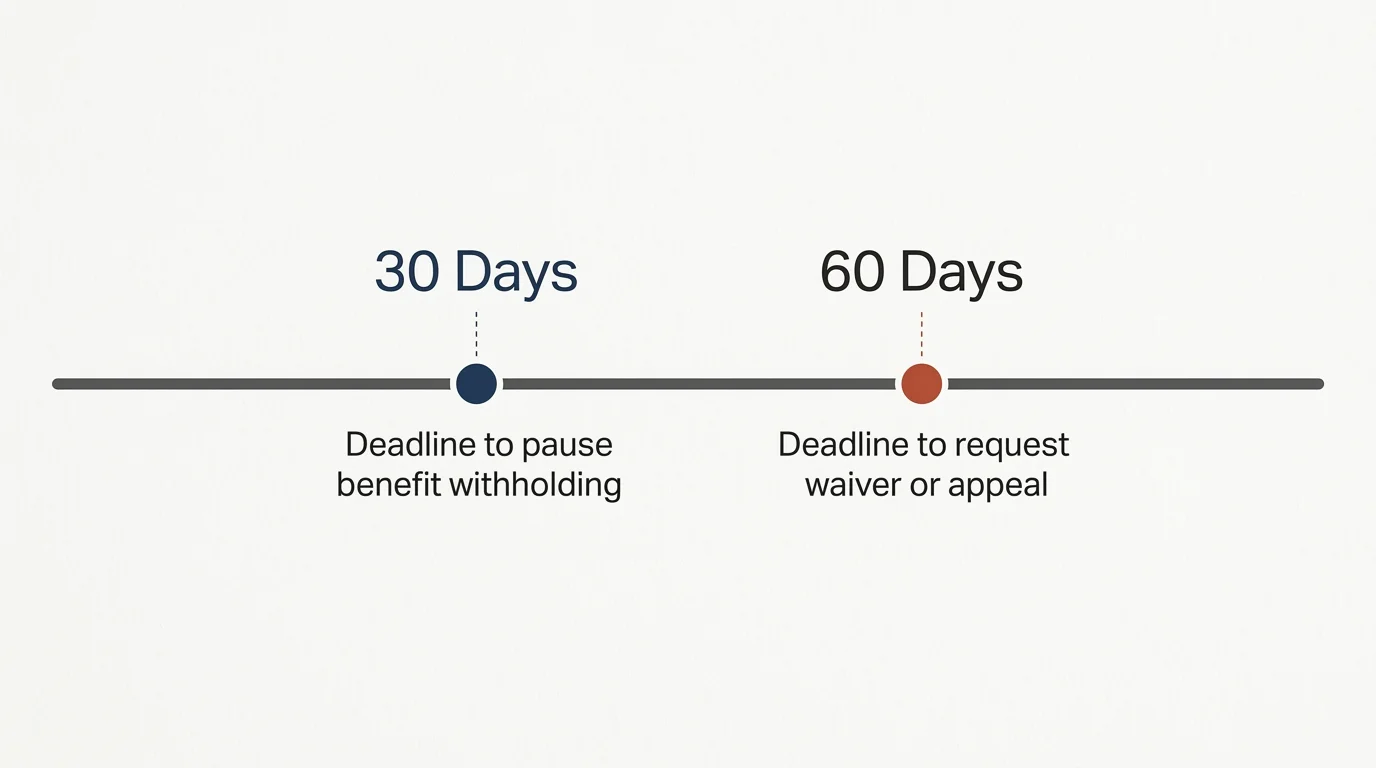
Two critical timeframes dictate how you must respond after receiving an overpayment demand:
- The 30-Day Collection Pause Window: The Social Security Administration must wait at least 30 days after sending an overpayment notice before initiating benefit reductions. If you submit a formal appeal or file a request for a waiver within 30 days of receiving the notice, the agency must freeze all recovery actions immediately. Your full monthly checks will continue while officials review your file.
- The 60-Day Appeal Deadline: You have exactly 60 days from the date you receive the notice (plus five assumed mailing days) to file a formal Request for Reconsideration. Filing within this timeframe preserves your legal right to dispute whether the overpayment calculation is accurate.
If you miss the 60-day window without demonstrating good cause (such as serious illness or a death in the family), the agency considers the debt established, leaving a waiver request or a negotiated repayment plan as your remaining paths forward.
Appeal vs. Waiver: Selecting the Right Legal Strategy
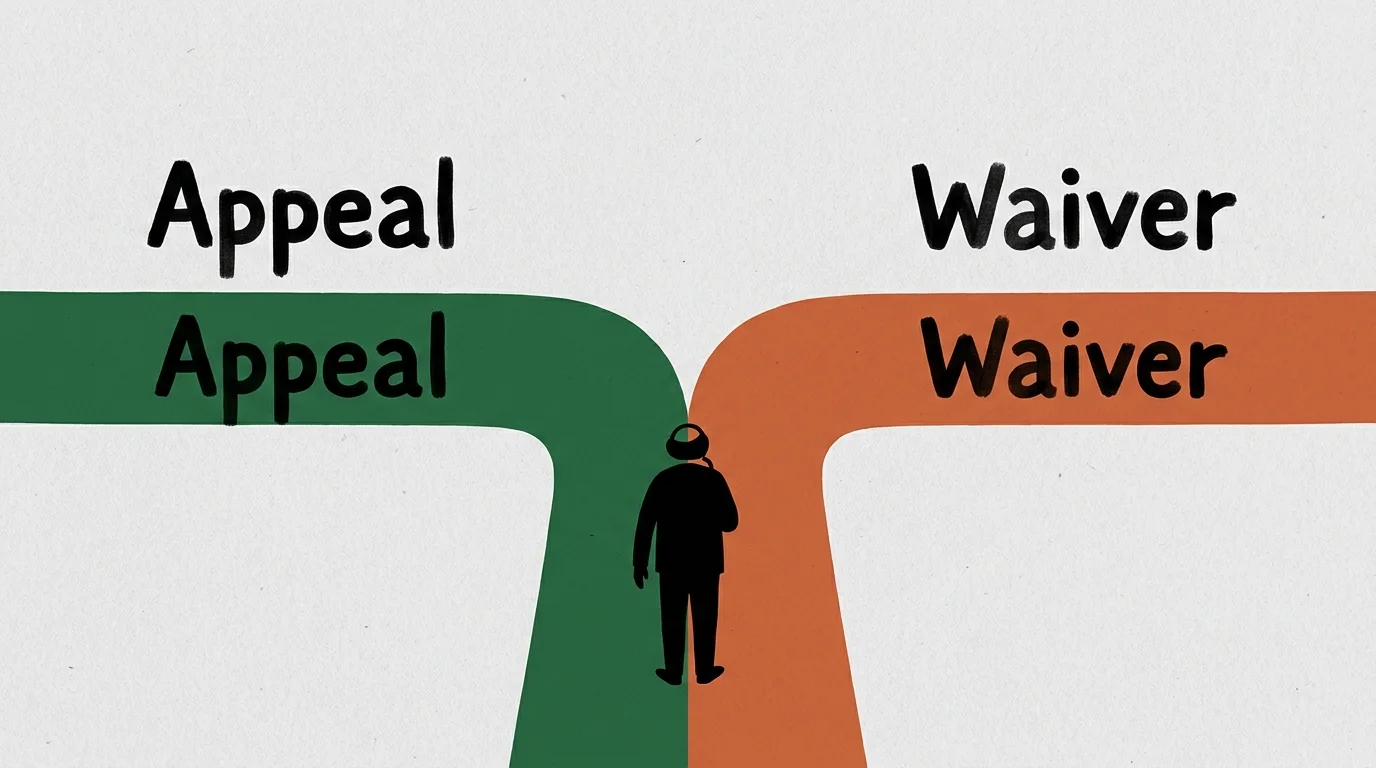
Retirees often confuse appealing an overpayment notice with requesting a waiver. These two remedies serve entirely distinct legal purposes. Choosing the correct path depends on whether you believe the government’s calculations are fundamentally wrong or whether you accept that an overpayment occurred but cannot afford to repay it.
A Request for Reconsideration (Form SSA-561) represents a formal appeal. You choose this route if you believe the agency made a mistake. Examples include situations where the agency relied on incorrect tax figures, mixed up your identity with someone else, or double-counted wages. When filing an appeal, you assert that you do not owe the money.
A Request for Waiver of Overpayment Recovery (Form SSA-632-BK) represents a request for debt forgiveness. You choose this route when you acknowledge that an overpayment occurred (or choose not to dispute it), but you meet specific statutory requirements for relief. Under federal law, the Social Security Administration will grant a full waiver only if you satisfy a mandatory two-prong legal standard:
- You Were Without Fault: The overpayment did not result from any deliberate statement, failure to furnish material information, or acceptance of payments you knew (or should have known) were incorrect.
- Repayment Causes Hardship or Violates Equity: Forcing you to repay the funds would deprive you of income needed for ordinary and necessary living expenses, or enforcement would be against equity and good conscience.
“When dealing with government clawbacks, documentation is your greatest shield; never accept an administrative error as an obligation until you examine every paper trail.” — Jean Chatzky, Personal Finance Expert
To evaluate which approach fits your scenario, consult the comparison table below.
| Strategy Option | Primary Form Used | Core Legal Argument | Impact on Monthly Checks | Key Deadline |
|---|---|---|---|---|
| Appeal (Reconsideration) | Form SSA-561 | “The Social Security Administration’s numbers or facts are incorrect.” | Pauses recovery if filed within 30 days of notice receipt. | 60 days from receipt (+ 5 days mail grace period). |
| Waiver Request | Form SSA-632-BK | “The error was not my fault, and repayment causes financial hardship.” | Pauses recovery if filed within 30 days of notice receipt. | |
| Repayment Plan | Form SSA-634 | “I owe the debt, but I need a manageable monthly payment schedule.” | Replaces full withholding with a negotiated lower deduction. | Can be requested at any point during active debt recovery. |

New Protections and Repayment Limits You Should Know
Public scrutiny and administrative reforms introduced in recent years shifted how the agency recovers overpayment balances. Previously, if you failed to respond quickly, the agency could withhold 100% of your monthly retirement check until it recovered the full amount, leaving vulnerable seniors without basic living funds.
Under updated operating standards (including Emergency Message EM-25029), significant administrative safeguards protect beneficiaries:
- Reduced Default Withholding for Title II Benefits: For Social Security retirement, spousal, and disability benefits, the default withholding rate for new overpayments drops from 100% down to 50% of the monthly benefit amount. While losing half your check remains a serious burden, it eliminates instant full benefit confiscation.
- Protections for Supplemental Security Income (SSI): Default overpayment withholding for SSI beneficiaries remains capped at 10% of the monthly benefit or $10, whichever is greater.
- Extended 60-Month Repayment Schedules: If you cannot afford the default withholding rate, you can negotiate a monthly repayment plan spread across up to 60 months (5 years) without submitting detailed personal asset disclosures or bank statements.
These rules give you significant leverage to negotiate an affordable monthly payment if an appeal or waiver is not viable.
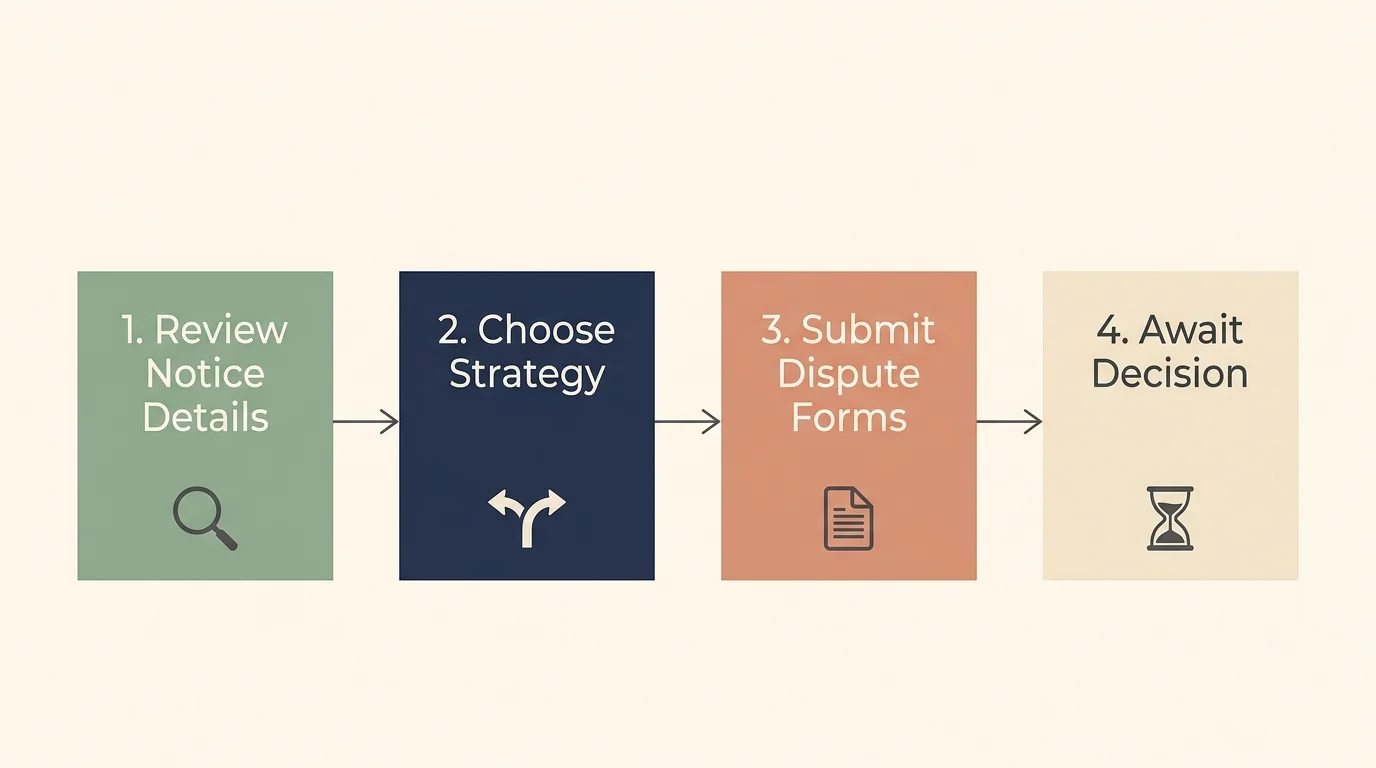
Step-by-Step Guide to Disputing or Negotiating an Overpayment
If an overpayment letter arrives at your home, taking systematic action protects your bank account and ensures the agency hears your dispute properly. Follow these concrete steps to manage the process effectively:
Step 1: Document the Envelope and Delivery Date. Write down the exact date you received the notice on the envelope itself. Store the original letter and envelope in a dedicated folder. This date establishes your 30-day and 60-day legal windows.
Step 2: Collect Relevant Financial Records. Gather W-2 forms, tax transcripts, pay stubs, bank statements, and any written correspondence you sent to or received from the agency during the period in question. Demonstrating that you attempted to report wage increases or life changes in good faith serves as crucial evidence for a waiver claim.
Step 3: Select and Complete the Correct Official Forms. Download the appropriate documentation directly from official resources like the Social Security Administration. Complete Form SSA-561 for appeals or Form SSA-632-BK for waivers. Fill out every section thoroughly, detailing your monthly household expenses down to the dollar if requesting a financial hardship waiver.
Step 4: Submit Documents via Tracked Delivery. Never rely on standard postal mail without tracking when sending legal forms to federal offices. Send your completed packages via Certified Mail with Return Receipt Requested, or hand-deliver them to your local field office. If delivering in person, demand that the clerk stamp a duplicate copy with the official date as your physical proof of submission.
Step 5: Follow Up and Confirm Collection Suspension. Contact your local office ten business days after filing to confirm that staff logged your paperwork and paused collection actions. Verify that your next scheduled benefit check will arrive without unexpected deductions.
Common Mistakes to Avoid
Handling government communications requires strict adherence to administrative procedures. Avoid these common missteps that can cost thousands of dollars or compromise your legal protections:
- Ignoring the Notice in Disbelief: Assuming an obvious agency error will fix itself without your intervention leads to automatic benefit reduction once the 30-day window expires.
- Relying Solely on Phone Conversations: Calling an agency representative on the phone does not stop statutory appeal deadlines. Unregistered phone conversations rarely generate official administrative stays on collection actions. Always submit formal written forms.
- Draining Retirement Savings Early: Taking lump-sum distributions from an IRA or 401(k) to clear a disputed overpayment creates unexpected income tax liabilities and permanently shrinks your retirement nest egg. Exhaust all administrative appeals and waiver options first.
- Failing to Prove Lack of Fault: Submitting Form SSA-632-BK while stating “I did not check my statements” can cause the agency to deny your waiver. You must prove you actively tried to comply with reporting rules or had no reason to suspect an overpayment occurred.
- Missing the 30-Day Window to Stay Collection: Waiting until Day 45 to file your paper appeal will still register the appeal within the 60-day legal limit, but the agency may still reduce your checks while reviewing the case because you missed the 30-day collection pause cutoff.

Professional vs. Self-Guided Dispute Resolution
Determining whether to manage an overpayment dispute on your own or hire legal representation depends on the financial complexity and dollar amount involved. Review these practical scenarios to decide the best path for your circumstances.
Scenario 1: Simple Earnings Calculation Discrepancy (Self-Guided)
If the agency claims an overpayment under $2,000 because of an easily explainable wage reporting lag, you can generally manage this process yourself. Submitting Form SSA-561 alongside copies of your W-2s or pay stubs clearly demonstrates the accounting discrepancy without requiring expensive legal help.
Scenario 2: Multi-Year Overpayment Demands Exceeding $10,000 (Professional Help Recommended)
When an overpayment claim spans several years and demands tens of thousands of dollars, self-guided forms can become risky. Working with an elder law attorney, legal aid advocate, or accredited disability representative ensures your documentation meets strict federal standards during administrative hearings. You can find guidance through organizations like the National Council on Aging or local legal assistance clinics.
Scenario 3: Severe Financial Hardship Requiring Full Waiver (Self-Guided with Local Advocate)
If you rely entirely on Social Security to cover basic survival expenses like rent, utilities, and prescription medications, you can successfully file Form SSA-632-BK on your own. Presenting detailed household budgets alongside utility bills and medical receipts demonstrates that debt recovery would violate equity principles. Local senior centers and consumer aid groups like the Consumer Financial Protection Bureau offer public guides to assist in documenting household financial stress.
Scenario 4: Dual Entitlement and Complex Pension Adjustments (Professional Help Recommended)
Cases involving intersecting rules—such as Supplemental Security Income, spousal survivor benefits, and non-covered public pensions—present deep statutory hurdles. Enlisting professional assistance prevents simple paperwork mistakes from triggering secondary tax issues or improper wage garnishments.

Protecting Your Cash Flow During an Ongoing Dispute
While an overpayment review moves through federal channels, protecting your day-to-day liquidity is essential. If an unexpected benefit deduction occurs due to processing lags, your bank account balance can drop rapidly, leading to bounced checks or unpaid essential bills.
Maintain a secondary emergency cash cushion inside a liquid account to cover critical expenses like prescription drugs, food, and housing costs. If the government inadvertently reduces your check while a timely appeal is pending, present your certified submission receipt directly to a local field office manager. Staff can issue emergency expedited payments to correct unauthorized collection withholdings.
Additionally, monitor consumer advocacy updates from organizations like AARP, which actively track policy shifts regarding senior benefit protections and administrative debt recovery guidelines.

Practical Next Steps for Retirees
Receiving an overpayment notice requires immediate, organized action. Open every piece of mail from the Social Security Administration promptly, calculate your exact filing deadlines, and assemble your financial records into a clear timeline. Whether you file a Request for Reconsideration to dispute an error or request a Waiver of Overpayment Recovery based on financial hardship, taking control within 30 days keeps your retirement checks flowing uninterrupted while your case undergoes formal review.
The information in this guide is meant for educational purposes. Your specific circumstances—including income, savings, health coverage, and goals—may require different approaches. When in doubt, consult a licensed professional.
Frequently Asked Questions
How far back can the Social Security Administration go to collect an overpayment?
Under current federal law, there is no statute of limitations on collecting Social Security overpayments. The agency can legally seek recovery for improper payments issued ten, twenty, or even thirty years prior, regardless of how much time has passed since the administrative error occurred.
Will Social Security take my entire monthly check if I receive an overpayment notice?
No. Updated regulations cap default withholding rates for Title II retirement and disability benefits at 50% of your monthly benefit amount. For Supplemental Security Income (SSI), default withholding is capped at 10% or $10, whichever is greater. You can also negotiate lower payment schedules spread across up to 60 months.
What happens if my request for an overpayment waiver is denied?
If the agency denies your initial waiver application, you have the right to request a formal administrative hearing before an Administrative Law Judge (ALJ). You can present detailed financial evidence, personal testimony, and supporting witness documentation at this hearing to demonstrate lack of fault and financial hardship.
Can I keep receiving my full benefit while my overpayment appeal is being reviewed?
Yes, provided you submit your appeal (Form SSA-561) or waiver request (Form SSA-632-BK) within 30 days of receiving the initial overpayment notice. Filing within this 30-day window legally pauses all benefit collection actions until the agency reaches a formal decision.
Last updated: February 2026. Retirement benefits, tax laws, and healthcare costs change frequently—verify current details with official sources.