Receiving an adverse decision or an unexpectedly low benefit calculation from the Social Security Administration does not mean the government’s ruling is final. In fact, filing an appeal often dramatically increases your odds of securing the monthly retirement, disability, or survivor income you earned through decades of work. Administrative staff handle millions of claims every year, making clerical mistakes, misinterpreting medical documentation, and misapplying complex statutory formulas remarkably common. If you know when to challenge an unfavorable ruling and act within the strict 60-day statutory window, you can rectify costly agency errors, restore your rightful benefits, and safeguard your financial security throughout retirement.

Understanding the Social Security Appeals Landscape
Most Americans assume that a ruling from the Social Security Administration (SSA) is conclusive. When an initial claim comes back denied or a benefit statement arrives with a smaller monthly payout than anticipated, many claimants simply walk away. Doing so can cost you tens of thousands of dollars over the course of your retirement.
Data from the Social Security Administration consistently reveals that the majority of initial disability and complex benefit applications face rejection. Approximately 62% to 64% of initial applications are denied. However, these denials frequently reflect administrative bottlenecks, missing documentation, or rigid initial screening protocols rather than a legitimate lack of eligibility. By taking advantage of the formal Social Security appeal process, you move your claim past automated filters and entry-level reviews into comprehensive evaluations where substantive evidence receives closer inspection.
| Appeal Level | Required Form | Who Reviews Your Case | Typical Approval Rate |
|---|---|---|---|
| 1. Reconsideration | Form SSA-561 | An independent SSA examiner who had no role in the initial denial | 13% – 16% |
| 2. Administrative Law Judge (ALJ) Hearing | Form HA-501 | An independent Administrative Law Judge via formal hearing | 50% – 59% |
| 3. Appeals Council Review | Form HA-520 | SSA Administrative Appeals Judges reviewing legal/procedural errors | 1% – 3% direct grant (many remanded) |
| 4. Federal District Court | Civil Complaint | Federal District Court Judge | 40% – 50% remanded or reversed |
As the data illustrates, your statistical probability of success changes dramatically depending on how far you carry your appeal. While filing a Social Security reconsideration request yields a modest approval rate, proceeding to an Administrative Law Judge (ALJ) hearing offers claimant approval rates between 50% and 59%. Recognizing the specific red flags in your determination letter is the first step toward reclaiming your benefits.
“The most expensive financial advice is free advice that happens to be wrong; knowing the statutory rules and your administrative rights gives you absolute leverage over bureaucratic errors.”
— Ed Slott, CPA and Retirement Distribution Specialist
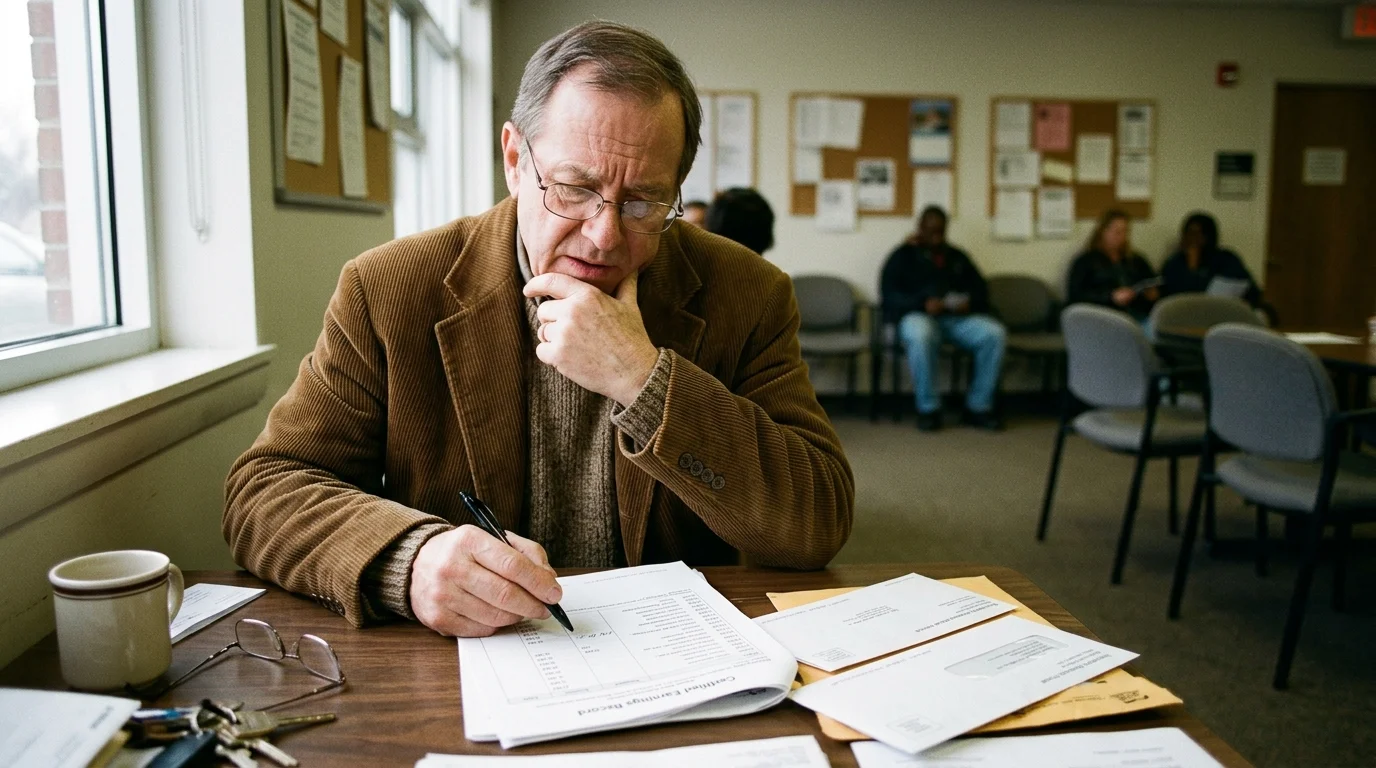
Sign 1: Your Certified Earnings Record Contains Missing Years or Inaccuracies
Your monthly retirement, spousal, and disability benefits rest entirely on your highest 35 years of indexed earnings. If your lifetime earnings record at the SSA contains missing years, incorrect wage entries, or uncredited self-employment income, the agency will calculate a Primary Insurance Amount (PIA) that is substantially lower than what you actually earned.
Employers occasionally submit incorrect W-2 forms, transpose digits in Social Security numbers, or fail to report earnings properly under corporate name changes. If you took time off, changed jobs frequently, or worked as an independent contractor, these discrepancies can go unnoticed until you formally claim your monthly benefits.
Under federal regulations (20 CFR § 404.802), claimants generally face a statutory time limit of three years, three months, and 15 days following the end of the calendar tax year in which wages were earned to correct an earnings record. However, several critical exceptions allow you to fix errors beyond this window, including:
- Correcting an entry to conform with tax returns filed with the Internal Revenue Service (IRS);
- Allocating wages that an employer failed to report at all;
- Resolving mathematical or mechanical transcription errors made directly by SSA processing staff.
If your benefit award notice reflects zero-income years where you know you paid Federal Insurance Contributions Act (FICA) taxes, appealing the calculation with your historical W-2s, tax returns, or pay stubs will permanently increase your monthly check.

Sign 2: The SSA Miscalculated Your Benefit Formulas or Applied Offsets Incorrectly
Social Security calculation rules involve intricate statutory provisions that frequently cause administrative errors. When processing complex claims involving public pensions, multiple marriages, or early benefit reductions, agency staff sometimes apply statutory reductions incorrectly.
Two common culprits of calculation mistakes are the Windfall Elimination Provision (WEP) and the Government Pension Offset (GPO). These provisions reduce Social Security benefits for individuals who receive a pension from non-covered employment (such as certain state, municipal, or federal jobs where employees did not pay FICA taxes). However, the SSA frequently miscalculates these offsets by:
- Applying WEP when you already have 30 or more years of “substantial earnings” in covered employment, which exempts you from the provision entirely;
- Applying full WEP reductions that exceed the legal maximum limit (which cannot exceed one-half of your non-covered pension amount);
- Improperly slashing spousal or survivor benefits under GPO without verifying whether your government pension truly qualifies as non-covered service.
Additionally, if you claimed benefits after your Full Retirement Age (FRA) up to age 70, the agency must credit you with Delayed Retirement Credits (DRCs), which increase your baseline payout by 8% per year (two-thirds of 1% per month). If your award letter does not reflect these accrued credits, challenging the determination will correct your baseline payment and yield back pay for previous underpayments.
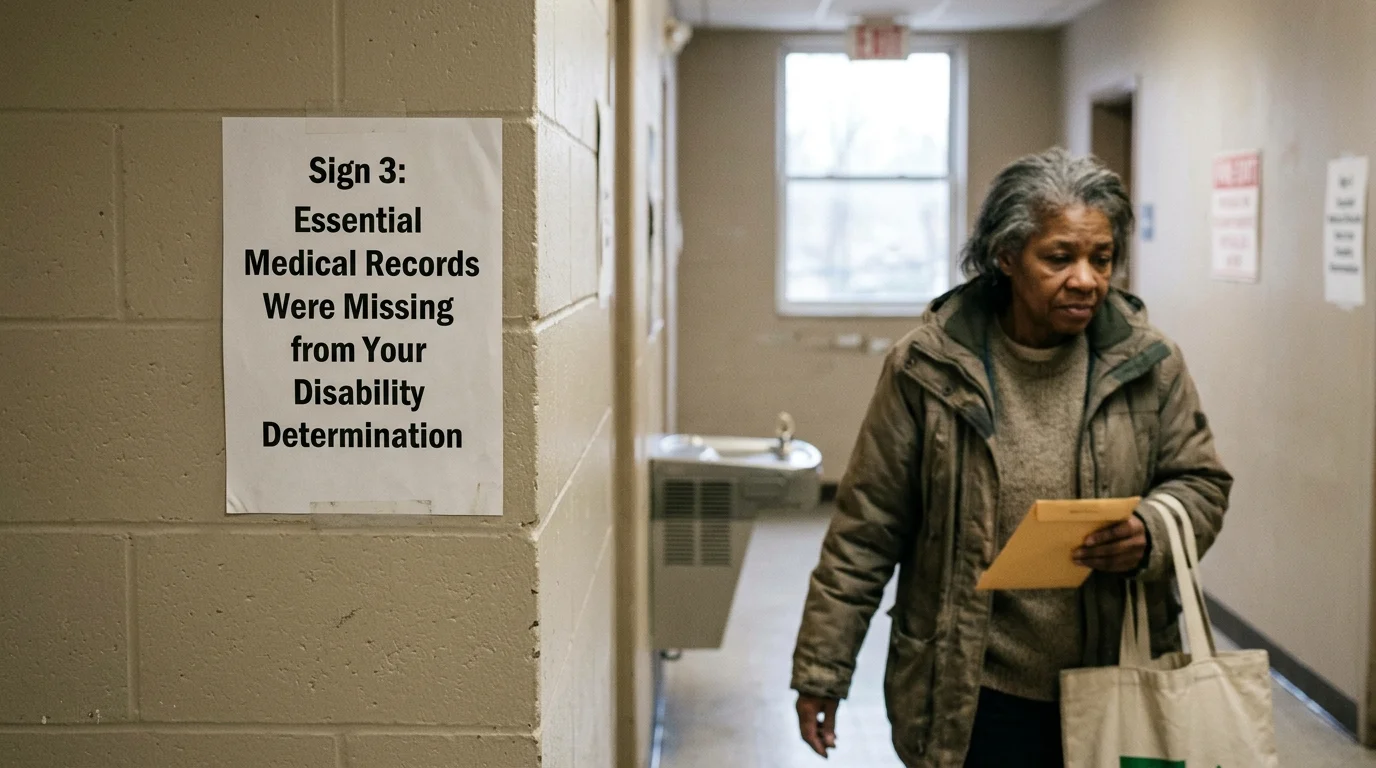
Sign 3: Essential Medical Records Were Missing from Your Disability Determination
When applying for Social Security Disability Insurance (SSDI) or Supplemental Security Income (SSI), the burden of proof rests squarely on your medical evidence. Disability Determination Services (DDS)—the state-level agency that evaluates medical eligibility for the SSA—routinely makes initial rulings before obtaining all relevant clinical records.
DDS examiners often send record requests to hospitals, specialists, and primary care physicians with short response windows. If your medical providers fail to send complete charts, diagnostic imaging, or operative reports in time, the examiner will evaluate your claim based solely on an incomplete file. In many instances, the formal denial notice will list the specific medical sources reviewed; examining this list often reveals that vital specialist evaluations or MRI scans were never received.
If you discover that DDS ruled against you without reviewing comprehensive treatment notes from your primary specialists, appealing the denial allows you to submit this missing documentation. Providing a comprehensive, longitudinal treatment history frequently turns an initial denial into an approval at the reconsideration or hearing stage.

Sign 4: Your Medical Condition Has Progressively Worsened Since Filing
The Social Security disability application process takes months—and often years. A degenerative or progressive condition that caused moderate functional limitations when you submitted your initial paperwork may deteriorate significantly while your file sits in an administrative queue.
If your functional capacity has declined, you should not submit a brand-new application. Filing a new claim resets your filing date, forfeits potential retroactive back pay, and forces you to restart the process from scratch. Instead, appealing the pending determination allows you to introduce updated clinical evidence demonstrating that your impairment now meets or equals an official SSA listing under the Blue Book regulations.
Critical evidence to add during your appeal includes:
- Recent surgical reports, hospital admissions, or emergency room visits;
- Updated imaging studies (e.g., MRIs, CT scans, X-rays) showing anatomical deterioration;
- Residual Functional Capacity (RFC) questionnaires completed by your treating physicians that clearly document your physical or mental limitations regarding sitting, standing, lifting, and maintaining workplace concentration;
- New clinical diagnoses that have developed as secondary complications to your primary condition.

Sign 5: You Received an Unjustified or Erroneous Overpayment Demand
Few communications from the federal government cause more distress than a Social Security Notice of Overpayment. These notices demand immediate repayment of thousands—sometimes tens of thousands—of dollars, asserting that the SSA issued excess payments due to unreported work activity, asset limits, or administrative miscalculations.
If you receive an overpayment demand, you must act rapidly. You have two distinct legal pathways, and choosing the right one (or combining both) depends on whether the agency’s underlying math is correct:
- Request for Reconsideration (Form SSA-561): Use this option when you dispute that an overpayment occurred, or when you believe the agency calculated the overpaid balance incorrectly.
- Request for Waiver of Overpayment Recovery (Form SSA-632): Use this option if an overpayment did occur, but it was not your fault and repaying the funds would deprive you of income needed for necessary living expenses or would be against equity and good conscience under 20 CFR § 404.506.
According to consumer guidance from the Consumer Financial Protection Bureau (CFPB) and advocacy groups like the National Council on Aging (NCOA), filing your appeal or waiver request within 30 days of the notice date legally halts all administrative withholding actions. The SSA cannot garnish your monthly benefit checks while your waiver or reconsideration request undergoes active adjudication.

Sign 6: The Rejection Was Based on Procedural Errors Rather Than Substantive Merit
A substantial percentage of adverse determinations stem from technical or administrative missteps rather than your actual qualifications. The SSA operates under strict technical rules, and minor communication breakdowns can trigger an automatic denial.
Common administrative errors that warrant an immediate appeal include:
- Failure to attend a Consultative Examination (CE): The SSA often schedules claimants for brief medical appointments with independent contract doctors. If the appointment notice was mailed to an outdated address or lost in transit, the agency will deny your claim for “failure to cooperate.”
- Alleged failure to provide information: If you mailed or faxed requested financial or vocational documents, but the local field office failed to scan them into your electronic folder, your claim may face an automatic procedural rejection.
- Insured status miscalculations: For SSDI, you must meet recent-work requirements (the 20/40 rule, requiring 20 work credits in the 40 quarters leading up to disability). Field offices occasionally misdate the Date Last Insured (DLI), wrongly asserting that you lack sufficient quarters of coverage.
Challenging a technical denial allows you to clear up procedural misunderstandings, provide proof of timely compliance, and force the agency to evaluate the substantive merits of your application.

Sign 7: Your Vocational Profile Qualifies You Under the Medical-Vocational “Grid Rules”
When evaluating disability claims for older adults, the SSA does not treat a 58-year-old claimant the same way it treats a 28-year-old claimant. Under the Medical-Vocational Guidelines (commonly referred to as the “Grid Rules” found in 20 CFR Part 404, Subpart P, Appendix 2), the agency explicitly recognizes that advancing age, limited education, and non-transferable job skills make adapting to new types of work exceedingly difficult.
Initial disability examiners often rely on computerized screening algorithms that classify claimants as capable of performing “other work” in the national economy, disregarding the nuances of the Grid Rules. However, if you meet the following criteria, the regulations frequently mandate a finding of disability:
- You are closely approaching advanced age (age 50 to 54) or are of advanced age (age 55 and older);
- Your physical limitations restrict you to sedentary or light work;
- Your past relevant work was unskilled, or your skilled/semi-skilled experience does not provide transferable skills to lighter occupations within your current residual capacity.
If an initial determination denied your claim by asserting that you can transition to light or sedentary jobs, an appeal before an Administrative Law Judge allows you to leverage the Grid Rules directly. Claimants who reach age 50 or 55 during the application process often win their appeals precisely because these vocational standards shift in their favor.

The 4 Levels of the Social Security Appeal Process
Navigating an appeal requires adhering strictly to the administrative hierarchy established by federal law. Skipping steps is not permitted; you must progress through each successive tier to keep your claim alive.
Level 1: Reconsideration
A reconsideration is a complete desk review of your file conducted by an examiner at the state agency (DDS) or field office who had no part in the original determination. You can submit new supporting evidence, updated financial records, or additional clinical notes online via the SSA website or using Form SSA-561. Although the statistical approval rate at this stage is relatively low (13% to 16%), it is a mandatory administrative prerequisite before requesting an in-person hearing.
Level 2: Hearing Before an Administrative Law Judge (ALJ)
The ALJ hearing is where claimants have the highest probability of success, with national approval rates averaging between 50% and 59%. Unlike previous stages, this proceeding is an independent evidentiary hearing. You appear before the judge (in person, by video conference, or via telephone) to provide sworn testimony regarding your daily limitations, work history, and symptoms. The judge will also question independent Medical Experts (ME) and Vocational Experts (VE). Having an experienced representative at this stage ensures that vocational testimony is properly cross-examined regarding job availability and workplace tolerances.
Level 3: Appeals Council Review
If the Administrative Law Judge issues an unfavorable ruling, you can request a review by the SSA Appeals Council in Falls Church, Virginia. The Appeals Council does not conduct a new hearing. Instead, it reviews the hearing transcript, judge’s written decision, and admitted exhibits to determine whether the ALJ committed an error of law, abused their discretion, or issued a ruling unsupported by substantial evidence. The Council may grant your claim directly, deny review, or remand (send back) the case to an ALJ for a brand-new hearing with corrective instructions.
Level 4: Federal District Court Review
If the Appeals Council denies your request for review, you have exhausted all administrative remedies within the executive branch. Your final option is filing a civil lawsuit against the Commissioner of the Social Security Administration in the appropriate U.S. District Court. Federal judges review the administrative record to ensure proper legal standards were applied. Claimants win remands or outright reversals in approximately 40% to 50% of federal court filings, making this a potent remedy for complex legal errors.

Critical Deadlines: The 60-Day Appeal Rule
Timeliness is paramount when challenging any Social Security determination. Missing a statutory deadline can result in the permanent dismissal of your appeal, forcing you to accept an incorrect benefit amount or forfeit years of retroactive back pay.
By statute, you have 60 days from the date you receive your denial or determination notice to file an appeal at any level. Federal regulations apply a 5-day mailing presumption, assuming you received the letter five calendar days after the date stamped on the notice. This effectively provides a 65-day total window from the notice date.
If you miss this window, the SSA will dismiss your appeal unless you can establish “good cause” under 20 CFR § 404.911. Good cause exceptions are narrow and require definitive proof, such as severe illness, hospitalization, death in the immediate family, or catastrophic loss of records due to natural disaster.
For individuals facing a termination of existing disability or non-medical monthly benefits, an even stricter timeline applies: you must file your appeal within 10 days of receiving the notice if you wish to request that your monthly payments continue uninterrupted throughout the reconsideration and hearing process.

Avoiding Common Errors When Appealing a Determination
Claimants frequently undermine their own appeals by making avoidable tactical errors. When challenging an adverse ruling, steer clear of these missteps:
- Filing a brand-new application instead of appealing: Many people mistakenly believe that reapplying is simpler than appealing. In reality, filing a new claim forfeits all accrued back pay, establishes a later protective filing date, and often results in an immediate summary denial under the legal doctrine of res judicata.
- Submitting disorganized or duplicate records: Flooding the administrative record with hundreds of pages of irrelevant medical bills or redundant records slows down your adjudication. Focus on submitting targeted diagnostic findings, functional assessments, and detailed physician letters.
- Ignoring the 10-day continuation rule: If your monthly benefits are being reduced or terminated, waiting until day 50 to appeal will forfeit your right to keep receiving checks while your appeal is evaluated.
- Failing to update contact information: If you move or change your phone number without notifying the SSA, you may miss consultative exam appointments or hearing notices, triggering an automatic dismissal.

When DIY Isn’t Enough: Working with Professional Representation
While you have the legal right to represent yourself throughout the entire appeals process, navigating administrative law hearings and vocational cross-examinations requires deep regulatory familiarity. Claimants represented by qualified attorneys or non-attorney representatives certified under SSA rules consistently experience higher approval rates at the ALJ hearing and Appeals Council levels.
Retaining representation for a Social Security appeal involves minimal upfront financial risk. Under federal statute (42 U.S.C. § 406), Social Security representatives work on a strictly regulated contingency-fee structure. Representatives cannot charge an upfront retainer for core representation; instead, their fee is legally capped at the lesser of 25% of your past-due back pay or $9,200, paid directly by the SSA only if you win your claim. If your appeal is unsuccessful, you owe no attorney fee.
Professional guidance is especially critical if your appeal involves:
- Cross-examining a Vocational Expert regarding subtle physical or mental limitations at an ALJ hearing;
- Interpreting complex business, corporate, or self-employment tax structures to correct your lifetime earnings record;
- Drafting formal legal briefs to the Appeals Council or filing complaints in Federal District Court;
- Defending against high-dollar overpayment allegations involving complex administrative fault determinations.
Frequently Asked Questions
How long does the Social Security appeal process typically take?
The duration varies significantly by appeal tier and regional backlog. A Reconsideration review generally takes three to six months. If your claim proceeds to an Administrative Law Judge hearing, the waiting period typically ranges from eight to 15 months depending on the specific hearing office’s caseload. Appeals Council reviews average an additional six to 12 months.
Can I submit new evidence during my appeal?
Yes. You can submit new medical, vocational, or financial evidence at the Reconsideration and ALJ hearing stages. However, under the SSA’s “5-day rule,” you must submit or inform the judge about all written evidence at least five business days before your scheduled ALJ hearing. At the Appeals Council stage, new evidence is only considered if it relates to the period on or before the date of the ALJ hearing decision and meets strict “good cause” standards for why it was not submitted earlier.
Will appealing an overpayment stop the SSA from garnishing my monthly checks?
Yes, provided you submit your Request for Reconsideration (Form SSA-561) or Request for Waiver (Form SSA-632) within 30 calendar days of the date on the overpayment notice. If submitted within this 30-day window, the SSA is legally prohibited from withholding or reducing your monthly benefit payments until an initial determination on your appeal or waiver is rendered.
What happens if I miss the 60-day appeal deadline?
If you miss the 60-day statutory window (plus the five-day mailing presumption), you must submit a written explanation requesting an extension for “good cause.” You must provide documented proof justifying the delay, such as a severe medical emergency, hospitalization, mental impairment, or evidence that you never received the notice. If the SSA determines you lacked good cause, your appeal will be dismissed, and the previous determination becomes final and binding.
Taking Action on Your Social Security Appeal
Receiving an unfavorable ruling from the Social Security Administration can feel overwhelming, but an administrative denial is simply the opening step in a structured legal process. By identifying calculation errors, gathering decisive medical evidence, and adhering strictly to statutory timelines, you take command of your retirement and disability benefits.
Review your notice letter carefully, check the date stamped at the top, and note your 60-day filing deadline immediately. Whether you manage your initial reconsideration online or hire experienced counsel for an Administrative Law Judge hearing, asserting your right to appeal ensures that bureaucratic oversights do not dictate your financial future.
This article provides general retirement education and information only. Everyone’s financial situation is unique—what works for others may not work for you. For personalized advice, consider consulting a qualified financial professional such as a CFP or CPA.
Last updated: February 2026. Retirement benefits, tax laws, and healthcare costs change frequently—verify current details with official sources.