
Your Social Security claiming strategy directly determines hundreds of thousands of dollars in guaranteed lifetime income, yet several critical filing missteps permanently reduce your monthly checks with zero opportunity for appeal. While the Social Security Administration provides narrow remedies for early filing regrets, most claiming choices lock in for life once strict regulatory windows expire. Navigating full retirement age rules, spousal coordination guidelines, earnings test thresholds, and healthcare surcharges requires clear foresight before submitting your application. By understanding these nine permanent Social Security errors before filing, you protect your retirement cash flow, preserve valuable spousal protections, and avoid irreversible cuts to your hard-earned benefits.
1. Claiming at Age 62 and Missing the 12-Month “Do-Over” Window
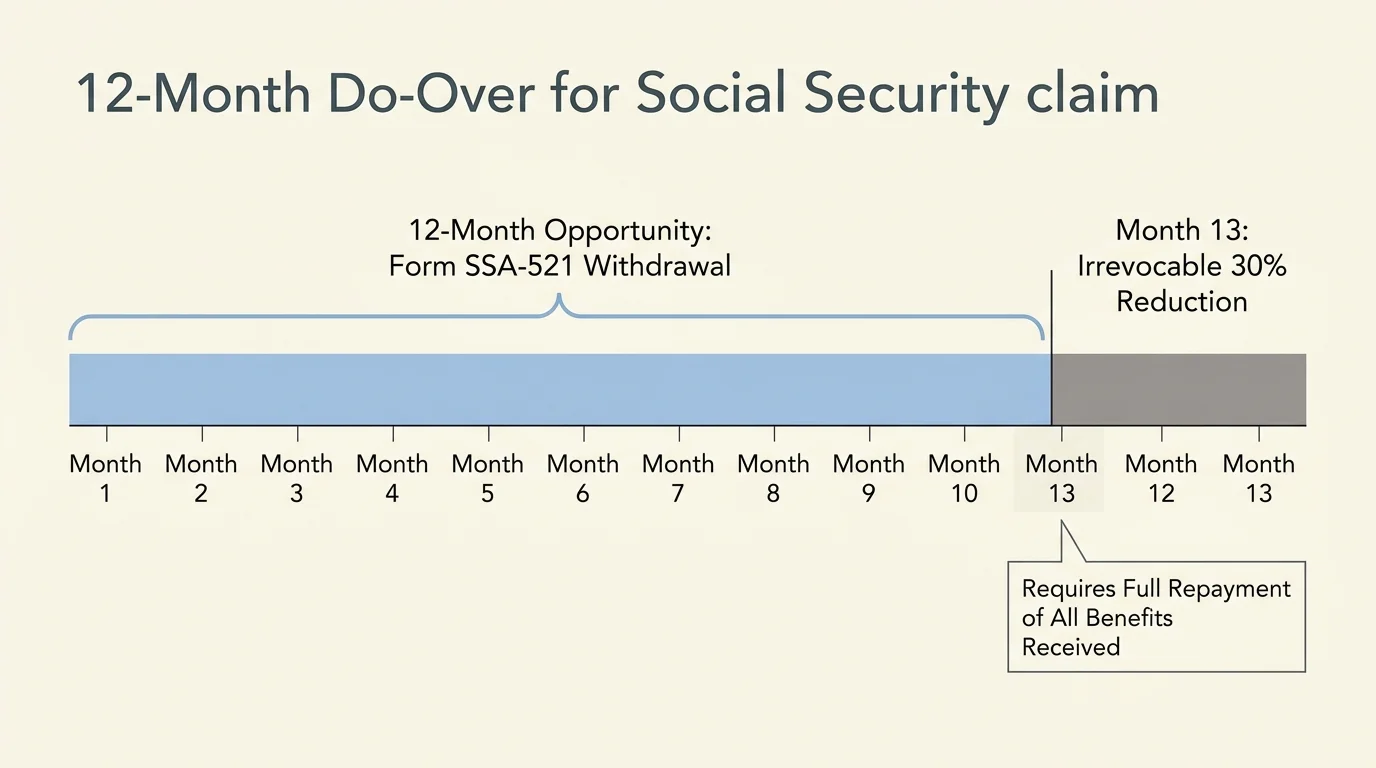
Filing for Social Security retirement benefits at age 62 is the most common way retirees lock in a permanent financial haircut. For anyone born in 1960 or later, Full Retirement Age (FRA) is 67. Claiming at age 62 permanently reduces your monthly retirement benefit by 30% for the rest of your life; spousal benefits claimed at 62 suffer an even steeper reduction of up to 35%.
The Social Security Administration (SSA) offers a narrow safety valve known as a withdrawal of application using Form SSA-521. However, this rule comes with two uncompromising restrictions:
- The 12-Month Clock: You must submit your withdrawal request within exactly 12 months of your initial entitlement date. Once month 13 arrives, the reduction is irrevocable.
- Full Repayment Mandate: You must repay every dollar received to date, including monthly payments, withheld Medicare Part B premiums, voluntary tax withholdings, and any auxiliary benefits paid to your spouse or children on your earnings record.
- One-Time Limit: You can only withdraw a claim once in your lifetime.
If you miss that 12-month cutoff or cannot produce the tens of thousands of dollars required to repay the agency in a single lump sum, your 30% reduction remains permanent. Over a 25-year retirement, that premature filing choice can easily cost an individual more than $100,000 in lost purchasing power.

2. Missing the Deadline to Fix Errors on Your SSA Earnings Record
The SSA calculates your Primary Insurance Amount (PIA) using your highest 35 years of indexed earnings. If an employer misreported your wages, transposed digits in your Social Security number, or failed to record earnings following a legal name change, your official record will reflect lower earnings—or an outright zero—for that year. That missing income permanently depresses your lifetime monthly benefit.
Under federal regulations (20 CFR § 404.802), the statutory time limit to correct an earnings record is exactly three years, three months, and 15 days following the close of the calendar year in which the wages were paid. After this limitations period expires, your earnings record becomes legally binding, and the agency will only correct errors under narrow exceptions, such as proving outright fraud or presenting specific tax returns filed before the deadline.
To prevent uncorrectable wage gaps, log into your personal account at SSA.gov annually. Review your verified earnings statement against your historical W-2 forms and tax returns before the statutory window closes.
3. Waiting Past Age 70 to Claim Delayed Benefits
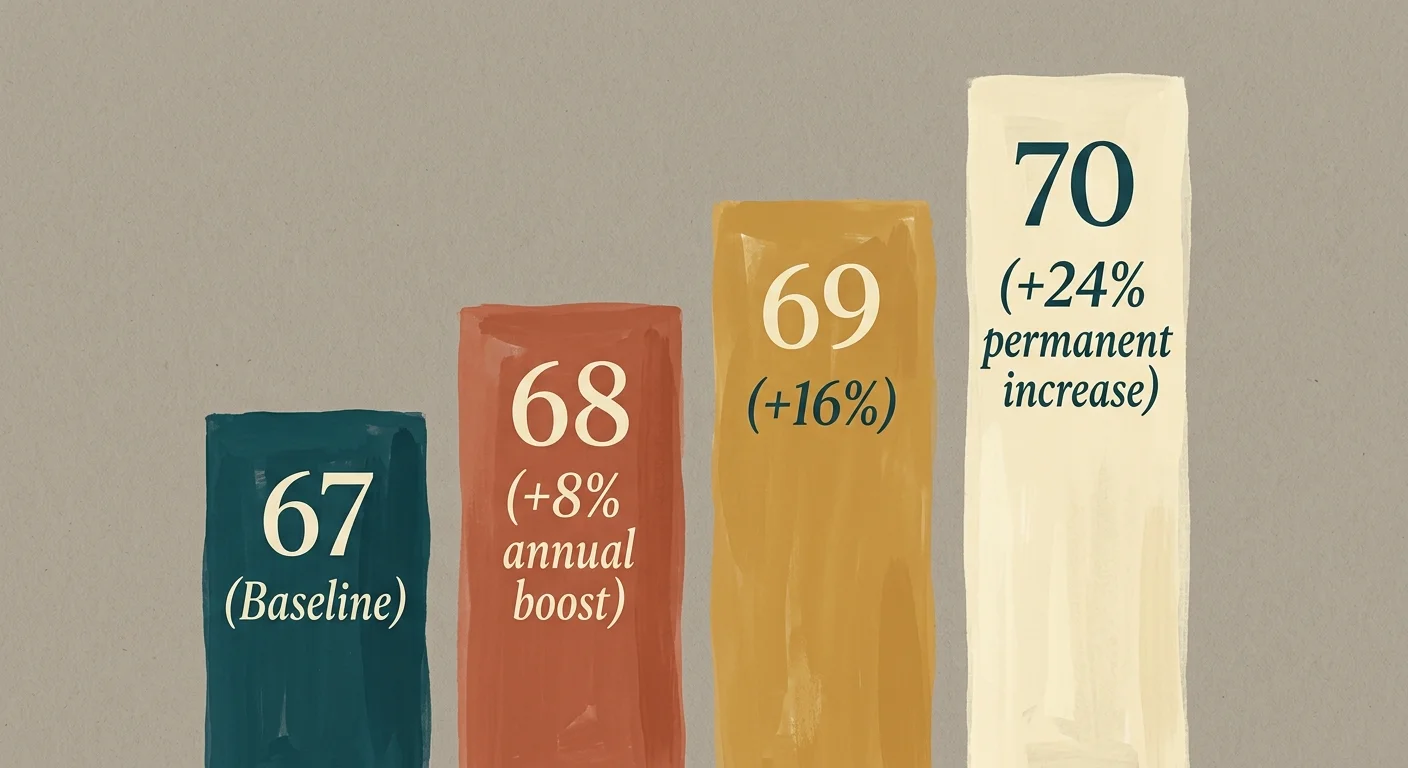
Between your Full Retirement Age and age 70, Social Security rewards your patience through Delayed Retirement Credits (DRCs). For every month you delay claiming past FRA, your benefit increases by two-thirds of 1%, equaling an 8% annual boost. For a worker whose FRA is 67, claiming at age 70 yields a permanent 24% increase above their base PIA.
However, delayed retirement credits stop completely at age 70. The agency provides zero additional financial incentive for delaying benefits past your 70th birthday. If you delay filing until age 71 or 72, you do not receive larger monthly checks; instead, you permanently forfeit every monthly payment issued during that elapsed time.
While the SSA permits up to six months of retroactive payments for claims filed after FRA, any unclaimed months beyond that six-month window vanish entirely. If you reach age 70, file immediately to prevent permanent asset destruction.
4. Accepting a 6-Month Retroactive Lump Sum at Full Retirement Age
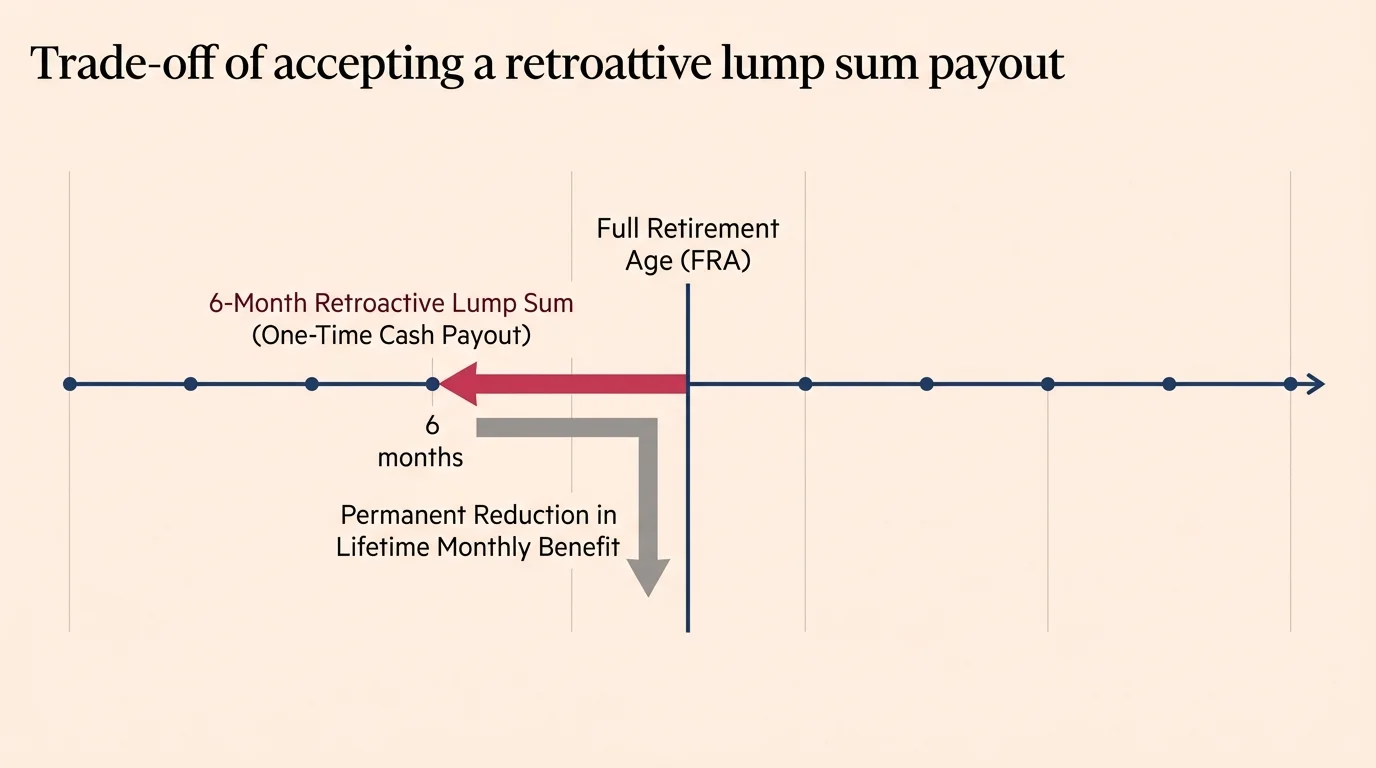
When you apply for Social Security benefits after reaching your Full Retirement Age—for instance, at age 69—the claims representative will often ask if you want a six-month retroactive lump-sum check. To many retirees, receiving an unexpected cash check for $15,000 to $20,000 sounds like a windfall. In reality, it represents a permanent structural trade-off.
Accepting a six-month retroactive payout resets your official entitlement date back by six months. Consequently, you permanently forfeit the six months of delayed retirement credits you accrued over that period—a permanent 4% reduction (0.667% per month × 6 months) across every future monthly check for the rest of your life.
Consider a retiree eligible for $3,500 per month at age 69. Taking the six-month retroactive lump sum rolls their benefit back to their age-68.5 level, permanently dropping their monthly check by roughly $140 per month. Because all future annual Cost-of-Living Adjustments (COLAs) compound on that lower baseline, the retiree will often lose far more in cumulative lifetime income than the initial lump sum provided, particularly if they live past average life expectancy.
5. Misunderstanding Deemed Filing When Coordinating Spousal Benefits
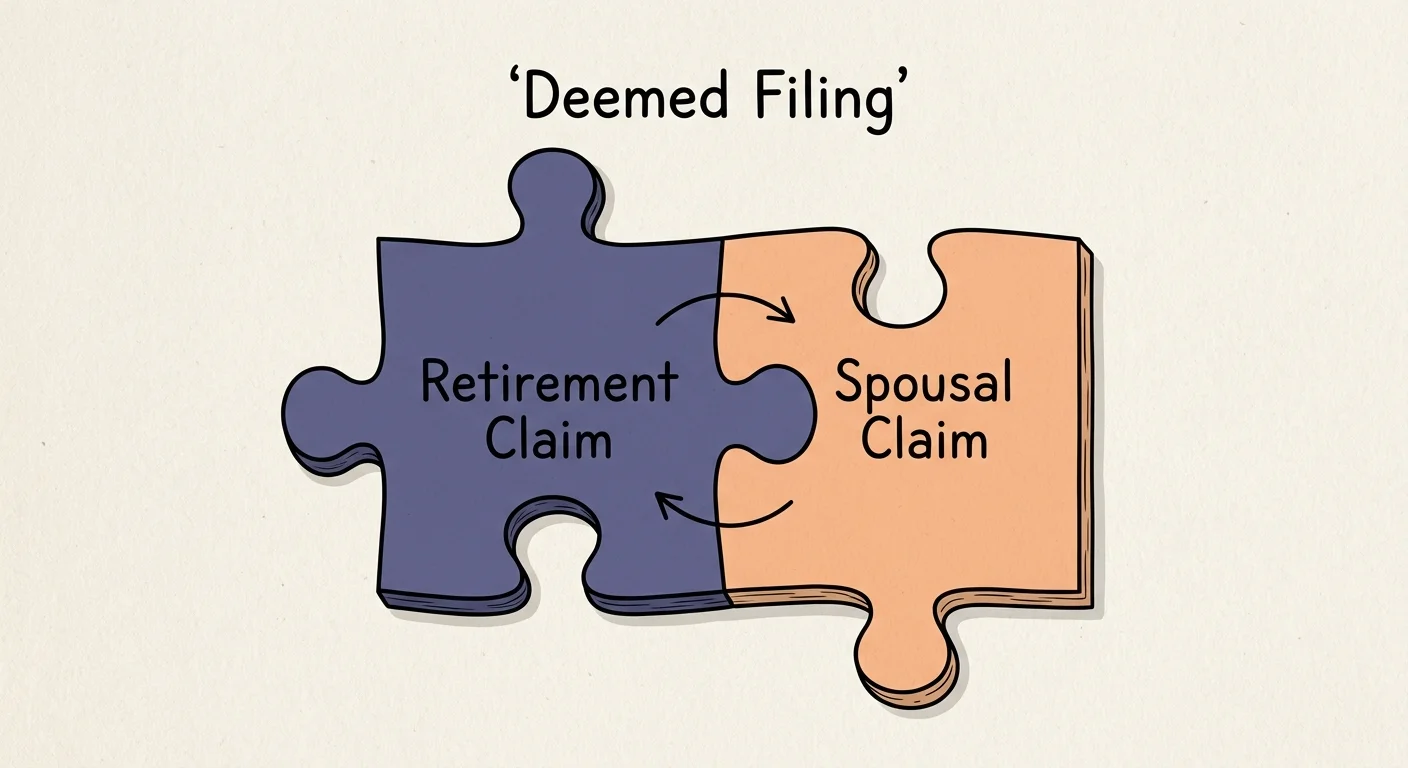
Prior to the passage of the Bipartisan Budget Act of 2015, retirees could file a “restricted application” for spousal benefits at FRA, collecting half of their spouse’s PIA while allowing their own worker benefit to grow by 8% annually until age 70. Congress eliminated this loophole for anyone born on or after January 2, 1954, through expanded “deemed filing” rules.
Today, when you apply for Social Security, you are deemed to have filed for both your own retirement benefit and any spousal benefits for which you are eligible. The SSA will automatically pay your own retirement benefit first; if your spousal benefit exceeds your own benefit, you receive an auxiliary top-up to equal the higher amount. You cannot choose to collect only the spousal benefit while letting your own record compound in the background.
If you claim early at age 62 assuming you can switch to your own full benefit at age 70, you will find yourself permanently locked into reduced payments across both records. The early filing penalty applies across the board, permanently eroding your household cash flow.

6. Locking Your Surviving Spouse into a Permanently Lower Benefit
One of the most devastating irreversible Social Security mistakes occurs when the higher-earning spouse claims benefits early without considering the survivor benefit implications. Social Security survivor rules dictate that when a worker dies, the surviving spouse can step up to receive 100% of the deceased worker’s actual benefit payout, provided the survivor has reached their own FRA.
If the higher-earning spouse files at age 62 and takes a permanent 30% reduction, they permanently cap the maximum survivor benefit available to their widow or widower. Even if the surviving spouse waits until age 67 to claim survivor benefits, they can never receive more than the reduced amount the primary earner locked in during their lifetime.
“Social Security is the only guaranteed, inflation-protected income source most Americans have. Making a claiming mistake doesn’t just hit you today—it echoes through your surviving spouse’s entire lifetime.” — Ed Slott, CPA and Retirement Distribution Expert
For married couples with significant earnings disparities, the higher earner should view their claiming date not merely as an individual retirement decision, but as a life insurance policy for the spouse projected to live longer.
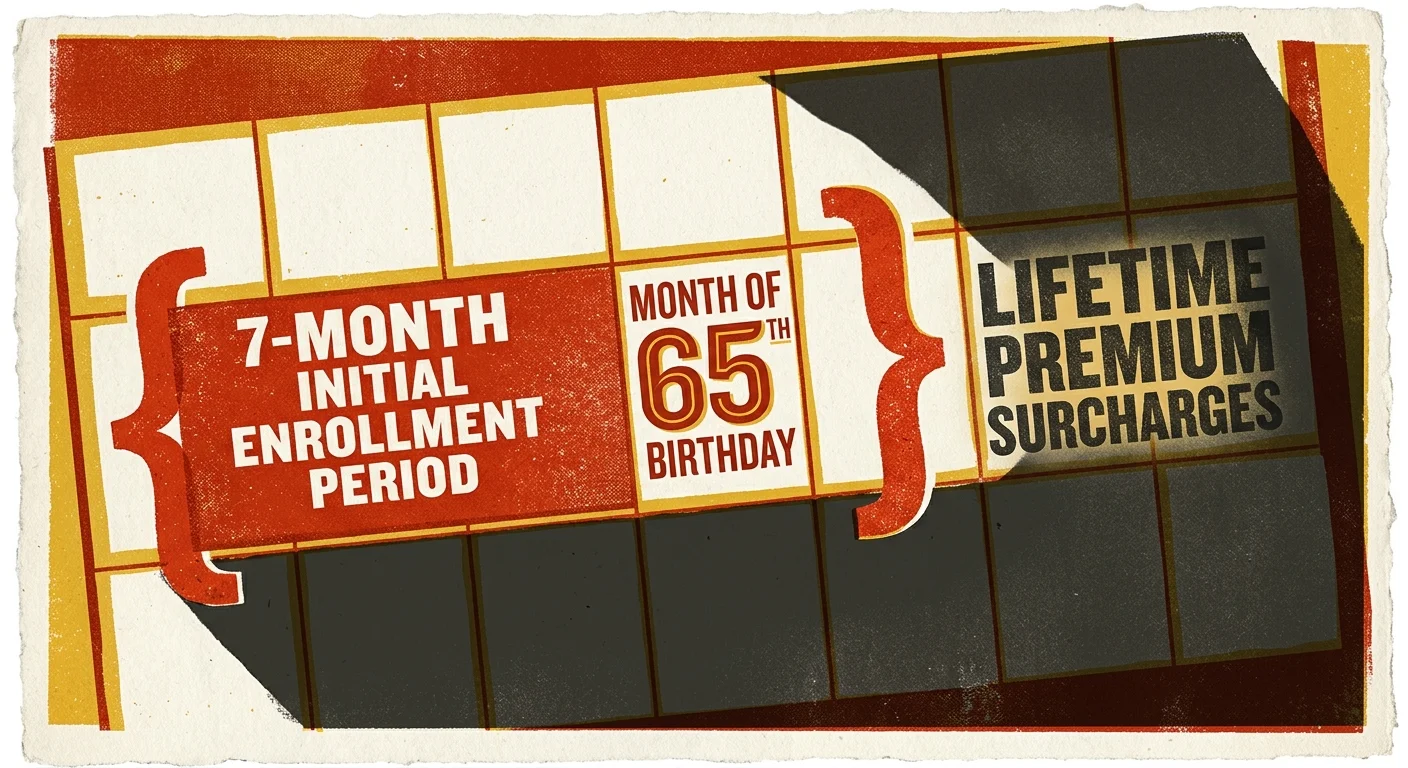
7. Missing the Medicare Part B Window and Triggering Lifetime Surcharges
Social Security and Medicare enrollment rules are tightly coupled. If you claim Social Security prior to age 65, the federal government automatically enrolls you in Medicare Part A and Part B when you turn 65. However, if you delay Social Security past age 65, you must manually manage your Medicare enrollment through Medicare.gov.
Unless you have qualifying health coverage through your own or your spouse’s active employer group plan (at a business with 20 or more employees), you must enroll during your 7-month Initial Enrollment Period (IEP), which spans three months before your 65th birthday month, your birth month, and three months after. Missing this window carries severe, irreversible penalties:
- Permanent Part B Premium Penalty: A 10% surcharge is added to your standard monthly Part B premium for every full 12-month period you were eligible but failed to enroll. This surcharge persists for the rest of your life.
- Coverage Gaps: You may face multi-month delays before coverage takes effect, leaving you vulnerable to catastrophic out-of-pocket medical bills.
- COBRA and Retiree Plan Traps: COBRA and individual retiree health plans do not count as active employer coverage; relying on them past age 65 without Part B triggers the permanent penalty.

8. Triggering the Retirement Earnings Test While Locking in Early Claiming Penalties
Many individuals file for benefits at age 62 intending to semi-retire, only to discover that continuing to work triggers the Social Security Retirement Earnings Test (RET). If you claim benefits before reaching your FRA and earn more than the statutory limits, the SSA temporarily withholds benefits.
For 2026, the lower annual earnings limit is $24,480. The agency withholds $1 in benefits for every $2 earned above that threshold. In the calendar year you reach Full Retirement Age, a higher limit applies—$65,160 in 2026—where the agency withholds $1 for every $3 earned above the limit until the month you reach FRA. (For context, the 2025 thresholds were $23,400 and $62,160, respectively.)
While the SSA recalculates your benefit at FRA to credit back months in which benefits were fully withheld, the early claiming filing election itself remains intact. If you earned just enough to keep some benefits but not enough to trigger full withholding, you remain saddled with an early filing reduction. If more than 12 months have passed since your initial application, you cannot execute a Form SSA-521 withdrawal to undo your early filing decision.
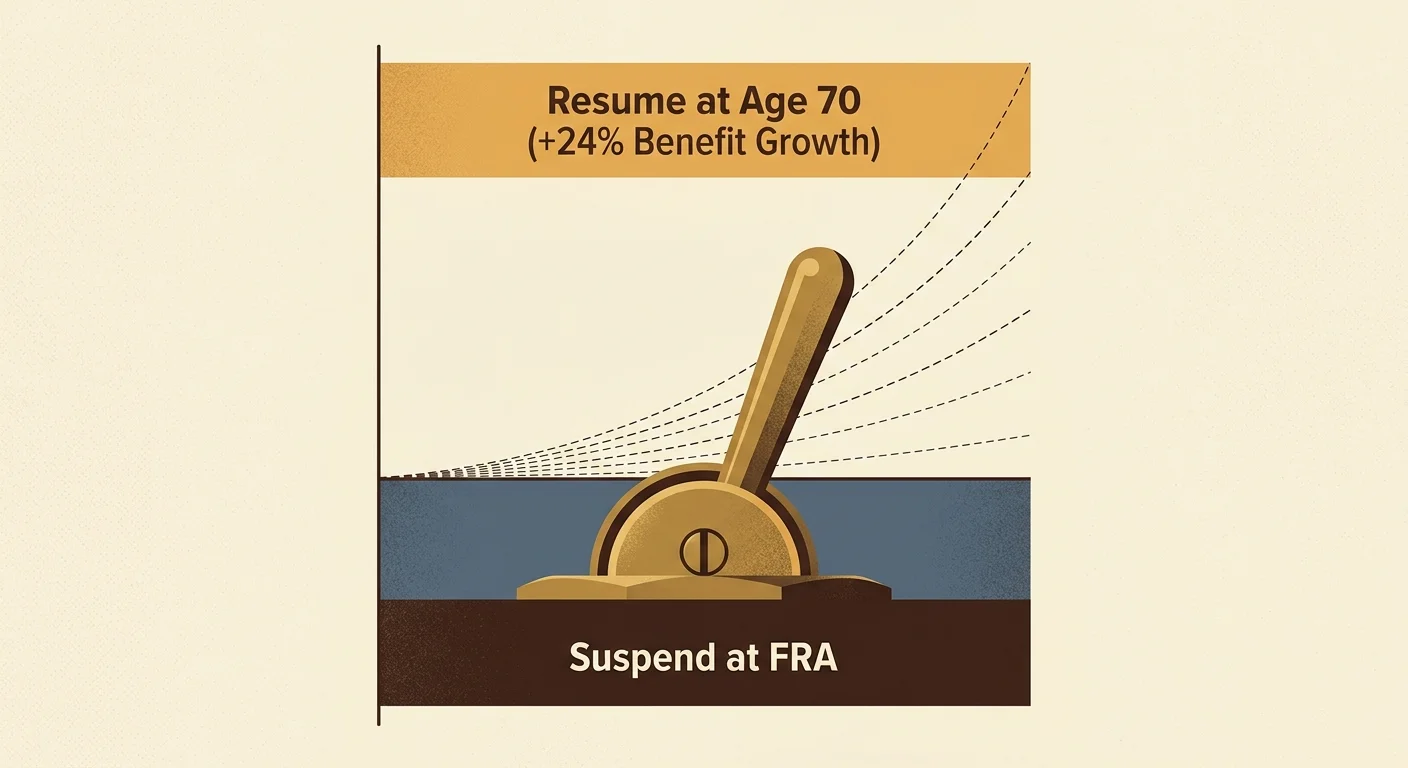
9. Suspending Benefits at Full Retirement Age Without Evaluating Auxiliary Payouts
If you filed early and missed the 12-month withdrawal window, you have a second option once you reach Full Retirement Age: voluntary suspension. By asking the SSA to suspend your payments between FRA and age 70, your benefit stops and begins accruing Delayed Retirement Credits at 8% per year, partially repairing your monthly baseline.
However, under the Bipartisan Budget Act of 2015, voluntarily suspending your benefit carries an important consequence: when you suspend your worker benefit, all auxiliary benefits paid to other individuals on your record—such as your spouse or minor dependent children—are automatically suspended as well. (Divorced spousal benefits are exempt from this restriction, provided the marriage lasted at least 10 years and the divorce occurred at least two years prior.)
Suspending your payments to gain delayed credits can abruptly eliminate necessary monthly cash flow for a dependent spouse or child. Once executed, you cannot selectively reinstate auxiliary benefits without unsuspending your own record.

Comparing Social Security Claiming Decisions: Flexibility and Permanence
Understanding which claiming decisions permit corrective action versus those that lock in permanently is essential for constructing a resilient retirement income plan.
| Claiming Decision | Reversibility Window | Financial Penalty / Consequence | Corrective Strategy |
|---|---|---|---|
| Early Filing at Age 62 | Within 12 months of entitlement | Permanent 30% monthly reduction if uncorrected | File Form SSA-521 and repay all distributed benefits in full |
| Earnings Record Discrepancy | 3 years, 3 months, 15 days from tax year | Lower lifetime Average Indexed Monthly Earnings (AIME) | Submit W-2 or tax returns to SSA before statutory deadline |
| Delaying Past Age 70 | Zero reversibility (6-month back-pay cap) | Complete loss of earned monthly income past age 70 | File immediately at age 70; claim up to 6 months retroactive pay |
| Retroactive Lump Sum at FRA | Irrevocable once processed | Permanent loss of up to 4% in Delayed Retirement Credits | Decline retroactive checks on application to maximize monthly check |
| Missed Medicare Part B at 65 | Irreversible lifetime surcharge | 10% permanent premium penalty for each 12-month delay | Enroll during 7-month IEP unless covered by active employer group plan |
| Voluntary Suspension at FRA | Flexible between FRA and age 70 | Freezes all spousal/dependent benefits on worker’s record | Model household cash needs before submitting suspension request |

Pitfalls to Watch For
Beyond the core claiming mistakes, several operational traps can complicate your retirement transitions:
- Relying on Front-Line SSA Personnel for Strategic Advice: Social Security claims representatives are trained to process paperwork and explain current eligibility, not optimize your long-term tax situation or household wealth. Asking a representative “When should I claim?” often leads to advice based on immediate cash flow rather than lifetime value.
- Overlooking the “Tax Torpedo”: Up to 85% of your Social Security benefits can become taxable depending on your “provisional income” (adjusted gross income + nontaxable interest + 50% of your Social Security benefits). Check current guidelines with the Internal Revenue Service (IRS) to prevent unexpected tax brackets when taking IRA distributions alongside benefits.
- Ignoring the Compounding Power of COLAs on Higher Bases: Annual Cost-of-Living Adjustments are percentages, not flat dollar amounts. A 3% COLA on a $3,500 monthly benefit delayed to age 70 adds $105 per month; that same 3% COLA on a $2,000 early benefit adds only $60 per month. Over a multi-decade retirement, this compounding gap widens significantly.

Getting Expert Help
Because unwinding a Social Security mistake is exceptionally difficult, specific complex scenarios require guidance from a licensed, fee-only Certified Financial Planner (CFP) or a specialized retirement analyst. Seek professional advice in the following situations:
- Substantial Age Gaps with Unequal Lifetime Earnings: If you and your spouse have an age difference of five or more years and disparate earning histories, optimizing the timing between primary retirement and survivor benefits requires dynamic actuarial modeling. Find credentialed fiduciaries through the CFP Board.
- Transitioning Business Owners Subject to the Earnings Test: If you own an S-Corporation, LLC, or partnership, determining what constitutes “earned income” versus investment distributions under the Retirement Earnings Test requires coordinated tax planning to avoid improper benefit withholding.
- Navigating Multiple Prior Marriages and Survivor Options: If you were married for at least 10 years, divorced, and subsequently remarried or widowed, evaluating whether to claim on a deceased ex-spouse, living ex-spouse, or current spouse demands detailed record analysis.
- Managing Large Pre-Tax IRA Balances: Retirees facing large Required Minimum Distributions (RMDs) at ages 73 or 75 must coordinate Social Security start dates with Roth conversions to avoid severe tax spikes and Medicare Income-Related Monthly Adjustment Amount (IRMAA) surcharges. Educational tools from the Consumer Financial Protection Bureau (CFPB) can assist in understanding these intersections.
Frequently Asked Questions
Can I change my mind after claiming Social Security early?
Yes, but only if you act within 12 months of your initial entitlement date. You must submit Form SSA-521 and repay all benefits received to date—including spousal payments, withheld taxes, and Medicare premiums. If more than 12 months pass, your early claiming decision cannot be undone, though you can voluntarily suspend benefits once you reach Full Retirement Age to earn delayed credits.
What happens if I delay claiming Social Security past age 70?
Delayed Retirement Credits permanently stop accumulating at age 70. Delaying past age 70 provides no additional monthly benefit increase. While you can claim up to six months of retroactive payments, any months past that six-month window represent lost income that you can never recover.
Does accepting a retroactive lump-sum check hurt my future benefits?
Yes. If you claim after Full Retirement Age and accept a six-month retroactive payout, the SSA rolls your claiming date back by six months. This permanently forfeits the delayed retirement credits you earned during that time, lowering your ongoing monthly benefit check for life.
How does my early retirement claim affect my spouse’s survivor benefit?
If you are the higher-earning spouse and claim early, you permanently limit the maximum survivor benefit your spouse can receive upon your death. While their own spousal benefit while you are alive is based on your Full Retirement Age amount, their ultimate survivor benefit is capped at the reduced monthly amount you were actually receiving.
Evaluating your Social Security options requires careful attention to timing, tax laws, and household income needs. Review your earnings records regularly, coordinate claiming timelines with your spouse, and verify enrollment deadlines for related programs like Medicare well before reaching milestone ages.
The information in this guide is meant for educational purposes. Your specific circumstances—including income, savings, health coverage, and goals—may require different approaches. When in doubt, consult a licensed professional.
Last updated: February 2026. Retirement benefits, tax laws, and healthcare costs change frequently—verify current details with official sources.