
Choosing where to spend your retirement on a single income requires balancing affordability, healthcare access, and built-in social networks. The best retirement destinations for seniors living solo stretch your monthly budget while making it easy to build new friendships.
According to U.S. Census Bureau data, nearly 29% of Americans aged 65 and older live alone, including 43% of women aged 75 and up. Because solo retirees cover all housing and living expenses with one income stream, location directly impacts your financial security.
Using 2026 data on tax laws, living costs, and 55-plus migration trends, we identified seven standout towns where independent seniors thrive.
Why Retiring Single Requires a Different Location Strategy
Planning for retirement as a couple often relies on two Social Security checks and shared housing costs. When you are retiring single, your housing, utilities, property taxes, and maintenance fall entirely on your shoulders.
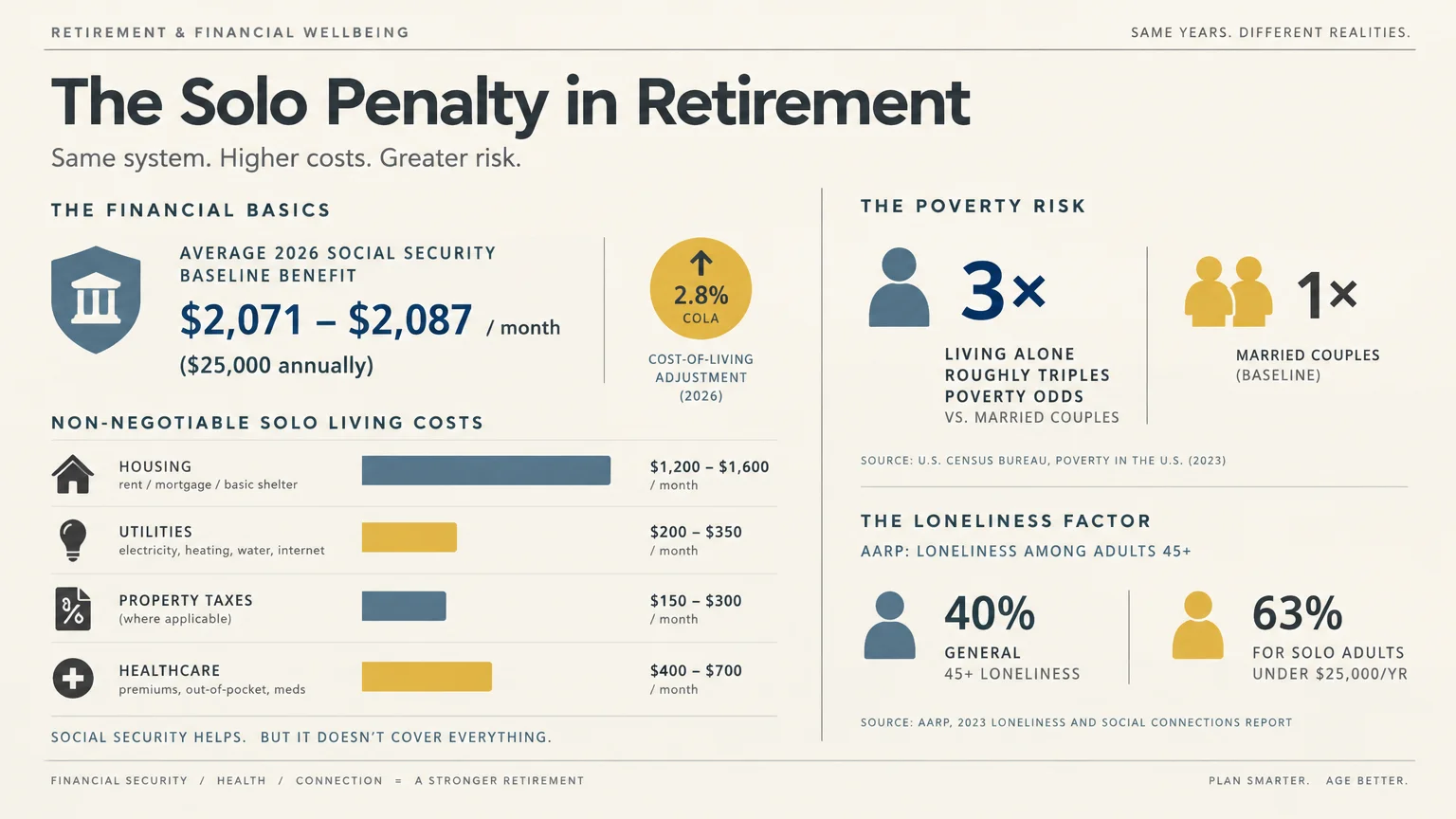
Census Bureau income data reveals that living alone roughly triples the odds of living below the poverty line in old age compared to married couples. Economists frequently call this financial gap the solo penalty.
Following the 2.8% Cost-of-Living Adjustment (COLA) for 2026, the average retirement benefit is $2,071 to $2,087 per month—or roughly $25,000 annually—according to the Social Security Administration. Stretching that baseline income plus your personal savings requires choosing a town with reasonable housing and low taxes.
Finances are only half of the equation when evaluating the best places to retire alone. Your social environment plays an equally vital role in your long-term health and happiness.
Research from AARP shows that 40% of U.S. adults aged 45 and older report feeling lonely. For solo adults earning under $25,000 per year, that loneliness rate climbs to 63%.
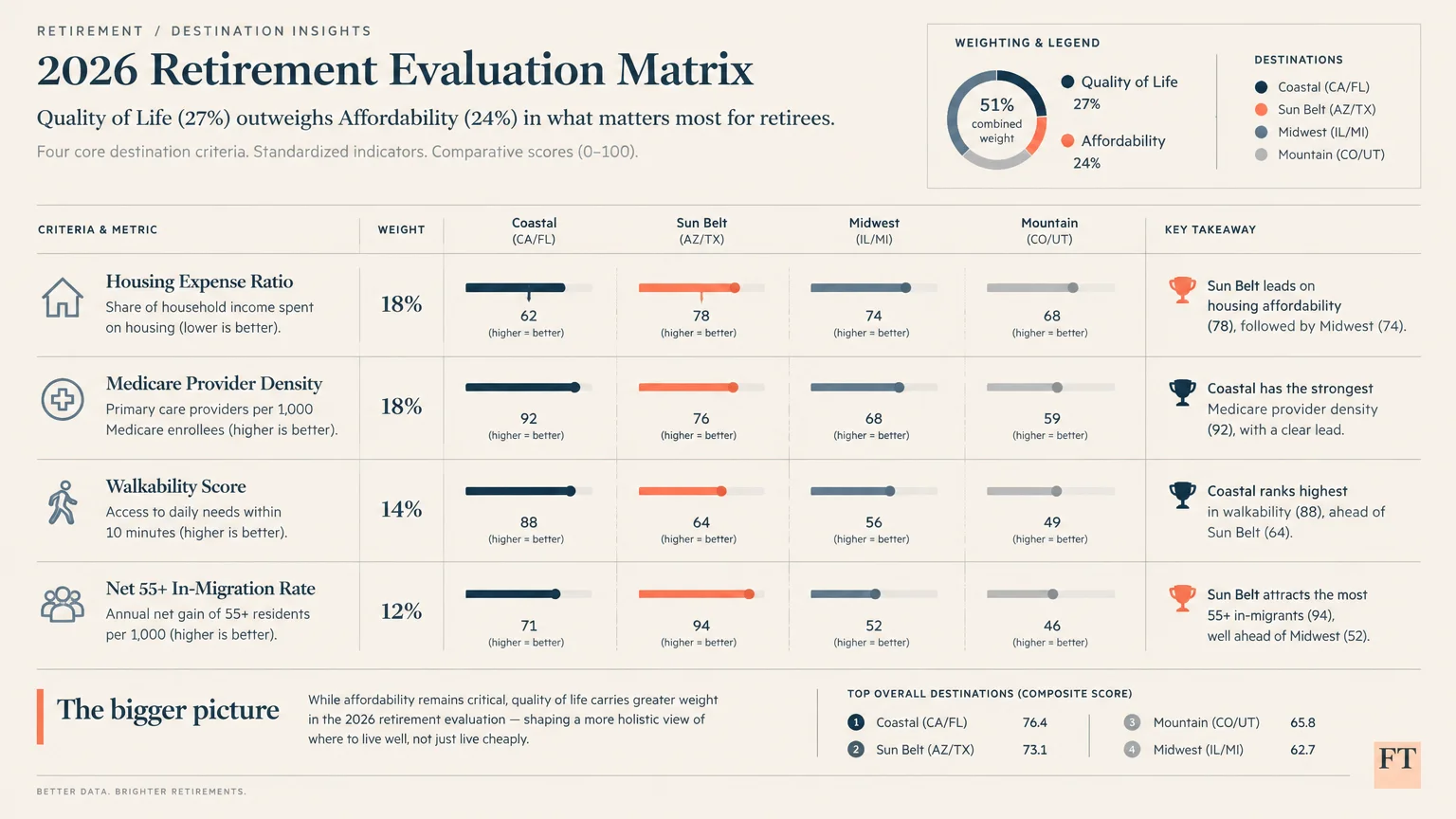
To reflect these realities, the 2026 U.S. News & World Report retirement rankings evaluated 859 cities and shifted their methodology. For the first time since the pandemic, quality of life (weighted at 27%) outweighed affordability (24%).
The 2026 rankings also incorporated 55-plus net migration data from the U.S. Census Bureau. Moving to a town where other older adults are actively relocating ensures you have a built-in peer group ready to make friends.
What to Look for in Top Retirement Towns for Solo Seniors
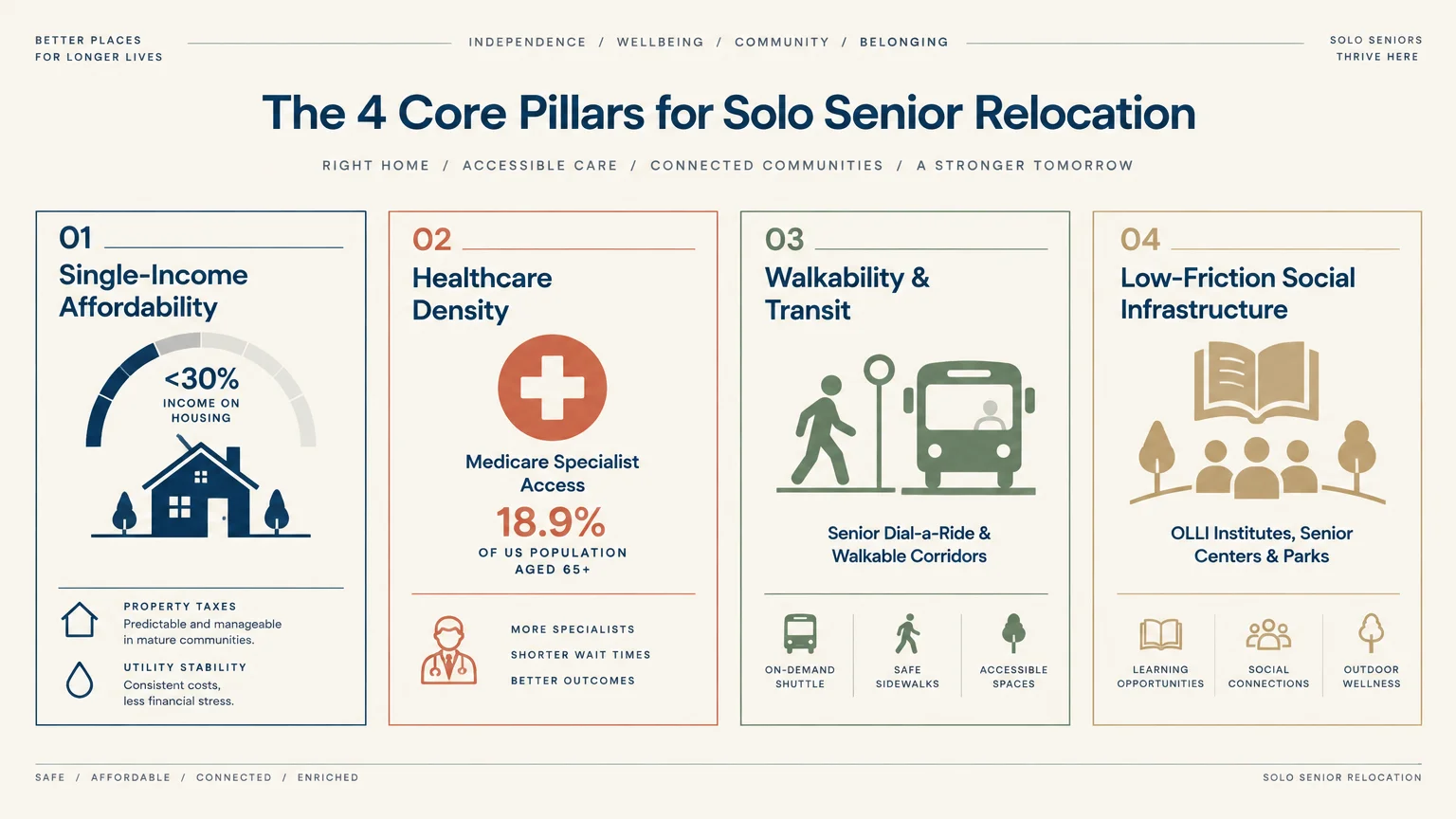
Before you pack boxes or hire a real estate agent, define what daily independence looks like for you now and ten years down the road. Focusing on four core pillars will help you filter out towns that look good on paper but fall short in practice.
- Single-Income Affordability: Look for median home prices and rents that allow you to keep total housing expenses under 30% of your monthly retirement income. Factor in property taxes, homeowners insurance, and utility spikes during extreme summer or winter weather.
- Healthcare Density and Specialist Access: Older adults make up 18.9% of the U.S. population—roughly 64.6 million people—according to the National Council on Aging. You want a community with high hospital bed capacity, abundant primary care doctors accepting Medicare, and nearby specialists.
- Walkability and Public Transit: Even if you drive comfortably today, an eye surgery or orthopedic procedure could temporarily ground you. Prioritize towns with senior dial-a-ride programs, reliable ride-share coverage, and walkable downtown corridors.
- Low-Friction Social Infrastructure: Seek out cities with active senior centers, Osher Lifelong Learning Institutes (OLLI) at local universities, volunteer networks, and abundant parks. These venues allow you to meet neighbors organically without feeling out of place as a single attendee.
“Live below your means, but within your needs.” — Suze Orman, Personal Finance Expert and Author

The Top 7 Retirement Destinations for Independent Seniors in 2026
The seven cities below top the 2026 national rankings by combining low living costs with vibrant community life. Each destination offers distinct advantages in climate, taxation, and recreation for solo retirees.
1. Midland, Michigan: Cultural Perks and Walkable Charm
Midland claimed the number-one spot in the 2026 U.S. News & World Report Best Places to Retire rankings. Located in Michigan’s Great Lakes Bay Region, this city of roughly 42,000 residents delivers big-city cultural amenities without metropolitan traffic or high prices.
As the historic headquarters of Dow Chemical, Midland benefits from decades of philanthropic investment. You can spend your mornings walking the paved, accessible paths of the 110-acre Dow Gardens or traversing the nation’s longest canopy walk at Whiting Forest.
For independent seniors looking to stay socially engaged, the Midland Center for the Arts hosts symphony performances, theater groups, art classes, and historical exhibits. Volunteering as an usher or docent is one of the fastest ways for solo newcomers to build a local network.
Healthcare access is exceptional thanks to MyMichigan Medical Center Midland, a flagship regional hospital situated right in town. Plus, Michigan has phased out state taxes on most retirement income, and Social Security benefits are completely exempt from state tax.
2. Weirton, West Virginia: Ultra-Affordable Living with New Tax Breaks
Ranked second nationally in the 2026 U.S. News evaluation, Weirton offers some of the lowest housing costs in the country alongside big-city convenience. Situated in West Virginia’s northern panhandle, Weirton sits just 35 miles west of downtown Pittsburgh.
That geography gives you a major financial advantage when retiring single. You pay small-town West Virginia housing prices and low property taxes while remaining within a 30-minute drive of Pittsburgh International Airport and world-class UPMC hospital networks.
2026 also brings a major tax milestone for West Virginia retirees. As of January 1, 2026, West Virginia officially finished phasing out its state income tax on Social Security benefits, leaving more cash in your monthly budget.
Locally, the Greater Weirton Senior Center serves as a lively social hub offering hot lunches, fitness classes, bingo, and organized day trips. The Marland Heights Park and the Panhandle Trail provide scenic, flat routes for daily walking clubs and cycling.
3. Homosassa Springs, Florida: Active Outdoor Living and Built-In Peers
Florida ranked second overall in WalletHub’s 2026 Best States to Retire study, and Homosassa Springs took third place on the U.S. News city list. Located along Florida’s Nature Coast in Citrus County, about 75 miles north of Tampa, this community is a magnet for solo seniors.
Census migration data shows strong 55-plus net migration into Citrus County, meaning a huge share of your neighbors are also retirees looking to connect. Unlike the congested mega-developments of South Florida, Homosassa Springs maintains a relaxed, old-Florida coastal atmosphere.
Outdoor enthusiasts can kayak the crystal-clear waters of the Homosassa River, view resident manatees at Ellie Schiller Homosassa Springs Wildlife State Park, or cycle the 46-mile Withlacoochee State Trail. Local birding clubs, fishing charters, and master gardener programs welcome single participants year-round.
From a tax perspective, Florida charges zero state income tax, zero tax on Social Security or pensions, and zero estate or inheritance tax. Housing costs in Homosassa Springs also remain significantly below the Florida state median, though you should always get quotes for flood and windstorm insurance before buying.
4. The Woodlands, Texas: Master-Planned Connectivity and Top Healthcare
If you want pristine infrastructure, endless clubs, and immediate access to premier medical care, look at The Woodlands, Texas. Ranked fourth by U.S. News for 2026, this master-planned community sits 30 miles north of Houston inside a natural forest canopy.
The Woodlands is uniquely designed to prevent isolation for independent seniors. More than 220 miles of interconnected hike-and-bike trails link neighborhoods directly to grocery stores, libraries, parks, and community centers.
You can join dozens of resident-led groups—ranging from pickleball leagues and book clubs to dragon boat racing teams on Lake Woodlands. The Woodlands Township also operates free trolley transit around the bustling Town Center, Market Street, and Waterway districts.
Healthcare in The Woodlands rivals major cities, anchored by branches of Houston Methodist, Memorial Hermann, and St. Luke’s Health right in the community. Texas levies no state personal income tax, though property taxes are high; fortunately, Texas homeowners aged 65 and older qualify for substantial school district homestead tax exemptions and a property tax ceiling freeze.
5. Rio Rancho, New Mexico: High-Desert Sunshine on a Solo Budget
Ranked sixth in the 2026 U.S. News retirement index, Rio Rancho delivers over 300 days of sunshine per year without the steep price tag of Santa Fe or Scottsdale. Perched above neighboring Albuquerque with sweeping views of the Sandia Mountains, Rio Rancho has grown into one of the Southwest’s premier retirement destinations for seniors.
Low humidity and mild winters allow you to stay active outdoors 12 months a year. Independent retirees flock to the Meadowlark Senior Center, which offers hundreds of weekly activities including line dancing, woodcarving, computer workshops, and billiards.
Medical needs are well covered by Presbyterian Rust Medical Center and UNM Sandoval Regional Medical Center right in Rio Rancho, supplemented by major university hospitals in Albuquerque. Housing remains remarkably affordable, featuring modern single-story ranch homes with low-maintenance xeriscaped yards that require no lawn mowing.
While New Mexico is one of the eight states that technically still taxes Social Security on paper, most single seniors never pay a dime. State law exempts Social Security benefits from state income tax for single filers earning under $100,000 annually.
6. Altoona, Pennsylvania: A Tax-Free Haven for Retirement Withdrawals
Taking eighth place in the 2026 U.S. News rankings, Altoona is a hidden gem tucked against the Allegheny Mountains in central Pennsylvania. For single retirees living on a combination of Social Security, 401(k) distributions, and traditional IRAs, Pennsylvania’s tax code is practically unbeatable.
Pennsylvania does not tax Social Security benefits, public or private pensions, or distributions from 401(k)s and IRAs taken after standard retirement age. When you combine that zero-tax treatment on retirement withdrawals with Altoona’s rock-bottom median home prices, a single income goes remarkably far.
Altoona also boasts strong healthcare infrastructure anchored by UPMC Altoona, a major regional trauma and medical center, alongside the James E. Van Zandt VA Medical Center for military veterans. Penn State Altoona adds college-town vitality, offering campus lectures, sporting events, and performing arts.
Blair Senior Services operates active senior centers across the county and runs daily door-to-door transportation for older adults. Whether you enjoy historic railroad museums, minor league baseball with the Altoona Curve, or scenic drives through central Pennsylvania’s autumn foliage, Altoona fosters warm, neighborly connections.
7. Lynchburg, Virginia: Blue Ridge Scenery and Lifelong Learning
Rounding out the top ten in the 2026 U.S. News rankings, Lynchburg sits along the James River at the foothills of the Blue Ridge Mountains. Known as the City of Seven Hills, Lynchburg blends historic architecture, mild four-season weather, and vibrant academic energy.
Home to several colleges—including the University of Lynchburg and Randolph College—the city provides abundant lifelong learning and cultural programming. Solo retirees can audit classes, visit the Maier Museum of Art, or join the Lynchburg Parks and Recreation Templeton Senior Center for kayak trips and social mixers.
The paved Blackwater Creek Trail winds through the heart of the city, giving walkers and cyclists a safe, car-free path through wooded ravines and historic tunnels. Centra Lynchburg General Hospital and Centra Virginia Baptist Hospital provide comprehensive cardiac, orthopedic, and primary care locally.
Virginia exempts Social Security benefits from state income tax and offers an age-based tax deduction of up to $12,000 for qualifying seniors aged 65 and older. With median housing costs well below the national average, Lynchburg lets you enjoy Blue Ridge living without exhausting your nest egg.
Comparing the Top Retirement Towns at a Glance
Evaluating tax structures alongside lifestyle strengths helps you narrow down your shortlist quickly. The table below compares how our seven featured destinations stack up in 2026.
| City and State | 2026 U.S. News Rank | State Tax on Social Security? | State Tax on 401(k) / IRA / Pensions? | Best Feature for Independent Seniors |
|---|---|---|---|---|
| Midland, MI | #1 | No | Phased out for most seniors in 2026 | Walkable botanical gardens, arts center, and strong hospital access |
| Weirton, WV | #2 | No (Fully repealed in 2026) | Yes (with senior modifications) | Ultra-low housing costs just 35 miles from Pittsburgh healthcare |
| Homosassa Springs, FL | #3 | No | No (Zero state income tax) | High 55+ net migration, coastal nature trails, and zero income tax |
| The Woodlands, TX | #4 | No | No (Zero state income tax) | 220+ miles of connected trails, free trolley, and premier medical centers |
| Rio Rancho, NM | #6 | Exempt for single filers under $100,000 AGI | Yes (standard state brackets apply) | Sunny dry climate, low-maintenance homes, and active senior centers |
| Altoona, PA | #8 | No | No (All eligible retirement income exempt) | Zero state tax on 401(k)/IRA withdrawals and low cost of living |
| Lynchburg, VA | #10 | No | Yes (up to $12,000 age deduction available) | Blue Ridge Mountain views, college-town culture, and mild four seasons |
If you want to expand your search to the state level, WalletHub’s 2026 Best States to Retire report ranked all 50 states across 46 metrics of affordability, healthcare, and quality of life. Their top five states for 2026 are Wyoming (#1), Florida (#2), South Dakota (#3), Colorado (#4), and Minnesota (#5).

Housing Choices: Aging in Place vs. Independent Senior Living
Once you choose a destination, you must decide what type of housing best supports your solo lifestyle. Buying a smaller single-family house or townhome gives you equity and control, but it also leaves you responsible for roof repairs, plumbing leaks, and yard work.
Many single retirees prefer transitioning into dedicated independent senior living communities or 55-plus apartment complexes. These communities bundle housing, exterior maintenance, fitness facilities, group excursions, and sometimes communal dining into a predictable monthly payment.
According to 2026 senior housing industry data, the national median cost for independent senior living ranges from $3,065 to $3,200 per month. Depending on the city and luxury amenities, monthly fees typically span from $1,500 in affordable Midwest and Southern towns to over $6,000 in coastal metro areas.
If you want guaranteed access to future medical care on the same campus, you might explore a Continuing Care Retirement Community (CCRC), also known as a life plan community. In 2026, CCRCs average roughly $400,000 for an upfront entrance fee plus a median monthly service fee of $3,353.
Even if you are completely healthy today, solo retirees must budget for potential long-term care down the road because you do not have a spouse at home to provide unpaid caregiving. According to the CareScout / Genworth Cost of Care Survey released in March 2026, national median care costs have reached the following benchmarks:
- Non-Medical In-Home Caregiver: $35 per hour, or $80,080 annually based on 44 hours of assistance per week (up 3% year-over-year).
- Assisted Living Facility: $6,200 per month, or $74,400 annually (up 5% year-over-year).
- Nursing Home Care (Private Room): $10,798 per month, or $129,575 annually.
Choosing an affordable city like Weirton, Altoona, or Midland helps you preserve your retirement portfolio today. That preserved principal gives you a crucial financial cushion if you eventually need in-home assistance or assisted living later in life.
How State Taxes Impact a Single Retiree’s Budget in 2026
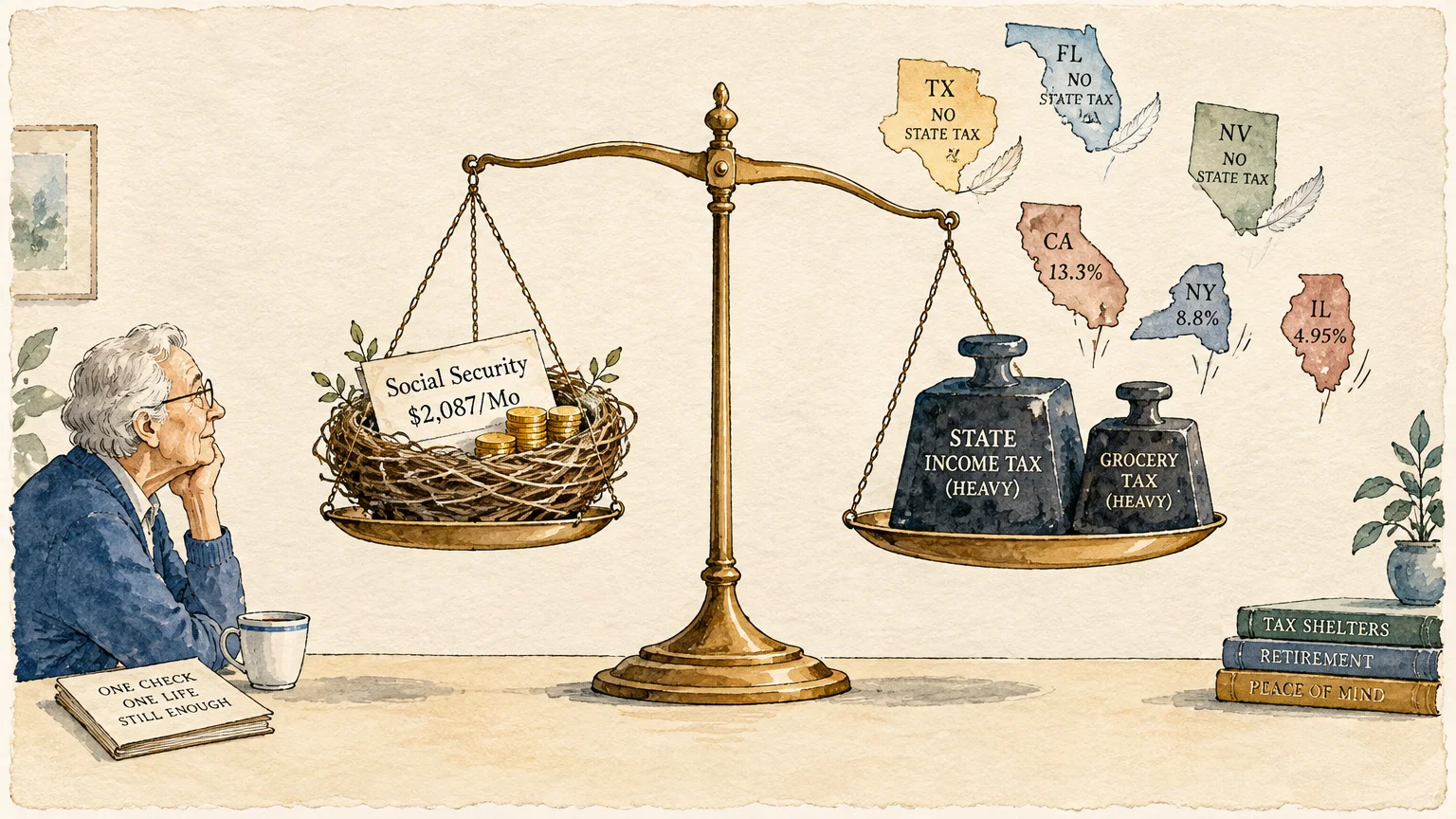
Single retirees often face a steeper tax burden than married couples with identical retirement incomes. Because federal and state tax brackets for single filers are roughly half as wide as joint brackets, large withdrawals from a traditional 401(k) or IRA can quickly push you into higher tax tiers.
Reviewing federal rules on IRS.gov alongside state revenue laws can save you thousands of dollars annually when relocating. As of 2026, nine states levy no individual wage or income tax at all: Alaska, Florida, Nevada, New Hampshire (which fully repealed its interest and dividends tax in 2025), South Dakota, Tennessee, Texas, Washington (which taxes high-earner capital gains only), and Wyoming.
If your income relies heavily on Social Security, your geographic options are even broader. In 2026, 42 states and Washington, D.C., do not tax Social Security benefits at the state level.
Only eight states still tax Social Security benefits in some form during the 2026 tax year: Colorado, Connecticut, Minnesota, Montana, New Mexico, Rhode Island, Utah, and Vermont. Even among those eight, states like Colorado, Connecticut, and New Mexico provide generous age or income exemptions that shield middle-income solo retirees from paying state tax on their benefits.
“Time is your friend; impulse is your enemy.” — John Bogle, Founder of Vanguard

Common Mistakes to Avoid When Relocating Solo
Moving to a new city in retirement is an exciting milestone, but rushing the process can lead to costly regret. Watch out for these four common pitfalls when evaluating the best places to retire alone.
- Buying a Home Sight Unseen or After a Short Vacation: A town that feels idyllic during a sunny week in October might feel isolating during a humid August or a snowy February. Rent an apartment or furnished condo for six to twelve months in your target destination before committing to a home purchase.
- Forgetting to Check Medicare Advantage and Medigap Networks: If you use a Medicare Advantage plan, your provider network is usually restricted to a specific county or region. Before moving, use Medicare’s official plan finder to verify which plans, hospitals, and primary care doctors accept new patients in your target ZIP code.
- Moving Solely to Be Near One Adult Child or Grandchild: Family ties are wonderful, but younger relatives often relocate for corporate job transfers or stay busy with work and school schedules. Choose a town that offers independent social outlets, clubs, and hobbies so your social calendar does not depend entirely on one family member.
- Underestimating Home Maintenance on a Solo Body and Budget: Buying a large house with a steep driveway and a half-acre lawn quickly becomes exhausting when you manage every chore alone. Prioritize single-level living with zero-step entryways, HOA-maintained exteriors, or trusted local handyman networks.
Frequently Asked Questions
What is the most affordable city for a single senior to retire in 2026?
Weirton, West Virginia, and Altoona, Pennsylvania, rank among the most affordable top-tier retirement destinations in 2026. Both cities offer median home prices well below the national average, exemptions from state taxes on Social Security, and immediate access to major regional healthcare networks.
How much income does a single person need to retire comfortably in 2026?
While comfort depends on location and debt levels, many single retirees live securely on $35,000 to $50,000 per year in low-cost towns when combining the average $25,000 annual Social Security benefit with personal savings. Choosing a mortgage-free home or keeping rent below 30% of your gross income is the biggest factor in making a solo budget work.
Is it better for an independent senior to buy a house or move to a 55-plus community?
If you want predictable monthly expenses, zero yard work, and effortless daily socializing, a 55-plus or independent living community (averaging $3,065 to $3,200 monthly in 2026) is often worth the cost. If keeping monthly fixed fees low is your top priority, buying a small condominium or patio home with a modest HOA fee may save money over a 15-year retirement.
Which states are completely tax-free for retirees in 2026?
Nine states charge no personal income tax on wages, Social Security, pensions, or retirement account withdrawals: Alaska, Florida, Nevada, New Hampshire, South Dakota, Tennessee, Texas, Washington, and Wyoming. Additionally, states like Pennsylvania, Illinois, Mississippi, and Iowa exempt eligible retirement income such as 401(k)s, IRAs, pensions, and Social Security from state income taxes.
Your Next Steps for a Confident Move
Finding the right community starts with matching your monthly budget to your ideal daily routine. Pick two or three towns from this list, calculate your projected state taxes and housing costs, and plan an extended offseason visit to experience local senior centers, walking trails, and neighborhoods firsthand.
This article provides general retirement education and information only. Everyone’s financial situation is unique—what works for others may not work for you. For personalized advice, consider consulting a qualified financial professional such as a CFP or CPA.
Last updated: February 2026. Retirement benefits, tax laws, and healthcare costs change frequently—verify current details with official sources.