
Your 2027 Social Security check reflects far more than a single annual raise. Every payment starts with your lifetime wage history, shifts with federal inflation formulas, and changes based on the exact month you claim.
For 2027, the Social Security Administration announced a 3.6% cost-of-living adjustment, lifting the average retired-worker benefit from $2,095 to $2,170 per month. Understanding how each moving piece fits together helps you verify your statement and keep more of every deposit.
Whether you already collect benefits or plan to file soon, you can take concrete steps right now to protect your payout.
The 2027 COLA Increase and When Your Higher Check Arrives
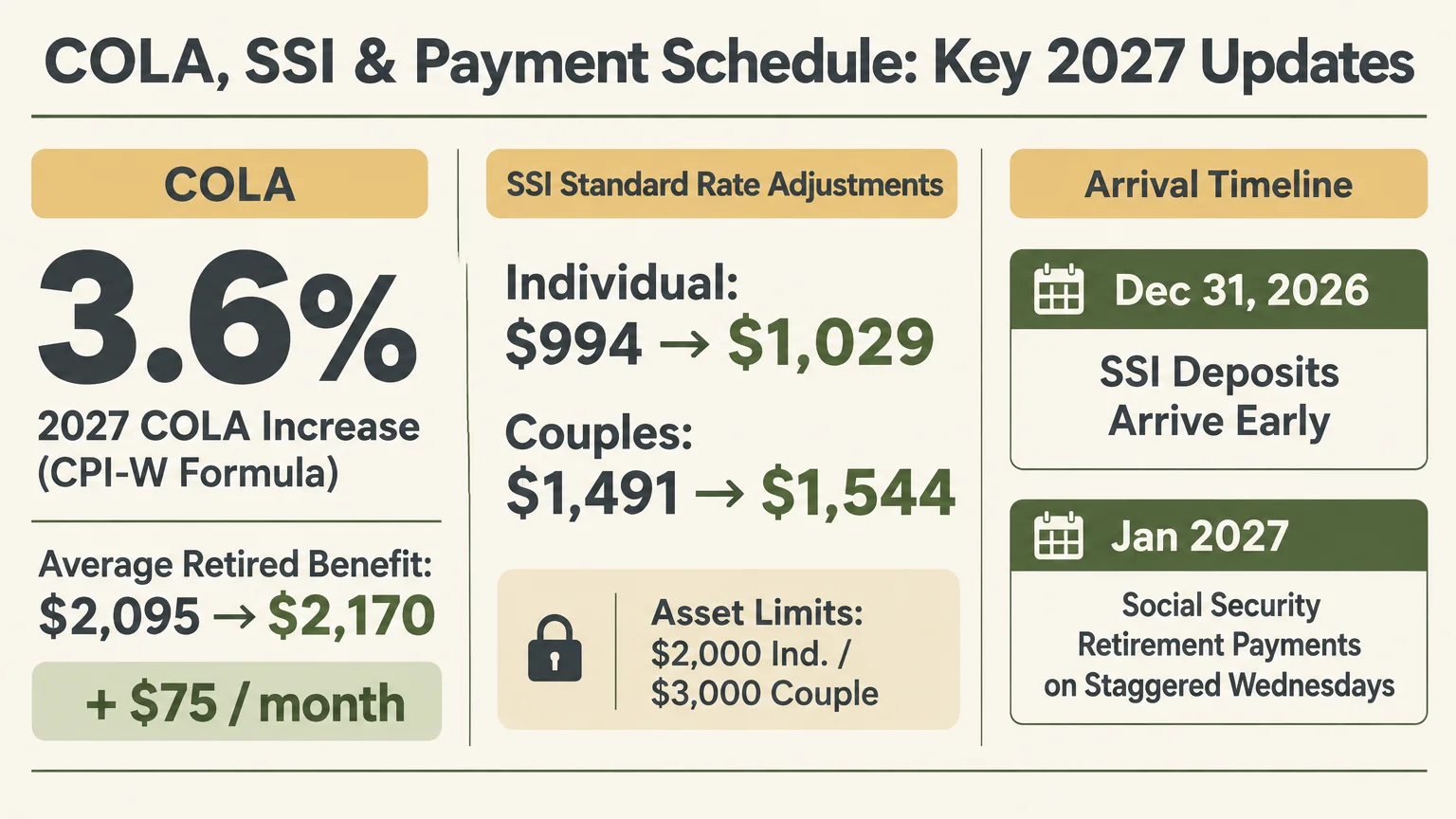
On October 14, 2026, the Social Security Administration (SSA) confirmed a 3.6% cost-of-living adjustment for 2027. That 2027 cola increase steps up from the 2.8% adjustment applied in 2026.
Roughly 76 million Americans will see larger deposits from this adjustment. That group includes nearly 72 million Social Security beneficiaries and 7.3 million Supplemental Security Income (SSI) recipients.
Federal law leaves no guesswork in how the SSA sets that percentage each autumn. The agency tracks the Consumer Price Index for Urban Wage Earners and Clerical Workers (CPI-W) published by the Bureau of Labor Statistics from the third quarter of 2025 through the third quarter of 2026.
When consumer prices climb across that twelve-month window, your benefit grows by the matching percentage. According to SSA estimates, the average retired worker will gain $75 per month, rising from $2,095 to $2,170.
Federal SSI payment standards will also climb alongside retirement checks in 2027. Eligible individuals will see their maximum federal SSI base rate increase from $994 to $1,029 per month, while eligible couples rise from $1,491 to $1,544 per month.
Asset limits for SSI remain unchanged at $2,000 for individuals and $3,000 for couples. If you receive SSI, keep a close eye on your bank balances so routine savings do not push you past those fixed caps.
Your exact delivery date depends on which program pays your benefit:
- Social Security retirement, spousal, and survivor checks: Higher amounts begin with your January 2027 payment, arriving on your normal Wednesday schedule or third-of-the-month date.
- Supplemental Security Income (SSI) deposits: Increased payments arrive slightly earlier on December 31, 2026, because January 1 is a federal holiday.
- Online COLA notices: If you created a personal my Social Security account on SSA.gov and opted into paperless alerts by November 18, 2026, you can view your simplified one-page notice starting in late November or early December.
- Mailed paper notices: Beneficiaries who still receive physical mail will get their official 2027 benefit letters throughout December 2026.
Checking that simplified notice early gives you time to build an accurate 2027 household budget. It also lets you verify that your gross raise matches what you expected before January arrives.
How Your Social Security Earnings Record Builds Your Base Benefit
Before any inflation raise applies, your 2027 social security check rests on a formula built from your career wages. That social security benefit calculation rewards both steady work years and higher earnings up to an annual cap.
First, you must earn enough work credits across your career to qualify for retirement benefits. In 2027, you earn one Social Security credit for every $1,970 in covered wages or self-employment income, up from $1,890 in 2026.
Second, payroll taxes and benefit credits only apply up to the annual taxable maximum. For 2027, the SSA raised that wage base cap to $192,300, up from $184,500 in 2026.
You and your employer each pay the 6.2% Social Security payroll tax up to $192,300, while self-employed workers pay 12.4%. Any wages earned above $192,300 avoid Social Security tax and do not add to your future check.
Medicare taxes work differently because they carry no wage ceiling at all. The 1.45% Hospital Insurance tax applies to every dollar you earn, plus an extra 0.9% surtax above $200,000 for single filers or $250,000 for joint filers.
When you file, the SSA turns your lifetime social security earnings record into a monthly base payment called your Primary Insurance Amount (PIA). Here is how the four-step calculation works for workers becoming eligible in 2027:
- Index past wages for inflation: The SSA adjusts your annual earnings up to the year you turn age 60 using the national Average Wage Index, which stands at $72,800.33 for 2027 eligibility calculations; wages earned at age 60 or later count at face value.
- Select your top 35 years: The formula picks your 35 highest-earning indexed years; if you worked fewer than 35 years, zeros fill the remaining slots and pull down your average.
- Compute your Average Indexed Monthly Earnings (AIME): The SSA sums those top 35 indexed years, divides the total by 420 months, and rounds down to the next whole dollar.
- Apply the 2027 PIA bend points: For workers turning 62, becoming disabled, or dying in 2027, the SSA applies three progressive percentages to slices of your AIME and rounds down to the next lower dime.
Because the formula replaces a larger share of lower earnings, middle- and lower-income workers see a higher percentage of their pre-retirement pay replaced. High earners still receive bigger dollar checks, though each extra dollar of AIME yields smaller marginal gains.
| 2027 AIME Earnings Tier | Replacement Rate | Maximum Dollar Contribution in Tier |
|---|---|---|
| First $1,340 of AIME | 90% | $1,206.00 |
| AIME over $1,340 through $8,077 | 32% | $2,155.84 |
| AIME over $8,077 | 15% | Varies up to taxable max |
If your record supports multiple family members, an additional cap limits the total household payout. For workers turning 62 or dying in 2027, the SSA sets family maximum bend points at $1,712, $2,471, and $3,223.
Working even one or two extra years at solid pay can meaningfully raise your base benefit if you have zero-earning years on file. Replacing a zero with a strong 2027 salary immediately lifts your 35-year average.
Full Retirement Age and How Claiming Timing Reshapes Your Check
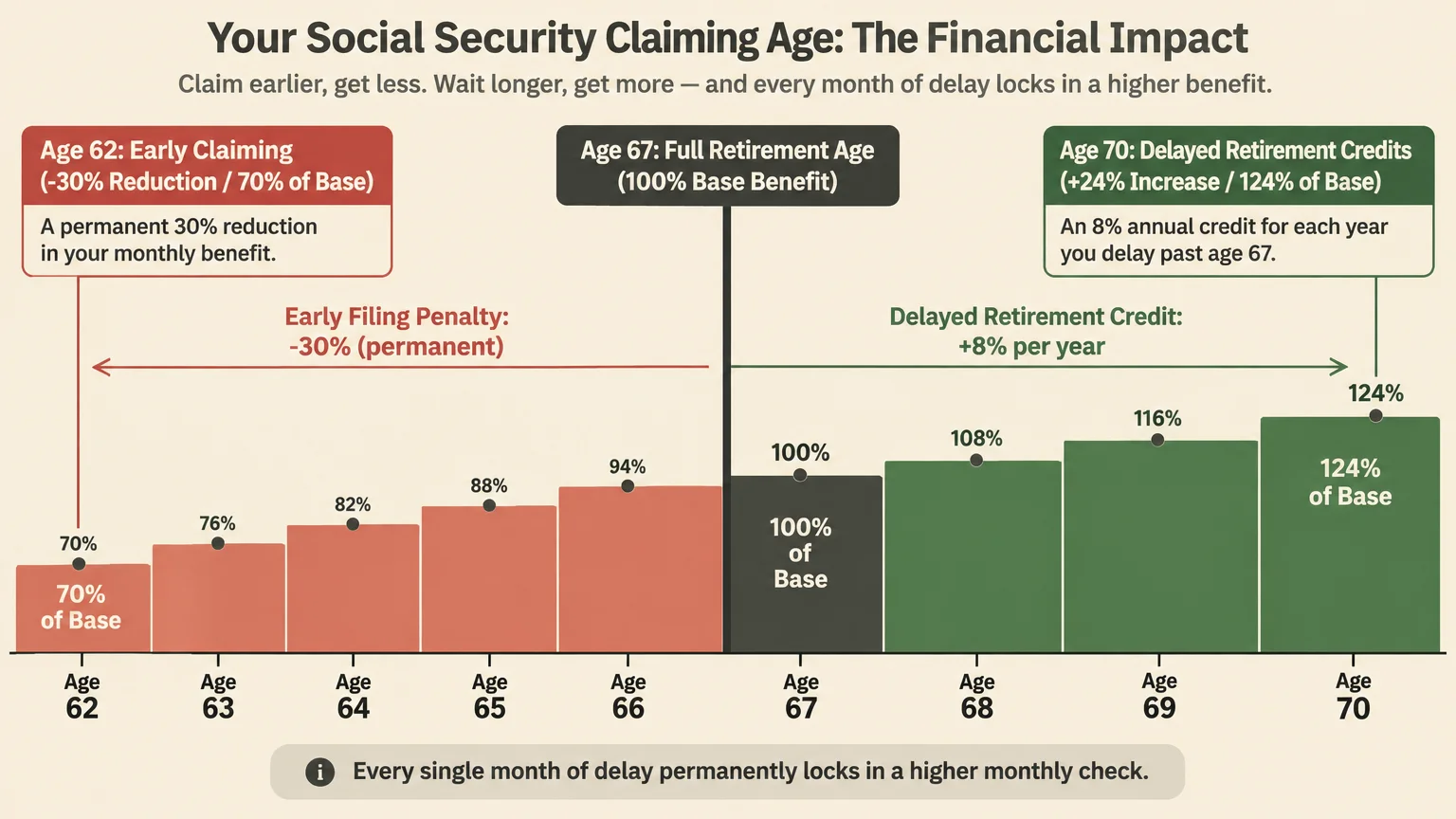
Your Primary Insurance Amount represents the exact monthly check you receive if you claim at your full retirement age. Claiming earlier locks in a permanent discount, while waiting past that milestone earns guaranteed annual raises.
Under SSA rules, full retirement age is 67 for anyone born in 1960 or later. That means workers born in 1960 reach full retirement age in 2027, while those born in 1965 turn 62 in 2027 with the same age-67 benchmark.
Filing before age 67 trims your monthly check for every single month you claim early. The SSA cuts your PIA by 5/9 of 1% per month for the first 36 early months and 5/12 of 1% per month beyond 36 months.
Suppose you turn 62 in 2027 and file right away, 60 months before your full retirement age of 67. Your monthly benefit drops permanently by 30%, and spousal benefits claimed at 62 face reductions up to 35%.
Delaying your claim past age 67 pushes the math firmly in your favor. You earn delayed retirement credits equal to 2/3 of 1% per month—an 8% boost per year—all the way until age 70.
For anyone with a full retirement age of 67, waiting until age 70 yields a 24% permanent bonus over your PIA. If you claim between 67 and 70, partial-year credits earned during the filing year appear in your check the following January.
| Claiming Age | 2026 Maximum Monthly Benefit | 2027 Maximum Monthly Benefit | Share of FRA Benefit (FRA 67) |
|---|---|---|---|
| Age 62 | $2,969 | $3,094 | 70% |
| Age 67 (Full Retirement Age) | $4,152 | $4,188 | 100% |
| Age 70 | $5,181 | $5,358 | 124% |
Those top figures apply only to workers who earned the taxable maximum every single year starting at age 22. Still, the gap between $3,094 at age 62 and $5,358 at age 70 illustrates how dramatically timing shapes your cash flow.
One major historic penalty no longer shrinks checks for public-sector workers in 2027. Under the Social Security Fairness Act signed into law on January 5, 2025, Congress permanently repealed both the Windfall Elimination Provision (WEP) and the Government Pension Offset (GPO).
If you spent part of your career as a teacher, firefighter, police officer, or state employee with a non-covered pension, your 2027 worker, spousal, and survivor benefits remain free of WEP and GPO cuts. That change restores substantial monthly income for many retired public servants.
Why Working While Collecting Can Temporarily Shrink Your 2027 Check
Many retirees stay on the payroll or consult part-time after starting Social Security. If you collect benefits before reaching full retirement age, the SSA applies an annual earnings test that can temporarily withhold part of your 2027 payout.
For beneficiaries who remain under full retirement age for all of 2027, the annual exempt limit rises to $25,560, or $2,130 per month. That threshold steps up from $24,480 in 2026.
If your 2027 wages exceed $25,560, the SSA withholds $1 in benefits for every $2 you earn above that cap. Only earned wages and net self-employment income count toward the test; pensions, IRA withdrawals, dividends, and rental income do not trigger withholding.
A much higher limit protects workers who reach full retirement age during 2027. If you turn 67 in 2027, you can earn up to $67,920—or $5,660 per month—in the months leading up to your birthday month, up from $65,160 in 2026.
For earnings above $67,920 before your full-retirement-age month, the SSA withholds $1 for every $3 over the cap. Starting the exact month you turn 67, the earnings test vanishes completely, allowing unlimited work income with zero benefit withholding.
Money withheld by the earnings test is not lost forever. Once you reach full retirement age, the SSA recalculates your monthly check upward to credit you for every month benefits were held back.
Still, sudden withholding can disrupt your short-term cash flow if the SSA pauses entire checks early in the year. Estimating your 2027 wages carefully and reporting changes promptly prevents surprise payment gaps.
Medicare Premiums, IRMAA Cliffs, and Taxes That Reduce Your Net Payout
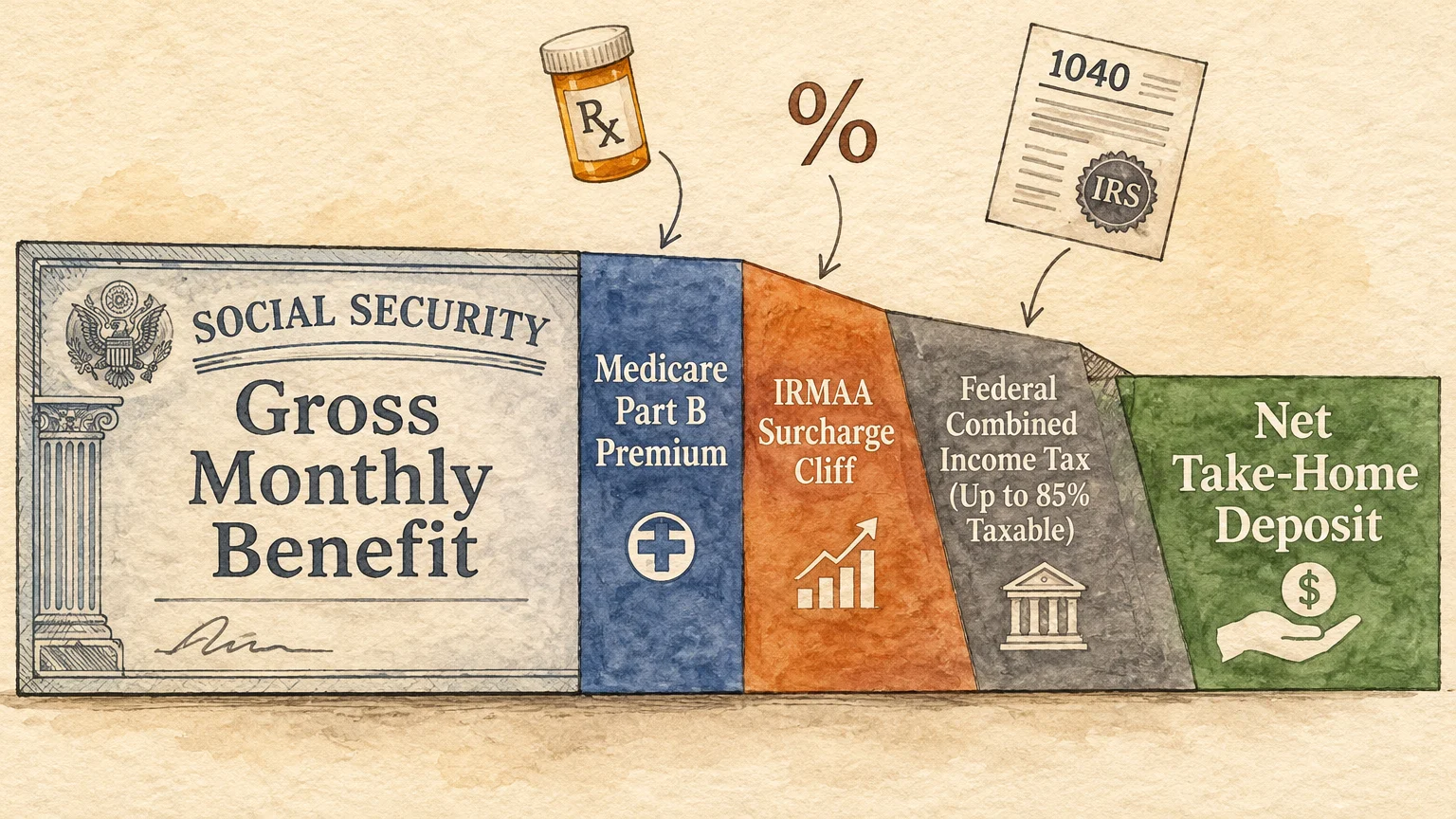
Your gross Social Security award rarely equals the net deposit hitting your checking account. Healthcare premiums and federal income taxes frequently claim a portion of your 2027 raise before you can spend it.
On November 17, 2026, the Centers for Medicare & Medicaid Services (CMS) announced higher Part B costs for 2027. The standard Medicare Part B monthly premium—typically deducted straight from your Social Security check—rises $6.50, moving from $202.90 to $209.40 per month.
That 3.2% premium hike absorbs a modest slice of the average $75 COLA increase, leaving most retirees well ahead in net dollars. Meanwhile, the annual Part B deductible ticks up $9 from $283 to $292 for 2027.
Higher-income retirees face steeper automatic deductions through Income-Related Monthly Adjustment Amounts (IRMAA). For 2027, CMS bases those surcharges on the Modified Adjusted Gross Income (MAGI) reported on your 2025 federal tax return.
If your 2025 MAGI exceeded $112,000 as a single filer or $224,000 on a joint return—up from $109,000 and $218,000 in 2026—IRMAA surcharges apply. Those brackets push 2027 Part B premiums to between $293.10 and $711.80 per month, plus Part D prescription drug surcharges up to $96.40 monthly.
IRMAA brackets act as hard financial cliffs rather than gradual phase-ins. Reporting just one extra dollar of 2025 income above a threshold triggers the entire surcharge tier for every month of 2027.
You can review premium details and appeal options directly on Medicare.gov if you experienced a qualifying life-changing event such as retirement or the loss of a spouse. Filing Form SSA-44 asks the SSA to recalculate IRMAA using your lower current income instead of your higher 2025 return.
Federal income taxes can trim your net benefit further because Social Security tax thresholds remain frozen in law and unindexed for inflation. You calculate whether benefits are taxable using combined income, defined as adjusted gross income plus nontaxable interest plus half of your Social Security benefits.
- 50% taxable tier: Up to half of your benefits become taxable once combined income tops $25,000 for single filers or $32,000 for married couples filing jointly.
- 85% taxable tier: Up to 85% of your benefits become taxable when combined income exceeds $34,000 for single filers or $44,000 for joint filers.
Fortunately, a newer federal tax break eases the overall tax burden for many older households in 2027. Under the One Big Beautiful Bill Act (OBBBA), the IRS notes that taxpayers age 65 and older can claim an extra $6,000 senior tax deduction for tax years 2025 through 2028.
That $6,000 deduction phases out at a 6% rate once MAGI exceeds $75,000 for single filers or $150,000 for joint filers, disappearing completely at $175,000 and $250,000. While it lowers your total taxable income, it does not alter how the SSA computes your benefit or change the $25,000 and $32,000 combined-income thresholds.

What Can Go Wrong With Your 2027 Social Security Calculation
Even well-prepared retirees lose thousands of dollars when small administrative errors or overlooked tax traps slip through the cracks. Watching out for these common mistakes helps protect every dollar of your 2027 check:
- Unchecked gaps in your earnings history: Employers occasionally report wages under an incorrect Social Security number or omit bonuses; if an error sits uncorrected for years, a zero replaces a high-wage year in your 35-year average.
- Unexpected IRMAA spikes from one-time income: Selling appreciated real estate, taking large traditional IRA distributions, or executing Roth conversions without checking MAGI cliffs can trigger hundreds in extra monthly Medicare deductions two years later.
- Misjudging the earnings test during semi-retirement: Taking a part-time consulting contract at age 64 without reporting expected wages leads the SSA to claw back overpayments by suspending multiple checks at once.
- Assuming WEP or GPO still applies: Former public employees who delayed filing because of old pension offsets may overlook larger survivor or spousal checks now available under the repeal law.
- Ignoring federal tax withholding: Failing to file Form W-4V for voluntary withholding from your Social Security check can leave you owing underpayment penalties at tax time.
Log into your online account at least once a year and match each posted wage figure against your W-2s or Schedule SE tax forms. Catching an error before you file is dramatically faster than correcting your record mid-retirement.
When to Consult a Professional
Straightforward single-earner retirements often require little more than reviewing your annual statement and picking a target claiming date. More complex households benefit from hiring a fiduciary planner listed with the Certified Financial Planner Board or an experienced retirement tax specialist in four specific situations:
- Coordinating dual-earner spousal and survivor strategies: When two spouses hold sharply different earnings histories or large age gaps, modeling staggered claiming ages protects the higher survivor benefit for the longer-lived partner.
- Managing withdrawals near IRMAA and senior deduction thresholds: Balancing Roth conversions, capital gains, and IRA distributions around the $75,000 senior deduction phase-out and $112,000 single or $224,000 joint IRMAA cliffs takes multi-year tax projections.
- Navigating self-employment near the wage base or earnings test: Business owners who control their compensation structure need clear guidance around the $192,300 wage base and pre-FRA earnings limits.
- Verifying public-sector recalculations after WEP and GPO repeal: Retirees with complex state or municipal pensions who suspect missing retroactive adjustments or miscalculated spousal amounts benefit from an independent review.
Community resources like the National Council on Aging also offer free benefits checkups if you want help evaluating SSI eligibility or Medicare savings programs that cover Part B premiums.
Frequently Asked Questions About 2027 Social Security Checks
How much will the 2027 COLA increase add to the average Social Security check?
The 3.6% COLA adds an estimated $75 per month to the average retired-worker benefit, raising it from $2,095 to $2,170 starting in January 2027. Your exact dollar increase equals 3.6% of your current gross monthly benefit before Medicare deductions.
Can I still increase my 2027 Social Security benefit if I already filed?
Yes, continuing to work in 2027 can raise your check if your current earnings exceed one of the lowest years in your top-35 calculation. If you reached full retirement age and claimed within the past year, you can also suspend payments to earn 8% annual delayed credits up to age 70.
Will Medicare Part B take away my entire 2027 COLA raise?
For most retirees, no. The standard 2027 Part B premium increases by $6.50 per month to $209.40, leaving the vast majority of the average $75 COLA increase intact—though high earners facing new IRMAA tiers could see smaller net gains.
How does the $6,000 senior tax deduction affect my Social Security taxes?
The $6,000 senior deduction available for 2025 through 2028 lowers your overall federal taxable income if you are 65 or older and fall under the MAGI phase-out caps. However, it does not change the $25,000 single or $32,000 joint combined-income thresholds used to calculate benefit taxability.

Next Steps for Your 2027 Benefit Plan
Sign into your my Social Security account this week to download your latest earnings record and verify every year of posted wages. Compare your expected 3.6% gross raise against the $209.40 standard Medicare Part B premium—and any potential IRMAA tier from your 2025 tax return—so your 2027 monthly budget starts on solid ground.
The information in this guide is meant for educational purposes. Your specific circumstances—including income, savings, health coverage, and goals—may require different approaches. When in doubt, consult a licensed professional.
Last updated: November 2026. Retirement benefits, tax laws, and healthcare costs change frequently—verify current details with official sources.