
Your 2027 retirement budget depends on knowing exact benefit deposit days, Medicare enrollment deadlines, and annual cost adjustments. Tracking key Medicare and Social Security dates in 2027 protects your monthly cash flow and prevents costly penalties.
A 3.6% cost-of-living increase boosts Social Security and SSI checks, while updated Medicare premiums, deductibles, and drug caps change your out-of-pocket expenses. Missing even one enrollment window can delay healthcare coverage or trigger permanent surcharges.
Use this 2027 retirement calendar to organize every deposit date, coverage window, and income threshold across the year.

Late-2026 Dates That Launch Your 2027 Benefits
Several critical 2027 benefit milestones actually happen in the final weeks of 2026. Handling these steps early ensures your January payments and health coverage start without disruption.
First, the Social Security Administration (SSA) makes 2027 Cost-of-Living Adjustment (COLA) notices available online in late November 2026. You can view your personalized notice in the Message Center of your my Social Security account if you created it by November 18, 2026.
If you prefer paper mail or opened your account later, watch your mailbox during December 2026. Checking that letter lets you verify your new net deposit after Medicare Part B deductions.
Second, Medicare’s Fall Open Enrollment for 2027 coverage runs from October 15 through December 7, 2026, following the October 1 plan comparison launch on Medicare.gov. Any Part D or Medicare Advantage changes you submit by December 7 take effect on January 1, 2027.
Third, Supplemental Security Income (SSI) recipients see the 2027 increase arrive early on December 31, 2026. Because January 1 is a federal holiday, SSA issues January SSI benefits on the last business day of December.
Beneficiaries who claimed Social Security before May 1997—as well as those receiving both Social Security and SSI—also receive their January 2027 Social Security deposit on December 31, 2026. Plan your winter bills carefully so that early deposit covers your January expenses.
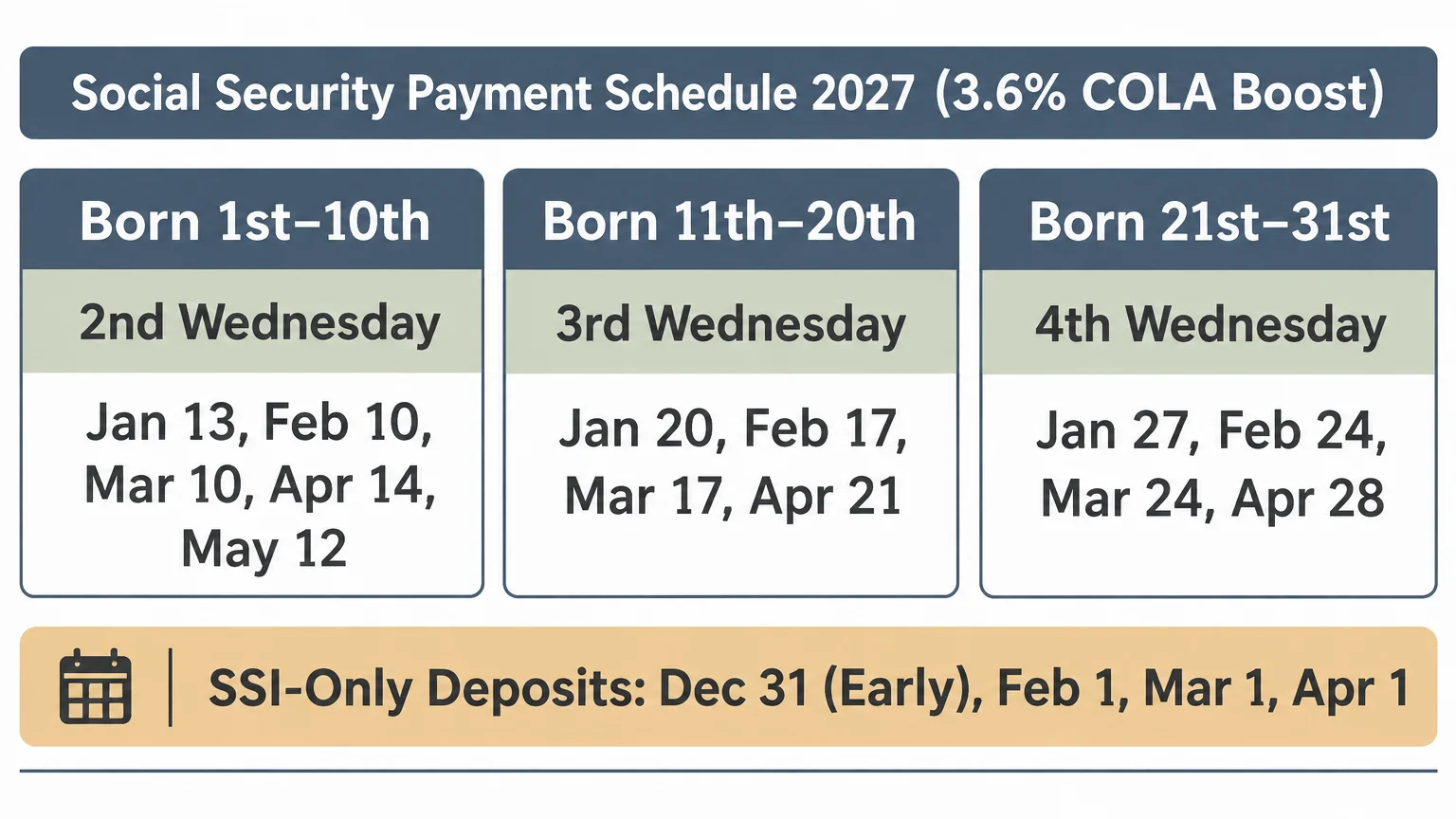
Social Security Payment Schedule 2027 by Birth Date and Program
Knowing the exact Social Security payment schedule 2027 prevents bounced autopays and unnecessary stress around the first of the month. SSA assigns your monthly deposit date based on when you first claimed benefits and which program pays you.
Under SSA Publication No. 05-10031, anyone who filed for Social Security retirement, spousal, survivor, or disability benefits on or after May 1, 1997, follows the Wednesday schedule. Your payment lands on the second, third, or fourth Wednesday based on the birth date of the worker on whose record you receive benefits.
Good news for your 2027 retirement calendar: none of the standard Wednesday payment dates shift for federal holidays during 2027. Every Wednesday cohort receives exactly twelve deposits on its regular schedule.
| Benefit Month | Born 1st–10th (2nd Wed.) | Born 11th–20th (3rd Wed.) | Born 21st–31st (4th Wed.) | SSI-Only Deposit Date |
|---|---|---|---|---|
| January 2027 | January 13, 2027 | January 20, 2027 | January 27, 2027 | December 31, 2026 (Early) |
| February 2027 | February 10, 2027 | February 17, 2027 | February 24, 2027 | February 1, 2027 |
| March 2027 | March 10, 2027 | March 17, 2027 | March 24, 2027 | March 1, 2027 |
| April 2027 | April 14, 2027 | April 21, 2027 | April 28, 2027 | April 1, 2027 |
| May 2027 | May 12, 2027 | May 19, 2027 | May 26, 2027 | April 30, 2027 (Early) |
| June 2027 | June 9, 2027 | June 16, 2027 | June 23, 2027 | June 1, 2027 |
| July 2027 | July 14, 2027 | July 21, 2027 | July 28, 2027 | July 1, 2027 |
| August 2027 | August 11, 2027 | August 18, 2027 | August 25, 2027 | July 30, 2027 (Early) |
| September 2027 | September 8, 2027 | September 15, 2027 | September 22, 2027 | September 1, 2027 |
| October 2027 | October 13, 2027 | October 20, 2027 | October 27, 2027 | October 1, 2027 |
| November 2027 | November 10, 2027 | November 17, 2027 | November 24, 2027 | November 1, 2027 |
| December 2027 | December 8, 2027 | December 15, 2027 | December 22, 2027 | December 1, 2027 |
Pre-May 1997 and Dual Social Security Plus SSI Recipients
If you started receiving Social Security before May 1997—or if you collect both Social Security and SSI—your Social Security payment normally arrives on the 3rd of each month. When the 3rd falls on a weekend or federal holiday, SSA pays on the preceding business day.
For 2027, verified early adjustments for this group include December 31, 2026, for January 2027 benefits, and April 2, 2027, for April benefits. Meanwhile, any separate SSI portion still follows the first-of-the-month schedule shown above.
How Early SSI Deposits Affect Your 2027 Cash Flow
SSI payments normally arrive on the 1st of the month, shifting to the preceding business day whenever the 1st lands on a weekend or federal holiday. In 2027, that rule creates several early payments you need to budget around carefully.
Besides the December 31, 2026 payout for January, SSI benefits for May arrive on April 30, 2027, and August benefits arrive on July 30, 2027. At the end of the year, your January 2028 SSI payment arrives early on December 30, 2027.
Because of those shifts, December 2026, April 2027, July 2027, and December 2027 each deliver two SSI deposits. Conversely, January, May, and August 2027 have zero SSI deposits—so treat every end-of-month payment as next month’s rent and grocery money.
If your scheduled deposit does not appear on time, check your bank account first and confirm your routing information hasn’t changed. SSA advises waiting three additional mailing days after your scheduled date before contacting the agency about a missing payment.
Social Security Dates 2027: COLA, Earnings Limits, and Age Milestones
Beyond deposit days, several annual rule changes and age thresholds shape your Social Security dates in 2027. On October 14, 2026, SSA announced a 3.6% COLA affecting 76 million Americans—nearly 72 million Social Security beneficiaries and about 7.3 million SSI recipients.
Average Social Security retirement benefits increase by roughly $75 per month starting with January 2027 checks. However, how much you keep depends on your claiming age, outside wages, and Medicare deductions.
Key 2027 Social Security Thresholds and Age Rules
- Full Retirement Age (FRA) milestone: Everyone born in 1960 or later has an FRA of 67, meaning people born in 1960 reach FRA in 2027 (January 1 births follow prior-year rules).
- Earliest claiming age: Anyone born in 1965 turns 62 in 2027, which remains the earliest age to claim retirement benefits—though claiming at exact age 62 permanently cuts your primary insurance amount by 30% and a spousal benefit by 35%.
- Maximum benefit at FRA: The maximum monthly retirement benefit for a worker claiming at Full Retirement Age climbs to $4,188 per month in 2027, up from $4,152 in 2026.
- Maximum taxable earnings: Workers pay the 6.2% Social Security payroll tax (12.4% if self-employed) on earnings up to $192,300 in 2027, up from $184,500 in 2026.
- Medicare payroll taxes: The 1.45% Medicare Hospital Insurance tax (2.90% self-employed) applies to all earnings with no cap, plus an extra 0.9% surtax on earned income over $200,000 for single filers or $250,000 for married joint filers.
- Quarter of coverage: Earning one Social Security work credit in 2027 requires $1,970 in covered wages or self-employment income, up from $1,890 in 2026.
- Disability income thresholds: Substantial Gainful Activity (SGA) limits increase to $1,770 per month for non-blind beneficiaries and $2,950 per month for blind beneficiaries, while the Trial Work Period threshold rises to $1,270 per month.
Working in 2027: The Retirement Earnings Test
If you work while collecting Social Security before reaching Full Retirement Age, watch the 2027 Retirement Earnings Test limits closely. Exceeding these caps temporarily reduces your monthly checks.
For beneficiaries under FRA for all of 2027, the annual exempt limit rises to $25,560 ($2,130 per month). SSA withholds $1 in benefits for every $2 you earn above that threshold.
If you reach your FRA during 2027, a higher limit of $67,920 ($5,660 per month) applies to earnings in the months before your FRA month. SSA withholds $1 for every $3 earned above that higher limit.
Once you reach your FRA month, the earnings test disappears completely regardless of how much you earn. Better yet, any benefits withheld earlier for excess earnings are credited back through a permanent upward adjustment to your monthly check starting at FRA.
Medicare Enrollment Periods on Your 2027 Calendar
Understanding Medicare enrollment periods keeps you covered without gaps and protects you from lifelong late penalties. Each Medicare window serves a distinct purpose and follows strict start-and-end dates.
Initial Enrollment Period (IEP)
If you turn 65 in 2027, your Initial Enrollment Period is a seven-month window centered on your birthday month. It begins three months before your birth month, includes your birth month, and ends three months after.
Enroll during the first three months of your IEP so your coverage begins on the first day of your birth month—or the first day of the prior month if your birthday falls on the 1st. Signing up during or after your birth month pushes your start date to the first day of the following month.
General Enrollment Period (GEP): January 1 to March 31, 2027
If you missed your Initial Enrollment Period for Part B or premium Part A—and you do not qualify for a Special Enrollment Period through employer coverage—mark January 1 through March 31, 2027. According to Medicare.gov, coverage you enroll in during the GEP begins the first day of the month after you sign up.
Keep in mind that signing up during the GEP often triggers permanent late enrollment penalties based on how long you went without Part B coverage. Check whether you qualify for a Special Enrollment Period before waiting for January.
Medicare Advantage Open Enrollment Period (MA OEP): January 1 to March 31, 2027
If you start 2027 in a Medicare Advantage plan and realize your doctor is out of network or your prescriptions cost too much, you get one second chance early in the year. From January 1 through March 31, 2027, current Medicare Advantage enrollees can switch to a different Medicare Advantage plan.
Alternatively, the Medicare & You Handbook 2027 confirms you can drop Medicare Advantage, return to Original Medicare, and join a standalone Part D drug plan during this window. Your new coverage takes effect on the first day of the month after the plan receives your request.
Annual Fall Open Enrollment and Telehealth Rules
Every fall from October 15 through December 7, anyone with Medicare can compare plans and adjust Part D or Medicare Advantage coverage for the following year. Changes submitted between October 15 and December 7, 2027, will take effect on January 1, 2028.
Also note a helpful coverage update for your 2027 medical appointments: according to the Medicare & You Handbook 2027, Medicare extended telehealth flexibilities through December 31, 2027. You can continue using eligible virtual visits under those extended rules all year.

2027 Medicare Premiums, Deductibles, and Drug Cost Caps
Medicare costs shift every January, and the 2027 Medicare dates bring higher Part B and Part A cost-sharing alongside important Part D prescription changes. Reviewing these figures now helps you budget accurately for out-of-pocket medical care.
On November 17, 2026, the Centers for Medicare & Medicaid Services (CMS) released official 2027 Medicare premiums and deductibles. Most changes take effect on January 1, 2027.
| Medicare Cost Item | 2026 Amount | 2027 Amount | 2027 Change |
|---|---|---|---|
| Part B Standard Monthly Premium | $202.90 | $209.40 | +$6.50 (+3.2%) |
| Part B Annual Deductible | $283 | $292 | +$9 |
| Part A Inpatient Hospital Deductible (Days 1–60) | $1,736 | $1,776 | +$40 |
| Part A Hospital Coinsurance (Days 61–90) | $434/day | $444/day | +$10/day |
| Part A Lifetime Reserve Days Coinsurance | $868/day | $888/day | +$20/day |
| Skilled Nursing Facility Coinsurance (Days 21–100) | $217/day | $222/day | +$5/day |
| Part D Maximum Annual Deductible | $615 | $700 | +$85 |
| Part D Annual Out-of-Pocket Cap | $2,100 | $2,400 | +$300 |
| Part D National Base Beneficiary Premium | $38.99 | $41.33 | +6% (statutory cap) |
Part A and Part B Highlights for 2027
Roughly 99% of Medicare beneficiaries pay $0 per month for Part A hospital insurance because they or a spouse accumulated at least 40 quarters of Medicare-covered work. If you have fewer credits, voluntary Part A premiums rise in 2027 to $328 per month for 30–39 quarters or $597 per month for under 30 quarters.
For Part B medical insurance, the standard monthly premium moves to $209.40, and you typically pay 20% coinsurance after meeting the $292 annual deductible. If your Part B premium comes out of your Social Security check, the statutory hold-harmless rule protects most beneficiaries from seeing their net Social Security payment drop.
Major 2027 Medicare Part D Prescription Updates
Starting January 1, 2027, the annual Part D out-of-pocket cap rises to $2,400, up from $2,100 in 2026 and $2,000 in 2025. Once your covered drug spending hits $2,400, you pay $0 out of pocket for covered Part D prescriptions for the rest of 2027.
Covered insulin remains capped at $35 per month or less without needing to satisfy your Part D deductible first. Furthermore, lower CMS-negotiated Maximum Fair Prices take effect on January 1, 2027, for 15 additional Part D drugs, including Ozempic, Rybelsus, Wegovy, Trelegy Ellipta, and Xtandi.
Shop carefully if you rely on standalone Part D coverage, because CMS ended the Part D Premium Stabilization Demonstration after 2026. While CMS projects average standalone Part D premiums rising less than $1 per month to around $36, KFF projects $51 per month for enrollees who stay put without switching plans.
On the Medicare Advantage side, CMS projects weighted average premiums to drop more than 16% from 2026 to 2027. Reviewing your plan options during Fall Open Enrollment or the MA OEP can uncover substantial savings.
2027 IRMAA Surcharges and Form SSA-44 Appeals
Higher-income retirees pay extra monthly charges on Part B and Part D known as the Income-Related Monthly Adjustment Amount (IRMAA). Affecting roughly 9% of Part B enrollees, 2027 IRMAA tiers are determined by the Modified Adjusted Gross Income (MAGI) reported on your 2025 federal tax return.
Because there is a two-year lookback, bonuses, home sales, or Roth conversions you completed in 2025 directly affect your 2027 Medicare deductions. Review the official CMS brackets released on November 17, 2026, to verify where your 2025 income lands.
| 2025 MAGI (Single Filer) | 2025 MAGI (Married Filing Jointly) | 2027 Part B Monthly Premium | 2027 Part D Monthly IRMAA |
|---|---|---|---|
| $112,000 or less | $224,000 or less | $209.40 | $0.00 |
| $112,001 – $141,000 | $224,001 – $282,000 | $293.10 | +$15.40 |
| $141,001 – $177,000 | $282,001 – $354,000 | $418.80 | +$39.70 |
| $177,001 – $212,000 | $354,001 – $424,000 | $544.40 | +$64.00 |
| $212,001 – $499,999 | $424,001 – $749,999 | $670.00 | +$88.30 |
| $500,000 or more | $750,000 or more | $711.80 | +$96.40 |
If your income dropped significantly since 2025 because you retired, reduced your work hours, divorced, or lost a spouse, do not quietly absorb the surcharge. You can file Form SSA-44 with SSA to request an IRMAA reduction based on a qualifying life-changing event.
Attach supporting documentation—such as an employer letter confirming your retirement date and a signed copy of your more recent tax return or income estimate—when submitting Form SSA-44. Getting approved before 2027 deductions start preserves hundreds or thousands of dollars in annual cash flow.

Common Mistakes to Avoid With 2027 Benefit Dates
Even organized retirees slip up when calendars, holiday shifts, and lookback rules collide. Watch out for these five frequent mistakes as you map out 2027.
- Spending early SSI deposits twice: When SSI deposits land on December 31, April 30, July 30, or December 30, treat them strictly as next month’s income so you are never short during January, May, or August.
- Assuming you can change Part D plans in February: The January 1–March 31 Medicare Advantage Open Enrollment Period only applies to people already enrolled in a Medicare Advantage plan, not standalone Part D enrollees on Original Medicare.
- Auto-renewing prescription coverage without comparing: With the Part D stabilization program ending after 2026 and 15 new negotiated drug prices starting January 1, 2027, checking formularies on Medicare.gov can prevent surprise premium jumps.
- Ignoring the Social Security earnings test: Working part-time while claiming before FRA without tracking the $25,560 limit—or the $67,920 limit in your FRA year—can pause your deposits unexpectedly until benefits are recalculated.
- Overlooking tax-driven IRMAA cliffs: Crossing an IRMAA threshold by even $1 on your tax return pushes you into the next monthly surcharge bracket, so factor IRS tax planning into every withdrawal decision.
Professional vs. Self-Guided Planning for Your 2027 Calendar
Many routine updates on your 2027 retirement calendar take just minutes to handle yourself using official portals. However, complex income and claiming choices often justify hiring a fee-only financial planner or tax advisor.
- Self-guided — Tracking deposits and COLA notices: Create your my Social Security account, download the 2027 payment dates for your birth bracket, and set automatic bill-pay dates two or three days after your scheduled Wednesday deposit.
- Self-guided — Comparing annual drug and health plans: Enter your exact prescriptions and preferred pharmacies into the Medicare.gov Plan Finder, or contact a State Health Insurance Assistance Program counselor through the National Council on Aging for free unbiased help.
- Professional guidance — Timing spousal claims and working in retirement: If you and your spouse have large age gaps, plan to work between ages 62 and 67, or are deciding whether to delay past FRA, modeling break-even ages with an advisor protects lifetime household income.
- Professional guidance — Managing IRMAA and tax brackets: A CPA or fiduciary planner can coordinate Roth conversions, capital gains, and charitable distributions with AARP retirement guidance and IRS rules to keep your MAGI below steep IRMAA cliffs—and help prepare Form SSA-44 after retirement.
Frequently Asked Questions About 2027 Medicare and Social Security Dates
When does the 3.6% Social Security COLA take effect in 2027?
Social Security beneficiaries receive the 3.6% COLA starting with January 2027 payments, delivered on the 3rd or on your assigned Wednesday. SSI recipients receive their increased January 2027 payment early on December 31, 2026, because January 1 is a federal holiday.
Why are there no SSI deposits in January, May, and August 2027?
Because SSI payments shift to the preceding business day whenever the 1st lands on a holiday or weekend, January, May, and August 2027 benefits arrive on December 31, April 30, and July 30. You still receive 12 full monthly payments across the year.
Can I switch my Medicare plan between January 1 and March 31, 2027?
Yes, if you already have a Medicare Advantage plan, the MA Open Enrollment Period lets you switch to another Medicare Advantage plan or return to Original Medicare with a Part D plan. People who missed Part B earlier can also enroll during the General Enrollment Period.
What happens if I earn over $25,560 while collecting Social Security in 2027?
If you remain under Full Retirement Age all year, SSA withholds $1 in benefits for every $2 earned above $25,560. Those withheld amounts are not lost permanently—SSA adjusts your monthly benefit upward once you reach Full Retirement Age.

Your Next Steps for a Smooth 2027
Log into your my Social Security account this week to download your 2027 COLA notice, verify your Medicare Part B deduction, and mark your exact Wednesday or early SSI deposit dates on your calendar. If your income recently dropped due to retirement, submit Form SSA-44 promptly so you do not overpay 2027 IRMAA surcharges.
This is educational content based on general retirement planning principles. Individual results vary based on your situation. Always verify current benefit amounts, tax laws, and eligibility with official sources.
Last updated: November 2026. Retirement benefits, tax laws, and healthcare costs change frequently—verify current details with official sources.