Missing your Medicare enrollment deadlines can permanently drain your retirement budget. A single delayed enrollment triggers lifetime surcharges that inflate your healthcare costs every single month.
The federal government calculates these surcharges using complex formulas that catch thousands of unsuspecting retirees off guard each year. Knowing the strict rules protects your monthly Social Security check from compounding penalties.
Before you turn 65, you need to understand how late enrollment penalties actually work. These ten hidden realities will help you safeguard your retirement savings and avoid costly lifetime mistakes.
1. The Part B Surcharge Compounds Annually as Premiums Rise
Most retirees assume a Medicare penalty is a one-time fine or a static dollar figure. In reality, the Part B penalty is a permanent percentage added to the standard monthly premium.
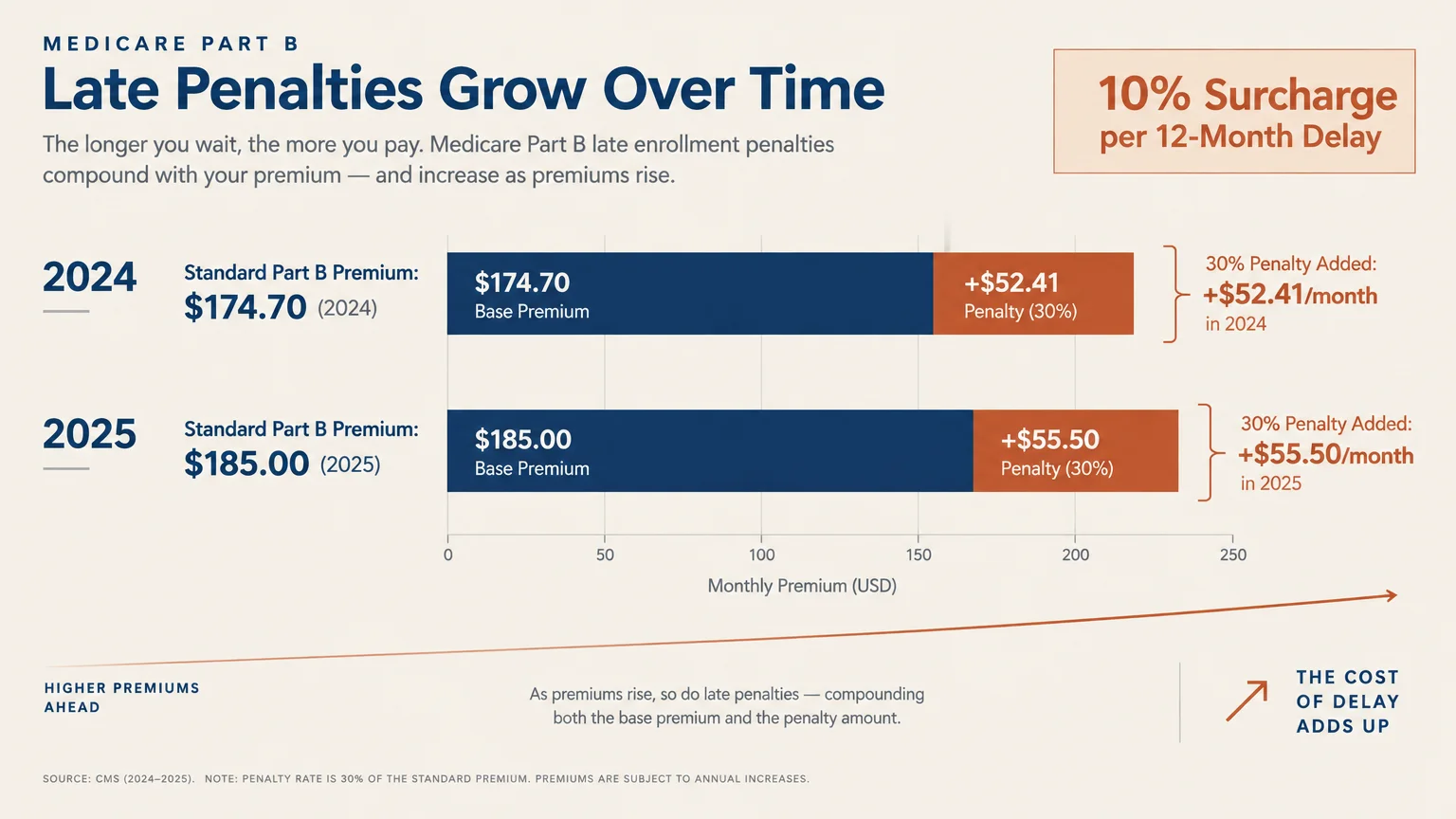
The government assesses a 10% surcharge for every full 12-month period you were eligible for Part B but did not enroll. If you delay enrollment for three full years, you face a permanent 30% penalty.
Because the penalty is a percentage rather than a fixed dollar amount, your penalty payment increases whenever standard Medicare premiums rise. You pay that percentage calculation against the current base rate each year.
According to Medicare.gov, the standard Part B premium increased from $174.70 in 2024 to $185.00 in 2025. A 30% penalty meant an extra $52.41 per month in 2024, but it rose to $55.50 per month in 2025.
As healthcare inflation drives base premiums higher over the coming decades, your out-of-pocket penalty amount expands right alongside them. A penalty incurred at age 65 becomes substantially more expensive by age 85.

2. Your Penalty Follows You for Life
Unlike conventional tax fines or consumer credit penalties, Medicare Part B and Part D surcharges never expire. Once the federal government applies the surcharge, you pay it for the rest of your life.
Every single month, the Social Security Administration automatically deducts this enhanced premium directly from your Social Security benefit check. You cannot negotiate this charge down once you trigger the underlying statute.
The only exception occurs if you qualify for Medicare before age 65 due to a qualifying disability. When you subsequently turn 65, your penalty slate wipes completely clean for a new Initial Enrollment Period.
Outside of that specific disability scenario, the penalty remains a permanent financial obligation. Planning your transition ahead of time remains the only foolproof defense against lifetime surcharges.

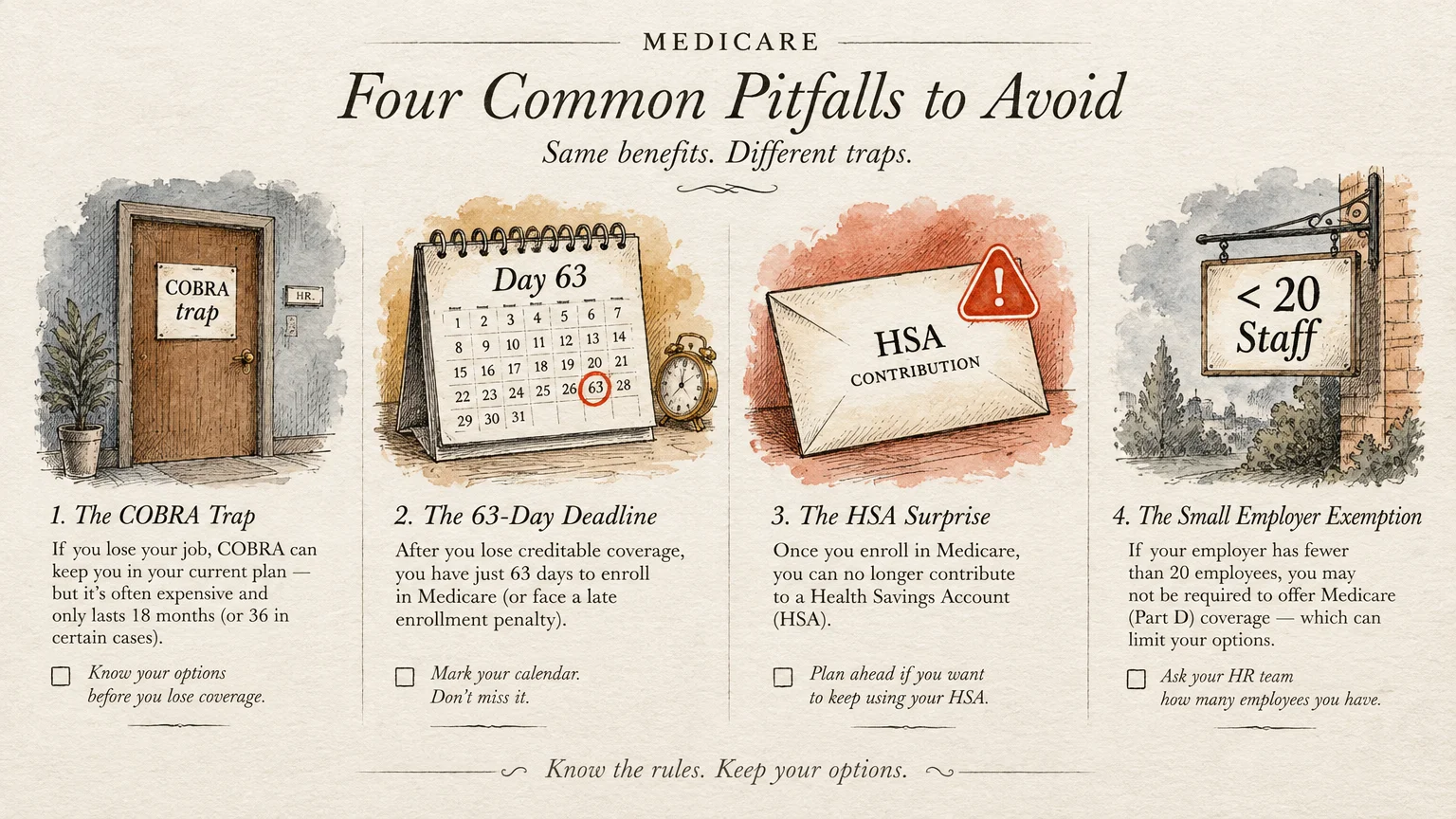
3. COBRA and Retiree Health Plans Do Not Protect You
One of the most dangerous Medicare traps catches people who retire and maintain health insurance through COBRA. Retirees frequently assume that continuous health coverage exempts them from Medicare late enrollment penalties.
Federal regulations explicitly state that COBRA does not qualify as active employer-sponsored group health coverage. The same restriction applies to standalone retiree health insurance plans.
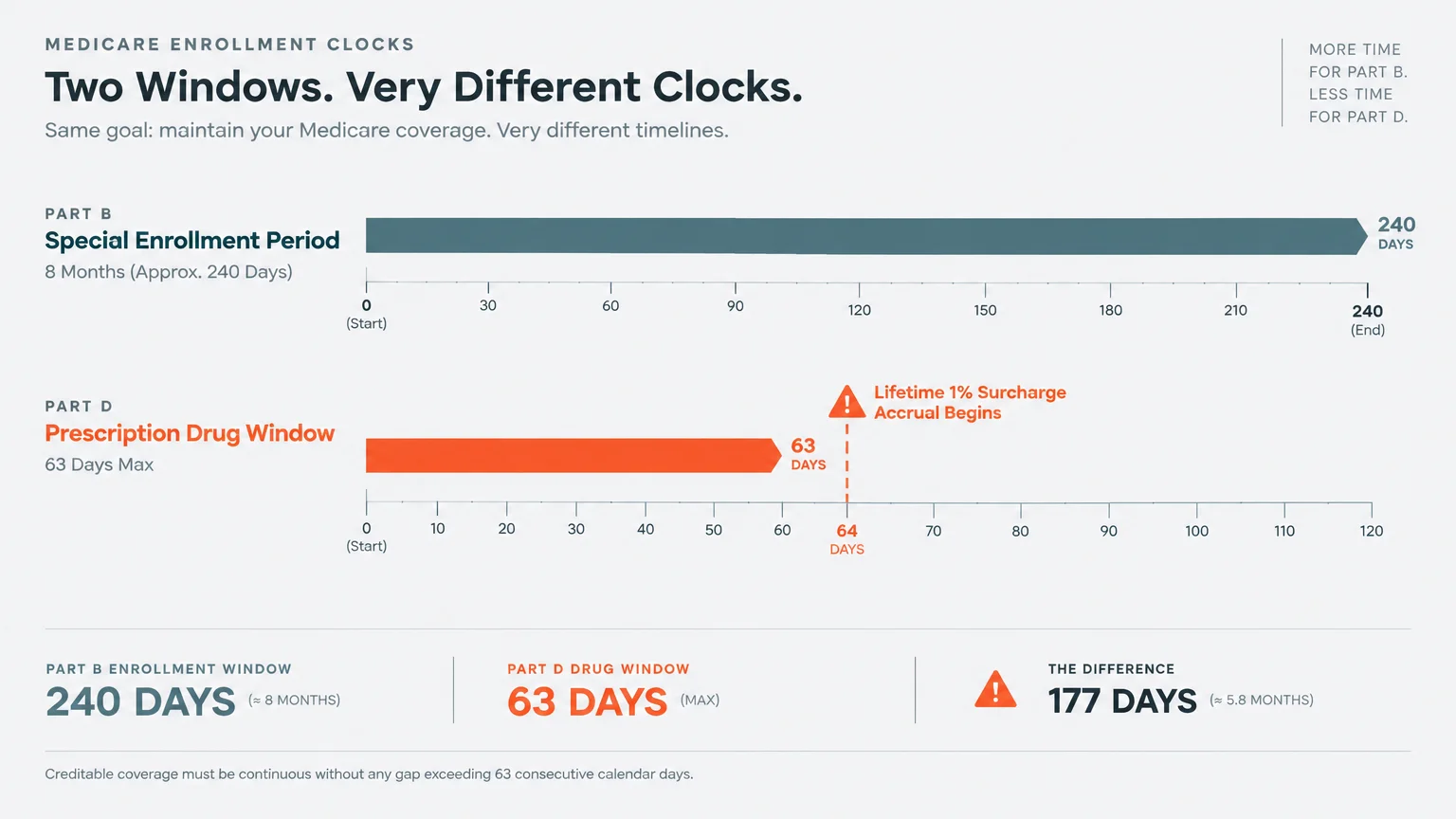
Your eight-month Special Enrollment Period (SEP) to enroll in Part B without penalty begins the month your active employment ends. It does not begin when your COBRA coverage expires.
If you rely on COBRA for 18 months before applying for Medicare, you will miss your eight-month SEP entirely. You will then accumulate a lifetime Part B penalty and face gaps in medical coverage.
Furthermore, many commercial insurance plans contain coordination-of-benefits clauses that make them secondary to Medicare once you reach age 65. If you lack Part B, your insurer may refuse to pay medical claims entirely.
4. The 20-Employee Rule Creates a Hidden Small Business Trap
Working past age 65 only allows you to delay Medicare Part B penalty-free under specific statutory conditions. The primary factor depends entirely on the size of your employer.
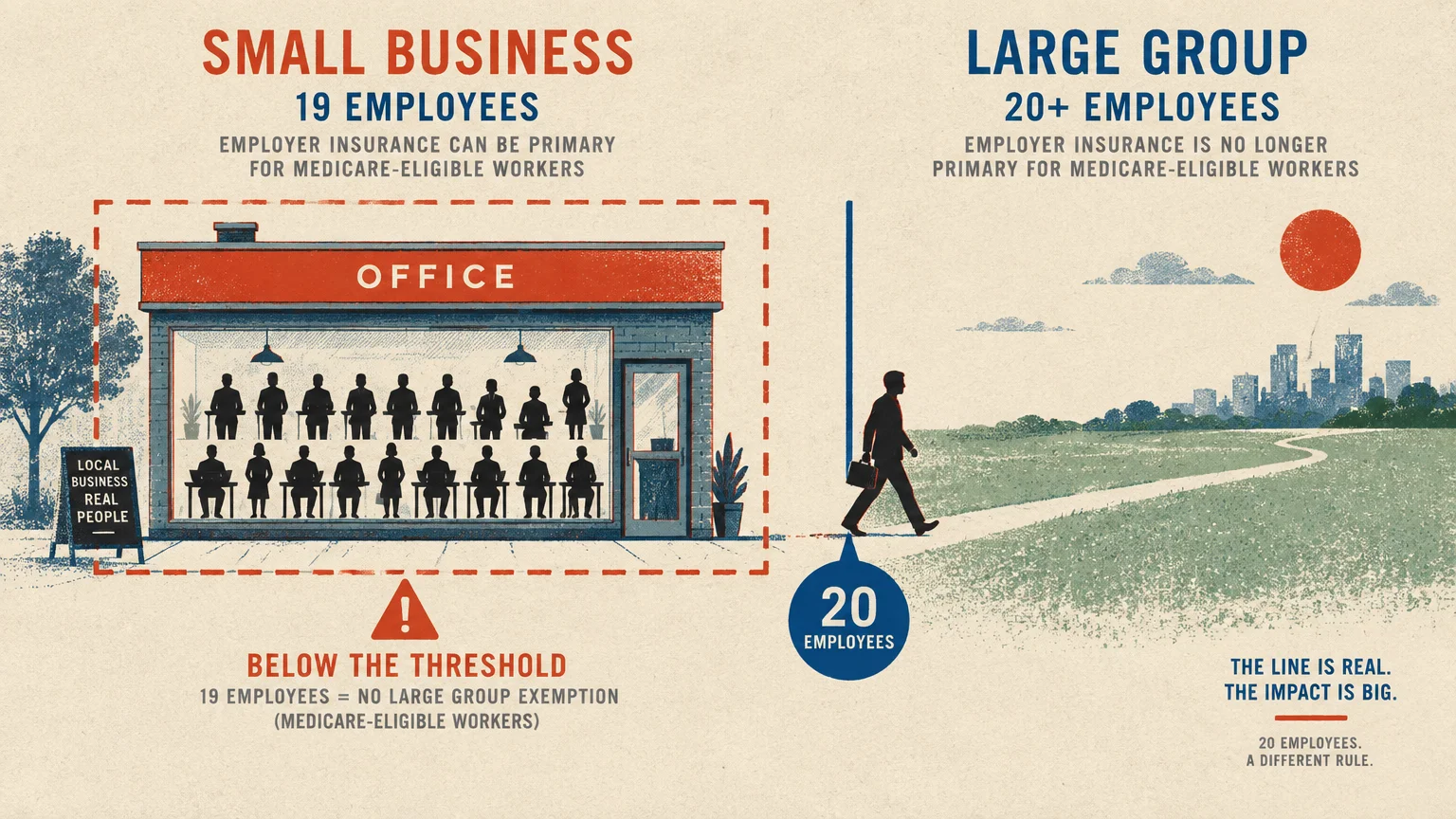
Under Medicare Secondary Payer rules, you can delay Part B without penalty only if your employer employs 20 or more workers. At companies of this scale, the employer group health plan acts as the primary payer.
If you work for a business with fewer than 20 employees, Medicare automatically becomes your primary insurer at age 65. The small group health plan becomes secondary coverage.
If you fail to enroll in Part B during your initial window while working for a small firm, penalties begin accumulating immediately. Your small business insurer can also decline payment for outpatient care that Medicare should have covered.
Always verify your company’s full-time equivalent employee count directly with your human resources department before your 65th birthday. Do not rely on casual verbal assurances from supervisors.
5. The 63-Day Clock for Part D Is Much Tighter Than Part B
When leaving an employer group health plan, most individuals know they have an eight-month window to sign up for Part B. However, prescription drug coverage operates under an entirely different deadline.
To avoid the Medicare Part D late penalty, you must secure creditable drug coverage within 63 consecutive days of losing your prior plan. Waiting through the full eight-month Part B window guarantees a drug penalty.
The Part D penalty formula multiplies 1% of the national base beneficiary premium by your total number of uncovered months. The government then rounds this figure to the nearest ten cents.
Federal data establishes that the national base beneficiary premium rose to $36.78 in 2025 and reaches $38.99 in 2026. Under the Inflation Reduction Act, annual growth in this base premium remains capped at 6% through 2029.
If you go 24 months without creditable drug coverage, you permanently pay an additional 24% of that national base rate monthly. That surcharge attaches to whatever private Part D plan premium you select.
“Medicare mistakes can cost you thousands of dollars over your retirement lifetime, and most people don’t realize that once you make certain election errors, you can never undo them.” — Ed Slott, CPA and Retirement Specialist

6. VA Healthcare Does Not Protect You From the Part B Penalty
Military veterans frequently believe that active enrollment in the Department of Veterans Affairs (VA) healthcare system completely covers their Medicare obligations. This common misunderstanding triggers steep financial consequences.
Medicare regulations do not classify VA healthcare as creditable coverage for Medicare Part B. If you decline Part B at age 65 relying solely on VA care, your late penalty accrues uninterrupted.
Should you decide to enroll in Part B years later, you will pay a lifetime surcharge on every monthly premium. You will also wait until the next enrollment window to access civilian medical providers.
Fortunately, the rules treat prescription coverage much better. The federal government officially certifies VA prescription drug benefits as creditable coverage for Medicare Part D.
Veterans can safely delay Part D without incurring late enrollment surcharges as long as they maintain active VA pharmacy benefits. However, preserving non-VA outpatient care access requires maintaining Part B enrollment.

7. The HSA Six-Month Retroactive Enrollment Tax Trap
Health Savings Accounts (HSAs) offer exceptional triple-tax advantages, but pairing them with delayed Medicare enrollment creates a severe administrative hazard. The problem stems from retroactive Medicare Part A effective dates.
When you apply for Medicare after your 65th birthday month, the Social Security Administration automatically retroactively backdates your Part A coverage by up to six months. It will not backdate prior to your 65th birthday month.
According to IRS regulations, individuals cannot make contributions to an HSA while enrolled in any part of Medicare. The retroactive Part A start date instantly invalidates any HSA deposits made during that lookback window.
Those invalid deposits turn into excess contributions subject to a strict 6% IRS excise tax each year until properly corrected. You must withdraw the excess funds and their earnings before your annual tax filing deadline.
To prevent this tax trap, stop all HSA contributions at least six months before applying for Medicare or claiming Social Security benefits. This pause guarantees a seamless transition without triggering IRS financial penalties.

8. Part A Penalties Are Temporary—Unlike Parts B and D
Most American workers earn premium-free Medicare Part A by paying Medicare payroll taxes for at least 40 calendar quarters. However, individuals who fall short of that 10-year threshold face monthly Part A premiums.
If you must pay for Part A and miss your Initial Enrollment Period, Medicare imposes a 10% premium penalty. This surcharge catches legal immigrants and non-qualifying workers who delay their applications.
Unlike the lifelong penalties for Parts B and D, the Part A late enrollment penalty is strictly temporary. The surcharge lasts for twice the number of full years you delayed enrollment.
If you delayed enrolling in premium-paying Part A for two full years, you will pay the 10% penalty for exactly four years. Once that four-year timeframe concludes, your monthly Part A premium drops back to the standard rate.
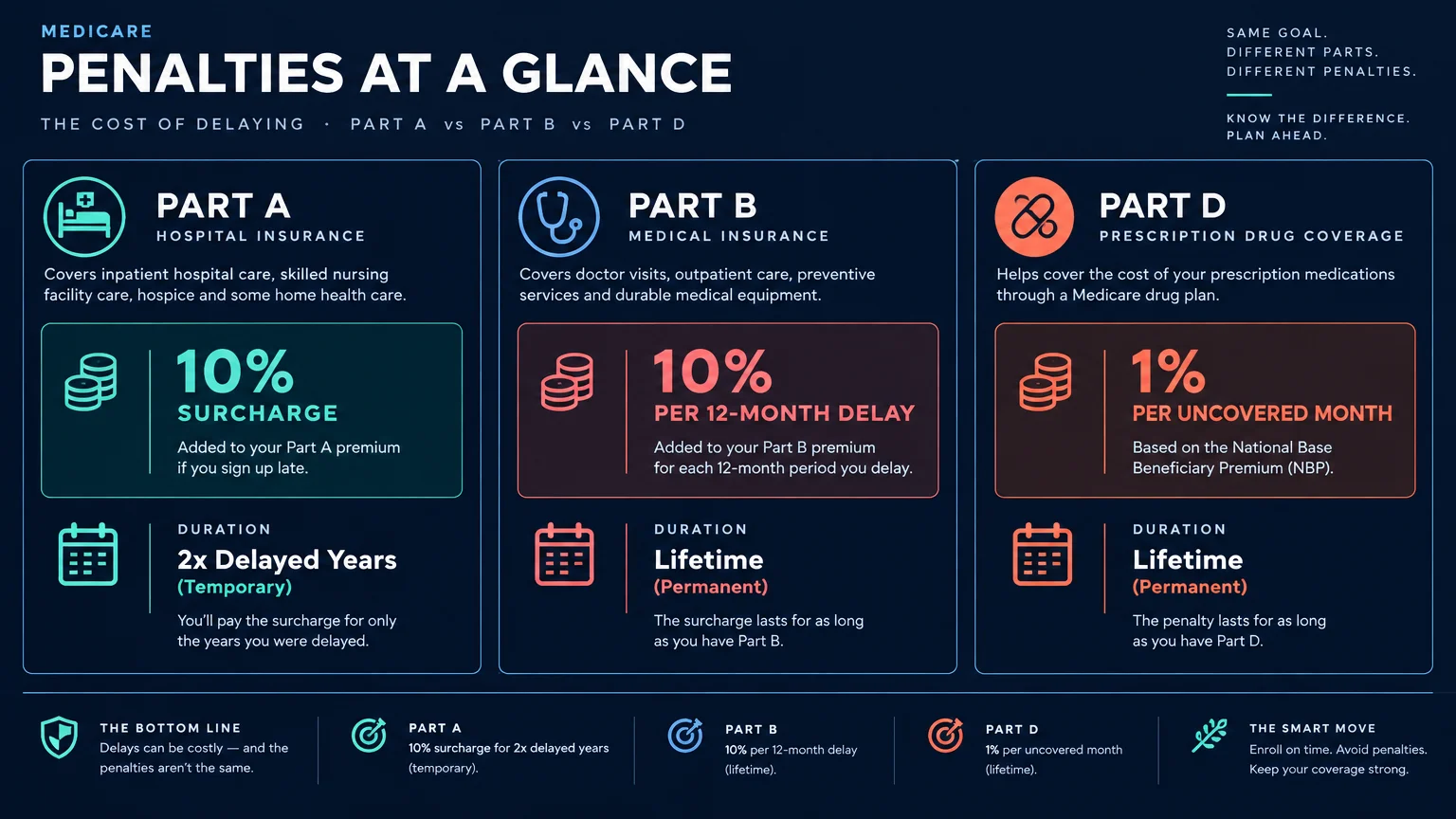
Comparing Medicare Late Enrollment Penalties
The three Medicare late penalties calculate surcharges differently, operate on distinct timelines, and carry varying financial durations. Understanding these structural differences clarifies your actual financial exposure.
| Medicare Part | Penalty Calculation Formula | Duration of Penalty | Current Cost Base Benchmark | Safe Harbor / Grace Period |
|---|---|---|---|---|
| Part A | Flat 10% added to monthly premium | Temporary (2x the number of delayed years) | Full premium up to $518/month in 2025 | Premium-free for workers with 40 quarters |
| Part B | 10% per full 12-month uncovered period | Permanent (lasts your entire lifetime) | $185.00/month standard premium in 2025 | Active work + group plan (20+ workers) |
| Part D | 1% of national base rate per uncovered month | Permanent (lasts your entire lifetime) | $36.78 (2025) / $38.99 (2026) base rate | Must obtain creditable coverage within 63 days |
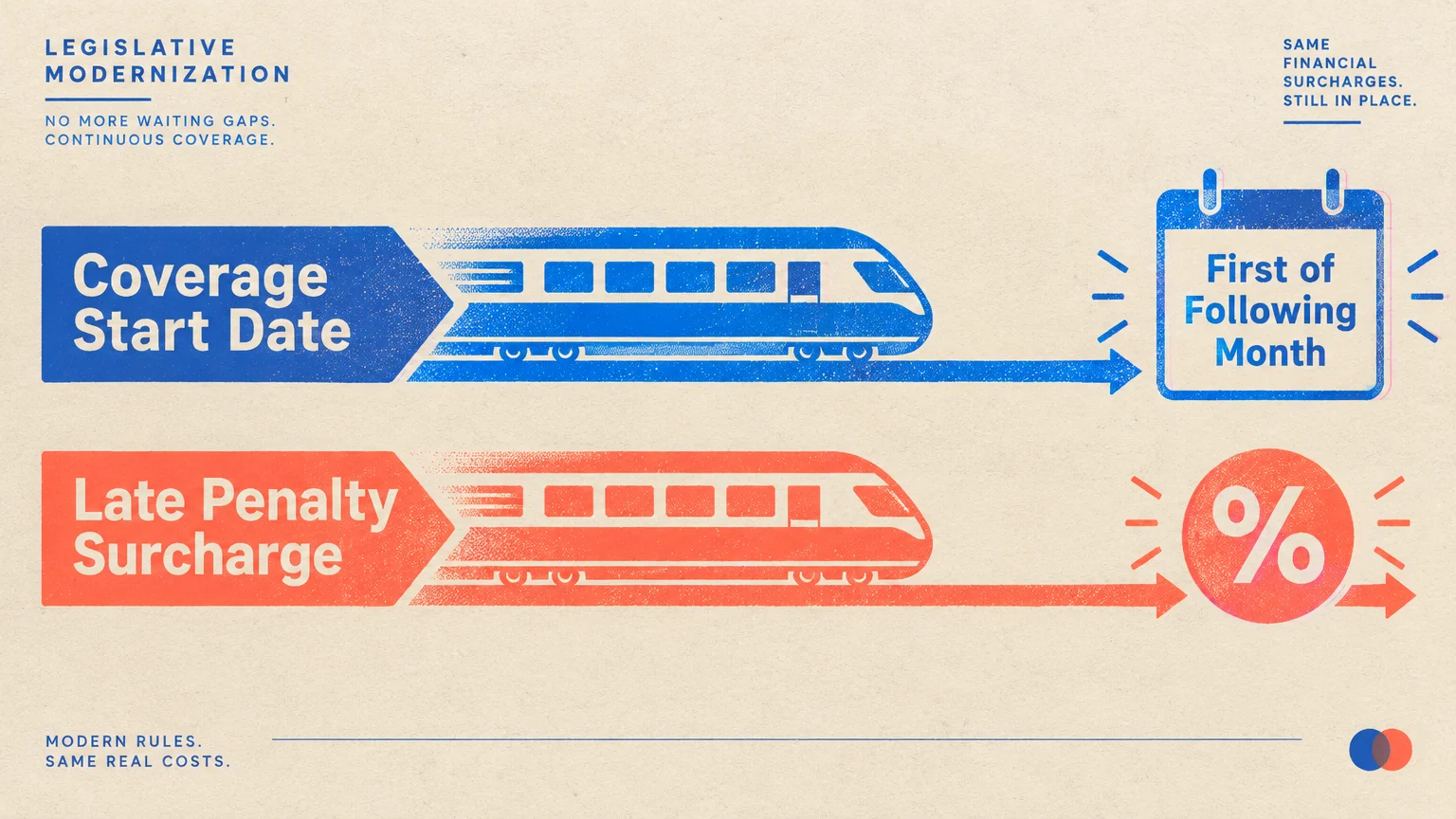
9. The BENES Act Fixed Coverage Gaps but Preserved Penalties
The Beneficiary Enrollment Notification and Eligibility Simplification (BENES) Act modernized Medicare’s General Enrollment Period (GEP), which runs annually from January 1 through March 31. This law altered coverage start dates significantly.
Under historic rules, enrolling during the GEP forced retirees to wait until July 1 for their medical coverage to begin. Today, your Medicare benefits take effect on the first day of the month following your enrollment month.
While this change successfully eliminates dangerous multi-month coverage gaps, it does nothing to waive your late enrollment penalties. The federal government continues calculating Part B penalties from the day your original window closed.
The clock counts every full 12-month period you spent without qualifying coverage before your enrollment took effect. Modernized processing speeds up medical protection, but it does not erase the financial penalty.

10. You Can Appeal or Eliminate Penalties Under Specific Rules
Receiving a late enrollment penalty notice is alarming, but these surcharges are not completely cast in stone. You have legitimate administrative pathways to dispute penalties or eliminate them through financial assistance.
If you delayed Medicare because an employer or government representative provided erroneous information, you can formally apply for Equitable Relief. This legal remedy allows the government to waive penalties and grant retroactive enrollment.
Beneficiaries who qualify for the federal Extra Help program—which assists with prescription costs—automatically eliminate accumulated Part D late enrollment surcharges entirely. State Medicare Savings Programs can similarly absorb Part B premium costs.
When leaving an employer plan, submit Form CMS-L564 completed by your benefits administrator alongside Form CMS-40B to the Social Security Administration. This documentation verifies continuous creditable coverage and protects you from erroneous penalties.
“Navigating healthcare transitions requires proactive planning; waiting until an employer plan ends without verifying Medicare rules creates unnecessary financial risk.” — Jean Chatzky, Financial Journalist and Author
Common Mistakes to Avoid
Retirees often encounter avoidable penalties by making assumptions based on incomplete advice. Staying alert to specific procedural missteps preserves your financial freedom.
- Assuming your spouse’s retirement date matches yours: Your Special Enrollment Period depends on your own coverage status; do not let your partner’s timeline dictate your critical health elections.
- Ignoring the annual Creditable Coverage notice: Private employers must send an annual notice proving their drug plan meets Medicare standards; save this document every autumn to prove coverage.
- Confusing individual marketplace coverage with employer plans: Health insurance purchased through the Affordable Care Act exchange does not count as active employer group insurance after age 65.
- Delaying Part B while on severance pay: Severance packages extend income, but they do not count as active employment under Medicare rules once your physical job duties stop.
- Missing the strict 7-month Initial Enrollment Period: Your initial window spans three months before your 65th birthday month, the birthday month itself, and three months after.

Professional vs. Self-Guided
Managing Medicare transitions independently works well for straightforward retirements, but complex career arrangements demand professional expertise. Review these scenarios to determine whether you require certified guidance.
Scenario 1: You are retiring at 65 with conventional benefits. If you leave work during your standard 7-month Initial Enrollment Period without an HSA, you can manage the application directly via the Social Security portal.
Scenario 2: You work past 65 at a company with under 20 employees. Consult a licensed Medicare advisor immediately. You must coordinate Part B to avoid secondary payer claim denials and lifetime penalties.
Scenario 3: You have accumulated significant HSA balances. Work directly with a fee-only financial planner or CPA. They will establish a strategic timeline to pause HSA contributions before retroactive Part A coverage begins.
Scenario 4: You plan to utilize COBRA while searching for another job. Seek counsel from your State Health Insurance Assistance Program (SHIP). Experts will help you transition to Medicare Part B without triggering lifetime surcharges.
Frequently Asked Questions
Can I drop Medicare Part B later to stop paying the penalty?
You can voluntarily terminate Part B coverage, but dropping it stops your outpatient medical benefits. If you choose to re-enroll in Part B later, the original penalty returns alongside additional surcharges for the new gap.
What counts as creditable coverage for Medicare Part D?
Creditable prescription drug coverage pays, on average, at least as much as standard Medicare drug coverage. Common examples include qualifying employer group plans, union health benefits, VA pharmacy benefits, and TRICARE.
How do I prove I had creditable coverage when I sign up late?
Submit federal Form CMS-L564 signed by your former employer verifying your health insurance history. For prescription drug history, provide copies of the annual creditable coverage letters mailed by your prior insurance carriers.
Does Medicare notify me when my enrollment window opens?
The government only sends automatic enrollment packages if you already draw Social Security or Railroad Retirement benefits. If you have not claimed Social Security by age 65, you must proactively initiate your own enrollment.
Taking Control of Your Medicare Timeline
Navigating Medicare enrollment rules can feel daunting, but proactive planning eliminates costly surprises. Verifying employer plan size, monitoring HSA contribution dates, and respecting rigid enrollment windows keeps your hard-earned retirement savings secure.
Begin auditing your personal healthcare transition at least six months before reaching age 65. Taking methodical action today ensures you receive full medical protection without sacrificing a portion of your Social Security income to permanent penalties.
This is educational content based on general retirement planning principles. Individual results vary based on your situation. Always verify current benefit amounts, tax laws, and eligibility with official sources.
Last updated: February 2026. Retirement benefits, tax laws, and healthcare costs change frequently—verify current details with official sources.