
Navigating retirement income taxes often determines whether your nest egg lasts twenty years or thirty. The IRS treats every dollar you collect differently depending on its origin, from completely tax-free withdrawals to income hit with both income and payroll taxes. Understanding how different income sources are taxed allows you to structure withdrawals strategically, minimize your lifetime tax burden, and preserve thousands of dollars in hard-earned wealth. This guide ranks ten primary retirement income streams from the most tax-friendly to the highest-taxed, giving you a clear roadmap to optimize your retirement distribution strategy and make confident financial decisions.

1. Health Savings Accounts (HSAs) — The Ultimate Triple Tax Advantage
Health Savings Accounts hold the absolute top spot on our list because no other account offers a triple tax advantage. You deposit pre-tax dollars (or claim a tax deduction for contributions), your investments grow completely tax-deferred, and distributions come out 100% tax-free when spent on qualified medical expenses. Healthcare represents one of the largest ongoing expenses in retirement; according to medical cost projections, an average retired couple at age 65 needs substantial savings just to cover healthcare and medical expenses throughout retirement.
You can use tax-free HSA funds to pay for out-of-pocket prescription costs, dental care, vision expenses, hearing aids, and even Medicare Part B and Part D premiums. Furthermore, once you reach age 65, the IRS allows you to withdraw HSA funds for non-medical expenses. While non-medical withdrawals face standard ordinary income tax, the standard 20% early withdrawal penalty disappears completely. This safety net transforms the HSA into an account that functions like a Traditional IRA for general spending, yet retains total tax neutrality for medical care.
To maximize this bucket, consider paying out-of-pocket medical bills with cash during your working years while keeping receipts. You can reimburse yourself from your HSA tax-free years—or even decades—later, allowing your underlying investments to compound tax-free inside the account for maximum long-term growth.

2. Roth IRAs and Roth Workplace Plans — 100% Tax-Free Growth and Withdrawals
Roth IRAs and designated Roth workplace accounts—such as Roth 401(k)s and Roth 403(b)s—provide total control over your retirement taxable income. Because you fund these accounts with after-tax dollars, every dollar of growth and every distribution remains entirely free from federal and state income taxes, provided you meet basic statutory rules. To qualify for tax-free distributions, you must meet the 5-year holding rule and reach age 59½.
Under the SECURE 2.0 Act, Congress eliminated lifetime Required Minimum Distributions (RMDs) for designated Roth accounts in workplace plans, matching the long-standing tax exemption of Roth IRAs. You can leave money in a Roth account indefinitely during your lifetime, allowing investments to compound without forcing taxable distributions into your broader budget.
Crucially, qualified Roth distributions do not count toward your Modified Adjusted Gross Income (MAGI) or your Social Security provisional income calculations. That means taking $50,000 from a Roth IRA will not push your Social Security benefits into a higher taxable bracket, nor will it trigger Medicare Part B income-related surcharges. Ed Slott, renowned IRA expert and CPA, frequently emphasizes the power of tax-free positioning:
“The biggest risk to your retirement savings is not market volatility; it’s tax volatility. Moving money into Roth accounts locks in tax-free distributions for the rest of your life.” — Ed Slott, CPA and IRA Expert

3. Municipal Bond Interest — Federal Tax-Exempt Yield
Municipal bonds—issued by state and local governments to fund public projects like schools, highways, and water systems—occupy the third position due to their unique tax exemption. Interest income earned from municipal bonds is 100% exempt from federal income taxation. Furthermore, if you purchase municipal bonds issued by your home state or municipality, the interest income is generally exempt from state and local income taxes as well.
For retirees residing in high-tax states or sitting in upper income brackets, municipal bonds offer an efficient way to generate predictable income without increasing taxable income. You do not owe federal ordinary income tax on the yield, making the effective tax-equivalent yield attractive compared to corporate bonds or taxable treasury notes.
However, municipal bond interest carries a critical tax catch that every retiree must understand: the IRS requires you to add tax-exempt municipal interest back into your provisional income formula when determining whether your Social Security benefits face federal taxation. While the bond interest itself remains federally tax-free, it can indirectly cause a portion of your Social Security payments to become taxable.

4. Return of Capital, Basis, and Cash Value Life Insurance — Tax-Free Principal
Not every dollar distributed into your checking account represents taxable gain. When you withdraw money that represents a return of your original, previously taxed principal (known as tax basis), you face zero federal or state income tax. This principle applies across several common financial vehicles in retirement:
- Taxable Brokerage Basis: When you sell investments in a standard brokerage account, you only owe taxes on the capital growth; the portion representing your original purchase price (cost basis) returns to you tax-free.
- Roth IRA Contributions: You can withdraw your original Roth IRA contributions at any time, at any age, tax-free and penalty-free, because you already paid income tax on those dollars.
- Cash Value Life Insurance: Withdrawals from permanent life insurance policies up to your cost basis come out tax-free. Additionally, policy loans taken against the cash value do not trigger income tax events, provided the policy remains active and does not lapse.
By carefully tracking cost basis across your portfolio, you can pull significant cash flow during high-income years without generating additional taxable income on the underlying principal returned to you.

5. Long-Term Capital Gains and Qualified Dividends — Preferential Tax Rates
When you hold investments in a taxable brokerage account for longer than one year, profits realized from selling those assets qualify as long-term capital gains. Similarly, qualified dividends paid by standard domestic and eligible foreign corporations enjoy preferential tax treatment. Instead of taxing these amounts at standard ordinary income tax rates (which reach as high as 37%), the IRS applies preferential capital gains tax rates of 0%, 15%, or 20%.
For taxpayers in lower brackets, the 0% long-term capital gains rate represents one of the most powerful tax planning strategies in the internal revenue code. According to the Internal Revenue Service, taxable income thresholds allow qualifying single and married taxpayers to realize thousands of dollars in gains each year at a zero percent federal tax rate:
| Tax Year | 0% Tax Rate (Single) | 0% Tax Rate (Married Joint) | 15% Tax Rate Bracket | 20% Tax Rate Threshold |
|---|---|---|---|---|
| 2025 | Up to $48,350 | Up to $96,700 | $48,351 – $533,400 (Single) / $96,701 – $600,050 (Joint) | Over $533,400 (Single) / Over $600,050 (Joint) |
| 2026 | Up to $49,450 | Up to $98,900 | $49,451 – $545,200 (Single) / $98,901 – $613,550 (Joint) | Over $545,200 (Single) / Over $613,550 (Joint) |
When you combine these preferential brackets with the standard deduction—which rises to $16,100 for single filers and $32,200 for married couples filing jointly in 2026, plus additional standard deductions for taxpayers aged 65 and older—a retired couple can collect substantial investment income without paying a single dollar in federal capital gains tax.
6. Social Security Benefits — Taxed on a Sliding Scale
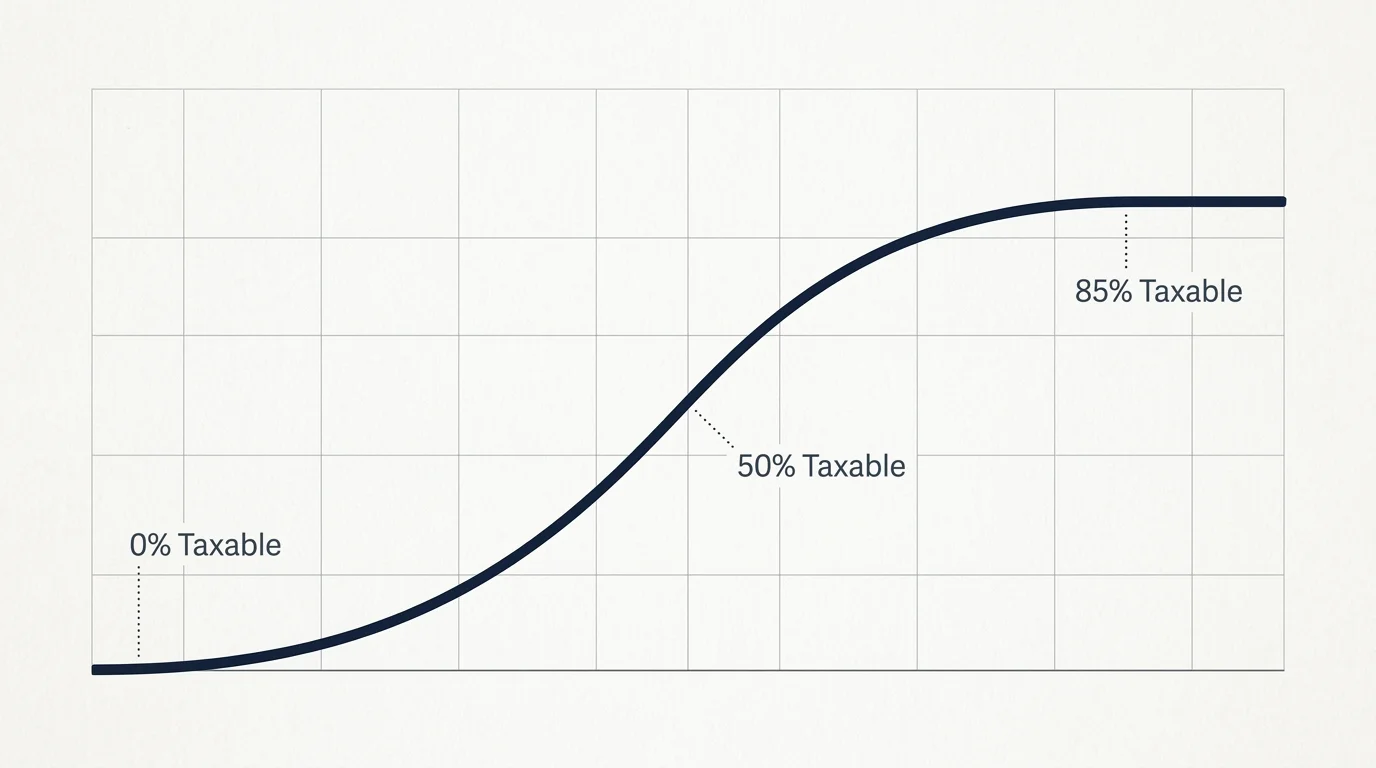
Social Security income receives a middle ranking because it is never 100% taxable at the federal level. Depending on your overall income, your Social Security benefits are taxed at 0%, up to 50%, or up to 85%. The federal government uses a specific metric called Provisional Income (also called Combined Income) to determine how much of your monthly benefit faces taxation.
The IRS defines Provisional Income using the following formula:
Provisional Income = Adjusted Gross Income (AGI) + Tax-Exempt Interest + (50% of Social Security Benefits)
According to official guidelines from the Social Security Administration, the threshold limits dictate federal taxation tiers:
- Single Filers:
- Provisional income below $25,000: 0% of benefits taxed.
- Provisional income between $25,000 and $34,000: Up to 50% of benefits taxed.
- Provisional income above $34,000: Up to 85% of benefits taxed.
- Married Filing Jointly:
- Provisional income below $32,000: 0% of benefits taxed.
- Provisional income between $32,000 and $44,000: Up to 50% of benefits taxed.
- Provisional income above $44,000: Up to 85% of benefits taxed.
Because Congress established these thresholds in 1983 and never indexed them to inflation, standard cost-of-living adjustments (COLAs) push an increasing majority of retirees into taxable territory every year. Understanding this formula enables you to manage distributions from other accounts to keep provisional income beneath key threshold steps when possible.

7. Non-Qualified Annuities and Bank Interest — Partial or Full Ordinary Income
Income falling into this category splits between return of principal and taxable interest. Standard bank savings accounts, high-yield deposit accounts, and Certificates of Deposit (CDs) generate simple interest income. The IRS taxes this interest as ordinary income in the year you earn it, subjecting every dollar to your top marginal tax bracket without any preferential capital gains relief.
Non-qualified annuities (annuities purchased with after-tax money outside of a traditional IRA or 401(k)) follow a slightly different rule called the Exclusion Ratio. When you annuitize a non-qualified contract into guaranteed lifetime payments, each check consists of two distinct components: a non-taxable return of your original premium (basis) and a taxable payment of investment earnings.
If you take lump-sum or systematic withdrawals from a non-qualified annuity instead of annuitizing, the IRS applies “Last-In, First-Out” (LIFO) tax rules. That means every early dollar distributed counts as fully taxable interest income until you exhaust all accumulated growth inside the contract. Only after pulling all growth out do you reach tax-free principal returns.

8. Traditional IRAs, 401(k)s, and 403(b)s — Fully Taxed Pre-Tax Distributions
Traditional retirement accounts—including Traditional IRAs, 401(k)s, 403(b)s, and 457(b) plans—allowed you to deduct contributions or defer pre-tax salary during your working career. In exchange for that upfront tax break, the federal government taxes every dollar you withdraw in retirement as standard ordinary income. Distributions do not qualify for reduced long-term capital gains tax rates, regardless of whether the underlying earnings came from stock appreciation or standard dividends.
Furthermore, you cannot leave tax-deferred money inside these accounts indefinitely. Under current federal tax laws established by the SECURE 2.0 Act, you must begin taking mandatory distributions called Required Minimum Distributions (RMDs) once you reach your required starting age:
- For individuals reaching age 73 through 2032, the RMD age remains 73.
- Starting in 2033, the mandatory RMD age rises to 75.
If you fail to take your full mandatory RMD amount by the annual deadline, the IRS imposes a severe excise tax penalty. While SECURE 2.0 reduced the missed RMD penalty from 50% down to 25% of the unwithdrawn amount, you can lower that penalty to 10% if you correct the mistake and submit a timely corrected return within the designated correction window (generally two years).
Investor pioneer John Bogle always reminded retirees to focus intently on long-term costs that erode total account value over time:
“In investing, you get what you don’t pay for. Costs matter, and taxes are one of the largest ongoing costs an investor faces throughout retirement.” — John Bogle, Founder of Vanguard

9. Pension Income and Deferred Compensation — Fully Taxed Ordinary Income
Defined benefit pensions and non-qualified deferred compensation payouts represent traditional, fixed retirement safety nets. However, their tax treatment is stringent. If your employer fully funded your pension using pre-tax corporate funds (as is standard practice for the vast majority of private and corporate pensions), 100% of your monthly annuity payments count as ordinary taxable income at both federal and state levels.
Unlike personal investment accounts, pension payments offer zero flexibility. You cannot adjust distribution timing or defer payments during years when your income spikes, nor can you harvest capital losses to offset pension payments. Every monthly direct deposit gets added straight to line 1 of your tax return, stacking directly on top of your Social Security or other income sources.
Some state governments offer tax exclusions or exemptions for specific public pensions, such as state government, law enforcement, or military retirement pay. Before choosing where to reside in retirement, verify specific state tax laws through official resources like USA.gov Benefits to understand how your specific pension source gets taxed at the state level.

10. Earned Wages and Self-Employment Income — Ordinary Income Plus Payroll Taxes
Working during retirement—whether taking a part-time job, consulting, or operating a small business—carries the heaviest overall tax burden on our ranking list. Earned income gets hit with a double tax impact: ordinary federal and state income tax plus mandatory federal payroll taxes under the Federal Insurance Contributions Act (FICA) or Self-Employment Contributions Act (SECA).
When you earn wages as an employee or profits as a self-employed individual, you pay:
- Ordinary Federal Income Tax: Scaled across progressive income tax brackets ranging from 10% up to 37%.
- Social Security Payroll Tax: A 6.2% worker contribution on earnings up to the annual wage cap ($176,100 in 2025; $184,500 in 2026).
- Medicare Payroll Tax: A 1.45% tax on all earned wages without any income ceiling, plus an additional 0.9% High-Earner Medicare tax on income exceeding federal thresholds.
- Self-Employment Tax: If you work as an independent contractor or consultant, you pay both the employer and employee portions, resulting in a 15.3% self-employment tax rate on net business profits.
Additionally, if you choose to claim Social Security benefits before reaching your Full Retirement Age (FRA) while continuing to earn wages, the Social Security Earnings Test reduces your monthly benefits if your earnings exceed annual limits. Once you reach full retirement age, earnings no longer reduce monthly benefit payments, but those earnings remain subject to standard payroll and ordinary income taxes.
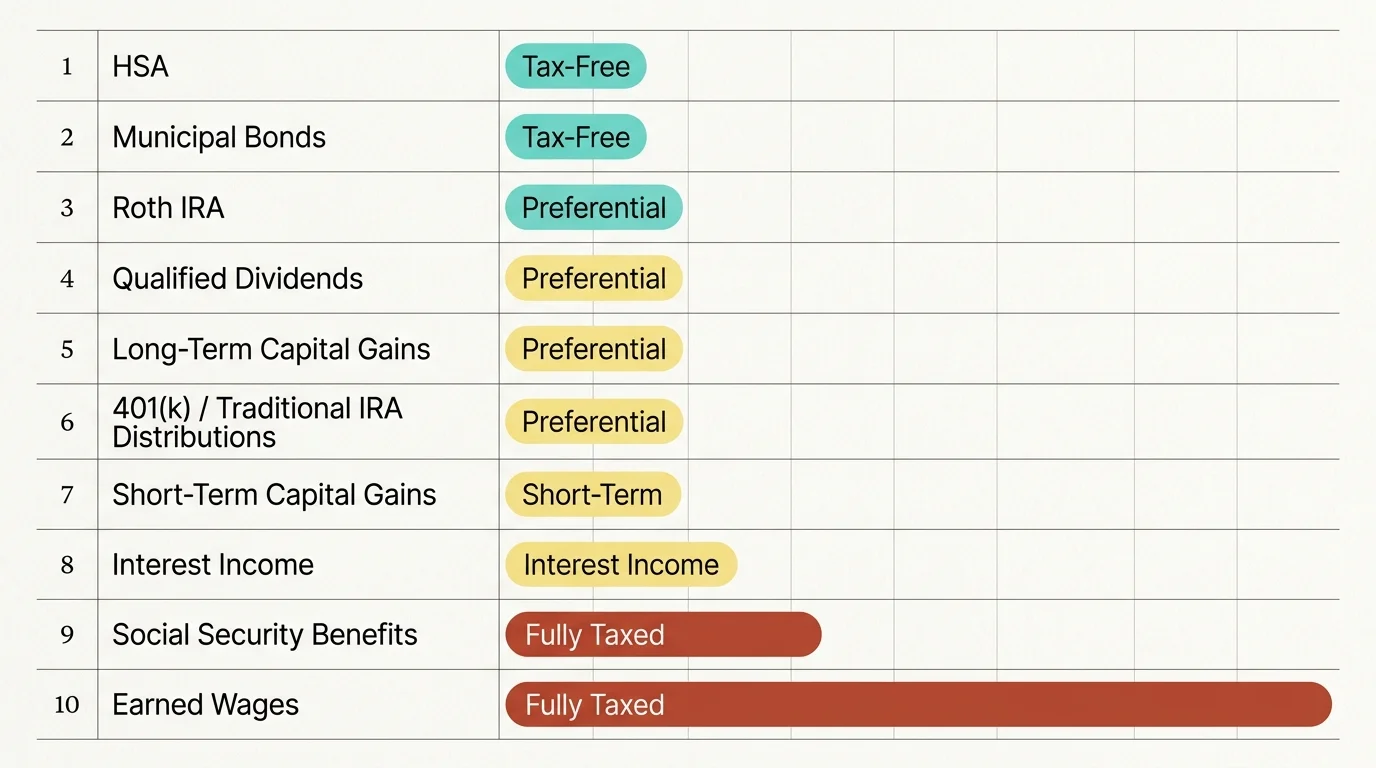
Comprehensive Tax Comparison Table
The table below summarizes all ten retirement income types, highlighting their taxation rates, mandatory distribution requirements, and impact on Social Security calculations:
| Rank & Income Type | Federal Income Tax Rate | Payroll Tax (FICA/SECA)? | Triggers SS Taxation? | RMD Requirements? |
|---|---|---|---|---|
| 1. HSA (Medical Use) | 0% (Tax-Free) | No | No | None |
| 2. Roth IRA & Workplace Roth | 0% (Tax-Free) | No | No | None (Owner Lifetime) |
| 3. Municipal Bond Interest | 0% (Federal Tax-Exempt) | No | Yes (In Provisional Income) | None |
| 4. Return of Basis / Principal | 0% (Tax-Free) | No | No | None |
| 5. Capital Gains & Dividends | 0%, 15%, or 20% Preferential | No | Yes (Included in AGI) | None |
| 6. Social Security Benefits | 0%, Up to 50%, or Up to 85% Taxed | No | Self-Referential Formula | None |
| 7. Annuities & Bank Interest | Exclusion Ratio / Ordinary Rates | No | Yes (Included in AGI) | Varies by Contract |
| 8. Traditional IRAs / 401(k)s | 100% Ordinary Income Rates | No | Yes (Included in AGI) | Yes (Starts Age 73–75) |
| 9. Pensions & Deferred Comp | 100% Ordinary Income Rates | No | Yes (Included in AGI) | Fixed Annuity Rules |
| 10. Earned Wages / Consulting | Ordinary Rates (Up to 37%) | Yes (7.65% – 15.3%) | Yes (Included in AGI) | None |
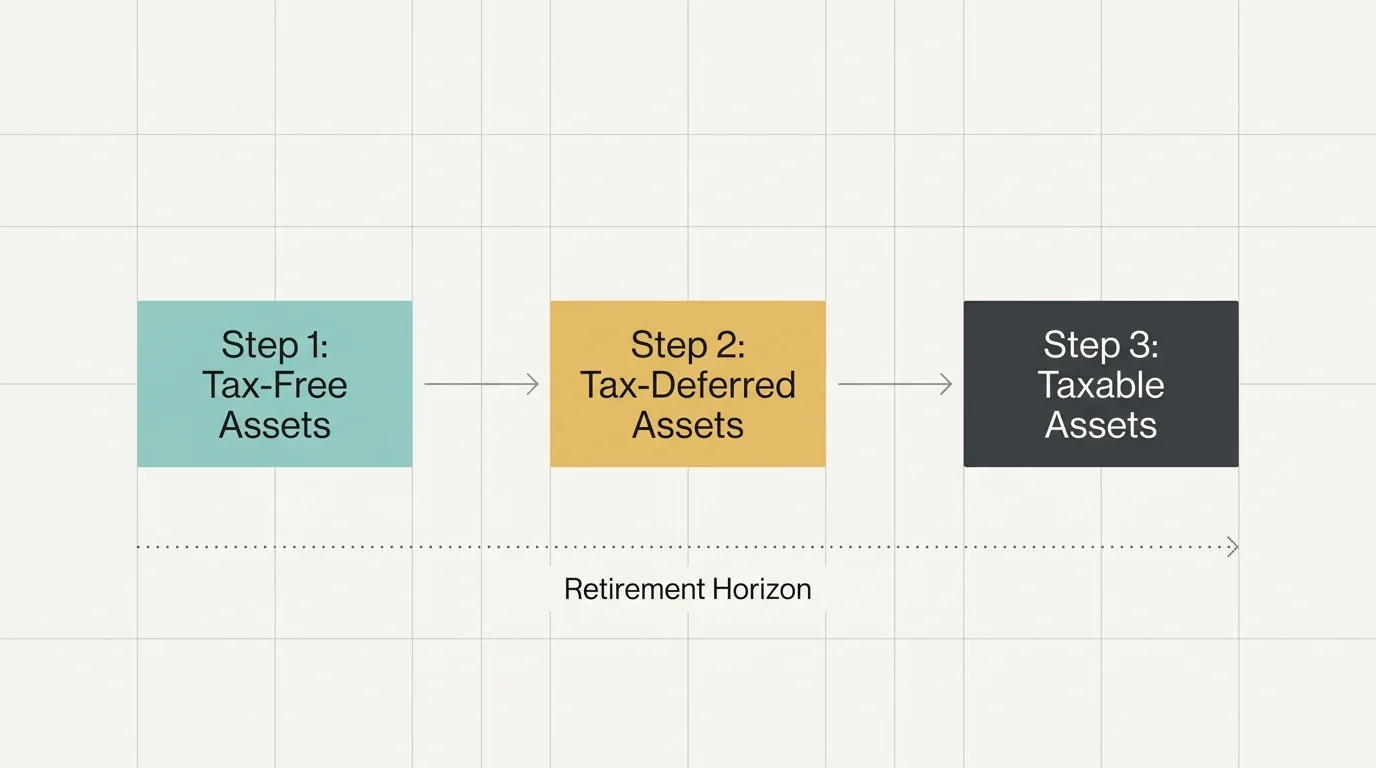
Strategic Withdrawal Framework: Managing Your Tax Brackets
Understanding how each income type gets taxed allows you to build a tax-efficient withdrawal sequence. Rather than pulling funds randomly from available accounts, experienced financial planners use a systematic framework to keep income within target tax brackets:
- Fill Lower Brackets First: Pull funds from Traditional IRAs or 401(k)s up to the top limit of the 10% or 12% ordinary income tax brackets. This strategy uses up lower tax brackets each year rather than leaving massive balances that trigger higher tax rates once mandatory RMDs kick in.
- Harvest Gains Tax-Free: If your taxable ordinary income leaves space beneath the 0% long-term capital gains threshold, sell appreciated stock in taxable accounts to lock in gains without federal tax liability.
- Supplement with Roth and HSA Accounts: When you need extra cash flow for large expenses—such as travel, roof repairs, or vehicle purchases—draw from Roth IRAs or HSAs. Because these distributions do not increase taxable income, they protect you from jumping into higher tax brackets.
- Monitor IRMAA Surcharges: Pay close attention to Medicare Income-Related Monthly Adjustment Amount (IRMAA) thresholds. If your Modified AGI exceeds specific cliffs ($106,000 for single filers or $212,000 for married joint filers based on typical index benchmarks), Medicare Part B and Part D premiums increase significantly on a two-year lookback schedule. Verification of rules can be done directly via Medicare.gov.

Pitfalls to Watch For
Retirees frequently encounter unexpected tax hurdles when transitioning from receiving a paycheck to drawing down saved assets. Watch out for these four common tax traps:
- The Social Security Tax Torpedo: Taking an extra $1,000 distribution from a Traditional IRA can cause an additional $850 of Social Security benefits to become taxable. This compounding effect creates a effective marginal tax rate far higher than your standard tax bracket indicates.
- Ignoring the Two-Year IRMAA Lookback: Medicare calculates your Part B and Part D premium surcharges based on your tax return from two years prior. A one-time income event at age 63—such as selling real estate or completing a large Roth conversion—can trigger higher healthcare premiums at age 65.
- Underestimating RMD Escalation: Mandatory distributions rise as a percentage of your account balance every year based on IRS life expectancy tables. Taking minimum distributions at age 73 might seem modest, but by age 80 or 85, forced withdrawals can push you into significantly higher tax brackets.
- Neglecting State Income Taxes: Federal tax rules apply nationwide, but state income tax rules vary dramatically. States like Florida, Texas, and Nevada charge no state income tax, while other states tax traditional account distributions heavily. Verify local tax rules on your home state government portal.

Getting Expert Help
While managing tax strategies independently is achievable, specific complex life scenarios benefit from professional guidance from a Certified Financial Planner (CFP) or Certified Public Accountant (CPA). Consider seeking tailored expert help under these scenarios:
- Approaching Age 73 with Massive Pre-Tax Balances: If you hold substantial funds in Traditional IRAs or 401(k) plans, an expert can design a multi-year Roth conversion schedule between retirement and age 73 to flatten your lifetime tax curve. Find qualified planning professionals through the CFP Board.
- Retiring Before Medicare Age (Ages 60–64): Navigating health insurance costs before age 65 often requires keeping Adjusted Gross Income low to qualify for Affordable Care Act (ACA) premium tax credits while funding living expenses.
- Selling High-Value Assets or Real Estate: Liquidating real estate, private business equity, or highly appreciated stock options requires sophisticated capital gain timing and tax-loss harvesting strategies.
- Structuring Dual-Spouse Social Security & Pension Timing: Coordinating two pensions, double Social Security claims, and portfolio withdrawals demands precise cash-flow modeling to minimize joint tax exposure.
Frequently Asked Questions
Are Roth 401(k) accounts subject to Required Minimum Distributions?
No. Under the provisions of the SECURE 2.0 Act, designated Roth 401(k) and Roth 403(b) accounts are fully exempt from pre-death lifetime Required Minimum Distributions, matching the tax-free lifetime rules that apply to Roth IRAs.
How does municipal bond interest affect my taxes if it is federally tax-exempt?
While municipal bond interest is exempt from federal ordinary income tax, you must report it on your tax return. The IRS includes tax-exempt municipal interest in the Provisional Income formula, which determines whether your Social Security benefits face federal income taxation.
What is the penalty if I forget to take my Required Minimum Distribution?
The SECURE 2.0 Act reduced the missed RMD penalty from 50% down to 25% of the unwithdrawn required amount. If you correct the mistake promptly and submit a corrected tax return within the IRS correction window, the penalty drops further to 10%.
At what age can I take non-medical withdrawals from my HSA without penalty?
Once you reach age 65, you can withdraw money from your Health Savings Account for non-medical expenses without incurring the 20% early withdrawal penalty. These non-medical withdrawals are taxed as ordinary income, similar to distributions from a Traditional IRA.
Taking Control of Your Retirement Income Strategy
Designing a tax-efficient retirement distribution strategy requires looking beyond individual account balances to evaluate how different income types interact on your tax return. By balancing pre-tax distributions, tax-free accounts, capital gains harvesting, and tax-advantaged yields, you keep a greater share of your nest egg working directly for you.
Start by auditing your existing accounts, identifying which tax categories your future cash flows belong to, and reviewing your distribution schedule annually. Taking proactive, deliberate steps today preserves your wealth and ensures financial security throughout your retirement years.
The information in this guide is meant for educational purposes. Your specific circumstances—including income, savings, health coverage, and goals—may require different approaches. When in doubt, consult a licensed professional.
Last updated: February 2026. Retirement benefits, tax laws, and healthcare costs change frequently—verify current details with official sources.