
For decades, the Government Pension Offset (GPO) unexpectedly reduced Social Security spousal and survivor benefits for public servants by up to two-thirds of their government pensions. Although President Joe Biden signed the historic Social Security Fairness Act into law on January 5, 2025—officially repealing the GPO and Windfall Elimination Provision retroactively to January 2024—millions of retired public school teachers, police officers, firefighters, and federal workers are still caught off guard. Navigating delayed benefit recalculations, unexpected tax liabilities from retroactive lump-sum payouts, and complex Social Security Administration rules requires immediate action to ensure you receive every dollar you earned.

Understanding the Government Pension Offset: How the Formula Slashed Benefits
Congress introduced the Government Pension Offset in 1977 and revised it in 1983 to prevent public employees from receiving what lawmakers viewed as a double dip into public retirement systems. The offset targeted retirees who earned pensions from state, local, or federal positions that did not withhold Social Security payroll taxes—frequently referred to as non-covered employment. While private-sector workers paid into Social Security throughout their careers, public sector workers in states like California, Texas, Ohio, Illinois, and Massachusetts contributed to state retirement systems instead.
The core mechanism of the GPO reduced your Social Security spousal or survivor benefit by an amount equal to two-thirds of your non-covered government pension. Unlike the Windfall Elimination Provision (WEP), which adjusted your earned primary worker benefit, the GPO focused exclusively on benefits derived from your spouse’s earnings history. In practice, this mathematical reduction routinely wiped out spousal benefits entirely.
Consider how this formula operated prior to the recent legislative overhaul:
- Non-Covered Monthly Pension: $3,000 from a public school teaching career.
- Two-Thirds Offset Calculation: $2,000 (which the Social Security Administration deducted from any spousal entitlement).
- Expected Spousal Social Security Benefit: $1,200 (based on a private-sector spouse’s earnings history).
- Actual Net Monthly Social Security Check: $0 ($1,200 minus $2,000 offset results in a negative figure, reducing payout to zero).
If your spouse passed away, your standard survivor benefit of $2,400 would face that same $2,000 offset, leaving you with a diminished monthly check of just $400. According to data published by the Social Security Administration, the GPO slashed or eliminated monthly benefits for approximately 734,000 spousal and survivor beneficiaries across the nation.

The Landmark Social Security Fairness Act: A New Era for Public Retirees
On January 5, 2025, public-sector advocacy groups achieved a major victory when the Social Security Fairness Act (H.R. 82) became law. This landmark legislation completely repealed both the Government Pension Offset and the Windfall Elimination Provision. Most importantly for your financial planning, Congress made the repeal retroactive to monthly benefits payable beginning in January 2024; this rendered December 2023 the final month the reduction applied.
The Congressional Budget Office estimated that repealing these provisions increases direct Social Security benefit payouts by roughly $198 billion through fiscal year 2034. For affected individuals, the Social Security Administration projected an average benefit increase of approximately $360 per month. By March 2025, the agency had disbursed more than $7.5 billion in retroactive back-payments to over one million impacted retirees and surviving spouses.
Despite this massive legislative shift, many retirees remain caught off guard. Administrative backlogs, complicated tax treatment of lump-sum back-pay, and confusion regarding survivor eligibility continue to create roadblocks for households expecting smooth benefit restorations.
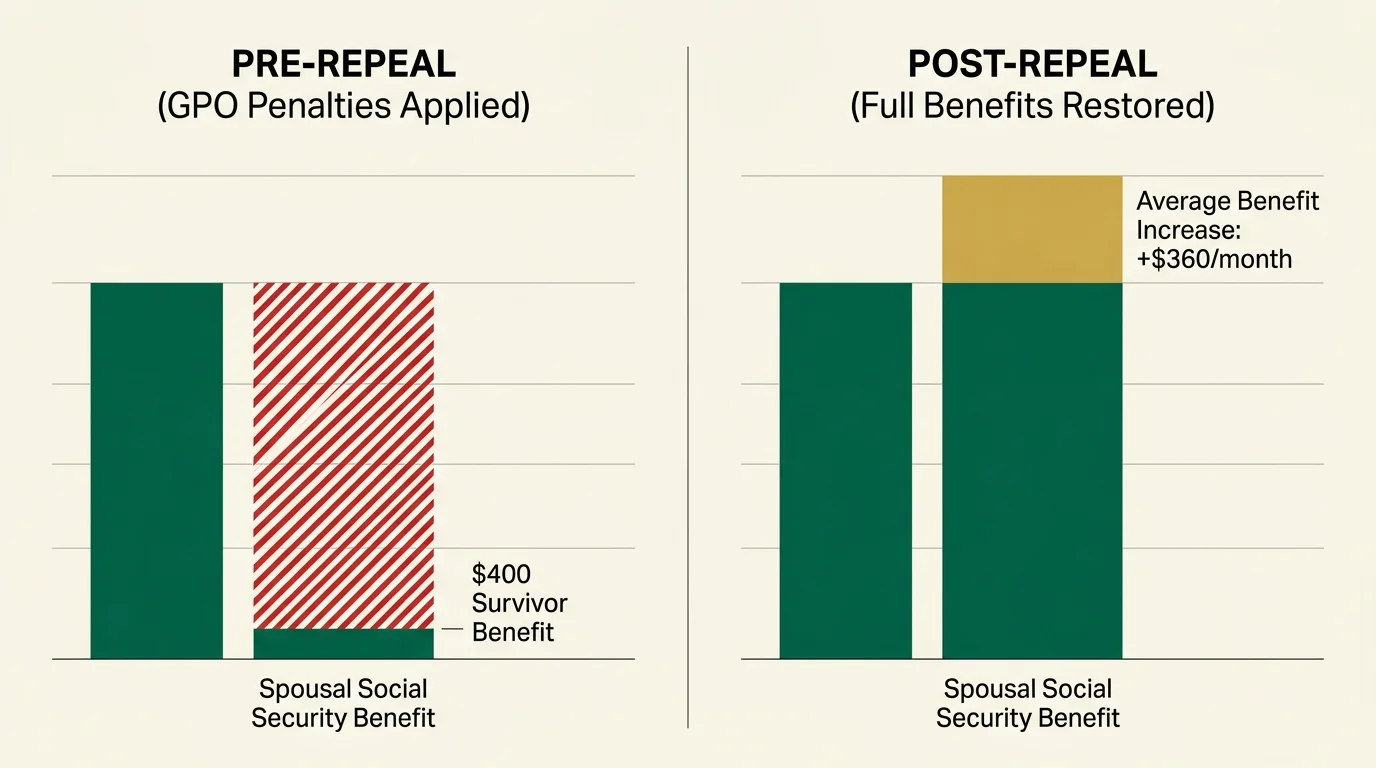
Pre-Repeal vs. Post-Repeal: What Changed for Public Servants
Understanding how the statutory landscape shifted allows you to verify whether the Social Security Administration calculated your updated benefit amounts correctly.
| Feature / Benefit Type | Pre-2025 Law (With GPO Active) | Post-2025 Law (GPO Repealed) | Action Needed by Retiree |
|---|---|---|---|
| Spousal Benefit Offset | Reduced spousal benefits by two-thirds of non-covered pension amount. | Zero offset. Spouses receive full entitlement up to 50% of worker’s benefit. | Verify monthly statement on your online portal. |
| Survivor Benefit Offset | Reduced widow or widower benefits by two-thirds of non-covered pension amount. | Zero offset. Surviving spouses receive full 100% survivor entitlement. | Contact SSA if your survivor benefit did not update automatically. |
| Retroactive Eligibility | Not applicable; offsets applied continuously every month. | Retroactive to January 2024 payouts. | Review lump-sum tax treatment using IRS Section 86(e). |
| Application Requirement | Required reporting of non-covered pension changes manually. | SSA automates updates for existing benefit record holders. | File a claim if you previously avoided applying due to GPO. |

Why Retirees Are Still Caught Off Guard in 2026
The complete elimination of the Government Pension Offset represents a significant policy win, but administrative and financial complexities persist. Retirees across the country face four distinct challenges during this transitional period.
1. The Retroactive Lump-Sum Tax Spike
When the Social Security Administration processed retroactive payments covering 12 to 18 months of back-pay, many public retirees received sudden lump-sum deposits ranging from $4,000 to over $15,000. Receiving this accumulated income within a single calendar year can artificially inflate your Adjusted Gross Income (AGI). Without proper guidance, this spike can push your income into higher federal tax brackets and trigger Medicare Part B income-related monthly adjustment amounts (IRMAA).
2. Automated Processing Errors and Backlogs
Modifying millions of complex payment records presented unprecedented administrative demands for federal workers. While automated algorithms processed straight-forward accounts smoothly, retirees with complex histories—such as those receiving multiple public pensions or those transitioning between spousal and primary benefits—encountered processing delays, missing back-pay months, or miscalculated monthly totals.
3. Confusion Between GPO and WEP Rules
Because many public sector workers spent time in both covered and non-covered employment, they often confuse how the GPO repeal affects their spouse’s record versus their own worker record. While the GPO repeal restores full spousal and survivor benefits, the WEP repeal restores your personal retirement benefit derived from your own covered work history. Understanding which portion of your check changed helps you audit your monthly deposit accurately.
4. Previously Deterred Beneficiaries Missing Out
Thousands of eligible spouses and surviving partners never applied for Social Security in past years because local offices informed them that the GPO would wipe out their entire payout. Because these individuals were never listed in active Social Security databases, automated systems cannot issue them retroactive lump sums or updated monthly payments; they must actively submit new benefit claims.
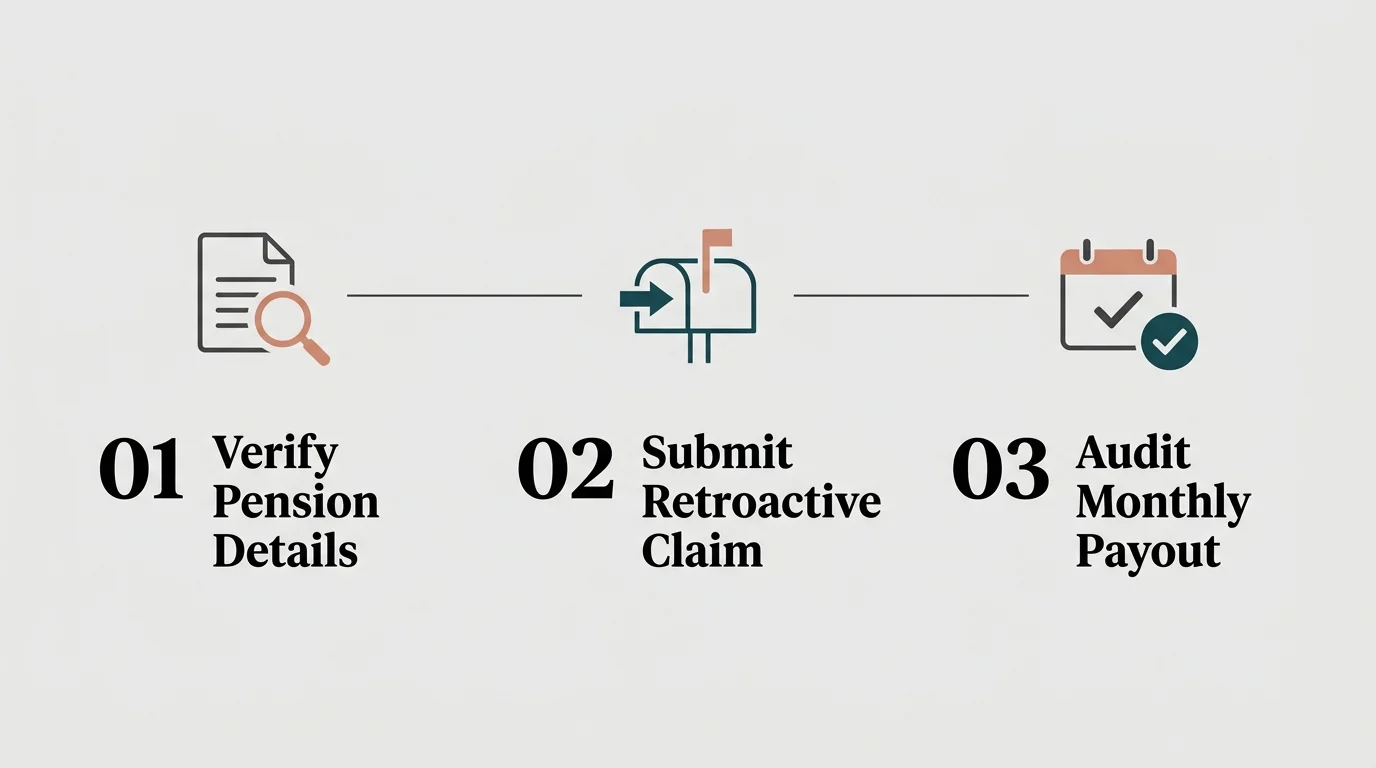
Step-by-Step Action Plan to Claim and Verify Your Benefits
Take charge of your retirement income by following these actionable steps to audit your record and maximize your benefits:
- Log Into Your Personal Account: Access your account through the official portal at the Social Security Administration. Review your benefit verification letter to confirm that your monthly amount reflects the unreduced entitlement.
- Audit Your Retroactive Payout: Calculate your monthly increase from January 2024 through the month your regular check was adjusted. Compare this figure against the lump-sum deposit received in your bank account.
- Review IRS Lump-Sum Election Rules: Consult the official guidance on the Internal Revenue Service site regarding Section 86(e). This special tax provision allows you to allocate retroactive Social Security income to prior tax years, preventing unnecessary tax spikes in the current filing year.
- Submit Form SSA-21 for Unfiled Survivor Claims: If you avoided filing for widow or widower benefits in past years due to the GPO penalty, schedule an appointment with your local field office immediately to file a claim and request retroactive consideration back to the statutory limit.
- Monitor Your Medicare Premiums: Keep a close eye on your Medicare Part B and Part D premium notices from Medicare.gov to ensure that a one-time retroactive lump sum does not unfairly inflate your monthly healthcare expenses through IRMAA surcharges.

Managing the Tax Burden of Retroactive Lump-Sum Payments
Receiving back-pay from the GPO repeal requires careful tax management. Under standard tax rules, up to 85% of your Social Security benefits become taxable if your provisional income exceeds baseline thresholds ($25,000 for single filers and $32,000 for married couples filing jointly). However, combining multi-year back pay into one year’s income statement can lead to overpaying taxes.
Fortunately, Internal Revenue Code Section 86(e) provides a tax relief mechanism. Under Section 86(e), you can elect to compute the taxable portion of the retroactive Social Security payment using the prior years’ income levels (such as 2024) while still reporting the tax on your current year return. This calculation prevents you from filing amended prior-year tax returns while ensuring that the back-pay does not push you into a higher marginal bracket.
Articles published by financial planning outlets like Kiplinger emphasize that seniors over age 65 should also leverage the higher standard deduction available to older taxpayers to help offset taxable gains from benefit adjustments.

Expert Perspectives on Retirement Income Security
Financial planners stress the importance of understanding how statutory updates affect your long-term tax strategy and distribution plans.
“When receiving unexpected tax events like retroactive lump-sum distributions, failing to utilize special IRS rules like Section 86(e) is like leaving money on the table and handing it straight to the government.” — Ed Slott, CPA and Tax Expert
Coordinating guaranteed income sources requires taking a holistic look at all public sector benefits, investments, and survivor rights.
“Understanding how every dollar of guaranteed income fits together—from state pensions to Social Security—is the single most effective way to eliminate uncertainty in your retirement years.” — Jean Chatzky, Financial Educator

What Can Go Wrong: Critical Pitfalls to Avoid
Public sector retirees navigating the post-GPO environment should guard against these frequent mistakes:
- Assuming Automatic Processing for Unfiled Claims: If you never submitted a formal application for spousal benefits in past years because of the two-thirds rule, the SSA has no record of your entitlement. Assuming the government will automatically send you checks without an active claim will cost you money.
- Failing to Request Tax Withholding on Back Pay: The SSA does not automatically withhold federal income taxes from retroactive lump-sum disbursements. If you do not set aside funds or file Form W-4V, you may face a surprise tax bill and potential underpayment penalties.
- Filing Amended Returns Instead of Using Section 86(e): Taxpayers often make the mistake of filing Form 1040-X amended returns for prior years when receiving back pay. The IRS explicitly instructs beneficiaries to report the election directly on their current Form 1040 using prior-year computational worksheets instead.
- Ignoring Impact on Surviving Spouses: If an affected public servant spouse passed away after January 2024, the surviving spouse or estate remains entitled to the retroactive back-pay accrued between January 2024 and the date of death. Failing to request these accrued underpayments leaves earned dollars unclaimed.

When to Consult a Financial or Tax Professional
While many public retirees can manage their benefit updates independently, specific scenarios demand specialized professional guidance. You should consult a Certified Financial Planner (CFP) or CPA under the following circumstances:
- Your Retroactive Payout Exceeds $10,000: High lump-sum amounts significantly alter provisional income levels, requiring professional execution of IRS Section 86(e) tax elections.
- You Face Medicare IRMAA Surcharges: If a retroactive payment triggers higher Medicare Part B or Part D premiums, a financial advisor can help you file Form SSA-44 to appeal the surcharge based on a life-changing event or non-recurring income spike.
- You Hold Complex Combined Pensions: Retirees who transitioned between federal CSRS systems, state teacher retirement systems, and private sector jobs should seek specialized assistance to verify that total primary and spousal benefit calculations are completely accurate.
- You Are Managing Estate Underpayments: Executor representatives settling the estate of a deceased public servant who was eligible for retroactive GPO payments need professional help navigating SSA-1724 underpayment claims.
Frequently Asked Questions About the GPO Repeal
Do I need to file a formal application to receive my GPO repeal back-pay?
If you were already receiving an offset spousal or survivor benefit prior to the repeal, the Social Security Administration automatically recalculates your benefit and deposits retroactive back-pay directly into your bank account. However, if you never applied for spousal benefits because the GPO penalty would have reduced your check to zero, you must submit a new application with the SSA immediately to begin receiving benefits.
Will my retroactive lump-sum payment increase my Medicare premiums?
It can if not managed properly. Medicare Part B premiums are calculated using your Adjusted Gross Income from two years prior. A large lump-sum back-payment received in 2025 or 2026 could raise your income above IRMAA thresholds. If this occurs, you can appeal the premium increase with the SSA by demonstrating that the lump sum represents non-recurring retroactive income generated by a statutory correction.
Does the GPO repeal apply to state and local government workers in all 50 states?
Yes. The repeal of the Government Pension Offset applies universally across all municipal, county, state, and federal public retirement systems nationwide. Whether you were a teacher under a state retirement system, a local police officer, or a federal worker under the Civil Service Retirement System (CSRS), the offset no longer applies to your spousal or survivor benefits.
What should I do if my monthly check has not been adjusted yet?
First, verify your account status through the online portal at SSA.gov. If your benefit statement still shows a reduction attributable to a government pension offset, contact your local field office or call the SSA customer support line. Request a formal status review of your record under the Social Security Fairness Act provisions.
Taking Action on Your Restored Benefits
The elimination of the Government Pension Offset removes a long-standing financial burden for public service retirees, restoring the spousal and survivor security you earned. Moving forward, taking prompt action to verify your monthly benefit statement, calculate your exact retroactive back-pay, and manage potential tax liabilities ensures that you maximize the financial benefits of this historic legislative shift.
Begin by logging into your online Social Security account, gathering your pension records, and reviewing your tax strategy with a qualified professional. Empowering yourself with clear facts and precise calculations ensures you receive the full retirement income you deserve.
This is educational content based on general retirement planning principles. Individual results vary based on your situation. Always verify current benefit amounts, tax laws, and eligibility with official sources.
Last updated: February 2026. Retirement benefits, tax laws, and healthcare costs change frequently—verify current details with official sources.