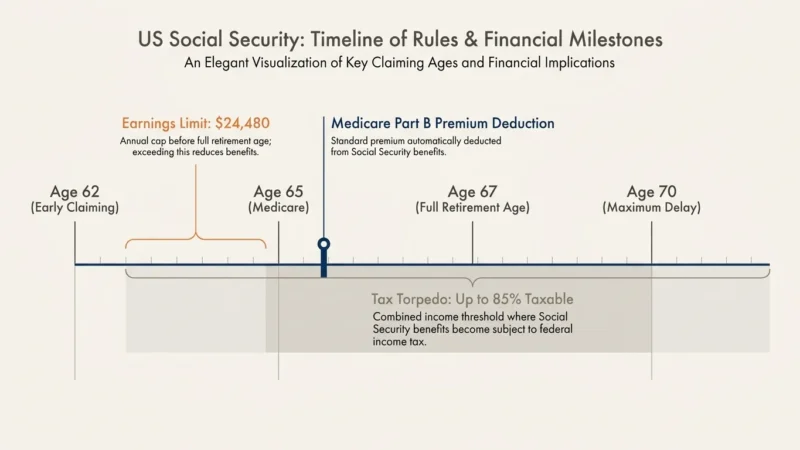
Postponing your Social Security claim by just twelve months yields a guaranteed, inflation-protected return that no commercial annuity or Wall Street bond can match. Under federal law, the Social Security Administration boosts your primary insurance amount by 8% per year for every year you wait past your Full Retirement Age up to age 70. Calculated at two-thirds of one percent for each month you delay, this single rule turns a standard monthly benefit into a formidable income stream for life. Whether you decide to work one extra year or bridge the financial gap with retirement savings, understanding this compounding growth gives you complete control over your guaranteed baseline income in retirement.
At a Glance
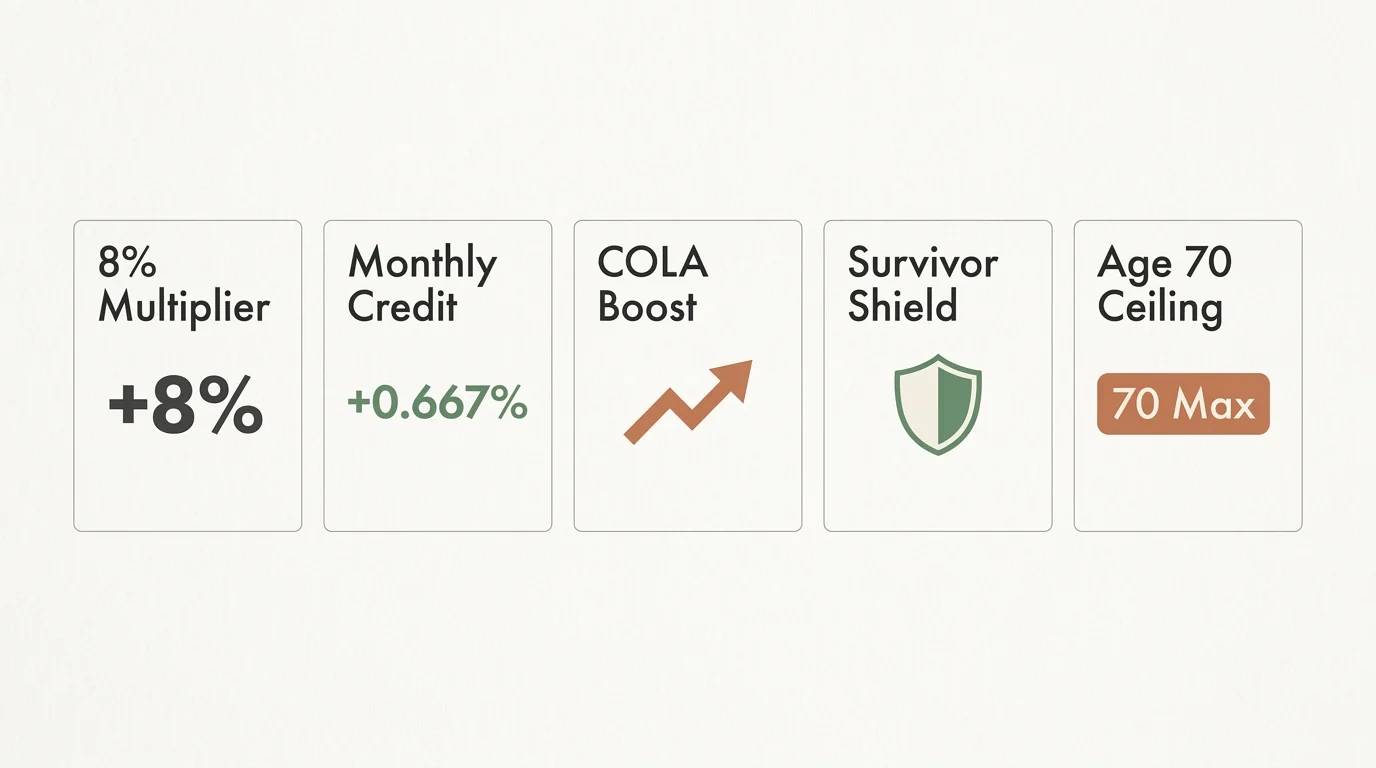
- The 8% Annual Multiplier: For every full year you delay claiming Social Security past your Full Retirement Age (FRA), your permanent monthly payout increases by 8% up to age 70.
- Monthly Credit Accumulation: You do not need to wait in full-year increments; credits accrue month-by-month at a rate of 0.667% (two-thirds of 1%).
- Compounded Inflation Defense: Annual Cost-of-Living Adjustments (COLAs) apply to your higher, delayed base benefit, multiplying your purchasing power over a 20- to 30-year retirement.
- Survivor Protection: Delaying the higher earner’s benefit permanently increases the monthly check left behind for a surviving spouse.
- The Age 70 Ceiling: Delayed retirement credits stop accumulating at age 70, making age 70 the absolute maximum age to begin receiving retirement benefits.
How the One-Year Delay Multiplier Works
The Social Security Administration (SSA) determines your baseline benefit—known as your Primary Insurance Amount (PIA)—based on your highest 35 years of indexed earnings. However, the exact age you decide to file determines how much of that baseline check actually lands in your bank account.
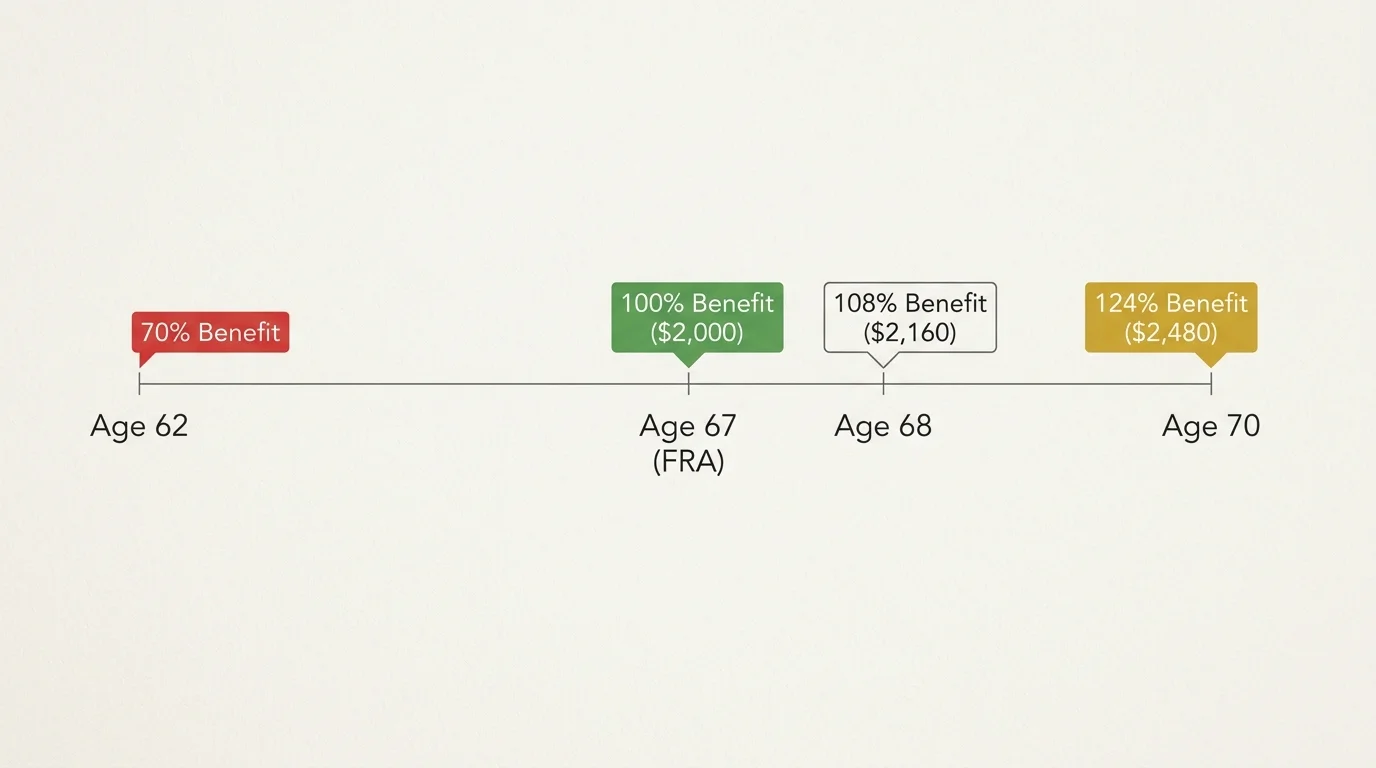
For anyone born in 1960 or later, federal law sets the Full Retirement Age (FRA) at 67. If you file at age 67, you collect exactly 100% of your earned benefit. If you claim early at age 62, the government permanently reduces your check by 30%. Conversely, if you delay claiming past age 67, the system rewards your patience through Delayed Retirement Credits (DRCs).
These credits accrue at a rate of two-thirds of 1% for each month you delay benefit receipt. Over twelve consecutive months, those monthly increments sum to an 8% permanent increase. If you defer claiming from age 67 to age 70, your total benefit increases by 24% over your baseline primary insurance amount.
“There is no financial product on the market that offers an 8% guaranteed, inflation-adjusted annual return backed by the U.S. government. Delaying Social Security is often the single best investment a retiree can make.” — Jean Chatzky, Financial Journalist and Author
Consider how this rule translates into real dollars. If your baseline benefit at an FRA of 67 equals $2,000 per month, waiting just one additional year raises your monthly baseline to $2,160. Holding out until age 70 elevates that monthly check to $2,480. That difference of $480 every month represents an additional $5,760 in risk-free gross income each year for the rest of your life.

The Real Math: Comparing Age 62, 67, and 70
To evaluate the impact of waiting just one more year, you must view your benefit potential across the full claiming spectrum. In 2026, baseline Social Security benefit numbers reflect significant purchasing power shifts due to recent wage adjustments and cumulative inflation updates.
| Claiming Age | Percentage of FRA Benefit | 2026 Estimated Average Monthly Check | 2026 Maximum Monthly Check (High Earner) | Lifetime Strategic Impact |
|---|---|---|---|---|
| Age 62 | 70.0% | $1,450 | $2,969 | Maximum reduction; permanent loss of compounding growth potential. |
| Age 66 | 93.3% | $1,932 | $3,875 | Slight early penalty for workers born in 1960 or later. |
| Age 67 (FRA) | 100.0% | $2,071 | $4,152 | Standard full benefit baseline (100% of PIA). |
| Age 68 (1 Year Delay) | 108.0% | $2,237 | $4,484 | Permanent 8% gain; establishes strong buffer against inflation. |
| Age 69 (2 Year Delay) | 116.0% | $2,402 | $4,816 | Permanent 16% gain; ideal balance for moderate retirement assets. |
| Age 70 (Max Delay) | 124.0% | $2,568 | $5,181 | Maximum possible lifetime payout rate; highest survivor benefit. |
According to current projections from the Social Security Administration, the average monthly benefit check for a retired worker in 2026 stands at approximately $2,071 at Full Retirement Age. A high earner who claims at Full Retirement Age in 2026 receives up to $4,152 per month. By waiting until age 70, that same high earner expands their baseline to a maximum of $5,181 monthly—a difference of over $12,300 per year in guaranteed cash flow.
Many pre-retirees express concern over the “breakeven point”—the age at which total cumulative dollars collected from delaying overtake total cumulative dollars collected by claiming earlier. Mathematically, the breakeven age between claiming at age 67 versus age 70 usually occurs around age 80 to 82. Because average life expectancy for a 65-year-old American reaches well into the mid-80s, the majority of retirees who wait one to three years end up significantly ahead in total lifetime payouts.

Why “Just One More Year” Delivers Guaranteed Returns
When you analyze retirement investments, you must always balance return potential against risk. Stock markets offer growth, but they expose your capital to sudden downturns. Certificates of deposit and treasury bonds offer safety, but their returns rarely outpace long-term inflation after taxes.
Delaying Social Security stands in a asset class of its own because the 8% annual return comes with three distinct guarantees:
- Zero Market Risk: Stock market crashes, interest rate fluctuations, and economic recessions do not reduce your delayed retirement credits. The 8% annual boost is fixed by federal statute.
- Compounded Inflation Adjustments: The Social Security Administration applies annual Cost-of-Living Adjustments directly to your calculated benefit. For instance, the 2.8% COLA enacted for 2026 provides a much larger dollar increase when calculated on a $2,500 monthly benefit than on a $1,500 monthly benefit. The larger your base, the larger every future inflation adjustment becomes.
- Tax-Advantaged Cash Flow: Social Security income receives preferential tax treatment compared to traditional retirement account distributions. Depending on your total provisional income, between 15% and 100% of your Social Security benefits remain entirely tax-exempt at the federal level. You can verify tax thresholds directly with the Internal Revenue Service.
“The best investment strategy in retirement isn’t about beating the market; it’s about eliminating tail-risk where you can. Maximizing your Social Security check creates an unbreakable floor for your retirement income.” — Ed Slott, CPA and Tax Expert

Spousal and Survivor Benefits: The Hidden Multiplier
The decision to delay claiming does not merely affect your personal bank account; it profoundly impacts your surviving spouse’s financial security. Under Social Security rules, when one spouse passes away, the surviving spouse surrenders the smaller of the couple’s two monthly benefits and keeps the larger one.
If you are the primary earner in your household, your decision to delay past Full Retirement Age effectively purchases a life insurance policy for your spouse. Delayed retirement credits build up your lifetime benefit, and that higher amount transfers directly to your surviving spouse if you pass away first.
For example, if you claim a reduced benefit of $1,800 at age 62 instead of waiting for your $2,500 Full Retirement benefit at age 67, you lock in that lower $1,800 baseline for your spouse’s future survivor benefit. If you wait until age 70, your benefit rises to $3,100 per month. Upon your death, your surviving spouse steps right into that $3,100 check for the rest of their life. For married couples, waiting “just one more year” functions as a critical risk management strategy for the surviving spouse’s longevity.
What Can Go Wrong: When Waiting Is the Wrong Move
While an 8% annual boost sounds universally attractive, delaying Social Security is not the correct decision for every retiree. Claiming early or sticking precisely to your Full Retirement Age makes far more sense under specific personal circumstances.
- Severe Health Issues: If you possess chronic health conditions or a family medical history that suggests a lower-than-average life expectancy, waiting until age 70 may prevent you from collecting your fair share of lifetime benefits.
- Depleting High-Yield Growth Assets: If delaying Social Security forces you to drain equity portfolios during a market correction—exposing your portfolio to sequence-of-returns risk—you might damage your long-term retirement sustainability more than the 8% Social Security gain offsets.
- Immediate Cash Needs: If you face job loss, disability, or unavoidable living expenses without other income sources, taking Social Security early provides necessary liquidity to prevent high-interest debt accumulation.
- Misinterpreting Regular Spousal Benefits: Delayed retirement credits apply only to your own worker benefit and survivor benefits. They do *not* increase regular spousal benefits while both partners are alive. A spouse claiming based on your record cannot receive more than 50% of your Primary Insurance Amount at Full Retirement Age, regardless of how long you wait past age 67.
- Delaying Past Age 70: Delayed retirement credits stop accumulating the exact month you turn 70. Leaving your benefits unclaimed past age 70 results in permanently forfeited checks with zero added upside.

How to Fund the “Bridge Year”
If you decide to delay claiming Social Security for one, two, or three years past your Full Retirement Age, you must establish a reliable income source to cover your living expenses in the interim. Financial planners call this tactical gap-funding a “Social Security Bridge Strategy.”
You can execute an effective bridge strategy using several proven funding mechanisms:
1. Drawdowns from Tax-Deferred Accounts (401k/IRA)
Using traditional IRA or 401(k) assets to fund your living expenses between ages 67 and 70 accomplishes two objectives at once. First, it allows your Social Security benefit to grow at a risk-free 8% annual pace. Second, it systematically lowers your tax-deferred balances, reducing the mandatory tax burden you will face once Required Minimum Distributions (RMDs) kick in later in your 70s.
2. Phased Retirement or Consulting Work
Working part-time or shifting into consulting for just 12 months generates enough cash flow to cover daily expenses without touching your principal investments. Once you reach Full Retirement Age, the Social Security earnings test no longer applies; you can earn unlimited income from active work without facing any benefit withholding penalties.
3. High-Yield Cash Buffers
Setting aside one to two years of living expenses in dedicated cash reserves or short-term Treasuries gives you complete autonomy. You can comfortably transition out of full-time employment at age 67, pay your bills from cash, and watch your Social Security check jump by 8% when you officially claim at age 68.

When to Consult a Professional
Determining your optimal claiming strategy requires evaluating taxes, legacy goals, market risk, and marital status together. You should consider working with a qualified professional, such as a Certified Financial Planner (CFP) or CPA, under these specific scenarios:
- You hold substantial tax-deferred retirement accounts: A planner can run multi-year tax projections to combine partial Roth conversions with a Social Security bridge strategy. Educational resources at the Certified Financial Planner Board can help you locate accredited fee-only advisors.
- You have complex marital histories: If you are divorced after at least ten years of marriage, widowed, or managing blended family dynamics, navigating ex-spousal and survivor benefit optimization requires tailored analysis.
- You qualify for non-covered pensions: If you worked for a government entity or foreign employer that did not withhold Social Security taxes, rules like the Government Pension Offset (GPO) or Windfall Elimination Provision (WEP) alter your claiming math.
- You face significant age or health disparities with your spouse: When spouses differ significantly in age or health status, coordinated claiming strategies yield tens of thousands of dollars in extra lifetime income. Guidance from retirement advocacy groups like AARP can clarify these decision frameworks.
Frequently Asked Questions About Delayed Retirement Credits
Do I have to wait a full 12 months to see an increase in my benefit?
No. Delayed retirement credits accrue on a monthly basis at a rate of 0.667% per month. If you decide to claim 7 months after your Full Retirement Age, your benefit permanently increases by 4.67%. However, the Social Security Administration typically credits mid-year delay increases to your check in the January following the year you earned them, unless you wait until age 70, where credit adjustments apply immediately.
Does delaying Social Security past age 65 affect my Medicare enrollment?
No. Medicare eligibility begins at age 65 regardless of when you claim Social Security. If you choose to delay Social Security past age 65, you must sign up for Medicare Part A and Part B directly through Medicare.gov to avoid permanent late-enrollment penalties, unless you maintain qualifying health coverage through active employment.
Can I change my mind if I start receiving delayed credits?
If you voluntarily suspend your benefits after reaching Full Retirement Age, you can earn delayed retirement credits up until age 70. Additionally, if you claim early benefits, you have a one-time option to withdraw your application within 12 months of filing, provided you repay all benefits received to date.
How does working past Full Retirement Age impact my delayed credits?
Working past Full Retirement Age does not reduce your delayed retirement credits. In fact, if your current earnings replace lower-earning years in your top 35-year work history, the SSA automatically recalculates your primary insurance amount upward, compounding your final benefit check even further.
Taking Action: Your Next Steps
Understanding the power of delayed retirement credits gives you a clear financial leverage point. Waiting “just one more year” past your Full Retirement Age provides a permanent 8% raise that pays out every month for the rest of your life, completely insulated from market volatility.
To take control of your retirement trajectory, start by creating or logging into your online personal account at SSA.gov. Download your latest Social Security statement and locate your Primary Insurance Amount at Full Retirement Age. Run the numbers for claiming at your FRA versus waiting 12, 24, or 36 months. By aligning your claiming age with your overall investment portfolio, tax strategy, and health outlook, you build an unshakeable foundation for your retirement years.
This article provides general retirement education and information only. Everyone’s financial situation is unique—what works for others may not work for you. For personalized advice, consider consulting a qualified financial professional such as a CFP or CPA.
Last updated: February 2026. Retirement benefits, tax laws, and healthcare costs change frequently—verify current details with official sources.