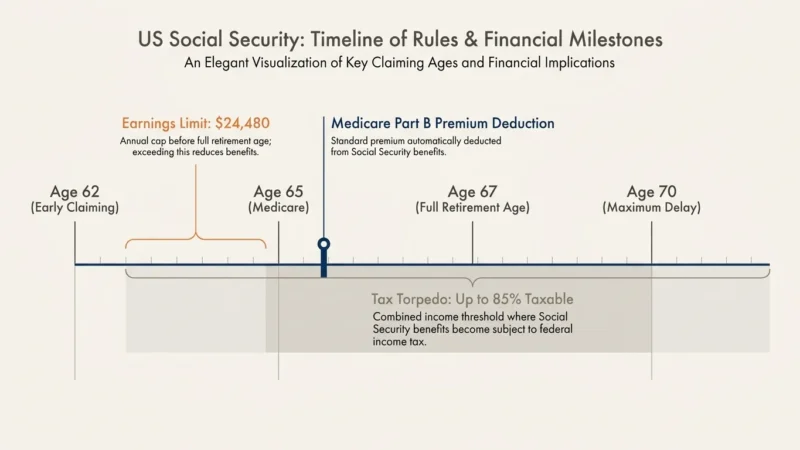
Every cost-of-living adjustment (COLA) increases your Social Security check by a fixed percentage, but you control the underlying baseline that percentage multiplies. For 2026, the Social Security Administration set the COLA at 2.8%, adding roughly $56 per month to the average retiree benefit. However, rising Medicare Part B premiums—reaching $202.90 per month in 2026—frequently eat away at those gains before your check hits your bank account. By strategically adjusting your claiming timeline, optimizing your top 35 earning years, and protecting your net income from unexpected Medicare surcharges, you can dramatically magnify the dollar value of every future annual adjustment.
At a Glance: Maximizing Your COLA
- COLA is Math: Percentage adjustments reward higher monthly benefit baselines exponentially over a long retirement.
- Medicare Deductions Matter: The standard 2026 Medicare Part B premium of $202.90 directly reduces your net Social Security check payout.
- 35-Year Window: Replacing zero or low-earning wage years with current higher earnings permanently recalculates your monthly benefit baseline.
- Surcharge Prevention: Keeping Modified Adjusted Gross Income below $109,000 (single) or $218,000 (joint) prevents steep Medicare IRMAA penalties.
1. Delay Claiming Benefits to Build a Higher Base Amount
The annual cost-of-living adjustment operates on a simple mathematical principle: a fixed percentage applied to a larger baseline creates a larger dollar increase. When the Social Security Administration (SSA) applies a 2.8% COLA, a retiree receiving $1,500 per month gets an extra $42 every month. However, a retiree receiving $3,000 per month gets an additional $84. Over a 20-year retirement, that differential compounding generates tens of thousands of dollars in extra cash flow.
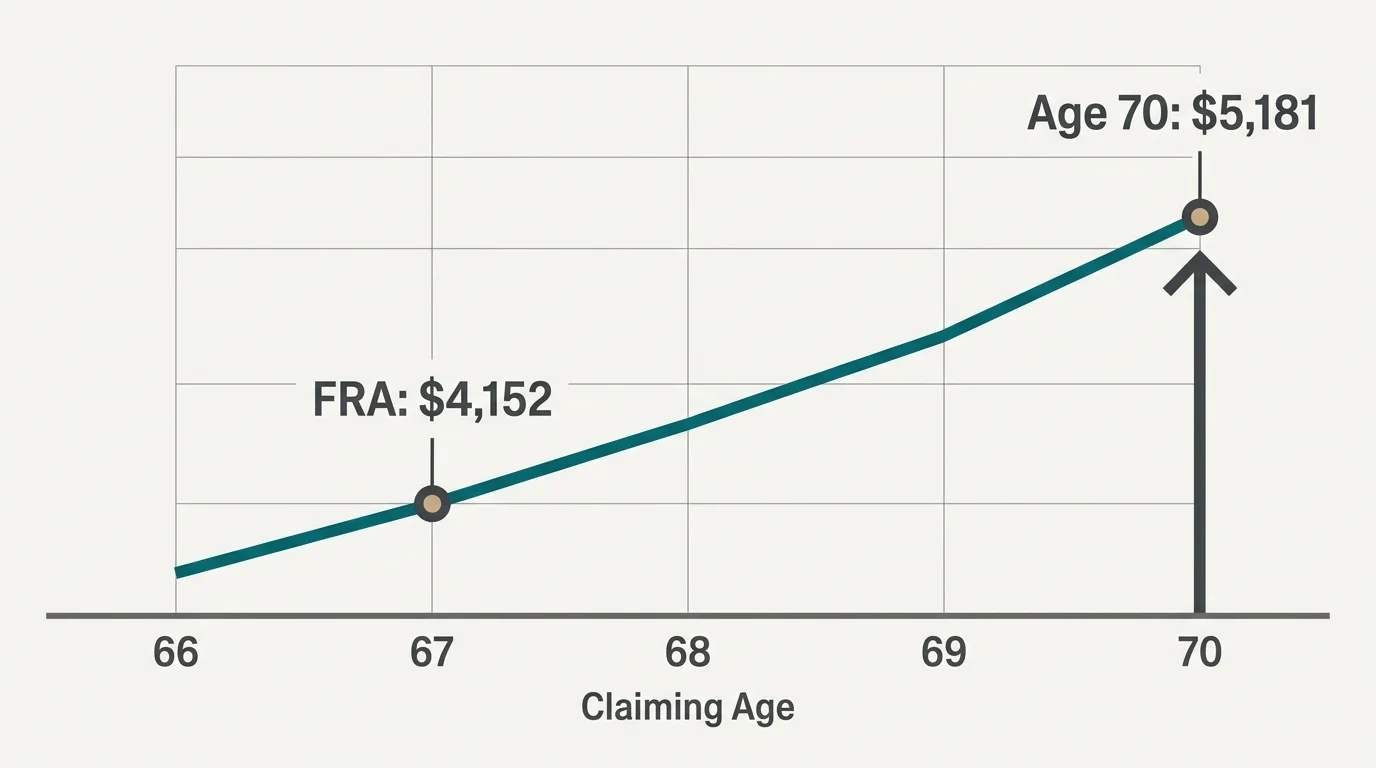
You directly influence this baseline by selecting when you begin taking benefits. If you claim at your Full Retirement Age (FRA)—which ranges between 66 and 67 depending on your birth year—you receive 100% of your earned primary insurance amount. If you delay claiming past FRA, your benefit baseline increases by 8% for every full year you wait up until age 70. In 2026, the maximum monthly benefit for someone retiring at FRA is $4,152, whereas the maximum benefit for someone delaying until age 70 reaches $5,181.
By maximizing your starting benefit at age 70, you lock in a permanently elevated floor. Every subsequent COLA then compounds on top of that inflated base figure for the rest of your life. If you have already claimed benefits early, you still have options; if you are under age 67 and within 12 months of claiming, you can request a benefit withdrawal, pay back what you received, and reset your baseline for future growth.

2. Replace Low-Earning Years in Your 35-Year Average
The Social Security calculation formula bases your initial monthly benefit on your top 35 years of indexed earnings. The SSA indexes your historical wages to account for general wage growth across the economy, ranks every year of your career, and averages the highest 35 years together to establish your Primary Insurance Amount (PIA).
If you worked for fewer than 35 years, the SSA inserts zeros for the missing years. Even a single year with zero earnings significantly drags down your monthly average, permanently reducing every future COLA check you receive. You can counteract this by working even a few extra years near the end of your career. Each new year of earnings replaces a $0 year—or a low-earning year from early in your working life, such as a teenage summer job.
In 2026, the maximum taxable wage base rises to $184,500. Earners who continue working late in their careers near or at this cap can systematically replace lower-earning historical years. The SSA automatically recalculates your benefit baseline annually when you report new income. When your baseline primary insurance amount rises, your COLA raise automatically generates a bigger dollar increase starting the following year.

3. Manage MAGI to Prevent Medicare IRMAA Surcharges
Most retirees have their Medicare Part B premiums automatically deducted directly from their monthly Social Security checks. Because of this direct link, a sharp increase in your Medicare premium directly reduces the actual cash value of your COLA boost. For 2026, the standard monthly Medicare Part B premium rose to $202.90, representing a $17.90 monthly increase over the 2025 standard rate of $185.00. That premium increase alone absorbs nearly a third of the average $56 COLA raise.
The situation becomes far more severe if your income triggers the Income-Related Monthly Adjustment Amount (IRMAA). IRMAA is a surcharge added to your standard Part B and Part D premiums if your Modified Adjusted Gross Income (MAGI) exceeds specific thresholds. The SSA uses your federal tax return from two years prior to determine your IRMAA tier. For 2026, IRMAA surcharges kick in at the following income levels:
- Single Filers: MAGI greater than $109,000
- Married Filing Jointly: MAGI greater than $218,000
Crossing those cliffs by even a single dollar triggers mandatory monthly surcharges ranging from an additional $81.20 to $487.00 per month for Part B alone. That penalty completely wipes out the financial benefit of a annual COLA check. You can manage your MAGI strategically through tax-smart withdrawals:
- Utilize Qualified Charitable Distributions (QCDs) directly from traditional IRAs once you reach age 70½ to satisfy Required Minimum Distributions (RMDs) without adding to your taxable income.
- Execute multi-year Roth IRA conversions early in retirement—specifically between your retirement date and age 73—to lower future mandatory distributions.
- Harvest capital losses strategically to offset taxable capital gains from investment accounts.
“Tax planning doesn’t stop when you stop working; managing your distributions in retirement dictates how much of your Social Security boost you actually keep.” — Ed Slott, CPA and Tax Expert

4. Audit Your Social Security Earnings Record for Omissions
Your benefit check—and every percentage-based COLA added to it—depends entirely on the historical earnings record maintained by the Social Security Administration. Clerical errors, employer reporting mistakes, misplaced records after a maiden name change, or incorrectly filed W-2 forms can cause years of valid income to vanish from your official statement.
A single missing year of earnings can cost you hundreds of dollars per year in lower baseline payments, compounded over decades of inflation adjustments. Fixing these discrepancies requires proactive monitoring on your part.
Create or log into your personal online account through the official Social Security Administration website. Review your year-by-year tax history against your historical W-2 forms, tax returns, or pay stubs. If you discover missing or incorrect earnings, contact the SSA immediately to file Form SSA-7008 (Request for Correction of Earnings Record). Correcting historical errors elevates your permanent base calculation, resulting in an immediate upward adjustment to your benefit and all subsequent COLA payouts.
5. Mind the Earnings Test Limits If Working Before Full Retirement Age
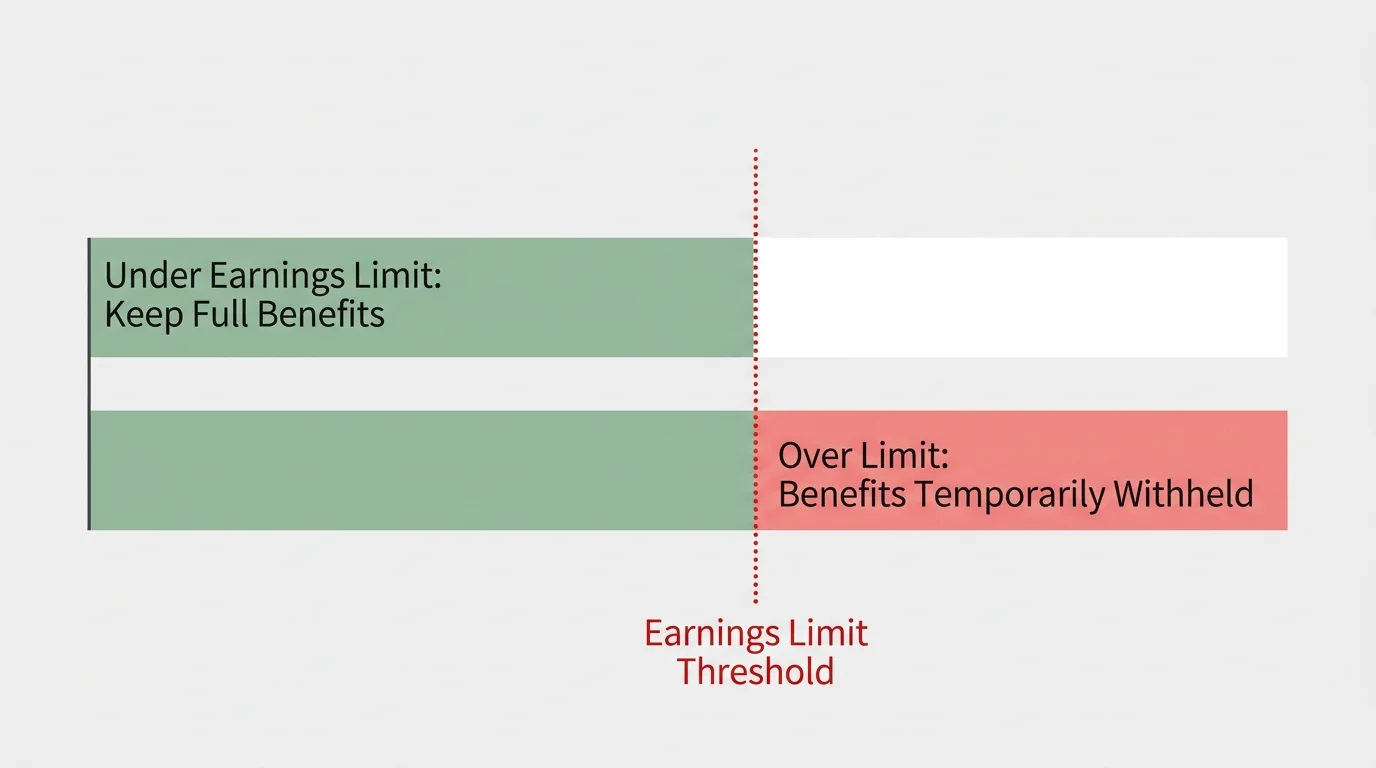
If you choose to claim Social Security benefits before reaching your Full Retirement Age and continue to work, you face the Social Security Retirement Earnings Test. Earning above specific limits triggers a temporary withholding of your monthly benefits, directly shrinking your current take-home cash flow.
For 2026, the SSA established clear limits on how much you can earn before benefit withholding begins:
- Under Full Retirement Age All Year: The earnings limit is $24,480 per year ($2,040 per month). The SSA withholds $1 in benefits for every $2 earned above this threshold.
- Reaching Full Retirement Age During 2026: The earnings limit rises to $65,160 per year ($5,430 per month). The SSA withholds $1 in benefits for every $3 earned above this limit up until the calendar month you reach full retirement age.
While withheld benefits are not permanently lost—the SSA recalculates your monthly benefit upward once you reach FRA to credit you for the withheld payments—heavy earned income during early retirement temporarily depresses your monthly benefit payments. Once you cross your FRA threshold, earnings limits disappear entirely; you can earn unlimited income without any benefit withholding, allowing you to maximize both your job earnings and your full COLA-adjusted benefit check.

6. Use Tax-Smart Withdrawal Strategies to Protect Benefits
Receiving a annual COLA raise increases your total gross income, which can unexpectedly expose a larger portion of your Social Security benefits to federal income tax. The IRS determines the taxability of your benefits using a metric called “Combined Income,” calculated as follows:
Combined Income = Adjusted Gross Income + Non-Taxable Interest + 50% of Social Security Benefits
Depending on your total Combined Income, you may owe federal income tax on a significant portion of your monthly check:
| Filing Status | Combined Income Threshold | Taxable Portion of Benefits |
|---|---|---|
| Single / Head of Household | $25,000 to $34,000 | Up to 50% |
| Single / Head of Household | Over $34,000 | Up to 85% |
| Married Filing Jointly | $32,000 to $44,000 | Up to 50% |
| Married Filing Jointly | Over $44,000 | Up to 85% |
These combined income thresholds have never been indexed for inflation since their introduction decades ago. Consequently, every annual COLA raise pushes more retirees over these static thresholds. You can mitigate this tax drag by drawing retirement income strategically from non-taxable sources like Roth IRAs, or by utilizing taxable brokerage accounts taxed at long-term capital gains rates rather than pulling exclusively from standard traditional pre-tax IRAs.
To analyze tax considerations on federal tax returns, verify official rules directly on the Internal Revenue Service website before initiating large portfolio liquidations.

Comparing Strategic Choices and COLA Impact
Understanding how different decisions alter your baseline and net COLA payout allows you to select the right levers for your household financial plan. The comparison table below highlights how key strategic actions alter your long-term payout potential.
| Strategy | Primary Mechanism | Impact on Base Benefit | Impact on Net COLA Value |
|---|---|---|---|
| Delaying to Age 70 | Earns 8% annual delayed credits | Increases base by up to 24%–32% | Magnifies dollar value of every future percentage adjustment |
| Working 35 Full Years | Eliminates $0 entries in earnings history | Raises Primary Insurance Amount (PIA) | Permanently elevates baseline for future percentage multiplication |
| IRMAA Surcharge Avoidance | Keeps MAGI under $109k / $218k caps | No change to gross baseline | Prevents Part B hikes ($81.20–$487.00/mo) from consuming gross COLA gains |
| Earnings Record Correction | Fixes employer reporting errors via SSA | Restores missing historical base earnings | Provides immediate retroactive baseline increase and higher monthly COLA |

Avoiding Common Errors
Retirees often undermine their own annual cost-of-living increases through predictable mistakes. Avoiding these traps ensures you keep the full financial benefit of every annual inflation adjustment.
- Claiming Early Out of Insolvency Fear: Filing for benefits at age 62 out of concern for Social Security’s trust fund reserves locks in a permanent 25% to 30% reduction in your base benefit. A smaller baseline permanently limits the compounding value of every subsequent COLA check.
- Accidentally Triggering IRMAA Cliffs: Selling real estate or converting a massive traditional IRA to a Roth IRA in a single tax year can push your MAGI over Medicare threshold limits, causing premium surcharges that swallow your net Social Security raise two years later.
- Ignoring Social Security Statements: Failing to review your wage history every year allows reporting errors to become permanent, resulting in a calculated baseline benefit lower than what you actually earned.
- Failing to Track Combined Income: Taking large distributions from pre-tax retirement accounts without accounting for the combined income formula needlessly forces 85% of your Social Security benefits into taxable status.

When DIY Isn’t Enough
While understanding Social Security guidelines allows you to make informed decisions, certain complex financial scenarios justify seeking tailored professional guidance from a certified financial planner or specialized tax accountant.
- Coordinating Spousal and Survivor Strategies: Determining the optimal claiming sequence between spouses—especially when balancing significant wage disparities, pension offsets, or survivor benefit considerations—requires sophisticated cross-market analysis.
- Managing Business Exits or Property Sales: Liquidating substantial real estate holdings or selling a private business creates massive temporary income spikes that require strategic timing to protect Medicare Part B and Part D premiums.
- Appealing IRMAA Surcharges After Life Events: If your income dropped significantly due to a major life-changing event—such as retirement, marriage, divorce, or the death of a spouse—a tax professional can help you file Form SSA-44 with the Medicare administration to eliminate unjust surcharges.
- Unwinding Early Filing Mistakes: Executing a formal benefit withdrawal within the 12-month window or electing to suspend benefit payments upon reaching Full Retirement Age involves rigid regulatory rules best handled alongside professional oversight.
Frequently Asked Questions
How is the annual Social Security COLA calculated?
The Social Security Administration calculates the annual COLA using the Consumer Price Index for Urban Wage Earners and Clerical Workers (CPI-W). The SSA compares the average CPI-W figures from the third quarter (July, August, and September) of the current year against the third quarter average of the previous year. The percentage difference determines the COLA increase applied to January benefit checks.
Does Medicare Part B directly reduce my monthly Social Security check?
Yes. If you are enrolled in Medicare Part B and receive Social Security benefits, the SSA automatically deducts your monthly Part B premium directly from your benefit check. When Part B premiums rise—such as the increase to $202.90 per month in 2026—the additional premium cost directly reduces the net increase you see from your annual COLA raise.
Can working past age 65 increase my Social Security benefits and COLA check?
Yes. If your current earnings are higher than any of the lowest earnings years in your original 35-year wage history, the SSA automatically recalculates your benefit baseline. Replacing lower-earning historical years with higher current income raises your Primary Insurance Amount, which in turn increases the dollar value of all future percentage-based COLA increases.
What should I do if my earnings record is missing a working year?
If you notice missing or incorrect earnings on your online statement, gather supporting documentation such as old W-2 forms, tax returns, or pay stubs. Contact the Social Security Administration or file Form SSA-7008 to request a formal correction. Once verified, the SSA updates your earnings record and adjusts your baseline benefit upward.
Taking Action on Your Social Security Strategy
Maximizing the value of your annual cost-of-living adjustment requires actively managing the variables that dictate your payout. You cannot change the inflation rate chosen by the government, but you retain direct control over your claiming age, your 35-year work history, your tax brackets, and your Medicare IRMAA thresholds. Taking proactive steps today ensures that every future percentage adjustment delivers maximum cash flow to your retirement account.
Start by creating your online account on official government portals, reviewing your earnings history for accuracy, and building an integrated withdrawal strategy across all your investment accounts. Navigating benefit schedules, tax laws, and healthcare adjustments requires careful execution. To learn more about navigating health coverage choices alongside your retirement benefits, explore resources provided by the National Council on Aging.
The information in this guide is meant for educational purposes. Your specific circumstances—including income, savings, health coverage, and goals—may require different approaches. When in doubt, consult a licensed professional.
Last updated: February 2026. Retirement benefits, tax laws, and healthcare costs change frequently—verify current details with official sources.