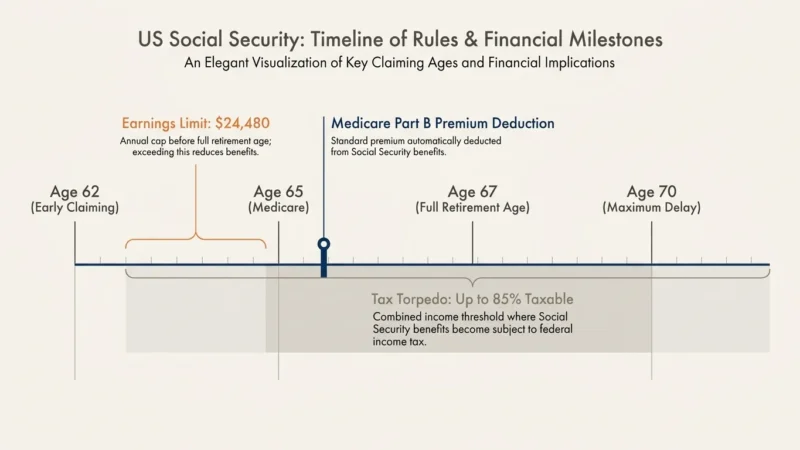
A sudden spike in your retirement income can trigger an unexpected financial penalty that drains your monthly cash flow. The Income-Related Monthly Adjustment Amount, commonly known as IRMAA, adds a substantial surcharge to your Medicare Part B and Part D premiums whenever your earnings cross specific federal thresholds. Crossing a tier by even one dollar forces you to pay hundreds or thousands of dollars in extra healthcare costs throughout the entire year. Understanding how Medicare calculates your income—and learning how to strategically manage capital gains, Roth conversions, and mandatory distributions—empowers you to protect your wealth and avoid this frustrating retirement income trap.
What Is IRMAA and How Does the Two-Year Lookback Work?
Medicare IRMAA is an extra fee added to your standard Medicare Part B (medical insurance) and Medicare Part D (prescription drug coverage) monthly premiums. Congress designed this surcharge to ensure that higher-income retirees contribute a larger share toward the cost of their federal healthcare benefits. However, many retirees discover IRMAA only after receiving a surprise bill from the Social Security Administration.
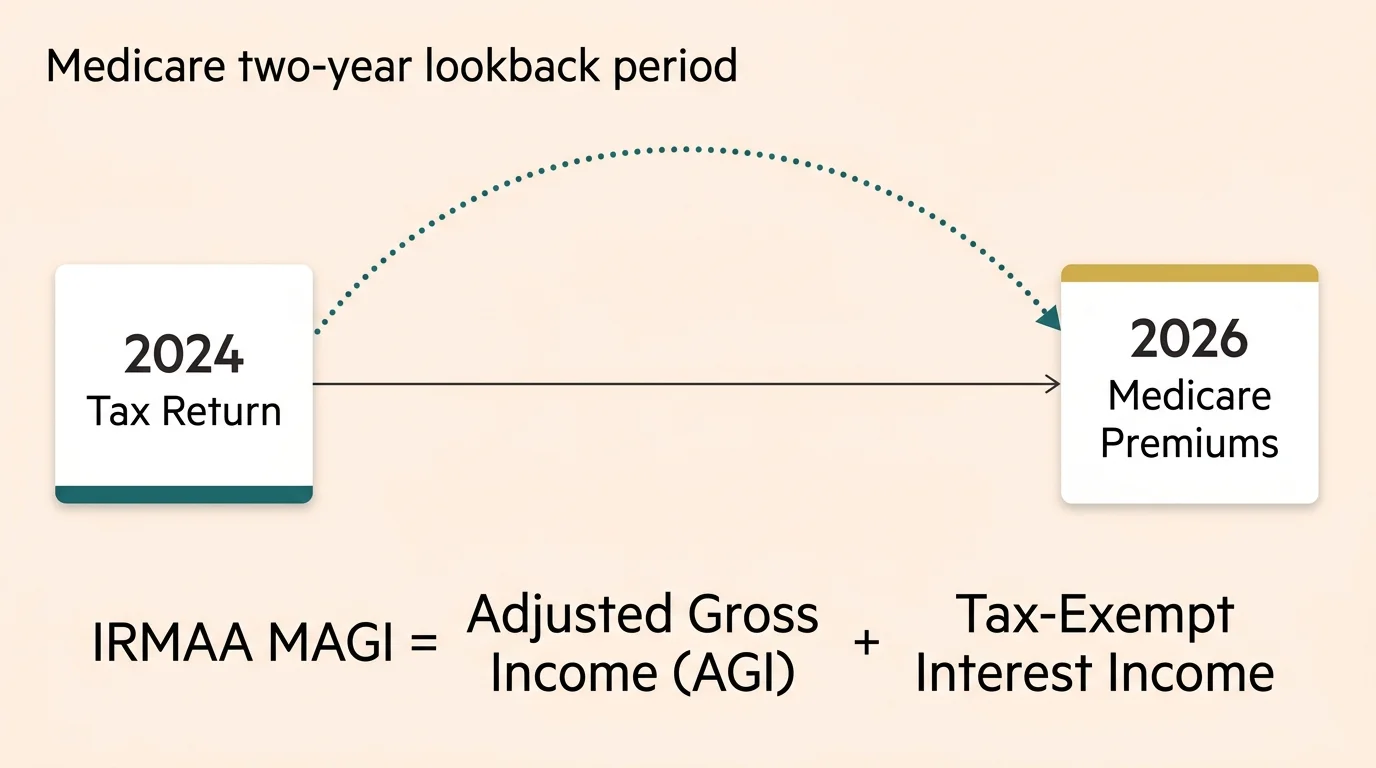
To determine whether you must pay an IRMAA surcharge, the federal government uses a two-year lookback period. The Social Security Administration evaluates your Modified Adjusted Gross Income (MAGI) reported on your federal income tax return from two years prior. For example, your 2026 Medicare premiums rely entirely on the income you reported on your 2024 tax return. If you realized a large capital gain or took a substantial withdrawal in 2024, that single decision dictates your Medicare costs for all of 2026.
Calculating your IRMAA MAGI involves a specific IRS formula that catches many seniors off guard. Your MAGI for Medicare purposes is your Adjusted Gross Income (AGI) plus any tax-exempt interest income you earned during the tax year. The federal formula looks like this:
IRMAA MAGI = Adjusted Gross Income (AGI) + Tax-Exempt Interest Income
This formula means that investments often marketed as tax-free can inadvertently trigger Medicare surcharges. Even if income escapes federal income tax, Medicare counts it when evaluating your bracket tier.
The Cliff Effect: Why Crossing a Threshold by $1 Costs Thousands
Federal income tax brackets operate on a progressive scale. When your income moves into a higher income tax bracket, the IRS taxes only the dollars that fall within that specific new tier. You never pay a higher tax rate on your baseline income simply because you earned one extra dollar.
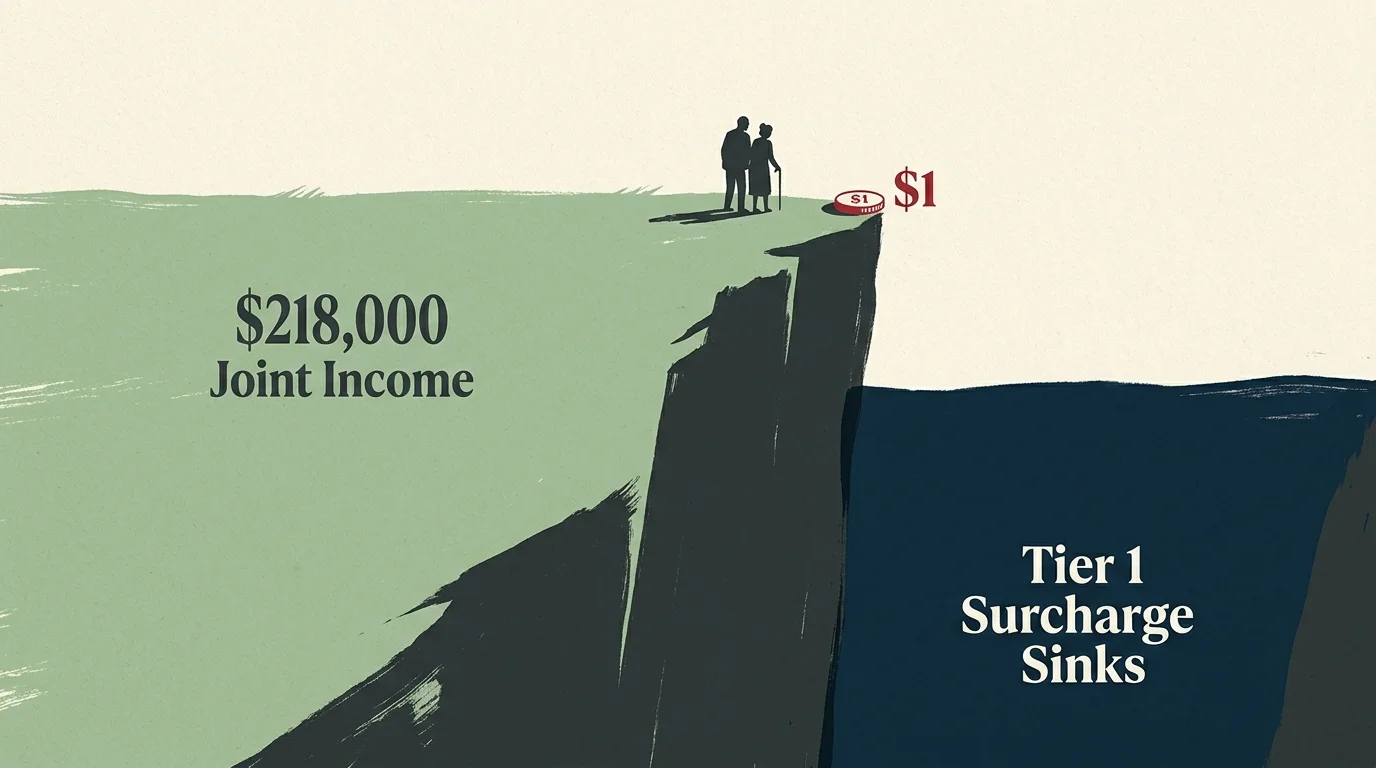
Medicare IRMAA operates on a completely different, harsher principle known as the “cliff effect.” IRMAA income tiers act as strict financial drop-offs. If your MAGI exceeds an IRMAA threshold by a single dollar, you trigger the full surcharge across all 12 months of the premium year for both Medicare Part B and Medicare Part D. There is no pro-rating, smoothing, or marginal adjustment for missing a threshold by a small margin.
Consider a married couple filing jointly in 2026. If their combined 2024 MAGI was exactly $218,000, they remain in the base tier and pay the standard 2026 Part B premium of $202.90 per month each, with no Part D surcharge. However, if their 2024 MAGI reached $218,001—just one dollar over the baseline threshold—both spouses get pushed into Tier 1. In 2026, Tier 1 increases each spouse’s Part B premium to $284.10 per month (an extra $81.20 per month each) and adds a Part D surcharge of $14.50 per month each.
That single extra dollar of reported income increases the couple’s combined Medicare costs by $95.70 per month. Over the course of 12 months, that one-dollar oversight costs the couple an additional $1,148.40 in healthcare premiums.

2026 Medicare IRMAA Income Brackets and Premium Costs
The Centers for Medicare & Medicaid Services (CMS) adjusts IRMAA brackets annually based on inflation figures. In 2026, the standard Medicare Part B monthly premium is $202.90 (up from $185.00 in 2025). The baseline income threshold for single filers is $109,000 (up from $106,000 in 2025), while the baseline threshold for joint filers is $218,000 (up from $212,000 in 2025).
Review the 2026 IRMAA bracket tiers in the table below to see how reported income from 2024 impacts your monthly Medicare payments. Note that the top income tier remains frozen by federal statute through 2028 and does not adjust for inflation.
| 2026 MAGI Tier (2024 Tax Return) — Single | 2026 MAGI Tier (2024 Tax Return) — Married Filing Jointly | Part B Monthly Premium | Part D Monthly Surcharge | Total Combined Monthly Surcharge (Per Person) |
|---|---|---|---|---|
| $109,000 or less | $218,000 or less | $202.90 | $0.00 | $0.00 |
| $109,001 to $137,000 | $218,001 to $274,000 | $284.10 | +$14.50 | +$95.70 |
| $137,001 to $171,000 | $274,001 to $342,000 | $405.80 | +$37.50 | +$240.40 |
| $171,001 to $205,000 | $342,001 to $410,000 | $527.50 | +$60.40 | +$385.00 |
| $205,001 to $500,000 | $410,001 to $750,000 | $649.20 | +$83.30 | +$529.60 |
| More than $500,000 | More than $750,000 | $689.90 | +$91.00 | +$578.00 |

The Most Common Retirement Income Surcharge Triggers
Retirees often trigger IRMAA surcharges without realizing they are making an expensive tax mistake. Standard retirement milestones and wealth management strategies can unexpectedly inflate your AGI and MAGI. Recognizing these financial triggers gives you the opportunity to plan ahead and neutralize potential income spikes.
- Required Minimum Distributions (RMDs): Under the SECURE 2.0 Act, the mandatory RMD age is 73 (rising to 75 in 2033). When you turn 73, the IRS requires you to withdraw minimum taxable amounts from traditional IRAs and 401(k) plans every year. Forced RMD withdrawals stack directly on top of your Social Security benefits and pension income, pushing your MAGI over standard IRMAA thresholds.
- Large Roth IRA Conversions: Converting traditional pre-tax retirement funds into a Roth IRA builds future tax-free income. However, the IRS treats the converted amount as ordinary taxable income in the year you complete the transaction. Executing a massive single-year Roth conversion creates an immediate income spike that triggers IRMAA surcharges two years later.
- Real Estate and Investment Capital Gains: Selling a primary home with gains exceeding your statutory capital gains exclusion ($250,000 for single filers, $500,000 for joint filers) adds substantial taxable income to your tax return. Similarly, selling appreciated stock, cryptocurrency, or investment property outside a tax-deferred account inflates your AGI.
- Municipal Bond Interest (The Tax-Exempt Trap): Municipal bonds generate interest income that escapes federal income tax. Because financial advisors frequently promote municipal bonds as tax-free investments, retirees often accumulate large bond portfolios. However, the IRS requires you to add municipal bond tax-exempt interest back into your AGI when calculating your IRMAA MAGI.
- Lump-Sum Pensions and Social Security Back Pay: Receiving a one-time payout from a corporate pension plan or collecting retroactive lump-sum Social Security benefits creates an artificial taxable income surge during that calendar year.
“Tax planning in retirement isn’t just about what you keep from the IRS; it’s about avoiding domino effects like Medicare surcharges that quietly erode your retirement income.” — Ed Slott, CPA and Retirement Tax Expert

Practical Strategies to Avoid the IRMAA Income Trap
Protecting your retirement income from Medicare surcharges requires a forward-looking tax strategy. By anticipating your income needs two or three years in advance, you can implement tax-efficient withdrawal strategies that keep your MAGI beneath key threshold cliffs.
First, utilize Qualified Charitable Distributions (QCDs) once you reach age 70½. The IRS permits you to transfer up to $105,000 per year directly from a Traditional IRA to an eligible 501(c)(3) public charity. Money distributed through a QCD counts directly toward your annual RMD requirement but does not enter your Adjusted Gross Income. Because the money bypasses your tax return entirely, it never triggers an IRMAA surcharge.
Second, execute multi-year partial Roth conversions before you reach Medicare age. If you plan to retire in your early 60s, convert pre-tax IRA dollars into Roth IRAs in small, controlled annual increments between ages 60 and 62. Because Medicare enrollment begins at age 65 (using age 63 tax returns), completing conversions early reduces future traditional IRA balances—and future RMDs—without exposing your Medicare premiums to surcharges.
Third, optimize your asset location and cash withdrawal sequence. When you need cash for extra living expenses or a major purchase, balance your withdrawals across different account types. Pulling funds from taxable brokerage accounts, tax-deferred accounts, and tax-free Roth accounts allows you to fine-tune your exact MAGI for the year, keeping your reported income safely below the nearest IRMAA bracket line.
Fourth, tap into Health Savings Accounts (HSAs) if you funded one prior to enrolling in Medicare. Qualified HSA withdrawals for legitimate medical expenses remain completely tax-free and do not count toward your AGI or MAGI calculations. Utilizing HSA funds for major healthcare expenses keeps your taxable withdrawals lower.

Appealing Your Surcharge: How to Use Form SSA-44
If your reported income from two years ago was unusually high because of a major life transition, you do not have to accept an unfair Medicare surcharge. The Social Security Administration allows you to contest an IRMAA determination if your income has dropped significantly due to a qualifying life-changing event.
Under federal regulations, the Social Security Administration recognizes eight official life-changing events for an IRMAA reduction appeal:
- Work stoppage (complete retirement)
- Work reduction (transitioning from full-time to part-time work)
- Marriage
- Divorce or annulment
- Death of a spouse
- Loss of income-producing property due to a disaster, fraud, or theft
- Loss or reduction of employer pension income
- Receipt of a settlement payment from an employer due to bankruptcy or reorganization
To request an IRMAA reassessment, download and complete Form SSA-44 (Medicare Income-Related Monthly Adjustment Amount – Life-Changing Event) from the Social Security Administration website. You must provide an estimate of your current year’s lower income and attach supporting documentation, such as a letter of retirement from your employer, a death certificate, or divorce decree. Submitting Form SSA-44 promptly allows the Social Security Administration to calculate your Medicare premium based on your current, lower income rather than your two-year-old tax return.

Pitfalls to Watch For
Avoiding Medicare surcharges requires paying close attention to specific tax rules and life situations. Keep these major pitfalls in mind when structuring your retirement distributions:
- The Survivor’s Tax Trap: When a spouse passes away, the surviving spouse’s filing status shifts from Married Filing Jointly to Single in the tax year following the death. The single IRMAA baseline threshold drops from $218,000 to $109,000. Meanwhile, the surviving spouse often inherits traditional IRAs, maintaining high RMD obligations while facing drastically lower income thresholds.
- Ignoring the 2-Year Lookback Window: Completing a massive financial transaction at age 63—such as selling a business or taking a large taxable distribution—will directly raise your Medicare Part B and Part D premiums when you enroll at age 65.
- Uncoordinated Real Estate Sales: Selling a secondary vacation property or investment rental without spreading capital gains across multi-year installment contracts can instantly push your MAGI into the highest IRMAA tier ($689.90 per month for Part B).
- Misunderstanding Municipal Bond Funds: Investing heavily in tax-exempt municipal bond funds under the false assumption that they cannot affect your healthcare costs. While exempt from federal tax, they directly elevate your IRMAA MAGI.

Getting Expert Help
Managing Medicare surcharges involves balancing federal income tax laws, healthcare regulations, and investment strategies. Navigating these rules can prove difficult on your own. Consider consulting a qualified financial advisor, Certified Financial Planner (CFP), or Certified Public Accountant (CPA) in the following scenarios:
- You plan to sell a business or real estate asset: A professional can help you structure an installment sale or time your transaction to limit IRMAA surcharges across multiple tax years.
- You are designing a multi-year Roth conversion plan: A financial advisor can calculate exact bracket limits, ensuring your conversions maximize long-term tax savings without accidentally triggering Medicare premium penalties.
- You recently experienced a qualifying life-changing event: A CPA can assist you in gathering supporting documents and filing Form SSA-44 accurately with the Social Security Administration.
- You lost a spouse and face the single filing status: A advisor can help restructure your income-producing assets to prevent the Survivor’s Tax Trap from overwhelming your cash flow.
Frequently Asked Questions About Medicare IRMAA
How long does an IRMAA surcharge last?
An IRMAA surcharge lasts for one calendar year (12 months). The Social Security Administration recalculates your Medicare premiums every year based on your tax return from two years prior. If your income drops back below the threshold in subsequent years, your premium automatically returns to the standard rate.
Does Social Security income count toward IRMAA calculations?
Yes. The taxable portion of your Social Security benefits is included in your Adjusted Gross Income (AGI). Because your AGI forms the foundation of your IRMAA MAGI, taxable Social Security benefits contribute directly toward your IRMAA threshold limits.
Can I avoid IRMAA by opting out of Medicare Part B or Part D?
If you opt out of Medicare Part B or Part D, you will not pay the IRMAA surcharges associated with those parts. However, declining Part B or Part D when you are eligible can lead to severe lifelong late-enrollment penalties if you decide to enroll in Medicare later. You also risk operating without comprehensive healthcare and prescription coverage.
What happens if my income drops back down after a high-income year?
If your income spike was a one-time event (such as selling stock or taking an extra IRA distribution) and you did not experience an official qualifying life-changing event, you must pay the IRMAA surcharge for that specific 12-month period. Once the two-year lookback window moves past that high-income year, your Medicare premiums will adjust back down automatically.
Securing Your Retirement Income Strategy
Navigating Medicare surcharges requires active wealth management and early planning. By tracking your Modified Adjusted Gross Income and coordinating withdrawals across your accounts, you can prevent unexpected spikes that trigger high IRMAA tiers. Using tools like Qualified Charitable Distributions, structured Roth conversions, and Form SSA-44 appeals keeps your healthcare costs predictable throughout your retirement years.
Review your financial strategy with your tax professional annually before completing major financial transactions. Proactive financial planning protects your hard-earned savings, allowing you to enjoy a secure and confident retirement.
This article provides general retirement education and information only. Everyone’s financial situation is unique—what works for others may not work for you. For personalized advice, consider consulting a qualified financial professional such as a CFP or CPA.
For official guidance on Medicare premiums and tax regulations, explore resources directly from Medicare.gov, the Social Security Administration (SSA), the Internal Revenue Service (IRS), and financial planning insights from Kiplinger and Fidelity Retirement.
Last updated: February 2026. Retirement benefits, tax laws, and healthcare costs change frequently—verify current details with official sources.