
You do not need a million-dollar budget to enjoy a wine country retirement. While California hotspots price out most buyers, smaller vineyard towns across the country still offer real value.
In late 2026, home prices in several scenic grape-growing regions sit well below the national median. You can trade steep housing costs for walkable streets, local tasting rooms, and four-season views.
Below are six affordable wine towns with verified 2026 housing numbers. You will also find practical steps to match your retirement income with local living costs.

Why Wine Country Still Fits a Retirement Budget
Famous California wine regions carry steep price tags in 2026. The median existing single-family home in Paso Robles reached $954,400 in mid-2026, according to the National Association of REALTORS (NAR).
The San Francisco metro area reached $1,500,000 in that same period. By contrast, NAR reported a national existing-home median price of $417,500 in September 2026.
Regional gaps give you real buying power outside the West Coast. NAR data from mid-2026 shows median single-family prices of $340,800 in the Midwest and $380,000 in the South.
Your retirement income stretches much further in those markets. The Social Security Administration (SSA) announced a 3.6% cost-of-living adjustment for 2027, up from 2.8% in 2026.
That raise lifts the average retired worker’s benefit from $2,095 to $2,170 per month in January 2027. However, rising everyday expenses still eat into that gain.
The U.S. Bureau of Labor Statistics (BLS) reported 3.7% annual consumer inflation in September 2026. Meanwhile, the Centers for Medicare & Medicaid Services (CMS) set the standard Medicare Part B premium at $209.40 in 2027.
That $6.50 monthly premium increase leaves the average retiree with about $68.50 to $69 more each month. Choosing cheap retirement towns helps you protect that modest raise.
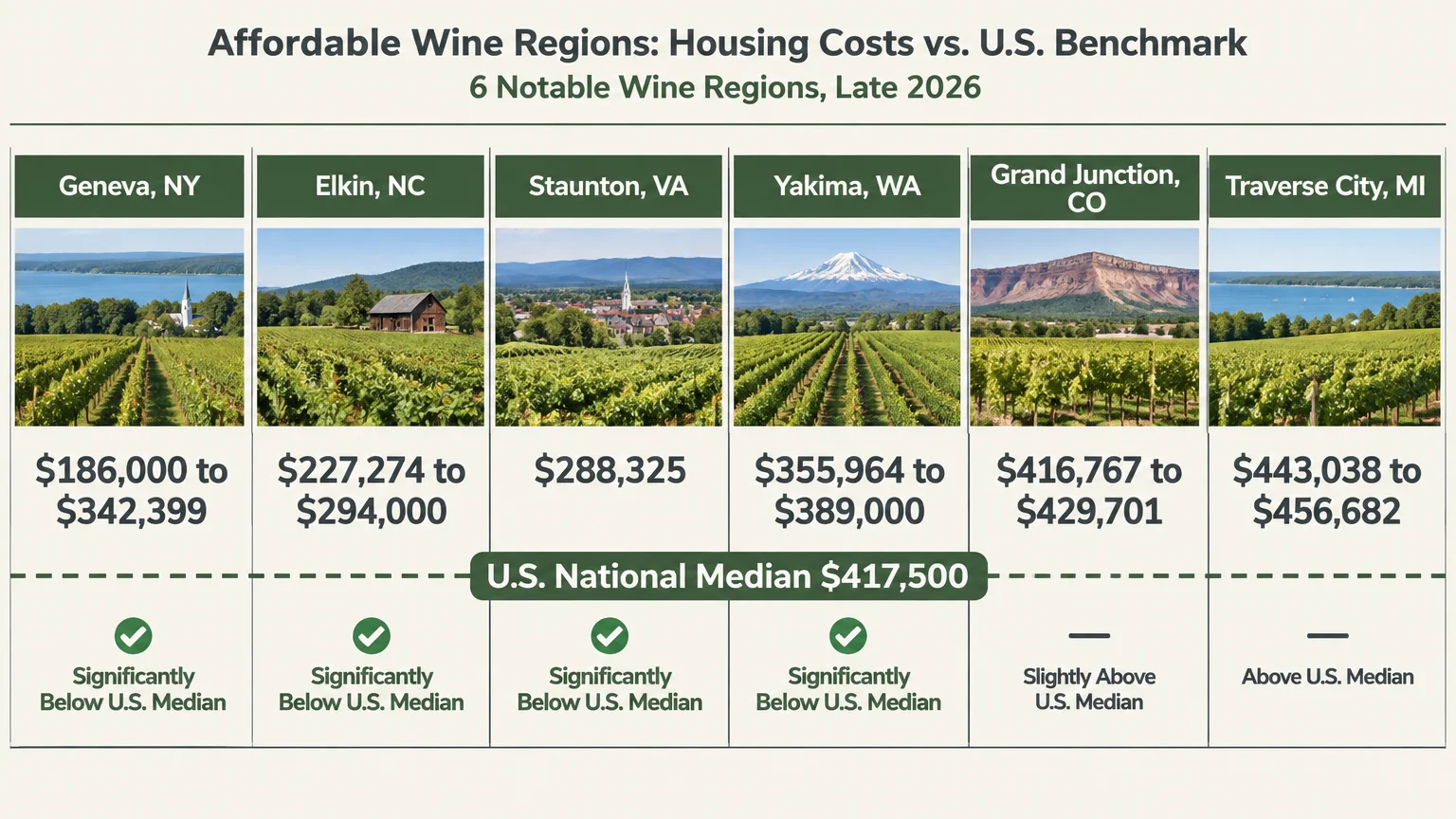
How Six Affordable Wine Towns Compare
Each town below pairs local vineyards with housing prices near or below national benchmarks. Review this snapshot to see which market fits your housing budget.
| Town and Region | Late 2026 Home Price | Rent or Market Pace | Local Highlight |
|---|---|---|---|
| Geneva, NY (Finger Lakes) | $186,000 to $342,399 | May to October market season | Over 100 Seneca Lake wineries |
| Elkin, NC (Yadkin Valley) | $227,274 value to $294,000 sale | 57 to 79 days on market | Quiet foothill town in Surry County |
| Staunton, VA (Shenandoah Valley) | $288,325 value ($429,874 ZIP sale) | 38% below Virginia’s median | Historic town of 25,948 people |
| Yakima, WA (Yakima Valley) | $355,964 value to $389,000 sale | $1,278 average monthly rent | Rent sits 33% below U.S. average |
| Grand Junction, CO (Grand Valley) | $416,767 value to $429,701 sale | $1,761 average monthly rent | ZIPs 81501 and 81504 under $380,000 |
| Traverse City, MI (Northern Michigan) | $443,038 value to $456,682 sale | $1,837 average monthly rent | Over 50 wineries on two peninsulas |
Home values reflect late 2026 data from Zillow, Redfin, and Realtor.com. Prices differ by source because each tracks different home types and time periods.

Six Great Places to Retire in Wine Country
1. Geneva, New York
Geneva sits at the northern tip of Seneca Lake in New York’s Finger Lakes region. You get direct access to more than 100 wineries along the lakeshore, known for crisp Riesling.
Retirees who enjoy outdoor routines stay busy without big-city prices. You can walk the 141-acre Seneca Lake State Park or shop the Saturday farmers market from late May into mid-October.
Housing remains a major draw for a low-cost wine country retirement. WorldAtlas cited Redfin data showing a three-month median sale price of about $186,000 through June 2026.
Broader ZIP code data from HavenScore listed a higher Redfin median sale price of $342,399 in September 2026. Even at that higher figure, Geneva sits well below the national median.

2. Elkin, North Carolina
Tucked into Surry County, Elkin anchors the Yadkin Valley wine region. FinanceBuzz named it among affordable U.S. wine country retirement towns.
Home values stay friendly for retirees living on Social Security and modest savings. Zillow reported a median home value of $227,274 as of October 31, 2026, with a $279,967 median list price.
Other late 2026 listings show a similar price range. Realtor.com placed the median asking price at $251,000 in mid-November 2026, while Redfin recorded a $294,000 three-month median sale price.
Homes here also sell at a relaxed pace. Redfin tracked an average of 79 days on the market, giving you time to inspect homes before you buy.
3. Staunton, Virginia
Staunton sits in the scenic Shenandoah Valley and offers small-town charm without isolation. HearthMap cited U.S. Census Bureau data putting the city’s population at 25,948.
You can stretch your housing equity when you relocate here. Zillow Research reported an October 2026 median home value of $288,325, which sits 38% below Virginia’s statewide median of $462,626.
Buyers looking at larger or updated properties may see higher prices. HavenScore tracked a Redfin median sale price of $429,874 for the 24401 ZIP code in September 2026.
Staunton still delivers strong value for an East Coast retirement. ReloMaps noted a median resident age of 41.0 years in November 2026, creating a balanced community.
4. Yakima, Washington
If you want sunny West Coast wine country without California prices, look at Yakima. FastExpert estimated the city’s population at 93,637 in November 2026, large enough for reliable local services.
Renters get major relief compared with big coastal cities. Zillow reported an average rent of $1,278 per month in October 2026, which is 33% below the $1,913 national average.
Buyers also find prices below the national existing-home mark. Zillow placed Yakima’s median home value at $355,964 at the end of October 2026.
Redfin tracked a three-month median sale price of $389,000 through October 2026, with homes selling in 39 days on average. That steady pace lets you downsize without overpaying.
5. Grand Junction, Colorado
Grand Junction anchors Colorado’s Grand Valley wine region on the Western Slope. FinanceBuzz highlighted it among U.S. wine country retirement towns.
Citywide home prices sit right around the national median. Zillow listed a median home value of $416,767 in late October 2026 and an average rent of $1,761 per month.
Redfin reported a three-month median sale price of $429,701 through October 2026. Homes moved in about 42 days, slightly slower than the national median of 33 days.
You can trim your housing bill by targeting specific neighborhoods. Zillow data from October 31, 2026 shows median values of $340,905 in ZIP code 81501 and $379,906 in ZIP code 81504.
6. Traverse City, Michigan
Traverse City sits on Lake Michigan at the base of the Leelanau and Old Mission peninsulas. More than 50 vineyards and wineries circle the area.
The city holds about 15,678 residents inside a metro area of roughly 153,448 people. You get small-town lakefront charm alongside regional amenities.
It is the priciest town here, yet still less than half the cost of Paso Robles. Zillow put the median home value at $443,038 in October 2026, with average rent at $1,837.
Redfin recorded a $456,682 three-month median sale price through October 2026, up 17.1% from a year earlier. Strong demand means you should tour homes early if this lakeside spot tops your list.

What to Check Before You Buy in Wine Country
Low home prices tell only half of the affordability story. State taxes, healthcare networks, and tourism spillover can quickly change your monthly budget.
Other popular wine areas show why these trade-offs matter. Towns in Oregon’s Willamette Valley like Newberg, McMinnville, and Carlton stay under 35,000 residents and charge no state sales tax.
Meanwhile, Fredericksburg in the Texas Hill Country offers zero state income tax. Yet heavy wine tourism has pushed home prices above many small Texas towns, and property taxes can be steep.
Follow these four steps to test any affordable wine town before making an offer:
- Review state and local taxes: Check how each state taxes Social Security, pensions, and account withdrawals using tools from the Internal Revenue Service (IRS) and state revenue offices. Ask county offices about senior property tax breaks.
- Verify local healthcare and Medicare plans: Search doctors and Advantage plans in your target ZIP code on Medicare.gov. Remember that the standard Part B deductible rises to $292 and the Part A hospital deductible reaches $1,776 in 2027.
- Compare buying versus renting: Use guides from the Consumer Financial Protection Bureau (CFPB) to weigh mortgage, insurance, and upkeep costs against local rent.
- Test the town off-season: Visit during winter or early spring before you commit. You will see how active the town feels when harvest crowds leave.
You can also explore broader relocation checklists through AARP as you narrow your picks. Comparing total living costs now helps prevent budget surprises later.
Frequently Asked Questions
Can I afford wine country on Social Security alone?
Living on Social Security alone is tight, even in cheap retirement towns. In January 2027, the average retired worker receives $2,170 per month before Medicare premiums.
Pairing that benefit with a paid-off home or modest savings makes towns like Geneva, Elkin, or Yakima much more realistic. Renting in Yakima at $1,278 per month still leaves room for food and utilities.
Should I rent first before buying a home in a wine town?
Renting for six to twelve months lets you test local weather, traffic, and healthcare before paying closing costs. In Yakima, renting saves money against the $1,913 national average while you learn each neighborhood.
How much more will Medicare cost in 2027?
CMS set the 2027 standard Medicare Part B premium at $209.40 per month, up $6.50 from $202.90 in 2026. The Part B annual deductible increases by $9 to $292, and the Part A inpatient deductible rises to $1,776.
Next Steps for Your Move
Pick two towns from this list that fit your housing budget, then price out local taxes and Medicare coverage. A short visit during a quiet month will tell you quickly if the community feels like home.
The information in this guide is meant for educational purposes. Your specific circumstances—including income, savings, health coverage, and goals—may require different approaches. When in doubt, consult a licensed professional.
Last updated: November 2026. Retirement benefits, tax laws, and healthcare costs change frequently—verify current details with official sources.