
Yes, you can pause your Social Security checks to increase your future monthly payments through a rule called voluntary suspension. Once you reach full retirement age, pausing benefits earns delayed retirement credits that raise your check 8.0% per year.
This strategy works best if you claimed early, returned to work, or no longer need monthly income right away. You do not have to repay benefits you already collected, and payments automatically restart at age 70.
Before calling the Social Security Administration, you should weigh how pausing affects your spouse, your Medicare billing, and your long-term income plan.
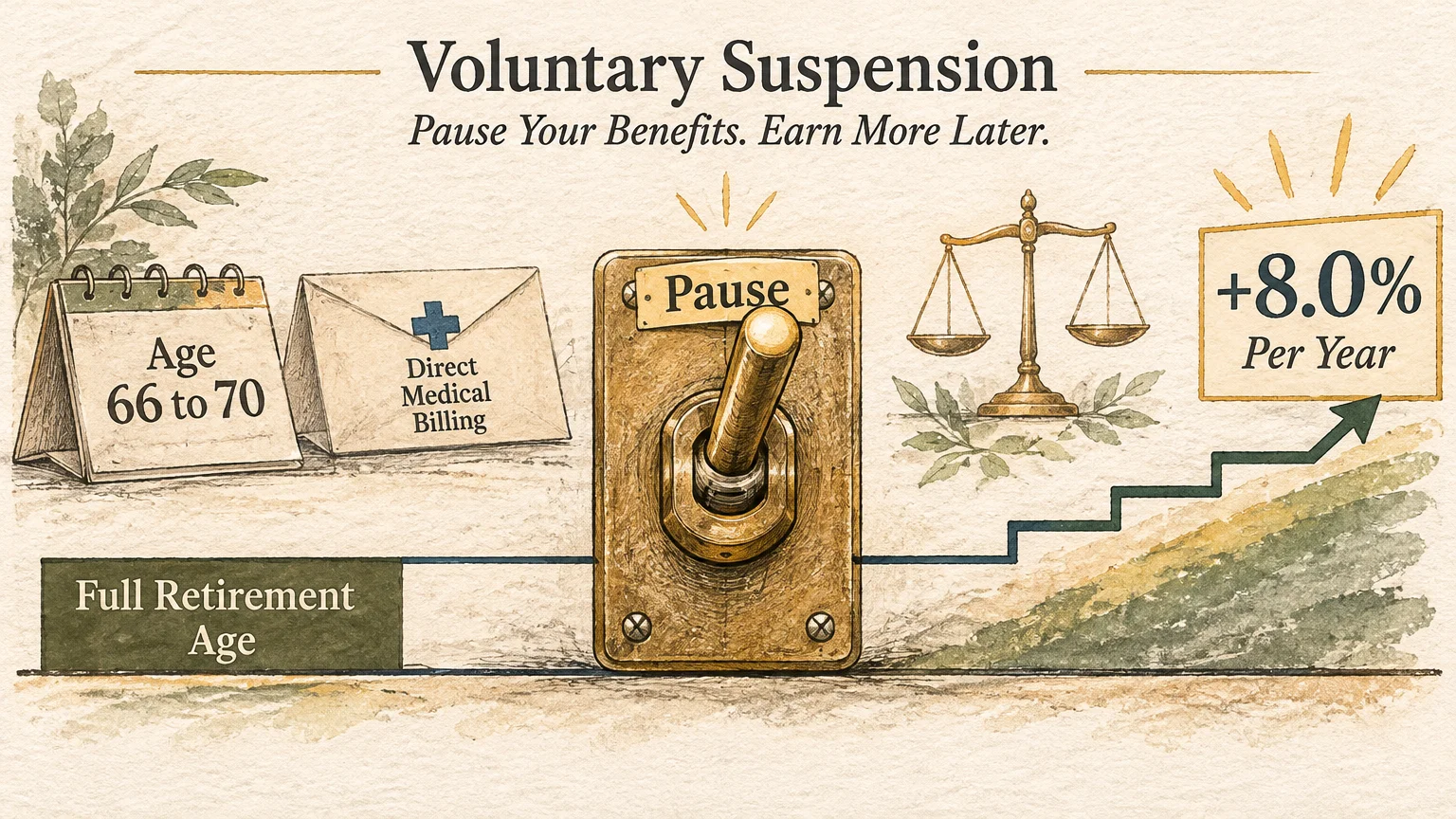
At a Glance: How Voluntary Suspension Works
Voluntary suspension gives eligible retirees a way to trade temporary monthly checks for permanently higher payments later. These five rules govern how the option works under current federal guidelines:
- Age window: You can suspend benefits only after reaching your full retirement age and before turning 70.
- Growth rate: Each suspended month adds two-thirds of 1% to your benefit, totaling 8.0% per full 12-month year.
- No repayment needed: Unlike withdrawing a claim, suspending benefits lets you keep every dollar you already received.
- Family impact: Current spouses and dependent children collecting on your record also lose payments while your check is paused.
- Medicare billing: Your health coverage continues, but Medicare bills you directly for Part B premiums instead of deducting them.
Who Can Suspend Social Security Benefits—and When
According to the Social Security Administration (SSA), you must meet two strict timing requirements before you can suspend Social Security benefits. First, you must already be receiving retirement benefits on your own work record.
Second, you must have reached your full retirement age—often called FRA—and not yet reached age 70. If you claimed at 62 and want to pause at 64, voluntary suspension is not available to you yet.
Under federal law (Social Security Act § 216(l)), your exact full retirement age depends on the year you were born. Anyone born on January 1 uses the schedule for the prior calendar year.
| Birth Year | Full Retirement Age (FRA) | Maximum Months of Suspension to Age 70 |
|---|---|---|
| 1943–1954 | 66 | 48 months |
| 1955–1959 | 66 plus 2 months per year after 1954 (66 and 10 months for 1959) | 38 to 46 months |
| 1960 or later | 67 | 36 months |
Timing your request matters because Social Security never suspends benefits retroactively. Under SSA rules, your voluntary suspension can begin no earlier than the month after the month you submit your request.
You also cannot request a start date earlier than the month you reach full retirement age. Keep the payment schedule in mind so you are not surprised when one more deposit arrives.
Social Security pays benefits one month after the month for which they are due. If you call SSA in June to suspend your benefits, your suspension begins with your July benefit, meaning your June check still arrives in July.
If you later decide you need the income again, you can restart payments any time before age 70. Just like the initial pause, reinstatement takes effect the month after you make the request.
If you leave your benefits paused all the way to your 70th birthday, you do not need to call again. Per SSA and AARP guidance, SSA automatically restarts your payments in the month you turn 70.
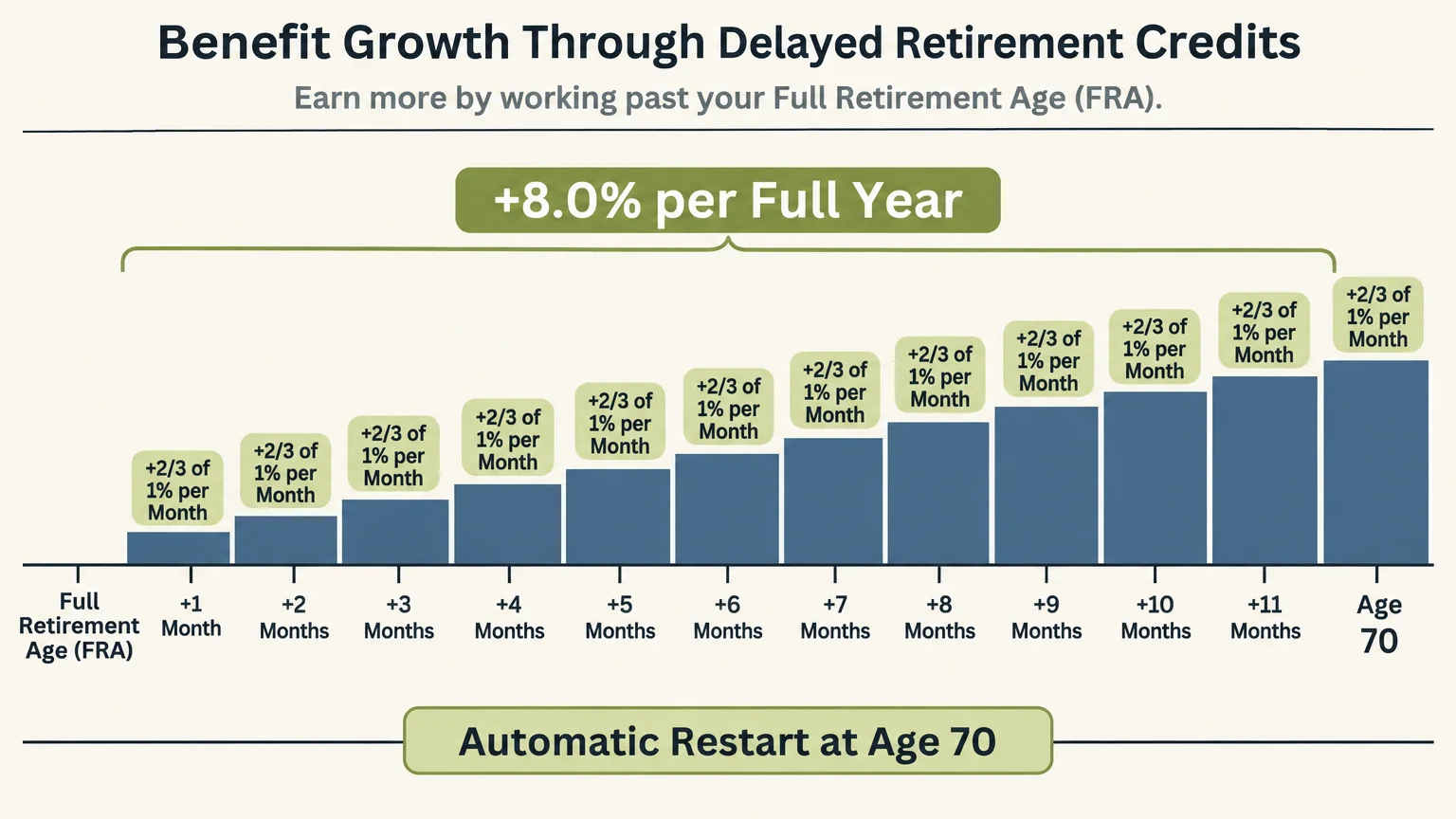
How Delayed Retirement Credits Increase Your Check
The core reason to suspend benefits is to earn delayed retirement credits. For anyone born in 1943 or later, every month your payments stay paused between full retirement age and age 70 increases your benefit by two-thirds of 1%.
Over a full 12-month year, those monthly increments add up to an 8.0% permanent raise. Credits stop accruing once you turn 70, so leaving your claim paused past your 70th birthday produces no additional boost.
Someone born in 1960 or later with a full retirement age of 67 can earn up to 36 months of credits by waiting until 70. According to SSA, delaying the full 36 months adds 24%, bringing your payment to 124% of your full retirement age amount.
By contrast, claiming as early as possible at age 62 locks in just 70% of your full retirement age benefit for that same birth cohort. Pausing later cannot restore that full baseline, though it still creates meaningful growth.
Many retirees mistakenly assume voluntary suspension wipes out an early-claiming penalty. Under federal regulations (20 CFR 404.313) and Claim & Cover analysis, suspension does not restore your original unreduced Primary Insurance Amount.
Instead, your 8.0% annual delayed retirement credits apply to the reduced benefit you were already receiving when you hit full retirement age. Your check still climbs substantially, just from a lower starting point than if you had never claimed early.
If you resume your payments before turning 70, expect a brief delay before every credit appears in your bank account. SSA notes that delayed retirement credits earned during a calendar year generally are not added until January of the following year.
At that time, SSA recomputes your benefit and updates your monthly payment automatically. If you wait until age 70 to restart, all accumulated credits apply right away.
Pausing also strengthens how annual Cost-of-Living Adjustments (COLAs) compound over time. On October 14, 2026, SSA announced a 3.6% COLA for 2027—up from 2.8% in 2026—taking effect with January 2027 payments for nearly 72 million Social Security beneficiaries.
SSA estimates that the 2027 COLA lifts the average retired worker’s check by about $75, from $2,095 in 2026 to $2,170 in 2027. Couples who both receive benefits see average checks rise from $3,238 to $3,355.
When your base benefit is larger thanks to delayed retirement credits, every future percentage COLA applies to a bigger base amount. Over a multi-decade retirement, that compounding raises your inflation-protected floor year after year.
Voluntary Suspension vs. Withdrawing Your Application
If you claimed Social Security less than a year ago and regret the timing, voluntary suspension may not be your best move. You might qualify for a complete reset by withdrawing your application instead.
Under SSA rules (SSA POMS GN 00206.005), you can file Form SSA-521—Request for Withdrawal of Application—within 12 months of your first month of benefit entitlement. You can submit the form online or by mail, and you do not have to wait until full retirement age.
Withdrawing an application treats your claim as though you never filed it in the first place. Unlike voluntary suspension, however, withdrawal carries strict financial and administrative hurdles.
First, you are limited to just one approved retirement withdrawal in your entire lifetime. Second, you must repay every gross dollar paid on your record.
According to SSA and Claim & Cover, that repayment includes checks paid to family members plus amounts withheld for Medicare premiums, income taxes, and garnishments. If you are 65 or older, you may withdraw your retirement claim while keeping Medicare Part A, avoiding repayment of medical expenses.
Any family member whose benefits would be erased by your withdrawal must also consent in writing. Once SSA approves your withdrawal, 20 CFR 404.641 and AARP note that you have 60 days from the approval notice date to cancel the withdrawal in writing.
| Feature | Voluntary Suspension | Application Withdrawal (Form SSA-521) |
|---|---|---|
| When you can use it | At or after full retirement age, before age 70 | Within 12 months of your first month of entitlement |
| Repayment required? | No; you keep all benefits already received | Yes; must repay all gross benefits and withholdings |
| Lifetime limit | No strict one-time cap before age 70 | One approved withdrawal per lifetime |
| Effect on early-claiming reduction | Reduction stays; delayed credits grow the reduced check | Erases early claim completely so you can refile fresh later |
| Impact on family benefits | Suspends spouse and dependent checks on your record | Voids family checks; requires written consent and repayment |
Choosing between these two paths usually comes down to timing and cash reserves. If you are still inside your 12-month window and have the cash to repay prior checks, withdrawing erases an early-claiming cut entirely.
If more than 12 months have passed—or if writing a large repayment check would drain your emergency fund—waiting until full retirement age to use voluntary suspension is your practical alternative.
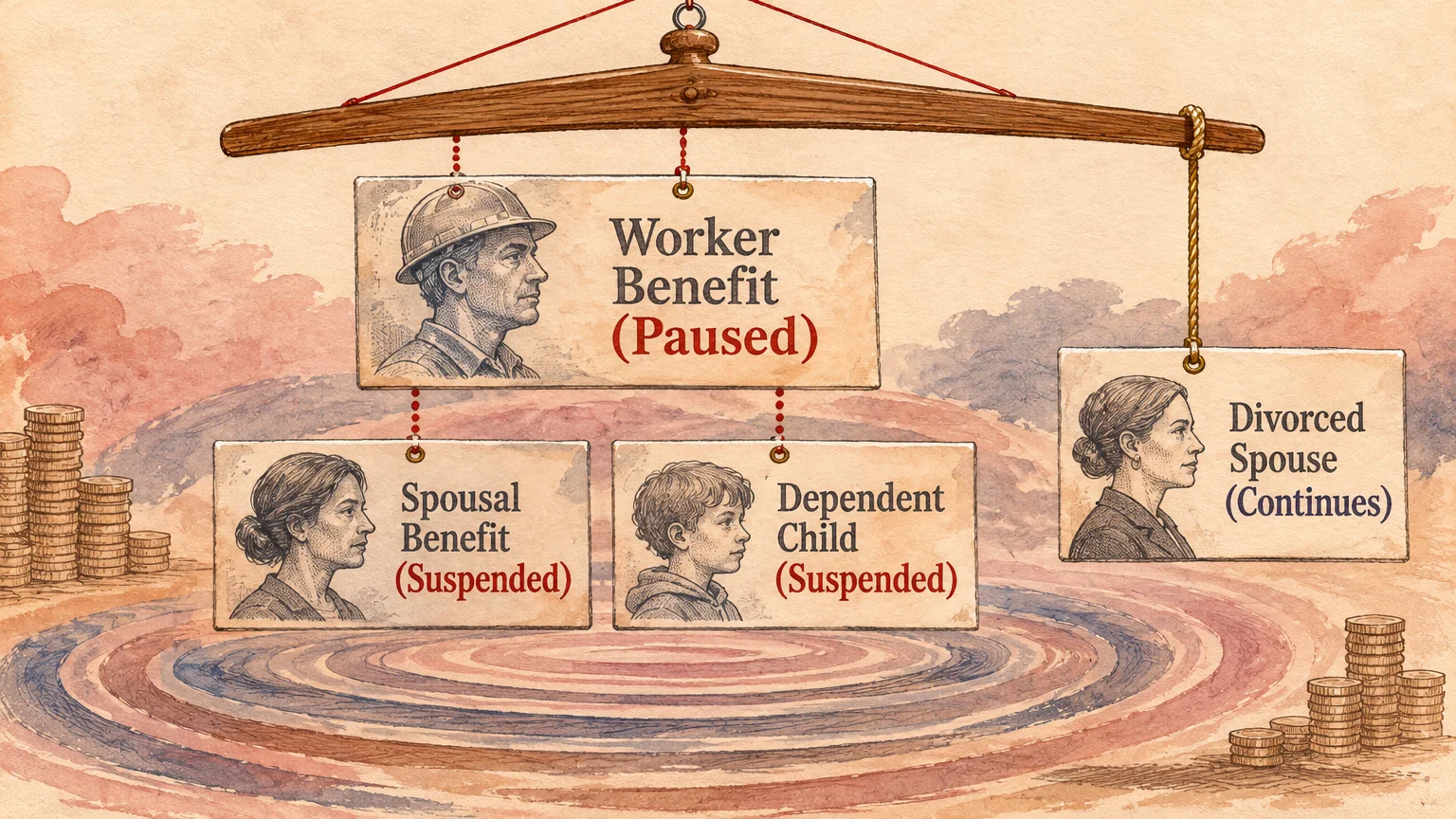
How Pausing Benefits Affects Your Spouse, Family, and SSI
Before suspending your Social Security check, look closely at everyone else who relies on your work record. Under the Bipartisan Budget Act of 2015, rules changed dramatically for suspension requests submitted on or after April 30, 2016.
According to SSA, if you voluntarily suspend your retirement benefit, anyone else collecting benefits on your record stops receiving payments during your suspension. That includes a current spouse receiving spousal benefits and any eligible dependent children.
The rule cuts both ways if you collect benefits based on someone else’s earnings. If you suspend your own retirement benefit, any spousal or survivor benefits you receive on another person’s record are suspended as well.
There is one notable exception to the family freeze rule. SSA confirms that an ex-spouse receiving divorced-spouse benefits on your work record continues receiving payments even while your own check is paused.
Married couples should also distinguish between spousal benefits paid during life and survivor benefits paid after death. Delayed retirement credits you earn while your check is paused do not raise the spousal benefit your partner receives while you are alive.
However, SSA rules allow those delayed retirement credits to increase the survivor benefit your spouse can collect after you pass away. For a higher-earning spouse, pausing benefits can serve as an effective form of inflation-adjusted life insurance for a surviving partner.
Finally, check whether you receive Supplemental Security Income (SSI) alongside your retirement check. SSA states that voluntarily suspending your Social Security retirement benefits makes you ineligible for SSI payments for the entire suspension period.
Managing Medicare Premiums While Benefits Are Paused
Many retirees worry that pausing Social Security will interrupt their health insurance. Fortunately, suspending your retirement check does not cancel your Medicare coverage.
What changes is how you pay your monthly Medicare Part B premium. Because you are no longer receiving a monthly Social Security deposit, SSA can no longer deduct Part B premiums automatically from your check.
Know the exact dollar figures before your deductions stop so you can budget accurately. The standard monthly Medicare Part B premium is $202.90 in 2026, paired with a $283 annual deductible.
On November 17, 2026, the Centers for Medicare & Medicaid Services (CMS) announced that the standard Part B premium will increase by $6.50—or 3.2%—to $209.40 per month in 2027. The Part B annual deductible will rise to $292 in 2027.
Higher-income retirees face additional surcharges known as the Income-Related Monthly Adjustment Amount (IRMAA). For 2027, enrollees whose 2025 modified adjusted gross income exceeded $112,000 as a single filer—or $224,000 filing jointly—will pay total Part B premiums ranging from $293.10 to $711.80 per month.
When deductions stop, Medicare switches you to direct billing, typically sending a quarterly bill via Form CMS-500 for Part B. Paying one lump bill every three months requires discipline because unpaid balances trigger delinquency notices and can eventually terminate your Part B coverage.
To avoid missing a paper bill, consider enrolling in Medicare Easy Pay through Medicare.gov or by submitting Form SF-5510. This free CMS service automatically drafts your Part B premiums from your checking or savings account around the 20th of each month.
Plan ahead when setting up automatic payments. CMS notes that Medicare Easy Pay takes 6 to 8 weeks to activate, meaning you may still need to pay your first direct bill manually while the electronic draft kicks in.

Working After Claiming: When Suspending Makes Sense
Returning to the workforce is one of the most common reasons retirees pause Social Security. Maybe consulting work picked up, or a former employer offered a flexible role with strong pay.
Before you reach full retirement age, working while collecting Social Security triggers the Retirement Earnings Test. In 2026, SSA deducts $1 in benefits for every $2 you earn above $24,480—a threshold that rises to $25,560 in 2027.
During the calendar year you reach full retirement age, a higher limit applies in the months prior to your FRA birthday month. SSA deducts $1 for every $3 earned above $65,160 in 2026, increasing to $67,920 in 2027.
Once you reach your full retirement age month, the Retirement Earnings Test disappears completely. You can earn any salary without losing a penny of Social Security—yet working past FRA still creates a compelling reason to pause your checks.
If your new paycheck covers your daily living expenses, you may not need your Social Security deposit at all. Suspending benefits lets you avoid pushing extra taxable income onto your return while earning an 8.0% annual return on your future check.
A new job is not the only reason to consider a voluntary suspension. You might also pause checks if you receive an inheritance, sell a business, or realize your retirement portfolio can comfortably bridge a few years.
Pausing Social Security works best when your current cash flow covers daily needs and you expect either a long retirement or a surviving spouse who will rely on your higher benefit.
Compare that guaranteed 8.0% annual increase—backed by future inflation adjustments—against what you earn on safe cash or bonds. For retirees in good health, trading two or three years of checks for permanently higher lifetime income often pays off over time.
Step-by-Step: How to Suspend and Restart Your Benefits
Requesting a voluntary suspension is straightforward and requires no complicated paperwork. Follow these six steps to keep your benefits, taxes, and healthcare billing running smoothly:
- Verify your full retirement age and claim history: Log into your personal account at SSA.gov to confirm your exact FRA month and ensure you are eligible to pause.
- Check household benefit impacts: Confirm whether a spouse, child, or SSI payment is tied to your record so nobody loses needed monthly income unexpectedly.
- Prepare for direct Medicare billing: Budget for quarterly Form CMS-500 bills or enroll in Medicare Easy Pay 6 to 8 weeks before your suspension starts.
- Submit your suspension request to SSA: No special form is required; request suspension orally or in writing by calling 800-772-1213, mailing a letter, or visiting a local Social Security office.
- Plan around the one-month payment lag: Remember that your request takes effect the following month, and your final check for the month prior arrives one month later.
- Monitor your restart date: Contact SSA the month before you want payments to resume, or let SSA automatically restart your higher check in the month you turn 70.
Keep copies of every confirmation letter SSA mails to your home. Written records make it simple to verify your suspension start month and track the delayed retirement credits added when your checks resume.
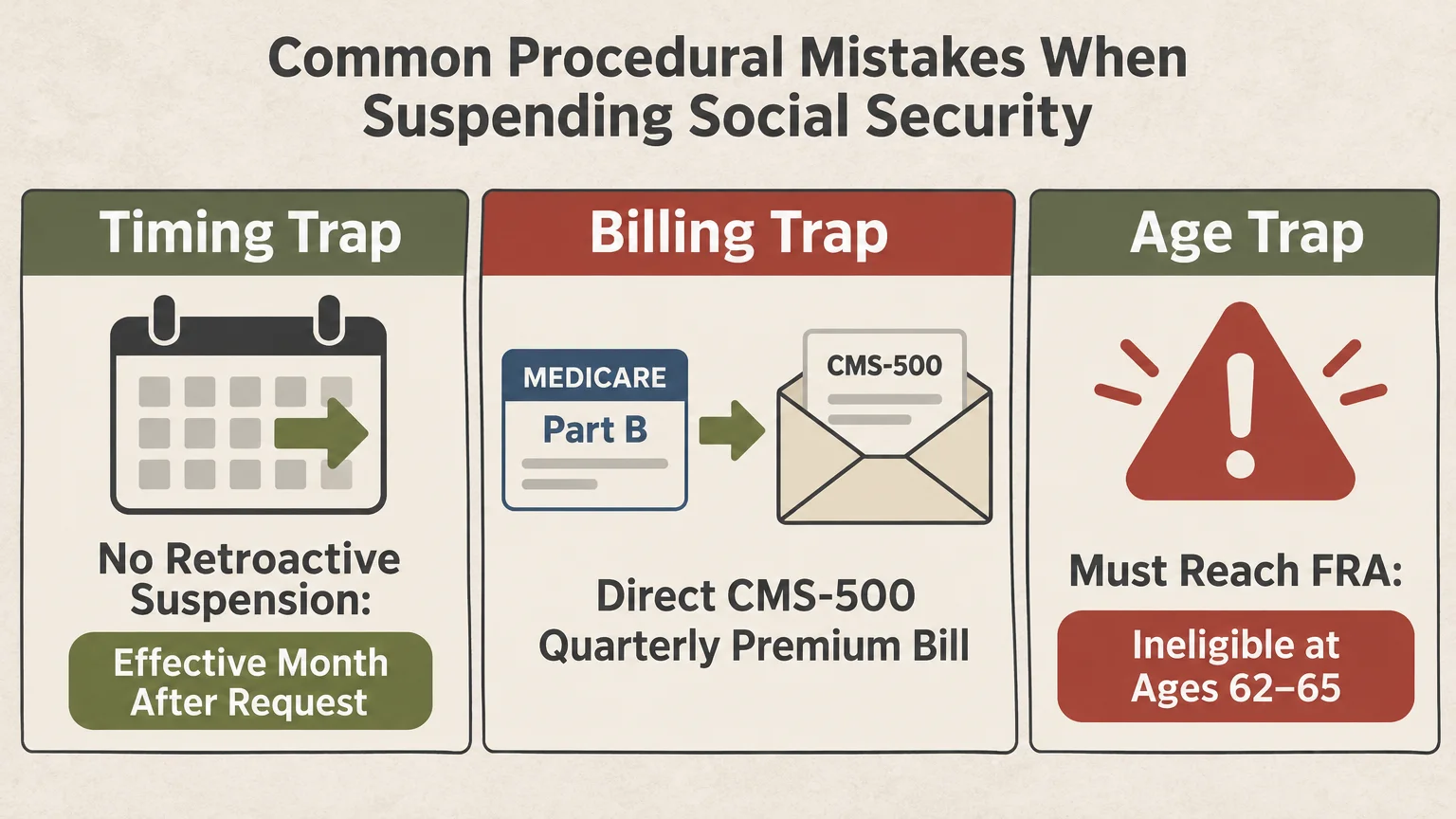
Avoiding Common Errors
Even savvy retirees trip over the fine print when pausing Social Security. Watch out for these four costly mistakes before making your request:
Assuming suspension erases early-claiming cuts. If you claimed at 62 and suspend at 67, your check will not jump to 124% of your unreduced benefit. Your 8.0% annual credits only grow the reduced benefit amount you locked in when you first filed.
Ignoring quarterly Medicare bills. Once Social Security stops paying you, Part B deductions vanish automatically. Missing Form CMS-500 bills can put your medical coverage at risk of termination just when you rely on it most.
Overlooking a spouse’s check. Because suspension freezes spousal and dependent benefits tied to your record, pausing your payment can cut household income more sharply than expected. Always calculate total household cash flow, not just your own check.
Expecting a retroactive lump sum. Under rules enacted through the Bipartisan Budget Act of 2015, you cannot change your mind after two years of suspension and demand back pay for the paused months. Once suspended, those foregone checks convert strictly into higher future monthly payments.
When DIY Isn’t Enough
Basic suspension math is simple, yet household finances rarely exist in a vacuum. Consider consulting a fee-only fiduciary planner—such as a professional listed through the Certified Financial Planner Board—or a qualified tax advisor in these four situations:
Married couples with wide age or earnings gaps. Coordinating when a higher earner pauses benefits, how spousal checks freeze, and how survivor income grows requires multi-year modeling across both life expectancies.
Retirees near Medicare IRMAA income cliffs. Deciding whether to replace paused Social Security checks with traditional IRA withdrawals can push your modified adjusted gross income above $112,000 single or $224,000 joint, triggering steep 2027 Part B surcharges.
Recent claimers weighing a Form SSA-521 withdrawal. Repaying a full year of gross benefits—including withheld taxes—often involves amending tax returns and gathering written family consent, where professional tax guidance prevents expensive mistakes.
Households supporting dependents or SSI recipients. If a disabled adult child, minor dependent, or SSI beneficiary depends on benefits linked to your record, an advisor specializing in public benefits can help you avoid unintended eligibility losses.
Frequently Asked Questions
Can I pause Social Security before my full retirement age?
No, you cannot use voluntary suspension until you reach your full retirement age. If you claimed within the past 12 months, your only option to pause and restart later is filing Form SSA-521 to withdraw your application and repay all benefits received.
Do I have to pay back the Social Security checks I already received?
No, voluntary suspension requires zero repayment of prior checks. You keep everything you already collected, and your benefit simply pauses starting the month after your request so delayed retirement credits can accumulate until age 70.
Can I collect a lump sum for the months my benefits were suspended?
No, SSA rules prohibit retroactive lump-sum payouts for voluntarily suspended months. If you restart benefits before age 70, you receive your updated monthly check going forward, with any current-year delayed retirement credits added the following January.
What happens to my Medicare coverage if I suspend Social Security?
Your Medicare coverage stays fully active without interruption. However, because Part B premiums can no longer come out of your monthly benefit, Medicare will bill you quarterly via Form CMS-500 unless you enroll in monthly Medicare Easy Pay.
Your Next Steps
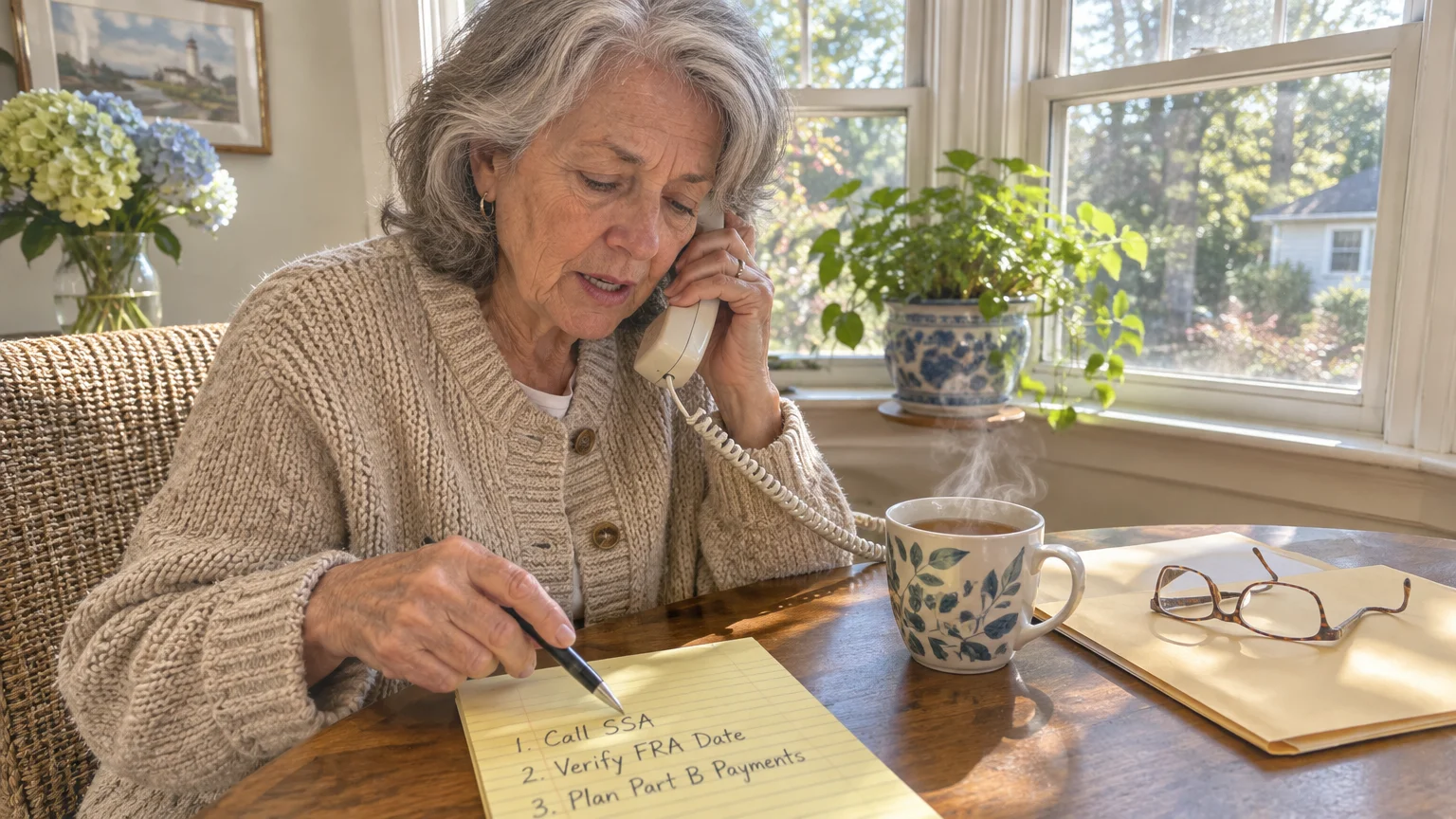
If you have reached full retirement age and no longer need your monthly check right away, voluntary suspension offers a rare chance to lock in an 8.0% annual benefit boost. Review your household budget, check how your spouse’s benefits could be affected, and line up direct Medicare payments before calling SSA.
This is educational content based on general retirement planning principles. Individual results vary based on your situation.
Always verify current benefit amounts, tax laws, and eligibility with official sources.
Last updated: November 2026. Retirement benefits, tax laws, and healthcare costs change frequently—verify current details with official sources.