
Talk about a Trump-backed Social Security bill can feel confusing because three separate laws and plans share the spotlight. You need to know which rules already passed and which proposals are still ideas.
One new law updates how the Social Security Administration names your claiming ages. Another law gives seniors a temporary tax break, while a third plan proposes borrowing money to boost trust funds.
Understanding these social security changes helps you protect your monthly check. You will also see how new 2027 benefit rates affect your take-home pay.

At a Glance: Three Developments Shaping Your Benefits
Recent benefits news covers both signed laws and early ideas in Congress. Knowing the difference keeps your retirement plan grounded in facts.
- The Claiming Age Clarity Act became law in November 2026 and replaces confusing agency labels with plain terms.
- The One Big Beautiful Bill Act became law in July 2025 and created a temporary tax deduction for people age 65 and older.
- Senator Bill Cassidy proposed a Sovereign Debt Fund to invest borrowed cash, though lawmakers have not passed it yet.
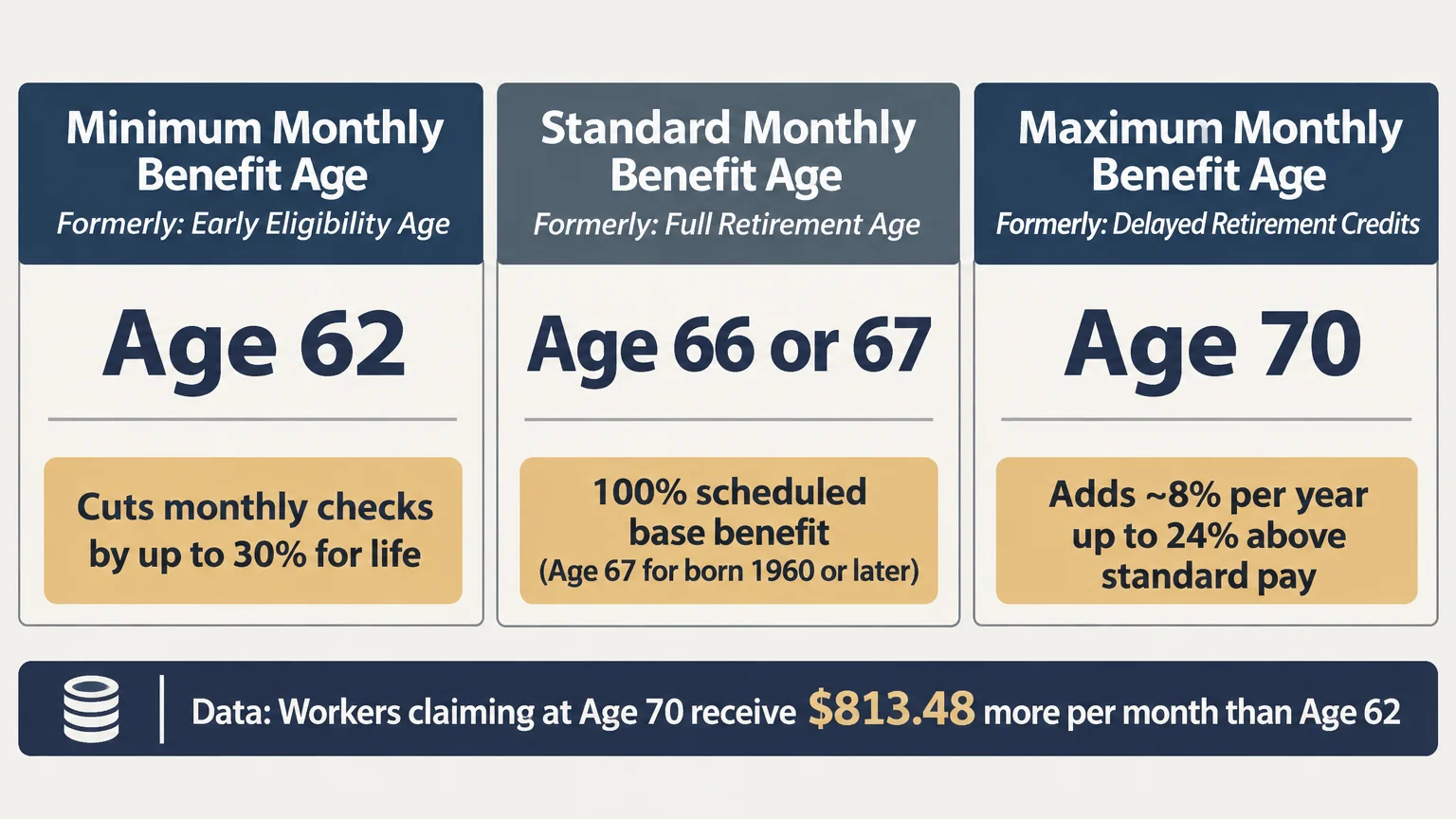
The Claiming Age Clarity Act Updates Official Terms
President Donald Trump signed the Claiming Age Clarity Act into law on November 20, 2026. Both parties backed the bill along with groups like AARP.
This social security legislation does not alter your payment formula or change when you can claim. Instead, it orders the Social Security Administration to use clearer names in guides and online tools.
The agency has until November 20, 2027, to update its public materials. Clearer labels help you avoid locking in a smaller check by mistake.
In 2025, roughly 53% of new retirement awards had lower payments because people claimed early. Data from June 2026 showed workers age 70 received $813.48 more each month than recipients age 62.
| Old Agency Term | New Plain-Language Term | Age and Payment Impact |
|---|---|---|
| Early Eligibility Age | Minimum Monthly Benefit Age | Age 62. Claiming early cuts monthly checks by up to 30% for life. |
| Full or Normal Retirement Age | Standard Monthly Benefit Age | Age 66 or 67 by birth year. Age 67 applies if you were born in 1960 or later. |
| Delayed Retirement Credits | Maximum Monthly Benefit Age | Age 70. Waiting adds about 8% per year up to 24% above standard pay. |
Wait until your Standard Monthly Benefit Age if you want your full scheduled check. Waiting past age 67 adds roughly 8% each year up to age 70.
Delayed credits stop growing once you reach your Maximum Monthly Benefit Age. Knowing those terms helps you time your application with a clear view of your monthly income.

How the 2025 Senior Tax Law Affects Your Return
Many retirees heard that a Trump-backed bill ended federal taxes on Social Security income. That claim is false, so check your tax math before filing.
Signed on July 4, 2025, the One Big Beautiful Bill Act kept existing benefit tax rules in place. Up to 85% of your benefits remain taxable if your combined income tops $34,000 single or $44,000 joint.
Instead of repealing benefit taxes, the law created a $6,000 senior deduction on Schedule 1-A for tax years 2025 through 2028. Married couples filing jointly can claim $12,000 if both spouses are at least 65.
You can claim this extra break on your IRS return whether you itemize or take the standard deduction. It sits on top of the regular standard deduction for people age 65 and older.
The deduction shrinks by 6% for every dollar of modified adjusted gross income over $75,000 single or $150,000 joint. It disappears completely at $175,000 single or $250,000 joint, and married-filing-separately filers cannot use it.
Lower income taxes mean less tax money flows back into Social Security trust funds. Estimates from the Social Security Chief Actuary show this break adds $168.6 billion in trust fund costs from 2025 through 2034.

The Proposed Investment Fund and Trust Fund Solvency
After the 2026 midterm elections, Senator Bill Cassidy said President Trump supports creating a separate Sovereign Debt Fund. The White House has not issued formal confirmation, and passage odds in late 2026 look low.
Under this plan, the federal government would borrow $1.5 trillion over five years to invest in stocks and other assets. Social Security would borrow to pay scheduled benefits until market gains repay the debt over 60 to 75 years.
Senator Cassidy says the fund could close up to 70% of the long-term shortfall without raising payroll taxes or cutting checks. Independent budget groups warn the real outcome looks much riskier.
The Committee for a Responsible Federal Budget tested the plan using Center for Retirement Research at Boston College models. Their review found the fund covers under half the gap with high returns and under one-tenth with low returns.
Only about 30% of tested market paths earned enough to pay back the loans. This debate matters because the 2026 Trustees Report shows the retirement trust fund running dry in late 2032.
Without new laws for social security reform 2027 and beyond, payroll taxes would cover only 78% of scheduled checks after depletion. The Congressional Budget Office sees a similar mid-2032 date with a 26% initial cut.

Your 2027 Social Security and Medicare Numbers
While Congress debates future fixes, new rates for 2027 are already set. Beneficiaries will receive a 3.6% cost-of-living increase starting in January 2027.
Supplemental Security Income recipients see their higher payments slightly earlier on December 31, 2026. Your net check also depends on updated Medicare premiums announced in November 2026.
The standard Medicare Part B premium rises $6.50 to $209.40 per month in 2027. Most retirees see Medicare deduct that fee straight from their monthly Social Security check.
| 2027 Benefit or Limit | 2026 Figure | 2027 Figure |
|---|---|---|
| Average retired worker check | $2,095 per month | $2,170 per month |
| Average aged couple check | $3,238 per month | $3,355 per month |
| Max check at age 62 | $2,969 per month | $3,094 per month |
| Max check at age 67 | $4,152 per month | $4,188 per month |
| Max check at age 70 | $5,181 per month | $5,358 per month |
| Taxable wage base cap | $184,500 per year | $192,300 per year |
| Earnings limit before full age | $24,480 per year | $25,560 per year |
| Medicare Part B premium | $202.90 per month | $209.40 per month |
If you keep working before your standard age, Social Security withholds $1 for every $2 earned over $25,560. In the year you reach full age, the limit jumps to $67,920 before your birthday month.
Once you reach your standard age, no earnings limit applies at all. You can also expect a higher Medicare Part B deductible of $292 and a Part A hospital deductible of $1,776.
Higher earners will pay payroll taxes on up to $192,300 in 2027 wages, up from $184,500 in 2026. Workers earning credits need $1,970 per quarter of coverage in 2027.

Avoiding Common Errors With Recent Benefits News
Fast-moving news about a trump social security bill often leads to costly tax and claiming mistakes. Watch out for these four common traps as you plan for 2027.
- Assuming your benefits are tax-free: Social Security checks remain taxable under federal rules if your combined income crosses $34,000 single or $44,000 joint.
- Claiming at the minimum age by default: Taking benefits at age 62 locks in up to a 30% cut, even though the new label sounds official.
- Forgetting Schedule 1-A at tax time: You must include the new form to claim the $6,000 senior deduction if you are 65 or older.
- Spending the whole 3.6% raise in your budget: Subtract the $6.50 Part B premium hike before counting your extra monthly cash.
Checking official portals like USA.gov Benefits alongside your personal Social Security record helps you verify rules before filing.
Frequently Asked Questions
Did a Trump-backed bill eliminate taxes on Social Security benefits?
No, the One Big Beautiful Bill Act left existing benefit tax rules unchanged. Instead, it added a temporary $6,000 deduction per person age 65 or older through 2028.
Does the Claiming Age Clarity Act change when I can retire?
No, you can still claim retirement benefits starting at age 62 or wait until age 70. The law only updates confusing terms in official Social Security guides by November 2027.
Will my Social Security check be cut in 2027?
Social Security has no cuts scheduled for 2027, and payments actually rise by 3.6% in January. Trust fund shortfalls are not projected to trigger automatic cuts until 2032 unless Congress acts sooner.
How does Senator Cassidy’s proposed fund affect current trust funds?
The proposal creates a separate investment fund rather than putting stock investments inside existing Social Security trust funds. Borrowed money would invest over decades, though lawmakers have not passed this bill.
Start by checking your 2027 benefit notice and estimating how the $6,000 senior deduction affects your next tax return. If you have not claimed yet, compare your age 62, age 67, and age 70 estimates before picking a start date.
This article provides general retirement education and information only. Everyone’s financial situation is unique—what works for others may not work for you. For personalized advice, consider consulting a qualified financial professional such as a CFP or CPA.
Last updated: November 2026. Retirement benefits, tax laws, and healthcare costs change frequently—verify current details with official sources.