
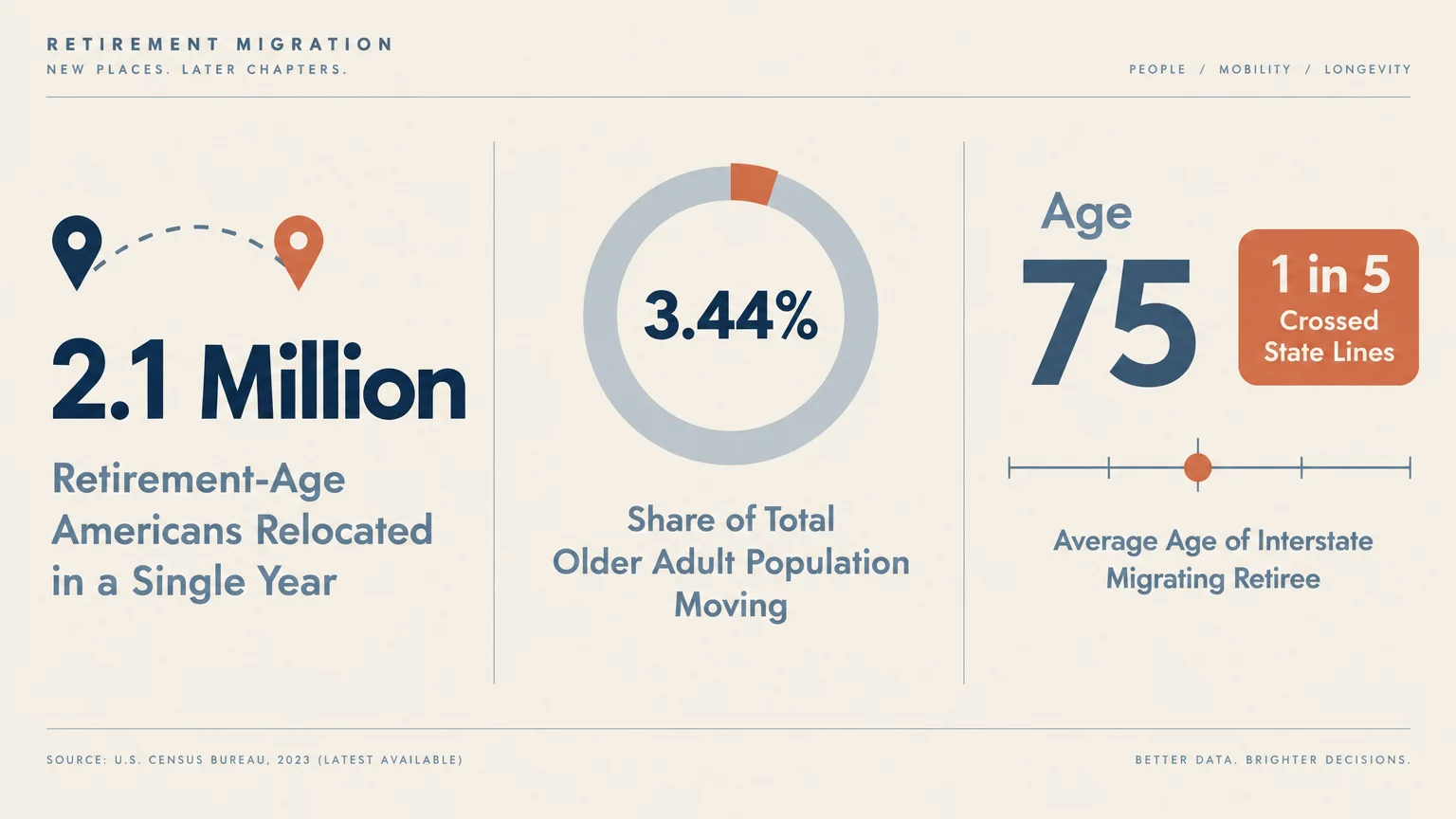
Over 2.1 million older adults moved across the country recently to stretch their fixed incomes and find better weather. Choosing the right state can save you tens of thousands of dollars in taxes and housing expenses.
Modern retirement migration data shows a dramatic shift toward tax-friendly regions in the Sun Belt and Mountain West. Knowing where your peers are heading helps you uncover hidden affordability hotspots.
Discover the top 11 states seeing the most retirees move in, along with the critical cost and lifestyle factors you must weigh before relocating.
The Shifting Landscape of Retiree Migration
Retirement relocation trends have evolved rapidly over the past few years. Rising property insurance rates, inflated housing prices, and changing state tax codes have altered the map.
Data from the U.S. Census Bureau indicates that nearly one million Americans aged 60 and older cross state lines each year. Many seek lower overall living costs to preserve their retirement savings.
A recent relocation study by HireAHelper analyzed 14.9 million moves and found that 2.1 million retirement-age Americans relocated in a single year. That represents roughly 3.44% of the older adult population.
Nearly one in five of those relocating seniors crossed state borders. The average age of an interstate relocating retiree was 75.
While warm weather remains a primary motivator, financial security now dictates the final destination. Retirees actively calculate state income taxes, local sales taxes, and annual property assessments before packing.
Health considerations also play a leading role. Proximity to premier medical centers and specialist networks heavily influences long-term satisfaction in your new hometown.

11 Most Popular States for Retirees
Demographic analyses from the U.S. Census Bureau American Community Survey reveal clear patterns in where older adults settle. Below are the 11 states gaining the highest net number of retirees aged 60 and older.
1. Florida
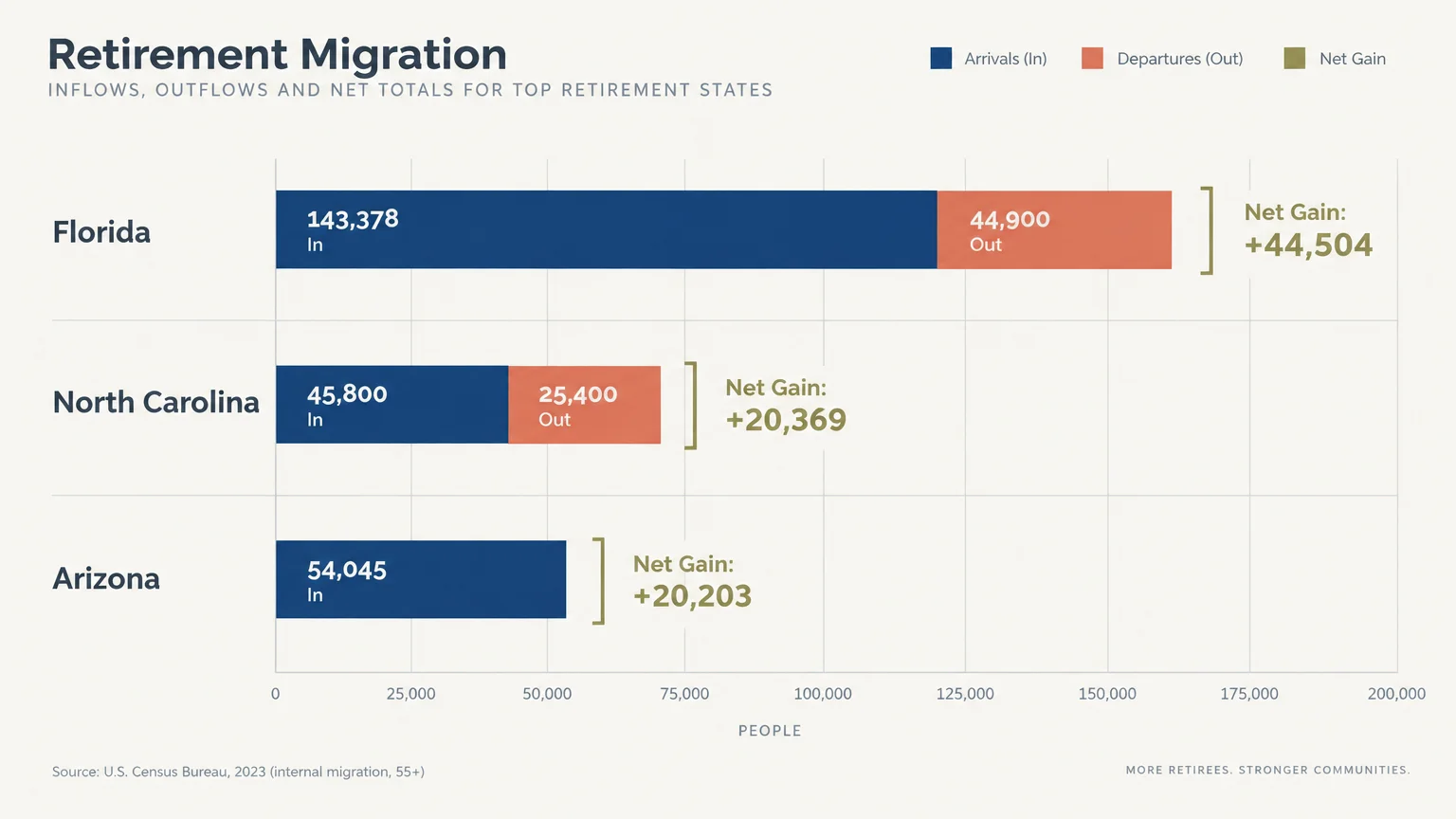
Florida continues to welcome a staggering volume of older Americans every year. Census data shows 143,378 retirees aged 60 and older moved in, producing a net gain of 44,504 new residents.
The state levies no personal income tax, protecting your private pensions, 401(k) withdrawals, and investment distributions. Year-round sunshine and established active-adult communities provide unbeatable social infrastructure.
However, relocating to the Sunshine State requires careful budgeting. Recent data highlights that Florida also saw nearly 44,900 older residents depart in a single year.
Soaring homeowners insurance premiums and rising real estate taxes have reduced net gains among older age brackets. If you choose Florida, shop for insurance coverage before signing a purchase contract.
2. North Carolina
North Carolina ranks second nationally, posting a net gain of 20,369 older migrants. Over 45,800 retirees moved into the Tar Heel State, while roughly 25,400 moved out.
The state delivers geographic diversity, offering scenic retreats in the Blue Ridge Mountains and peaceful coastal villages along the Atlantic shore. Mild winters provide a welcome respite from harsh northern temperatures.
North Carolina maintains a flat individual income tax rate that continues to decrease under scheduled state legislation. Furthermore, the state does not tax your Social Security benefits.
Retirees also enjoy world-class healthcare access. The Research Triangle hosts leading academic hospitals, including Duke University and UNC Health, ensuring advanced specialized care.
3. Arizona
Arizona gained 20,203 net retirees as 54,045 older Americans relocated to the Grand Canyon State. Warm desert air and dry heat continue to attract those managing arthritis and respiratory conditions.
Mesa, Arizona, stands out as one of the fastest-growing retirement cities in the country. Tucson also drew 7,627 inbound retirees aged 65 and older in recent moving surveys.
Arizona instituted a flat income tax rate of 2.5%, making state tax planning predictable and manageable. The state exempts Social Security benefits entirely from state income taxes.
Be prepared for intense summer heat and higher water utility bills in desert areas. Exploring neighborhoods during July or August gives you an honest preview of the warmest months.
4. South Carolina
South Carolina attracted 34,738 inbound older residents, generating a net migration gain of 14,676 retirees. The state is quickly rivaling Florida as the premier retirement destination on the East Coast.
In fact, recent moving benchmarks ranked South Carolina as the number one destination for net gains among Americans aged 65 and older. U-Haul migration reports similarly positioned the state at the top for Baby Boomer moves.
South Carolina appeals to fixed-income budgets by maintaining some of the lowest effective property tax rates in the nation. The state also offers generous income tax exclusions on qualified retirement revenue.
Charming coastal cities like Charleston, Beaufort, and Myrtle Beach offer rich history and walkable neighborhoods. Golf courses and recreational waterways provide endless opportunities for outdoor physical fitness.
5. Georgia
Georgia welcomed 37,145 inbound seniors, securing a net increase of 13,789 older residents. The Peach State balances southern hospitality with exceptional financial incentives for retirees.
For individuals aged 65 and older, Georgia provides a retirement income exclusion of up to $65,000 per person. Married couples filing jointly can exclude up to $130,000 of retirement income from state taxation.
Social Security benefits remain completely exempt at the state level. Housing costs outside the immediate Atlanta metropolitan area stay comfortably below the national average.
Communities such as Savannah, Athens, and Augusta blend historic culture with robust local healthcare systems. Humid summer months present the main lifestyle adjustment for newcomers from colder climates.
6. Texas
Texas gained 10,050 net older adults, recording an impressive 60,245 gross inbound moves. The Lone Star State offers a booming economy and extensive cultural amenities.
Recent studies focusing on retirees aged 65 and older found Texas gained over 5,100 net seniors in a single year. Many move to stay close to adult children and growing grandchildren who relocated for work.
Texas does not levy an individual state income tax, shielding all retirement accounts and pension payments. Metropolitan centers like Houston and Dallas house some of the world’s most renowned medical complexes.
You must balance the income tax savings against property taxes, however. Texas maintains some of the highest local real estate tax rates in the United States.
7. Nevada
Nevada achieved a net gain of 5,782 retirees, driven by 22,036 inbound older adults. Low humidity, dramatic mountain vistas, and extensive entertainment options make it a natural magnet for active retirees.
Las Vegas emerged as the single most popular urban destination in the nation for gross inbound moves among adults aged 65 and older. The city recorded 7,854 inbound senior relocations in recent moving data.
Like Florida and Texas, Nevada charges zero state personal income tax. The state does not tax your retirement pensions, investment portfolios, or Social Security earnings.
Healthcare infrastructure remains strained in certain rural sectors of the state. Make sure you confirm local physician availability and hospital network affiliations before finalizing your relocation.
8. Idaho
Idaho recorded 13,665 inbound seniors, producing a net influx of 5,182 older residents. The state has grown rapidly among retirees seeking low crime rates and spectacular mountain landscapes.
Medicare enrollment figures reveal that Idaho experienced a 5.6% growth rate in older adults over recent years. Outdoor enthusiasts appreciate easy access to world-class fly fishing, hiking, and camping.
Idaho exempts Social Security benefits from state income taxation, allowing you to maximize your federal benefit check. The state also maintains a homeowner property tax exemption that reduces taxable home value for primary residences.
Rapid population growth has driven home prices upward in popular hubs like Boise, Meridian, and Coeur d’Alene. You should expect genuine four-season weather with freezing temperatures and measurable winter snow.
9. Oklahoma
Oklahoma welcomed 13,021 inbound retirees, finishing with a net gain of 4,940 older adults. Exceptional real estate affordability serves as the state’s most compelling draw for budget-conscious seniors.
Median home prices in Oklahoma remain significantly lower than the national benchmark. If you sell a high-equity home in the Northeast or West Coast, you can easily purchase a comfortable home here with cash.
The state fully exempts Social Security benefits from state income tax obligations. Oklahoma also allows a retirement income deduction of up to $10,000 per person for qualifying pension distributions.
Severe weather represents a practical reality in the region. Purchasing a property with a certified storm shelter or reinforced basement offers essential peace of mind during spring storm seasons.
10. Delaware
Delaware posted a net gain of 4,519 retirees as 8,718 seniors relocated to the First State. It stands as the only northeastern state consistently ranking near the top of national retiree migration lists.
An analysis of Medicare enrollment records showed Delaware recorded the fastest percentage growth in older adults nationwide at 8.8%. Proximity to Philadelphia, Baltimore, and Washington, D.C., allows retirees to stay near lifelong family connections.
Delaware charges no state sales tax, lowering your day-to-day retail and grocery expenses. Property taxes also remain exceptionally low compared to neighboring New Jersey, Pennsylvania, and Maryland.
Coastal enclaves such as Lewes and Rehoboth Beach provide vibrant beachside boardwalks and year-round community events. Winter temperatures stay relatively mild due to the moderating influence of the Atlantic Ocean and Delaware Bay.
11. Missouri
Missouri gained 4,350 net older residents, recording 17,873 inbound arrivals. The state combines midwestern affordability with picturesque recreational destinations like the Ozark Mountains.
The state took major steps to improve its financial appeal for older adults. Starting in the 2024 tax year, Missouri completely eliminated state income taxes on Social Security benefits for all residents.
Housing values in Missouri offer substantial purchasing power compared to coastal housing markets. Communities like Springfield and Columbia provide college-town vibrancy alongside robust regional healthcare networks.
You will experience four distinct seasons, featuring warm summers and occasional winter snowstorms. Missouri’s central location makes domestic travel simple when visiting family spread across the country.
State-by-State Retirement Cost and Migration Comparison
Evaluating potential destinations side by side helps you prioritize the factors that matter most to your lifestyle. The table below outlines migration numbers and key financial policies across all 11 states.
| State | Net Inbound (60+) | State Income Tax | Taxes Social Security? | Primary Cost Advantage |
|---|---|---|---|---|
| Florida | +44,504 | None | No | Zero state income tax and extensive senior housing |
| North Carolina | +20,369 | Flat Rate | No | Moderate home prices and lower living costs |
| Arizona | +20,203 | Flat 2.5% | No | Predictable low flat tax and modest property taxes |
| South Carolina | +14,676 | Graduated | No | Extremely low property taxes and coastal living |
| Georgia | +13,789 | Graduated | No | Generous senior retirement exclusions (up to $65k) |
| Texas | +10,050 | None | No | No income tax and top-tier medical centers |
| Nevada | +5,782 | None | No | No income tax and dry desert climate |
| Idaho | +5,182 | Flat Rate | No | Low property taxes and outdoor recreational access |
| Oklahoma | +4,940 | Graduated | No | Remarkably low housing costs and low cost of living |
| Delaware | +4,519 | Graduated | No | Zero state sales tax and low property taxes |
| Missouri | +4,350 | Graduated | No | Social Security exempt and affordable real estate |

Key Tax Advantages Driving Retiree Migration
Taxes can consume a major portion of your fixed monthly income if you settle in an aggressive tax jurisdiction. Moving to a tax-advantaged state creates immediate room in your household budget.
“State taxes can take a massive bite out of your retirement accounts if you do not plan your location strategically.” — Ed Slott, CPA and Retirement Specialist
One major consideration is how states treat your monthly benefit check from the Social Security Administration. Only eight states continue to tax Social Security benefits in 2026: Colorado, Connecticut, Minnesota, Montana, New Mexico, Rhode Island, Utah, and Vermont.
Every single state on our top 11 list exempts your Social Security income entirely. Eliminating state taxes on this reliable monthly payment shields thousands of dollars every year.
Furthermore, federal tax legislation provides a substantial $6,000 additional deduction for qualifying seniors aged 65 and older. According to recent federal projections, this temporary deduction reduces the portion of seniors paying federal taxes on benefits to just 12%.
Nine states operate without a broad-based personal income tax. Florida, Nevada, Tennessee, and Texas provide immediate relief if you draw large distributions from traditional retirement savings accounts.
Be sure to review recent policy updates published directly by the Internal Revenue Service when calculating expected annual liabilities. State-level tax shifts can change the optimal withdrawal strategy for your portfolio.

Pitfalls to Watch For Before Relocating
Relocating during retirement involves much more than calculating state income tax savings. Overlooking ancillary expenses can erode your financial cushion quickly.
“Never relocate solely for tax savings without running the numbers on your full cost of living.” — Suze Orman, Personal Finance Author
Consider these common financial and lifestyle traps before purchasing a new home in another state:
- Property Tax Reassessments: States without income taxes often rely heavily on real estate taxes. A home with affordable historical taxes may receive an abrupt upward assessment right after you purchase it.
- Homeowners Insurance Volatility: Coastal regions face severe property insurance rate spikes. Always secure real homeowner insurance quotes on specific properties before waiving your purchase contingencies.
- Healthcare Network Gaps: Rural or rapidly expanding suburban communities often face acute physician shortages. Verify that local clinics accept your current Medicare plan and have open patient availability.
- Sales and Local Excise Taxes: Several states offset modest income taxes with high combined state and county sales taxes. Daily consumer expenses can silently cancel out your annual tax savings.
- Isolation from Family: Moving away from children and longtime friends can trigger emotional fatigue and costly travel expenses. Ensure your budget accounts for frequent return trips to see loved ones.
Renting for six months in your prospective new town offers a low-risk trial run. You can experience the regional seasons, evaluate traffic patterns, and build social connections before committing permanently.

Getting Expert Help
Relocating across state lines involves intricate legal and financial maneuvers. Engaging professional guidance prevents expensive oversights and helps you settle with peace of mind.
Consulting a Certified Financial Planner (CFP) allows you to model comprehensive cash flow projections across different state tax environments. A planner ensures your withdrawal rates comfortably support your new geographic lifestyle.
You should also work with a licensed CPA to establish legitimate state domicile. High-tax states frequently audit former residents to ensure they have cut sufficient financial and residential ties.
Additionally, meet with an elder law attorney to update your estate documents. Wills, healthcare proxies, and power-of-attorney forms often require specific legal language tailored to your new state of residence.
Advocacy groups like AARP provide valuable state-by-state transition checklists and consumer protection guidance. Leveraging these educational tools keeps you organized throughout the moving process.
Frequently Asked Questions
Which state gained the highest number of retirees overall?
Florida gained the highest total number of inbound retirees aged 60 and older, welcoming over 143,000 movers. However, South Carolina recently surpassed Florida in net gains among seniors aged 65 and older.
Do any of the top 11 destination states tax Social Security benefits?
None of the top 11 states tax Social Security benefits. Missouri eliminated its tax starting in 2024, leaving only eight states nationwide that tax Social Security in 2026.
Is it cheaper to rent or buy when relocating for retirement?
Renting for your first 6 to 12 months is often the most cost-effective decision. It protects you from rapid property value fluctuations and gives you time to evaluate local neighborhoods.
How do no-income-tax states fund public services?
States without individual income taxes generate revenue through alternative mechanisms. They typically rely on higher sales taxes, lodging fees, fuel taxes, and elevated property tax assessments.
Research your target state thoroughly, compare all carrying costs, and take your time making this important transition. Moving to the right location can enrich your retirement years while preserving your hard-earned wealth.
This article provides general retirement education and information only. Everyone’s financial situation is unique—what works for others may not work for you. For personalized advice, consider consulting a qualified financial professional such as a CFP or CPA.
Last updated: October 2026. Retirement benefits, tax laws, and healthcare costs change frequently—verify current details with official sources.