
There’s never too much information when it comes to taxes in retirement. All the complex rules and regulations require doing some research before actually retiring. 401(k) plans, IRAs, and other retirement plans include several tax traps that even the most experienced investors fail to notice.
It should come as no surprise that retirees aren’t always up to date on every aspect of the tax code, and this may lead to paying more taxes than is required.
For someone who approaches retirement, all the tax implications can be both overwhelming and confusing. There are so many questions out there like Will I pay fewer taxes in retirement? or Are Social Security benefits tax-free? and so on. And let’s not forget about the worry of overpaying the US government.
Don’t fret, though. We made a list of 7 questions that retirees frequently get wrong about taxes in retirement, and we have the right answer for each one of them. Take a look below to make sure you understand your own tax situation.

Taxes Rates in Retirement
Question: Once I retire, is my tax rate going to be higher or lower than it was when I was working?
Answer: It depends. Creating a plan for your golden years comes with the misconception that you’ll pay fewer taxes in retirement. However, this is not always the case, and we have three reasons for that.
- Retirees typically no longer have access to all the tax breaks they once received. There are no children to claim as dependents, nor are there any annual tax-deferred 401(k) contributions to lower-income. Also, their homes are paid off or close to it, so there is no mortgage interest deduction. Therefore, basically, all of your income in retirement will be taxable.
- As a retiree, you may want to have fun doing some things you couldn’t do while working. Well, fun activities like traveling or engaging in various hobbies don’t come cheap. So, the income you save for retirement may not be significantly lower than what you were earning during your working years.
- Tax rates in the future may be greater than they are now. If you looked at tax rates in US history, you’d be surprised to see how low they were back in the past. I mean, the highest tax rate of 37% is basically a bargain compared with the 94% of the 1940s. And, given the current political context and rising national debt, future tax rates (taxes in retirement included) could be far higher than they are now.
Taxation of Social Security Benefits
Question: Are Social Security benefits tax-free?
Answer: No, the Social Security benefits are taxable. Federal income taxes may apply to up to 85% of your Social Security benefits. The exact percentage depends on your provisional income. To calculate your provisional income, add half of your Social Security benefits and all of your tax-exempt interest to your modified adjusted gross income.
For married couples who file taxes jointly, here’s what some taxes in retirement would look like:
- Social Security benefits are tax-free if your provisional income is less than $32,000 ($25,000 for single filers).
- If your income is between $32,000 and $44,000 ($25,000 to $34,000 for single filers), you may be taxed on up to 50% of your Social Security benefits.
- If your income exceeds $44,000 ($34,000 for single filers), then you must pay tax on up to 85% of your Social Security benefits.
Here’s a handy tool that can help you to determine whether your Social Security benefits are taxable.
IRA Contributions
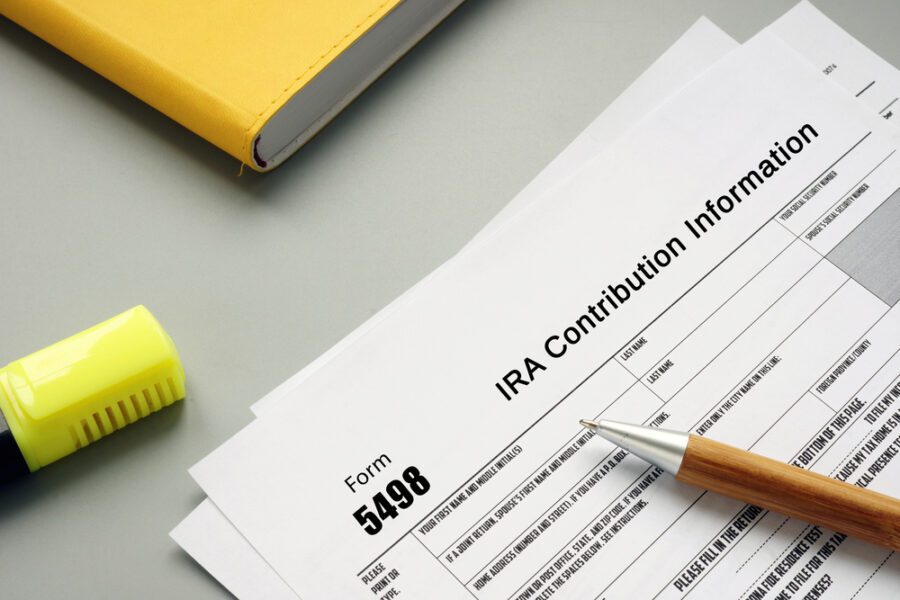
Question: Can you keep contributing to an IRA after you retire?
Answer: Yes. All retirees who earn a salary can contribute to both traditional or Roth IRAs. Back in the past, there was an age-based restriction. This cutoff age stated that those who turn 70½ could no longer contribute to traditional IRAs, but it was repealed a few years ago.
If you haven’t yet turned 50, the highest amount you can contribute to an IRA for 2022 is $6,000. If you’re 50 or older, then you can contribute an additional $1,000 annually, which means your annual IRA contribution can’t exceed $7,000.
To contribute to an IRA, you must earn an income from a job. Also, you’re not allowed to add more money to the account than what you’ve earned.
Sometimes, contributions to a traditional IRA may be tax-free. If you or your spouse aren’t covered by your employers’ retirement savings plan, you can deduct the full contribution to your traditional IRA, regardless of your income.
On the other hand, contributions to a Roth IRA aren’t tax-free. You pay taxes for every contribution you make, and you can withdraw all the savings free of taxes or penalties at retirement. You can also withdraw the earnings and never pay taxes on them if you’re at least 59½ and you’ve had the Roth IRA account for five years.
Withdrawals from Roth IRAs
Question: Do I have to pay taxes on withdrawals from Roth IRAs?
Answer: No. Unlike other retirement savings plans like 401(k) or traditional IRA – which are investments made with pretax contributions – you pay taxes in advance for every contribution to Roth IRA. This means you won’t have to pay anything for withdrawals once you retire.
Keep in mind that in order to enjoy your tax-free retirement savings, you must have owned the Roth IRA account for at least five years. Also, while you can benefit from the amount of savings you contributed at any time without paying any taxes, to avoid a 10% early-withdrawal penalty you must be at least age 59½ when you withdraw the earnings.
Age for Starting RMDs
Question: For those who own a traditional IRA account or a 401(k) retirement plan, at what age must they take the required minimum distributions (RMDs)?
Answer: Age 72. It had been 70 until 2020 when it was changed to 72.
Regarding the amount of money you are forced to withdraw, the rule is pretty simple. You’ll begin at around 3.65%, a percentage that increases every year. For instance, at 80 the percentage would be 4.95%. At 90, it would be 8.2% Using this RMD calculator will help you to know the exact percentage you must withdraw based on your age.

Taxation of Annuity Income
Question: Is annuity income taxable?
Answer: Most likely (at least for some of it). If you signed up for a retirement annuity, the amount of the payment that represents your principal is tax-free. The remaining part is taxable. But don’t worry because the financial service company that sold you the annuity is required to inform you what is taxable.
If you purchased the annuity with pretax funds (as for a traditional IRA), then some rules may change. If this is your case, your entire payment (so 100%) will be taxed as regular income.
Also, keep in mind that any taxes owed on the annuity will be assessed at your ordinary income tax rate, not the preferable capital gains one.
Standard Deduction Amounts
Question: If I’m over 65, can I claim a higher standard deduction than other people are allowed?
Answer: Yes! For most folks, the standard deduction in 2022 is $12,950 if you’re single and $25,900 for married couples that are joint filers. In 2021 the standard deduction was $12,550 and $25,100, respectively. Still, Americans aged 65 years or over who are single filers or head of household, benefit from an extra $1,750 in 2022 (the same deduction was $1,700 in 2021).
What about married couples who file taxes jointly? If one spouse is 65 or older and the other is not, the standard deduction rises by $1,400. If both you and your spouse are 65 or older, the rising for 2022 is $2,800.
To find more information about taxes in retirement here’s another article you may like: This Is How All 50 States Tax Your Retirement Income.