
Your Social Security calendar changes significantly as the year draws to a close. Between calendar quirks and federal holidays, payment dates frequently shift earlier than expected.
Beyond payment adjustments, major deadlines for Medicare enrollment, digital notice sign-ups, and the new 3.6% COLA raise will reshape your finances. Planning ahead ensures you protect your retirement budget.
This essential timeline covers the 12 critical dates between now and January 13 that dictate your benefits, healthcare costs, and retirement income. Mark these events to avoid unnecessary surprises.

How Year-End Payment Shifts Impact Your Cash Flow
The Social Security Administration follows a rigid monthly distribution schedule based on your birth date. However, federal banking holidays and weekend dates frequently disrupt that normal rhythm.
When an official payment date falls on a weekend or federal holiday, the agency pays you on the preceding business day. While early deposits feel welcome, they create longer gaps between paychecks.
Careless spending during these schedule shifts can leave your bank account depleted before the subsequent deposit arrives. You must track these changes to pace your household cash flow effectively.
Additionally, late autumn triggers vital administrative changes. Beneficiaries must finalize healthcare choices and confirm new monthly income rates before January arrives.
Understanding these calendar milestones allows you to budget precisely for winter utility bills, tax obligations, and holiday expenses. Let us examine each critical date step by step.
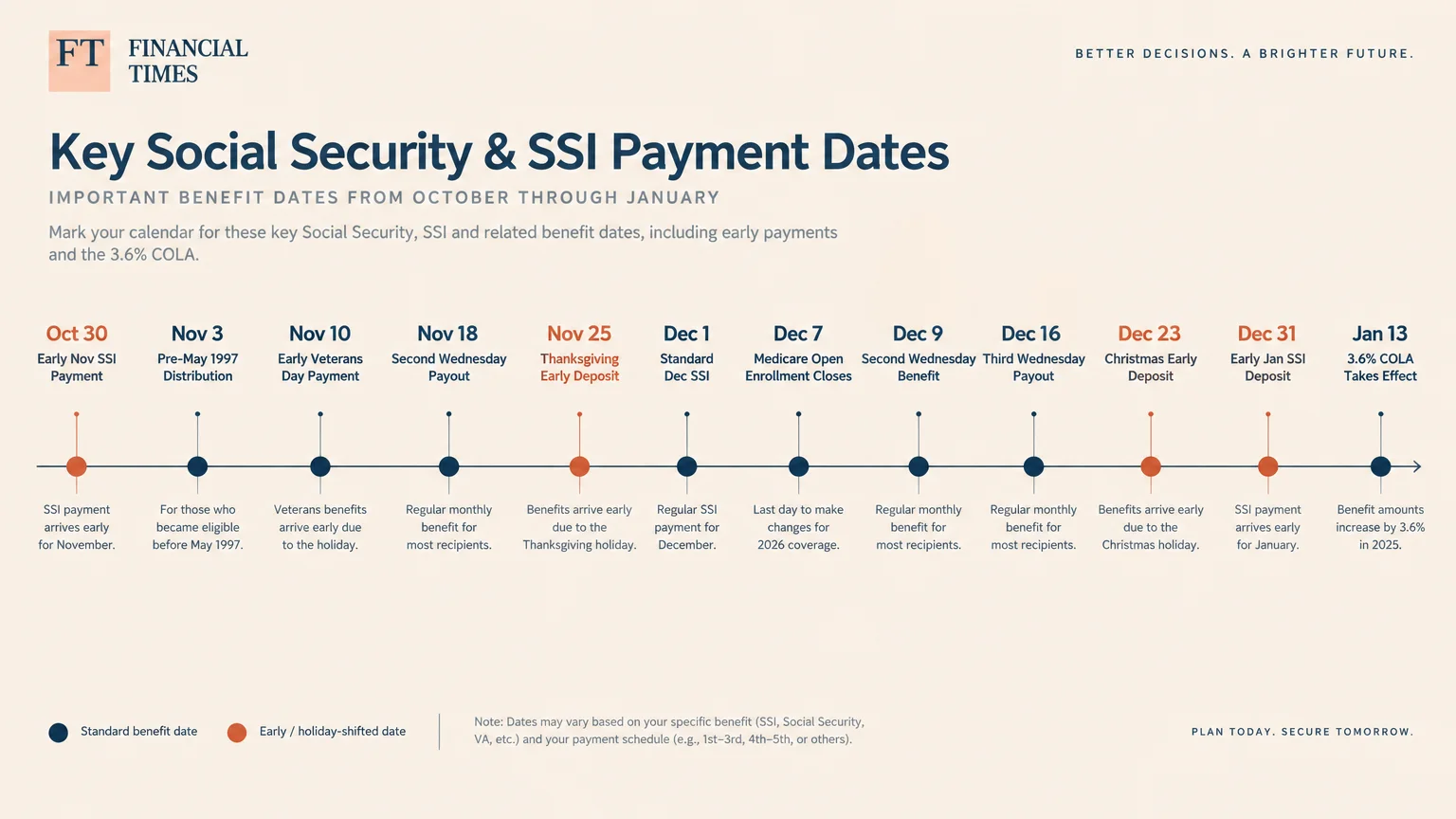
The Master Timeline: 12 Dates You Must Know
Between late October and mid-January, twelve specific calendar days demand your direct attention. Each date represents either an altered payment delivery, an administrative deadline, or a financial update.
1. Friday, October 30, 2026: Early November SSI Payment
Supplemental Security Income (SSI) beneficiaries usually receive their monthly funds on the first day of the calendar month. However, November 1, 2026, falls on a Sunday.
Because financial institutions close on Sundays, the federal government issues your November SSI payment on Friday, October 30. This ensures you maintain uninterrupted access to vital funds.
Keep in mind that you will receive two SSI deposits during October: your standard October 1 payment and this early November benefit. Consequently, you will receive zero SSI payments throughout November.
Budget this October 30 deposit carefully. That money must cover all your basic living expenses until your December benefit arrives five weeks later.
2. Tuesday, November 3, 2026: Pre-May 1997 and Dual Beneficiary Distribution
Beneficiaries who claimed Social Security before May 1997 follow an older payment framework. Instead of birth-date Wednesdays, they receive their benefits on the third day of each month.
Individuals who receive both traditional Social Security and SSI also collect their Social Security benefit on this day. Because November 3 falls on a Tuesday, your payment will arrive right on schedule.
Keep in mind that this payment continues to reflect your 2026 benefit rate. The newly announced cost-of-living increase does not apply to this check.
Review your direct deposit receipt on November 3 to verify accurate deductions for supplemental insurance or voluntary tax withholding. Report any unexpected discrepancies to your local field office immediately.
3. Tuesday, November 10, 2026: Veterans Day Early Wednesday Payment
Under standard rules, retirees born between the 1st and 10th of any given month receive benefits on the second Wednesday. For November 2026, the second Wednesday is November 11.
November 11 is Veterans Day, an official federal holiday that closes banks and halts electronic treasury transfers. Therefore, the Social Security Administration moves your payment to Tuesday, November 10.
Your electronic transfer or direct deposit will arrive one business day earlier than usual. If you still receive paper checks, mail carriers will deliver your check ahead of the holiday.
Take advantage of this early payment to settle mid-month household bills before banking networks pause for the federal holiday. Confirm that automated bill debits align with this modified deposit date.
4. Wednesday, November 18, 2026: Third-Wednesday Payment and Digital Notice Deadline
Beneficiaries born between the 11th and 20th will receive their regular November benefit on Wednesday, November 18. This distribution follows normal timing without any holiday alterations.
More importantly, November 18 serves as the official administrative cutoff for paperless notice enrollment. You must create your personal online account by this date to access digital COLA statements.
Beneficiaries who register at the official portal before November 18 can review their customized 2027 benefit calculation online by late November. Those who miss the deadline must wait for postal mail delivery.
Digital notices allow you to see your exact 2027 net raise weeks before letters reach physical mailboxes. Log in to your personal profile to opt into paperless messaging today.
5. Wednesday, November 25, 2026: Fourth-Wednesday Payment and Online COLA Letters
If your birthday falls between the 21st and 31st, your November payment arrives on Wednesday, November 25. This deposit occurs one day prior to Thanksgiving Day.
Late November also marks the window when personalized 2027 COLA notices begin posting inside online Message Centers. Beneficiaries who opted into digital delivery can log in and view their exact monthly numbers.
Your notice outlines your adjusted gross monthly payment following the official 3.6% COLA raise. It also itemizes deductions for Medicare premiums and voluntary tax withholding.
Knowing your net monthly deposit enables you to construct an accurate household budget well before January bills arrive. Print or download this document for your personal tax and financial files.
6. Tuesday, December 1, 2026: December SSI Deposit and Paper COLA Mailings
December begins with the regular delivery of Supplemental Security Income payments on Tuesday, December 1. Approximately 7.3 million SSI recipients will receive their standard monthly deposit on this date.
This December payment still utilizes 2026 rate tables. It represents the final SSI distribution before the new cost-of-living adjustment officially takes effect.
Simultaneously, the agency begins printing and mailing simplified, one-page paper COLA notices nationwide. Beneficiaries who chose not to receive digital notifications will receive these physical letters throughout December.
Watch your mailbox closely during early December for this official correspondence. The letter provides proof of updated income, which you may need for property tax relief or housing assistance.
7. Thursday, December 3, 2026: Final 2026 Distribution for Early Beneficiaries
Retirees who began receiving benefits prior to May 1997 receive their December payment on Thursday, December 3. Dual beneficiaries who receive both SSI and Social Security will also receive their funds.
This deposit marks the absolute final check calculated under the 2026 rate schedule for this beneficiary category. You will see no changes to your base benefit on this distribution.
Examine your December 3 statement to calculate your total cumulative Social Security earnings for the 2026 calendar year. This figure helps estimate your preliminary tax liability before tax forms arrive.
If you plan to adjust your voluntary federal income tax withholding for next year, file Form W-4V with your local office now. Updating your preferences early ensures smooth processing for January.
8. Monday, December 7, 2026: Medicare Open Enrollment Closes
Annual Medicare Open Enrollment officially ends at midnight on Monday, December 7. This represents the final opportunity for beneficiaries to modify their healthcare coverage for 2027.
You can switch between Original Medicare and Medicare Advantage, or select a different Part D prescription drug plan. Any adjustments submitted by December 7 become effective on January 1, 2027.
Your Medicare coverage choices directly influence your Social Security check. The government deducts Medicare Part B and Part D premiums straight from your monthly retirement benefit.
Review plan options carefully on Medicare.gov before the enrollment window shuts. Choosing a plan with lower out-of-pocket drug costs helps preserve more of your upcoming COLA raise.
9. Wednesday, December 23, 2026: Final Regular Wednesday Payment of 2026
The standard Wednesday distribution cycle finishes on December 23 for beneficiaries born between the 21st and 31st. (Beneficiaries born earlier receive payments on December 9 and December 16, respectively).
This distribution represents the final standard Wednesday payment issued under 2026 benefit formulas. Every subsequent Wednesday check will incorporate the new 3.6% cost-of-living raise.
Because December 23 precedes the Christmas holiday weekend, retail shopping and bank closures can accelerate your spending. Maintain a prudent cash cushion to handle unexpected end-of-year expenses.
Ensure that all planned year-end charitable gifts or required minimum distributions clear your linked financial accounts before December 31. Coordinate closely with your financial institution to avoid processing delays.
10. Thursday, December 31, 2026: Early 2027 COLA Payouts Arrive
Calendar logistics create a major payment event on New Year’s Eve. Because January 1 is a federal holiday, January 2027 SSI payments disburse one day early on Thursday, December 31.
Additionally, January 3, 2027, falls on a Sunday. Therefore, pre-May 1997 beneficiaries and dual recipients also receive their monthly benefits on December 31.
This early distribution is momentous because it represents the very first payment containing the 2027 COLA increase. Beneficiaries in these categories will see their 3.6% raise before the new calendar year starts.
Do not mistake this enhanced deposit for an unexpected holiday bonus. This money is your primary January benefit, and you must make it last through the entire month.
11. Friday, January 1, 2027: New Earnings Limits and Medicare Rules Take Effect
New federal regulations and retirement program guidelines take effect nationwide on New Year’s Day. If you work while collecting early retirement benefits, these updated rules directly impact your income.
The retirement earnings test exempt limit increases to $25,560 for individuals under full retirement age. The agency withholds $1 in benefits for every $2 earned above this threshold.
If you attain full retirement age during 2027, the cap increases to $67,920. Furthermore, the maximum taxable earnings subject to Social Security payroll tax expands to $192,300.
Medicare changes also take effect today, including an updated Part D annual out-of-pocket prescription cap of $2,400. Simultaneously, the Medicare Advantage Open Enrollment period begins, running through March 31.
12. Wednesday, January 13, 2027: First Standard Wednesday Check with 2027 COLA
Wednesday, January 13, marks the official rollout of 2027 COLA increases for standard Wednesday payees. Beneficiaries born between the 1st and 10th will receive their new benefit amounts today.
For the average retired worker, this 3.6% adjustment raises benefits by roughly $75 per month. That shifts average monthly checks from approximately $2,089 to $2,164.
Subsequent Wednesday cohorts will receive their increased checks later in the month. Beneficiaries born on the 11th through 20th receive deposits on January 20, while remaining recipients collect on January 27.
Verify that your net deposit matches the figures displayed on your COLA notice. Check your direct deposit statement to confirm that your deductions for Medicare Part B executed properly.

2026 vs. 2027 Social Security and Medicare Changes
Understanding policy changes helps you budget effectively for the upcoming year. The federal government adjusts multiple thresholds each autumn to counter persistent inflationary pressures.
The table below summarizes verified adjustments between 2026 and 2027. Review these benchmarks to understand how federal updates reshape your monthly retirement income.
| Program Metric | 2026 Level | 2027 Level | Net Change |
|---|---|---|---|
| Cost-of-Living Adjustment (COLA) | 2.5% | 3.6% | +1.1% Increase |
| Average Monthly Retired Worker Benefit | $2,089 | $2,164 | +$75 per month |
| Average Monthly SSDI (Disability) Benefit | $1,580 | $1,639 | +$59 per month |
| Maximum Federal Monthly SSI (Individual) | $967 | $1,002 | +$35 per month |
| Earnings Test Limit (Under Full Retirement Age) | $24,480 / yr | $25,560 / yr | +$1,080 allowance |
| Earnings Test Limit (Year Reaching Full Retirement Age) | $65,160 / yr | $67,920 / yr | +$2,760 allowance |
| Maximum Taxable Wage Base | $184,500 | $192,300 | +$7,800 subject to tax |
| Projected Medicare Part B Standard Premium | $202.90 / mo | $209.50 / mo | +$6.60 per month |
| Projected Medicare Part B Annual Deductible | $283 / yr | $292 / yr | +$9 per year |
| Medicare Part D Out-of-Pocket Prescription Cap | $2,100 / yr | $2,400 / yr | +$300 spending cap |
These figures demonstrate that while gross benefits climb, mandatory deductions also trend upward. You must account for rising healthcare premiums when evaluating your overall purchasing power.
Working retirees benefit from higher earnings caps, allowing them to keep more earned income. High earners will face Social Security taxes on a larger portion of their wages.
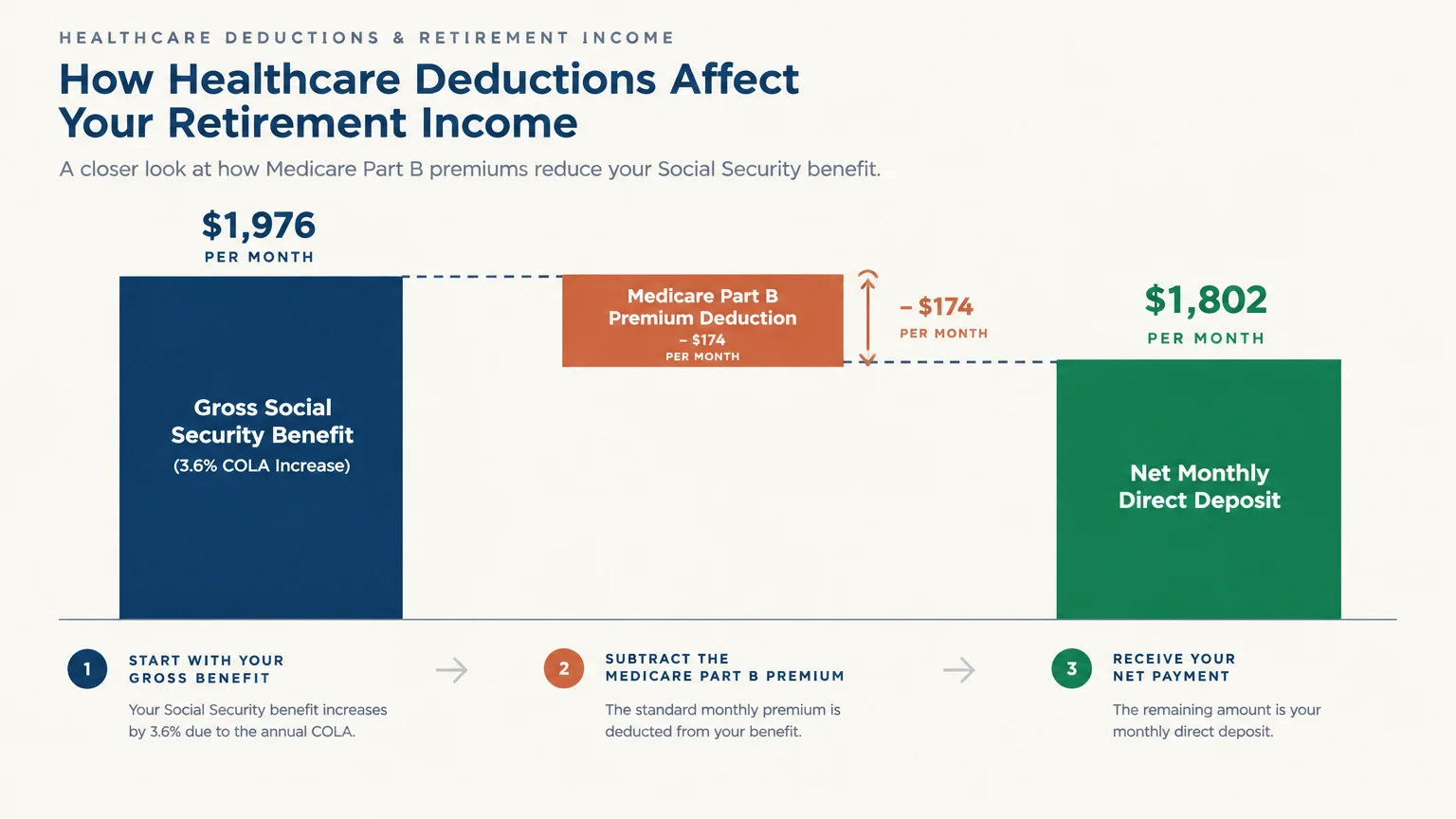
How Medicare Premiums Affect Your Net Benefit
Many beneficiaries assume the 3.6% COLA raise transfers entirely into their checking accounts. In reality, mandatory deductions frequently consume a noticeable portion of that increase.
The Centers for Medicare & Medicaid Services deducts your standard Part B monthly premium directly from your Social Security deposit. When Part B costs rise, your net monthly raise declines.
For 2027, the Medicare Trustees project the standard Part B premium to rise to $209.50 per month. That represents a $6.60 monthly increase over the 2026 baseline rate of $202.90.
If you receive an average gross benefit raise of $75 per month, that $6.60 healthcare increase reduces your take-home gain to roughly $68.40. Higher earners subject to Income-Related Monthly Adjustment Amounts (IRMAA) experience even steeper deductions.
“The single biggest mistake retirees make with Social Security is failing to anticipate how Medicare premiums and tax thresholds reduce their net increase.” — Ed Slott, CPA and Retirement Tax Specialist
Furthermore, state tax laws can affect your bottom line depending on where you reside. While most states exempt Social Security, several jurisdictions continue to tax a portion of benefits.
Check the latest rules on the Internal Revenue Service website to determine whether your total income crosses federal provisional tax thresholds. Up to 85% of your Social Security can become taxable if your combined income exceeds federal limits.

Pitfalls to Watch For
Navigating year-end retirement rules requires diligence and attention to detail. Many retirees commit avoidable administrative errors that disrupt their finances for months.
Watch out for these frequent missteps as you navigate the transition into the new year:
- Overspending Early Calendar Deposits: When holiday schedules disburse benefits early—such as the December 31 payout—spending that cash prematurely leaves you strapped in late January. Treat early checks as funds for the following month.
- Missing the Digital Notice Window: Waiting for physical mail delays your visibility into 2027 income. Establishing your online account before November 18 guarantees instant access to updated statements.
- Ignoring Medicare Plan Changes: Missing the December 7 Open Enrollment cutoff locks you into your existing healthcare coverage for an entire year. Sticking with an uncompetitive prescription plan could cost you thousands in higher copays.
- Exceeding Updated Earnings Limits: Working beneficiaries under full retirement age who surpass the $25,560 limit face benefit withholdings. Track your monthly wages carefully to avoid unexpected demand letters from the agency.
- Neglecting Tax Withholding Adjustments: A higher benefit check can push your provisional income into taxable territory. Failing to adjust voluntary tax withholding now can trigger an unwelcome tax bill next April.
Addressing these danger zones proactively protects your household savings. A single afternoon spent reviewing notices prevents months of financial frustration.

Getting Expert Help
While the Social Security framework operates under standardized rules, personal circumstances introduce complex variables. Consulting a qualified professional often prevents expensive, irreversible filing errors.
Consider seeking guidance from a credentialed advisor under the following specific circumstances:
- Coordinating Complex Spousal Benefits: If you and your spouse have significant age differences or disparate lifetime earnings records, timing strategies require detailed analysis. A financial planner can optimize claim timing to maximize survivor protections.
- Managing Earnings Test Penalties While Employed: If you plan to work part-time while collecting benefits before full retirement age, calculating phase-outs becomes intricate. A professional accountant ensures you pace wages below withholding thresholds.
- Appealing Medicare IRMAA Surcharges: If a recent life-changing event—such as retirement or widowhood—reduced your income, you can appeal Part B surcharges. Organizations like the National Council on Aging provide excellent advocacy resources for navigating these administrative appeals.
- Navigating Dual SSI and SSDI Eligibility: Managing income caps across multiple public assistance programs requires precise compliance. An elder law attorney helps structure assets to prevent unintentional loss of vital medical coverage.
Professional advice provides peace of mind when interpreting dense government regulations. Make sure your chosen advisor acts as a strict fiduciary regarding your retirement planning.
Frequently Asked Questions
Why does my SSI payment arrive on October 30 instead of November 1?
The federal government never issues benefit distributions on weekends or official federal holidays. Because November 1, 2026, falls on a Sunday, the agency disburses funds on the prior business day.
This payment shift means you receive two separate payments in October and none during November. You must budget those funds across November to cover routine living expenses.
When can I see my personalized 2027 Social Security COLA notice?
Beneficiaries who establish an online personal account before November 18 can view notices in late November. Notices post directly inside your secure Message Center.
If you prefer paper mail, the agency begins mailing physical letters in early December. Most households receive their physical statement by mid-to-late December.
Will the Medicare Part B increase erase my 2027 COLA increase?
No, the 2027 Medicare Part B premium increase will not erase your raise. The standard Part B premium is projected to rise by $6.60 per month, reaching $209.50.
Because the average retired worker benefit increases by approximately $75, most beneficiaries retain the majority of their raise. Your net monthly check will still show a positive increase.
Do I need to reapply to receive the 3.6% COLA increase in 2027?
You do not need to take any action to receive your cost-of-living increase. The Social Security Administration recalculates your benefits automatically under federal law.
Your adjusted payment will deposit automatically into your bank account according to the regular payment schedule. The increase applies to all checks issued starting in January 2027.
Prepare Your Retirement Budget Today
The closing months of the year bring swift changes to federal benefit payments and healthcare costs. Tracking these 12 critical dates ensures that you stay ahead of administrative deadlines and cash flow shifts.
Log into your personal account today, review your healthcare options before December 7, and establish a firm spending plan for January. Taking control of your retirement calendar empowers you to face the new year with complete confidence.
This is educational content based on general retirement planning principles. Individual results vary based on your situation. Always verify current benefit amounts, tax laws, and eligibility with official sources.
Last updated: October 2026. Retirement benefits, tax laws, and healthcare costs change frequently—verify current details with official sources.