Managing taxes in your 60s determines how much of your hard-earned wealth actually funds your retirement lifestyle. A single misstep can trigger higher Medicare premiums, surprise tax brackets, and severe IRS penalties.
Your 60s present an ideal tax-planning window between your peak earning years and mandatory retirement distributions. Taking deliberate steps during this decade gives you lasting control over your lifetime tax liability.
Smart strategies will help you sidestep the costliest retirement tax mistakes, protect your Social Security, and keep more money in your accounts.

The Social Security “Tax Torpedo” and Provisional Income
Many retirees assume Social Security benefits are entirely tax-free. Unfortunately, the Internal Revenue Service taxes up to 85% of your benefits once your earnings pass modest thresholds.
The government measures your liability using a formula called provisional income. This metric combines your modified adjusted gross income, tax-exempt interest, and 50% of your annual Social Security benefits.
For single filers, provisional income between $25,000 and $34,000 exposes up to 50% of benefits to taxation. Exceeding $34,000 makes up to 85% of your benefits taxable.
For married couples filing jointly, the 50% bracket begins at $32,000, while the 85% tier starts at $44,000. Congress has never indexed these thresholds for inflation since creating them decades ago.
Taking taxable distributions from a traditional IRA or 401(k) pushes you over these limits rapidly. Each dollar withdrawn can expose 85 cents of Social Security to taxation, creating an aggressive stealth tax bracket known as the tax torpedo.
You can review detailed benefit tax formulas through the Social Security Administration to model your potential liability before claiming benefits.
Medicare IRMAA: The Two-Year Lookback Trap
Medicare Part B and Part D premiums are not fixed costs for everyone. High earners pay an Income-Related Monthly Adjustment Amount (IRMAA), which functions as a steep surcharge added to standard monthly premiums.
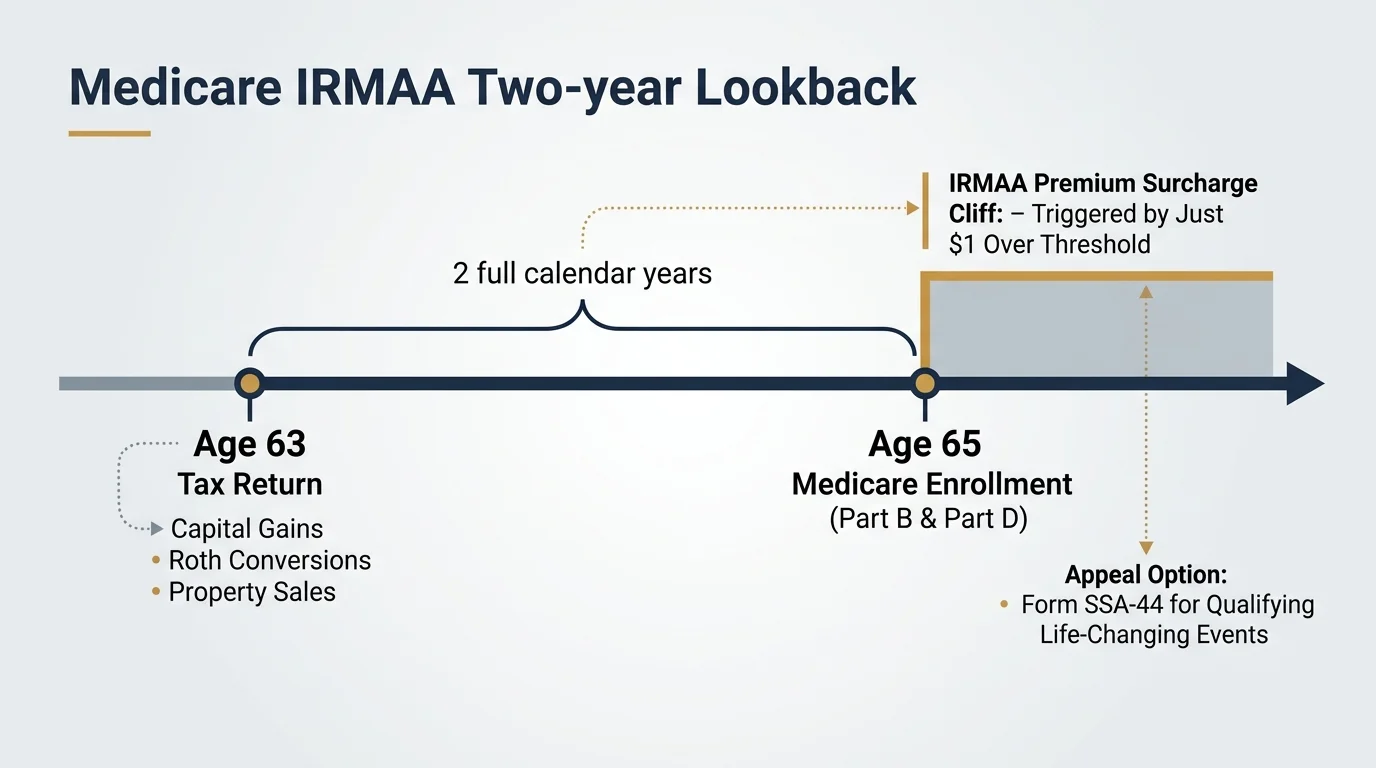
The Social Security Administration calculates your IRMAA using your federal tax return from two years prior. This means your income at age 63 directly establishes your Medicare premiums when you enroll at age 65.
Unlike standard marginal tax brackets, IRMAA thresholds operate as steep financial cliffs. Crossing an income threshold by a single dollar triggers the full premium surcharge across the entire upcoming calendar year.
Unexpected income spikes in your early 60s often trigger this trap. Selling a rental property, realizing major capital gains, or converting large traditional IRAs can dramatically increase your future healthcare costs.
If you experience a qualifying life-changing event—such as retirement or reduced work hours—you can appeal. Submit Form SSA-44 to the Social Security Administration to request an adjustment based on your current, lower income.
Consult official surcharge tier tables at Medicare.gov so you can monitor your income thresholds accurately.
The HSA Medicare Overlap and the Six-Month Retroactive Penalty
Health Savings Accounts (HSAs) offer unmatched triple tax advantages during your working years. However, continuing HSA contributions past age 65 while enrolling in Medicare creates a severe tax penalty.
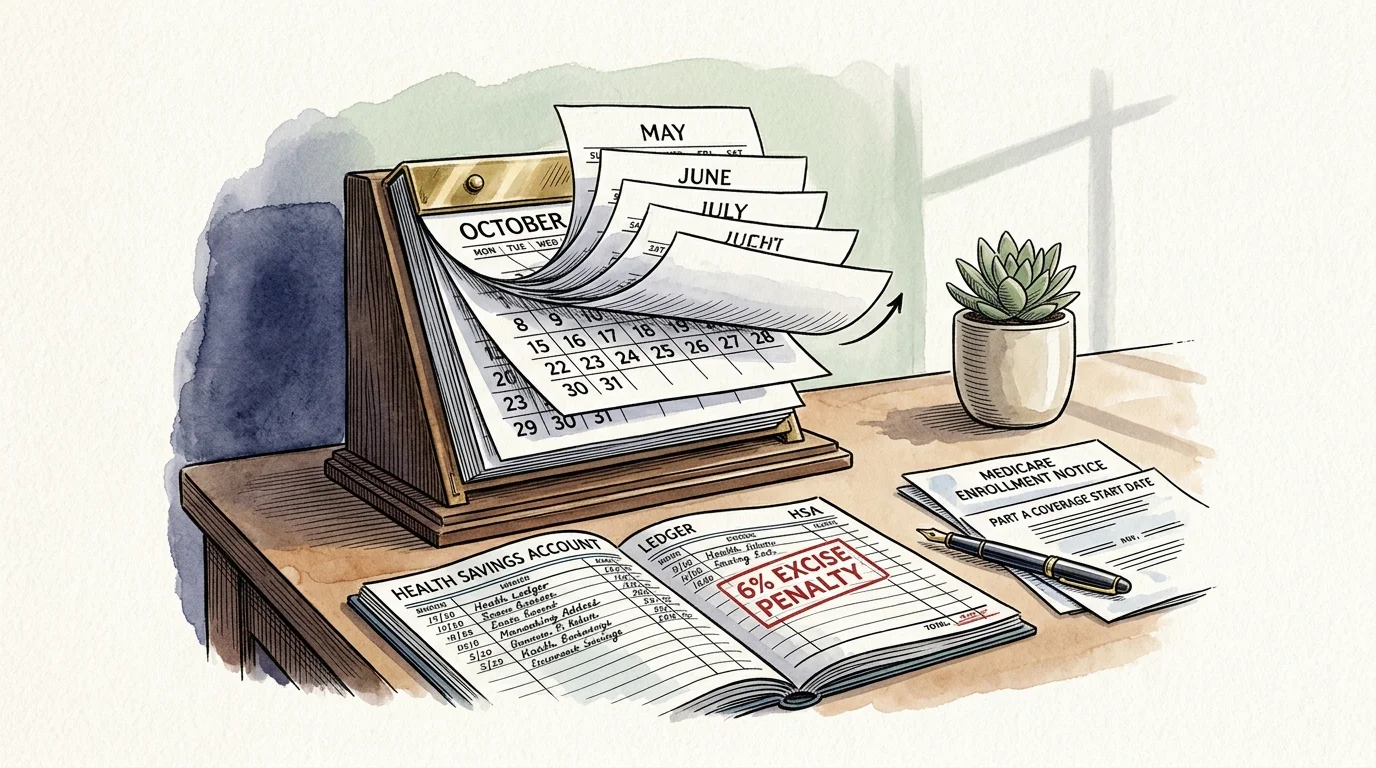
When you enroll in Medicare Part A after age 65, the government backdates your coverage by up to six months. Federal law strictly prohibits HSA contributions once you have active Medicare coverage.
Any deposits made during this retroactive window count as excess contributions. The IRS taxes these funds as regular income and imposes an ongoing 6% excise penalty until you remove them.
To avoid this costly error, stop all HSA contributions at least six months before applying for Medicare Part A. You must also halt contributions six months before claiming Social Security benefits if you are past 65.
Guidance from the Internal Revenue Service details the corrective steps required to withdraw excess contributions before tax-filing deadlines.

Required Minimum Distribution (RMD) Missteps and SECURE 2.0
Many pre-retirees mistakenly believe they must start taking Required Minimum Distributions as soon as they turn 70. Federal legislation has significantly delayed these mandatory withdrawals, offering valuable planning flexibility.
Under the SECURE 2.0 Act, your required beginning age is 73 if you reached age 72 after December 31, 2022. For Americans born in 1960 or later, the RMD age rises to 75 beginning in 2033.
Failing to withdraw the required amount still triggers harsh penalties, though lawmakers recently lowered the fee. The excise tax is now 25% of the shortfall, down from 50%, and drops to 10% if corrected within two years.
SECURE 2.0 also eliminated RMD requirements for employer-sponsored Roth 401(k) accounts during the owner’s lifetime. You no longer need to roll Roth 401(k) funds into a Roth IRA simply to avoid forced distributions.
Missing Strategic Roth Conversions in the Low-Income Valley
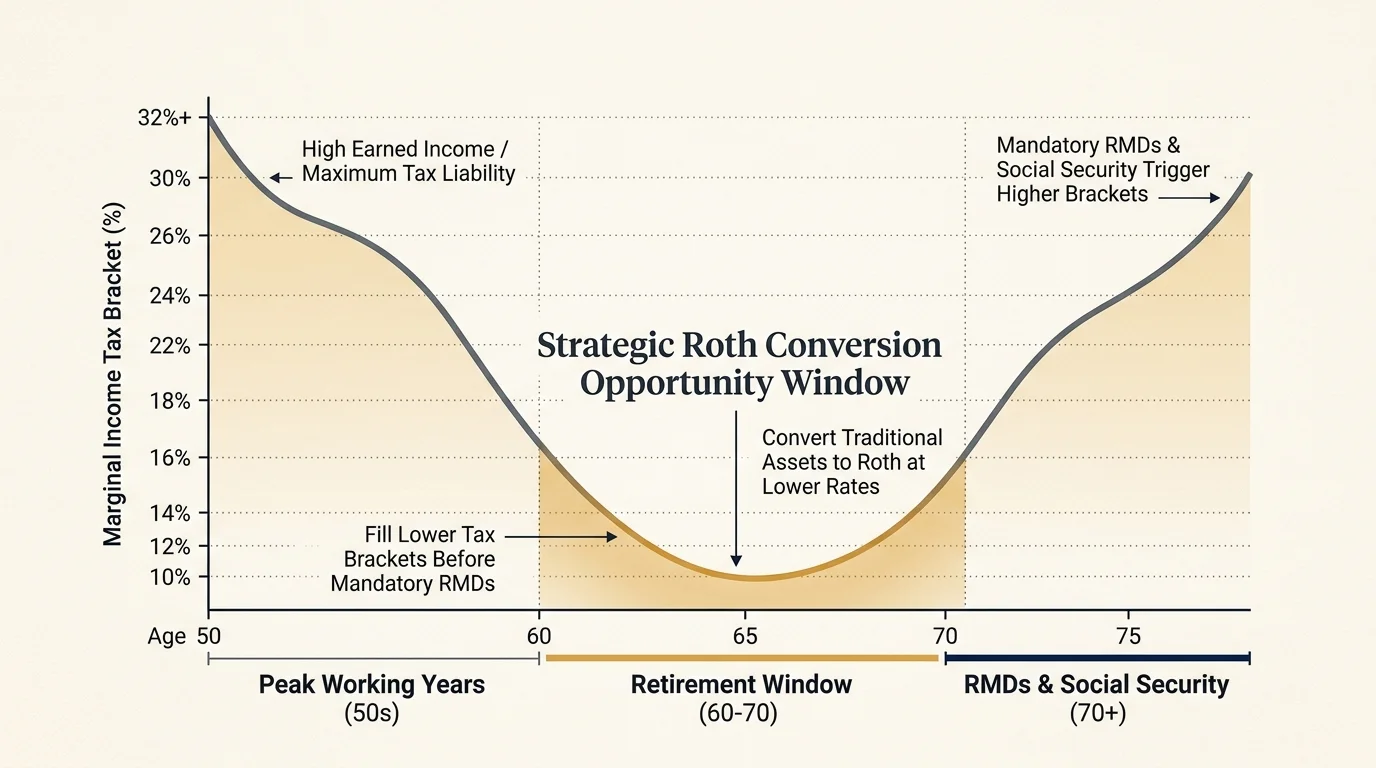
The years immediately following retirement often represent your lowest lifetime tax brackets. Wage income has ceased, while Social Security payments and RMDs have not yet begun.
Failing to leverage this low-income gap represents a major missed opportunity. Executing partial Roth conversions during your 60s transfers taxable retirement funds into permanent, tax-free growth at favorable rates.
Paying taxes now prevents ballooning traditional balances from forcing you into higher brackets later in life. It also diminishes the future tax burden on your surviving spouse or heirs.
“The best time to pay taxes is when rates are on sale, and for many retirees in their 60s, that window closes the moment mandatory distributions begin.” — Ed Slott, CPA and Retirement Distribution Expert
Calculate each conversion carefully to fill your current tax bracket without spilling into the next tier. Keep a close eye on Medicare IRMAA limits to ensure your conversions do not trigger premium surcharges.
Workplace Catch-Up Contribution Errors After Age 60
If you continue working into your 60s, recent tax reforms provide unprecedented opportunities to accelerate your savings. The SECURE 2.0 Act introduced higher catch-up limits specifically designed for older workers.
Employees aged 60, 61, 62, and 63 can make an enhanced “super catch-up” contribution to their workplace 401(k) or 403(b) plans. For 2025 and 2026, this limit is $11,250 instead of the standard catch-up amount.
At age 64, your eligible catch-up allowance drops back to the standard age-50 limit. Failing to adjust your payroll contributions during this four-year window leaves valuable tax-advantaged capacity on the table.
High earners must navigate another critical change taking effect in 2026. If your prior-year FICA wages exceed $150,000, federal law mandates that all workplace catch-up contributions go into Roth accounts.
You lose the upfront deduction for those catch-up dollars, but the funds grow and withdraw completely tax-free later. Verify your payroll designations with your human resources department to maintain compliance.
The Roth IRA Five-Year Rule Confusion
Many savers assume that reaching age 59½ grants unrestricted, tax-free access to all Roth IRA assets. That is only partially true, as a separate statutory holding period still applies.
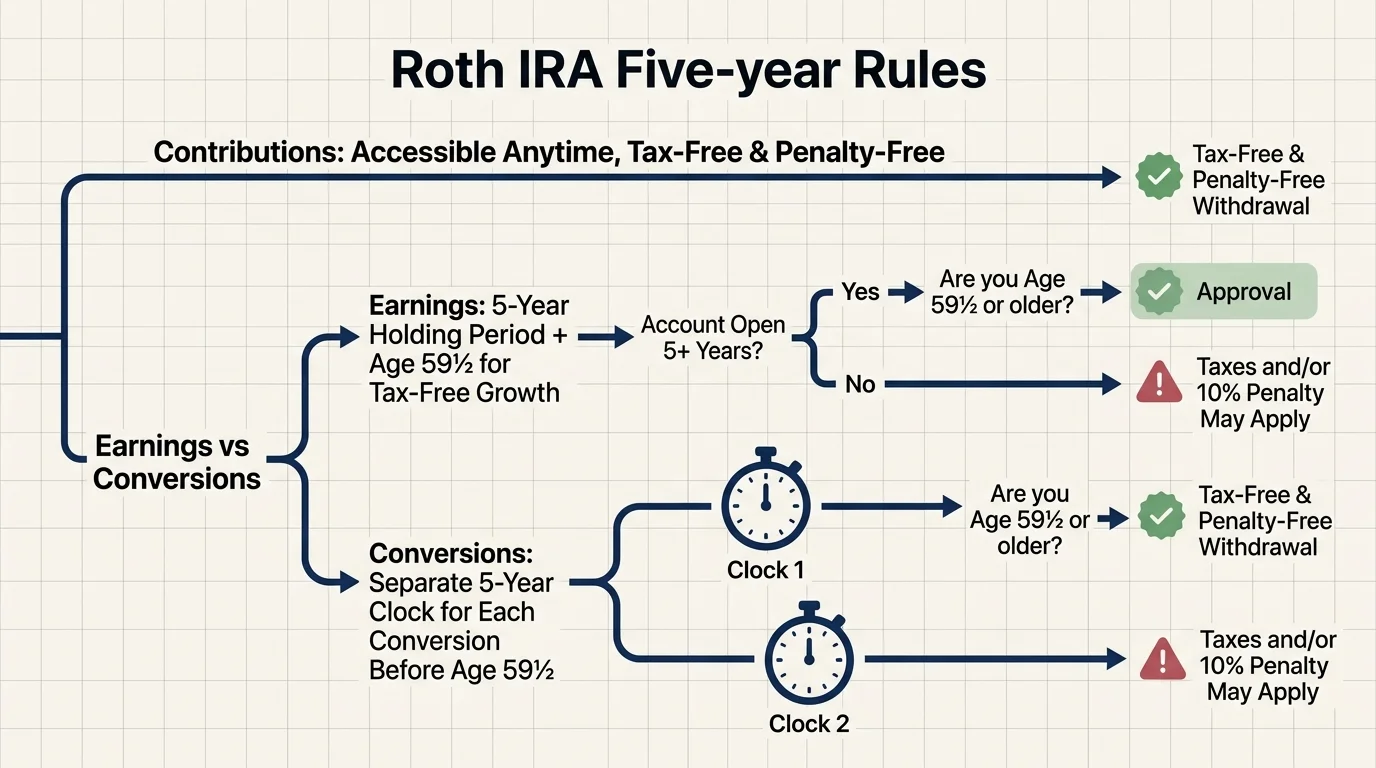
To withdraw investment earnings tax-free, your Roth account must satisfy the five-year rule. The clock starts on January 1 of the tax year for which you made your first contribution.
Withdrawing earnings before completing five years subjects that growth to ordinary income taxes, even if you are well past age 60. Your original contributions, however, can always be withdrawn tax-free at any time.
A separate five-year clock applies to each individual Roth conversion if you are under 59½. Fortunately, once you reach age 59½, conversion penalty clocks expire, leaving only the primary account clock in effect.

Taxable vs. Tax-Deferred vs. Tax-Free: Strategic Withdrawal Comparison
Managing your withdrawal sequence across different account types preserves your wealth and minimizes annual tax liabilities. Coordinated drawdowns prevent unnecessary bracket spikes throughout your 60s.
| Account Type | Tax Treatment on Withdrawal | Optimal Timing in Your 60s | Key Tax Risk to Manage |
|---|---|---|---|
| Taxable Brokerage | Capital gains rates (0%, 15%, or 20%) | Early retirement years to bridge income gaps | Realizing large gains that elevate provisional income |
| Traditional IRA / 401(k) | Ordinary income tax rates | Fill low brackets via strategic Roth conversions | Triggering IRMAA surcharges or the tax torpedo |
| Roth IRA / 401(k) | 100% tax-free distributions | Preserve for late retirement or major lump-sum needs | Withdrawing earnings before meeting the 5-year rule |
| Health Savings Account (HSA) | Tax-free for qualified medical expenses | Spend directly on healthcare or let investments compound | Contributing after enrolling in Medicare Part A |
Blending withdrawals from taxable and tax-free accounts keeps your adjusted gross income within favorable brackets. This balanced approach protects Social Security benefits from excessive taxation while keeping Medicare premiums affordable.

Pitfalls to Watch For
Even experienced investors make subtle tax mistakes during their transition away from full-time employment. Avoiding these common oversights will keep your financial plan on solid ground.
- Taking lump-sum pension payouts: Cashing out a pension in a single year can push you into the highest federal tax bracket. Consider direct rollovers or annuity structures instead.
- Overlooking state taxes: While some states exempt retirement benefits, others tax IRA distributions and pensions aggressively. Always evaluate your local tax code before executing large withdrawals.
- Neglecting tax-loss harvesting: Liquidating taxable assets without offsetting taxable gains leads to unnecessary capital gains taxes. Harvest losses systematically to buffer portfolio rebalancing.
- Failing to file Form SSA-44: If your income drops significantly due to retirement, do not quietly absorb higher Medicare premiums. File an appeal to reset your IRMAA surcharges immediately.
- Ignoring the widow’s tax trap: When one spouse passes away, the surviving spouse must file as single. This sudden shift compresses tax brackets and often leads to higher tax bills on the same income.
Financial consumer safeguards published by the Consumer Financial Protection Bureau can help you navigate complex retirement financial products securely.

Getting Expert Help
Retirement tax planning involves interconnected rules where a decision in one area impacts several others. Seeking guidance from a fee-only Certified Financial Planner or CPA makes sense in specific situations.
Consider hiring a specialized professional if you face any of the following complex planning challenges:
- Designing a multi-year Roth conversion schedule: An advisor can model conversions that maximize bracket space while avoiding IRMAA thresholds and Social Security taxation.
- Untangling retroactive Medicare HSA penalties: If you accidentally contributed to an HSA while on Medicare, a tax professional can calculate corrections and file required excise documentation.
- Managing complex equity compensation or deferred income: Executives retiring in their 60s often face lingering stock options or nonqualified deferred compensation that require strict tax coordination.
- Structuring estate plans to protect surviving spouses: A planner helps cushion the tax shock of switching from married filing jointly to single tax brackets later in life.
Frequently Asked Questions
What is the single biggest tax mistake people make in their 60s?
The biggest mistake is ignoring the low-income window between retirement and required distributions. Leaving traditional accounts untouched creates massive RMDs and tax burdens later in retirement.
Can I avoid paying taxes on my Social Security benefits entirely?
Yes, if your provisional income remains below $25,000 as a single filer or $32,000 for married couples. Drawing income primarily from Roth accounts and taxable cash helps keep you under these limits.
How does retiring at age 62 affect my Medicare IRMAA surcharges at 65?
Medicare evaluates your age-63 income when you turn 65. If your income dropped when you retired at 62, your age-65 premiums will naturally reflect that lower earnings level.
When exactly must I stop contributing to my HSA before starting Medicare?
You must stop contributing six months before applying for Medicare Part A if you enroll after age 65. Coverage applies retroactively for up to six months, making later contributions ineligible.
Taking Action on Your Retirement Tax Plan
Take time this week to review your account balances, projected income, and planned healthcare milestones. Establishing an intentional tax strategy today ensures you retain more of your wealth throughout retirement.
This is educational content based on general retirement planning principles. Individual results vary based on your situation; always verify current benefit amounts, tax laws, and eligibility with official sources.
Last updated: February 2026. Retirement benefits, tax laws, and healthcare costs change frequently—verify current details with official sources.