Losing a spouse creates an immediate financial shock when Social Security household income drops. Surviving spouses often assume they can combine their checks, but strict federal regulations slash household benefits instead.
The Social Security Administration eliminates the smaller check entirely and applies complex reduction formulas to the remaining payment. Timing errors, earning limits, and tax shifts can permanently reduce your monthly deposit by hundreds of dollars.
Knowing how these eight survivor benefit rules work protects your cash flow during an already painful transition. You can avoid permanent financial loss by coordinating your filing strategy before submitting paperwork.

1. The “One Check” Rule: Losing Dual Household Benefits
Social Security does not allow you to combine both checks after your spouse passes away. You receive only the larger of the two monthly payments, while the smaller check ends completely.
If you received $1,800 each month and your spouse received $2,400, your combined household benefit was $4,200. Following their death, you will collect only $2,400 per month, wiping out $1,800 in monthly cash flow.
This drop often catches households off guard because fixed living expenses do not drop by half. Housing, property taxes, utilities, and insurance premiums remain largely identical for single occupants.
The federal government also enforces a strict month-of-death clawback rule on Social Security deposits. Benefit checks are paid one month in arrears, and a beneficiary must survive the entire calendar month to remain eligible.
If your spouse dies on October 29, the payment issued in November for October must return to the government. The Social Security Administration will automatically claw this payment back from the linked bank account.
To ease administrative burdens, Social Security pays an official one-time lump-sum death payment. This payment remains fixed at just $255 and requires a formal application by the surviving spouse.
2. Early Survivor Claiming: The Age 60 Benefit Haircut
Surviving spouses can claim survivor benefits as early as age 60, or age 50 if living with a qualifying disability. Claiming before your own Full Retirement Age permanently cuts your monthly check.
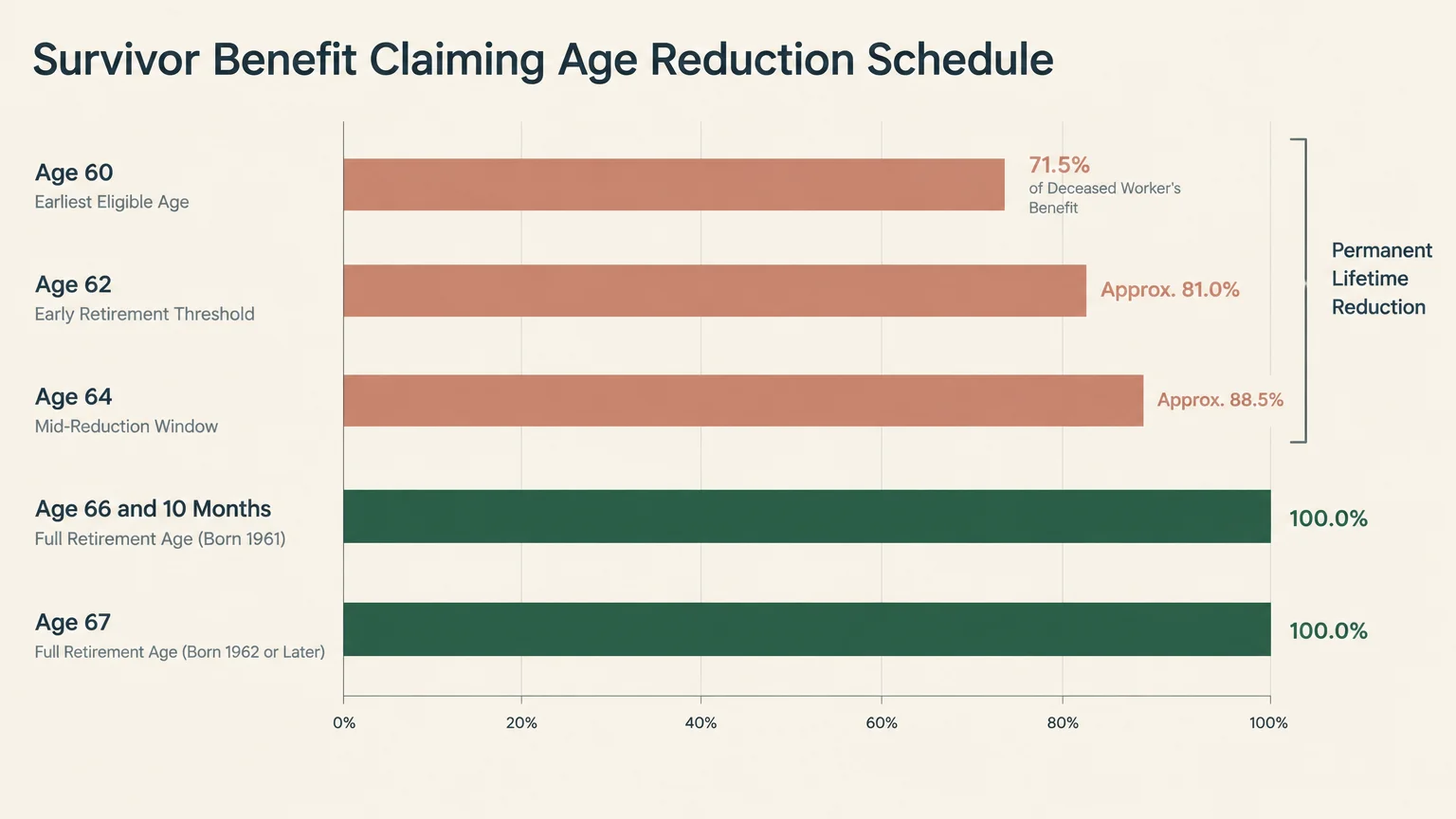
If you take survivor benefits at age 60, your payment drops to 71.5% of your late spouse’s benefit. This reduction remains permanent for the rest of your life.
Survivor Full Retirement Age follows a different schedule than standard retirement Full Retirement Age. For individuals born in 1961, survivor Full Retirement Age is 66 and 10 months.
For anyone born in 1962 or later, survivor Full Retirement Age is 67. Waiting until your survivor Full Retirement Age ensures you collect 100% of the eligible monthly benefit.
| Survivor Claiming Age | Survivor FRA Status | Percentage of Deceased Worker’s Benefit |
|---|---|---|
| Age 60 | Earliest eligible age (non-disabled) | 71.5% |
| Age 62 | Early retirement threshold | Approx. 81.0% |
| Age 64 | Mid-reduction window | Approx. 88.5% |
| Age 66 and 10 months | Full Retirement Age (born in 1961) | 100.0% |
| Age 67 | Full Retirement Age (born in 1962 or later) | 100.0% |
Every month you delay filing between age 60 and your survivor Full Retirement Age increases your check. Claiming early locks you into a permanently shrunken monthly income floor.

3. The Widow(er)’s Limit (RIB-LIM): Your Late Spouse’s Early Filing Penalty
Your survivor check depends heavily on the claiming decisions your spouse made while alive. If your spouse claimed their retirement benefits before their own Full Retirement Age, your payout faces an automatic ceiling.
This restriction is known as the Retirement Insurance Benefit Limitation, or the RIB-LIM rule. Under this statute, surviving spouses cannot collect more than the deceased worker actually received or was entitled to receive.
The rule provides a modest safety net to prevent extreme reductions. The survivor benefit will equal the greater of what the deceased spouse received or 82.5% of their Primary Insurance Amount.
Even if you wait until your own Full Retirement Age to file, this cap remains active. Your spouse’s decision to file early locks in a lower lifetime benefit ceiling for you.
“The biggest mistake surviving spouses make is rushing into Social Security decisions without looking at their tax brackets and claiming options.” — Ed Slott, CPA and Retirement Tax Expert
If your late spouse waited until age 70 to claim, the reverse occurs. You inherit their fully accumulated delayed retirement credits, raising your monthly survivor check.
4. The Retirement Earnings Test: Working While Under Full Retirement Age
Continuing to work while collecting survivor benefits before your Full Retirement Age can trigger steep benefit withholdings. The Social Security earnings test withholds benefits once your wages pass strict annual thresholds.
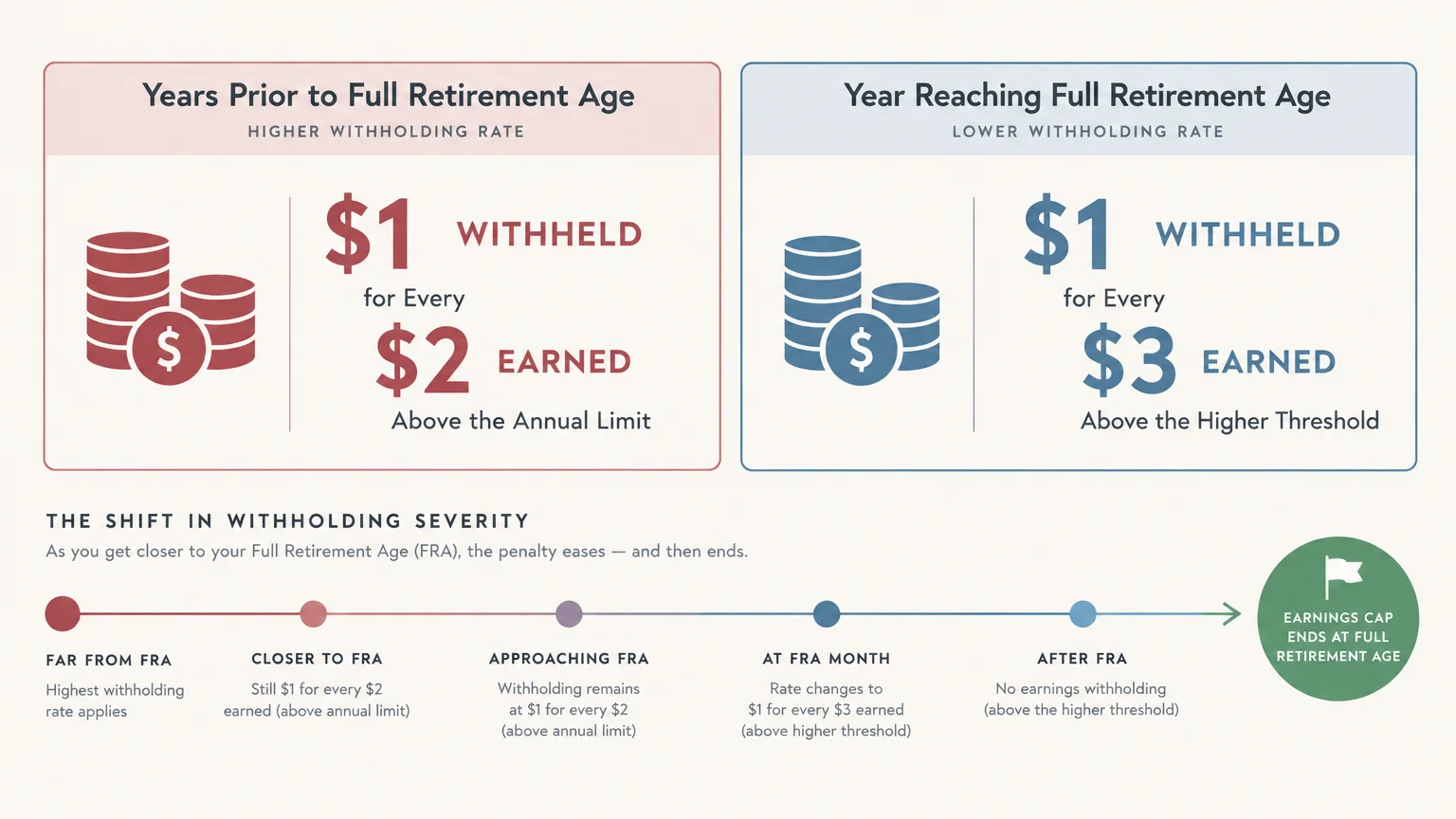
In 2026, the baseline earnings limit is $24,480 per year, or $2,040 per month. The agency withholds $1 from your benefit check for every $2 you earn over this limit.
The earnings threshold increases significantly during the calendar year you reach your Full Retirement Age. In 2026, you can earn up to $65,160 before reductions kick in.
For earnings above $65,160 in that specific year, the agency deducts $1 for every $3 earned up until your birth month. Once you reach Full Retirement Age, earnings penalties end entirely.
For 2027, the baseline earnings test threshold rises to $25,560, reflecting the 3.6% cost-of-living adjustment. The upper limit for those reaching Full Retirement Age in 2027 increases to $67,920.
These withheld funds are not permanently lost, but they delay your cash flow during active working years. The agency recalculates your monthly benefit upward once you hit Full Retirement Age to credit withheld amounts.

5. Remarriage Rules Before Age 60: Forfeiting Eligibility
Marriage choices directly alter your eligibility for survivor benefits. If you remarry before reaching age 60, you cannot receive survivor benefits based on your deceased spouse’s earnings record.
Disabled surviving spouses face a lower age cutoff of 50. If you remarry prior to age 50 while disabled, you lose access to those survivor payments.
Remarrying after reaching age 60 does not disrupt your benefits. You can collect survivor benefits from a late spouse even after marrying a new partner at age 60 or older.
Divorced surviving spouses can also claim survivor benefits if the prior marriage lasted at least 10 full years. Surviving current spouses need only have been married for nine months before the death, barring accidents or military duty.
If you remarry before 60 and that subsequent marriage later ends in divorce or death, your eligibility returns. You can then resume claiming survivor benefits on your previous spouse’s work record.
6. The Family Maximum Benefit Cap: Competing Beneficiary Claims
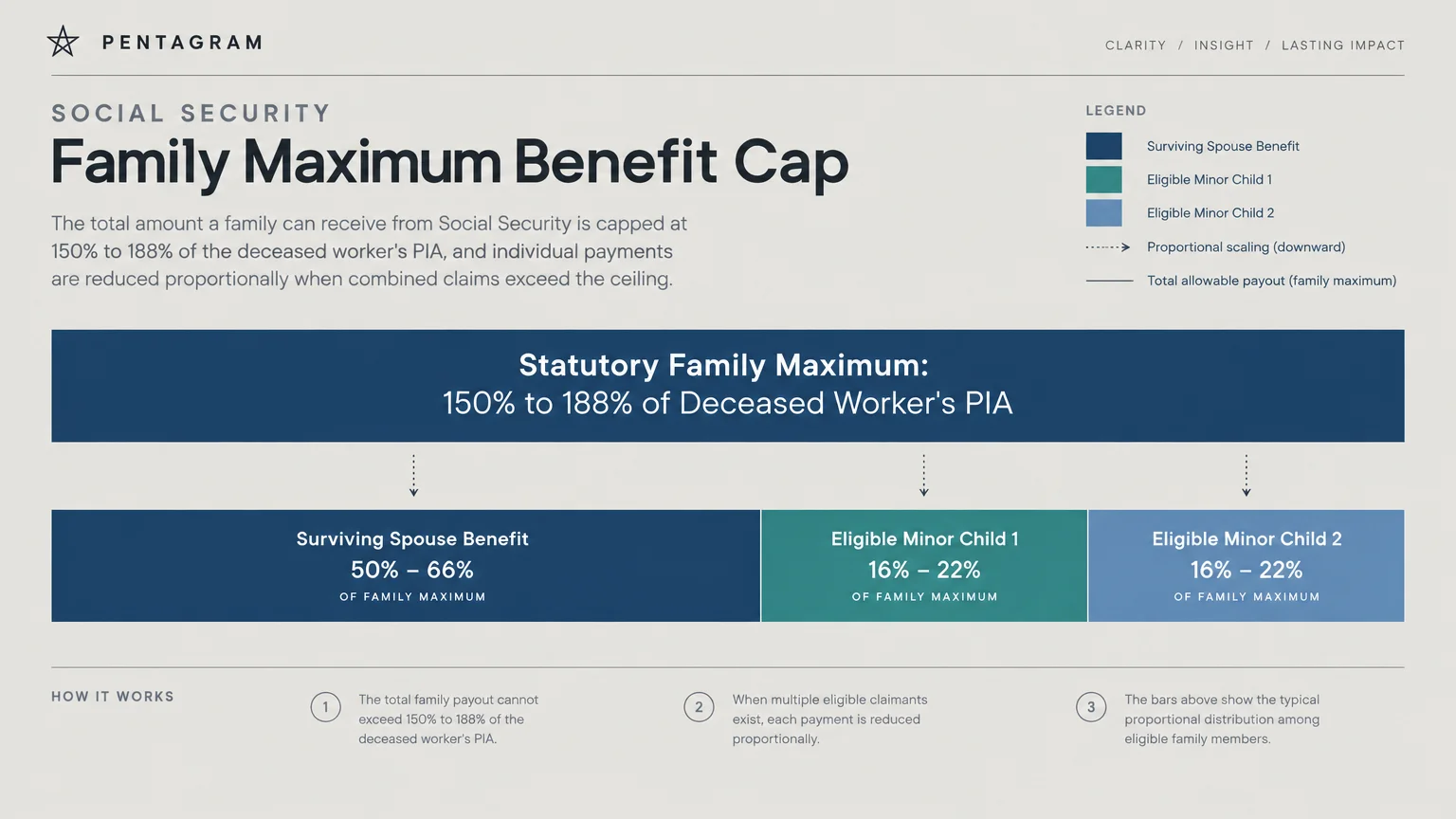
When multiple family members claim benefits on a single worker’s record, total payments cannot exceed statutory limits. Social Security caps aggregate monthly family payouts between 150% and 180% of the deceased worker’s primary insurance amount.
Minor children under age 16 and disabled adult children can each receive up to 75% of the deceased worker’s benefit rate. Dependent elderly parents may also qualify for auxiliary survivor benefits.
If the sum of all dependent checks exceeds the family cap, each claimant’s benefit shrinks proportionally. The surviving spouse’s monthly check drops to keep the total family payout within legal thresholds.
Payments made to surviving divorced spouses do not count toward the family maximum limit. Their benefits will never reduce the amounts paid to you or your children.
Once children reach age 18 or finish high school, their survivor checks stop. The agency then restores the surviving spouse’s check to its full statutory level.
7. The “Widow’s Tax Penalty”: Shift to Single Filer Tax Brackets
Your tax burden often spikes in the calendar year following your spouse’s death. You must transition your tax filing status from Married Filing Jointly to Single, which cuts standard deduction thresholds in half.
This transition frequently pushes surviving spouses into higher marginal tax brackets on identical or lower gross income. It also triggers heavier taxation on your Social Security check through the Internal Revenue Service provisional income formulas.
For married couples filing jointly, provisional income between $32,000 and $44,000 exposes up to 50% of benefits to income taxes. For single filers, that 50% taxation threshold drops down to just $25,000.
Joint filers face up to 85% benefit taxation when income exceeds $44,000, while single filers hit that top threshold at $34,000. Because Congress never indexed these figures for inflation, almost every surviving spouse faces benefit taxes.
“Taxes can consume a huge portion of retirement benefits if you fail to anticipate how filing single changes your bracket.” — Jean Chatzky, Personal Finance Educator
Converting traditional retirement accounts or withdrawing investment capital can push your provisional income past these low thresholds. Careful tax distribution planning prevents taxable income from eroding your net monthly deposit.

8. Medicare IRMAA Surcharges: Direct Deductions from Net Benefits
Medicare Part B and Part D premiums come directly out of your monthly Social Security payment. When your tax status changes to single, your threshold for the Income-Related Monthly Adjustment Amount gets cut in half.
Surviving spouses often face surprise IRMAA surcharges two years after a spouse passes away due to two-year lookback tax returns. These surcharges directly shrink your net monthly Social Security check before it hits your bank account.
For example, if you take large Required Minimum Distributions from inherited retirement accounts, your single taxable income can jump. The Centers for Medicare & Medicaid Services then tacks hundreds in surcharges onto your premium.
You can appeal an IRMAA surcharge using Form SSA-44 after the death of a spouse. The death of a spouse qualifies as a formal life-changing event that allows the agency to recalculate your premiums using current income.
Filing this appeal promptly prevents unnecessary Medicare deductions from eating away at your survivor check. Keep a certified copy of the death certificate ready to support your request.

Positive Relief: The Repeal of the Government Pension Offset
For decades, public servants faced the Government Pension Offset, which wiped out survivor benefits for teachers, police officers, and municipal workers. This harsh formula deducted two-thirds of a non-covered government pension from survivor payments.
This penalty no longer exists thanks to federal legislation. The Social Security Fairness Act, signed into law on January 5, 2025, permanently repealed both the Government Pension Offset and the Windfall Elimination Provision.
The repeal applies retroactively to January 2024, restoring full Social Security survivor benefits to public sector workers. If you were previously denied survivor benefits because of a public pension, you can now claim your full earned check.
You no longer have to worry about a state or local government pension shrinking your survivor deposit. This change provides long-awaited financial protection for thousands of surviving public servants.

Strategic Benefit Filing: The Surviving Spouse Advantage
Unlike standard retirement benefits, survivor benefits remain exempt from deemed filing rules. This unique exception allows surviving spouses to coordinate two separate benefit streams for maximum lifetime payout.
You can claim survivor benefits as early as age 60 while letting your own retirement benefit grow untouched. Your personal retirement benefit continues earning delayed retirement credits of 8% per year until you reach age 70.
At age 70, you can switch from the survivor benefit to your own maximized retirement payment. This strategy produces a significant bump in lifetime household income.
Alternatively, if your late spouse was the higher earner, you can collect your own benefit early and switch to full survivor benefits at your Full Retirement Age. You should review both options before submitting your claim.

Pitfalls to Watch For
Failing to plan for the month-of-death clawback can trigger immediate bank overdraft fees. Make sure funds from the month of death remain in your account until Social Security reclaims them.
Filing for survivor benefits too early without checking the earnings limit often leads to withheld payments. Verify your projected annual wage income before submitting your application to the agency.
Forgetting to file Form SSA-44 for Medicare IRMAA relief causes many widows to overpay for healthcare coverage. Always submit documentation proving your spouse’s death to reduce your Medicare Part B deductions.
Neglecting tax withholding on your survivor check can lead to unexpected tax penalties at year-end. Request voluntary federal income tax withholding using Form W-4V when you set up your benefit.
Relying on unverified verbal advice from local field offices can also create filing mistakes. Confirm all benefit claiming calculations in writing and check consumer guidance through the Consumer Financial Protection Bureau.

Getting Expert Help
Navigating survivor benefits alongside tax brackets and investment portfolios requires careful technical analysis. Consulting a fee-only financial planner or Social Security specialist helps protect your retirement stability in several critical situations:
- You own traditional IRAs or 401(k) accounts that will trigger large Required Minimum Distributions alongside Social Security.
- You plan to continue working between age 60 and your Full Retirement Age while receiving survivor benefits.
- You have a blended family where minor children or dependent parents are also claiming benefits against the deceased worker’s earnings record.
- You qualify for both a generous survivor benefit and your own high earner retirement benefit at age 70.
A professional planner can model various claiming scenarios to show how taxes, Medicare surcharges, and timing intersect. Taking time to run the numbers ensures you do not leave thousands of dollars in earned benefits behind.
Frequently Asked Questions
Can I collect both my own Social Security check and my deceased spouse’s check?
No, Social Security does not permit dual entitlement payouts. You will receive an amount equal to the higher of the two benefits, and the smaller check disappears.
What happens to the Social Security check received in the month my spouse died?
Social Security requires beneficiaries to live the entire calendar month to keep that month’s payment. The payment received for the month of death must be returned to the government.
How does remarriage affect my widow’s Social Security benefits?
Remarrying before age 60 (or age 50 if disabled) disqualifies you from receiving survivor benefits on your late spouse’s record. Remarrying at or after age 60 does not impact your survivor checks.
Can I switch from a survivor benefit to my own retirement benefit later?
Yes, survivor benefits are exempt from deemed filing rules. You can take survivor benefits early and switch to your own higher retirement benefit at age 70.
Navigating Social Security survivor benefits requires patience and careful timing during an emotionally challenging period. Review your earnings history, calculate your survivor Full Retirement Age, and consider tax implications before locking in your claiming decision.
The information in this guide is meant for educational purposes. Your specific circumstances—including income, savings, health coverage, and goals—may require different approaches. When in doubt, consult a licensed professional.
Last updated: October 2026. Retirement benefits, tax laws, and healthcare costs change frequently—verify current details with official sources.