
You could be walking away from thousands of dollars in retirement income if you overlook Social Security divorced spouse benefits. When your marriage ends, your connection to your ex-spouse’s earnings record doesn’t automatically disappear; yet many retirees mistakenly believe they forfeit these benefits once the divorce is finalized. Understanding the exact requirements allows you to claim up to 50% of your former spouse’s full retirement age benefit without their involvement. Whether you are nearing age 62, working part-time, or adjusting your financial strategy after a separation, knowing how these specific rules apply is critical. This guide breaks down the essential 2026 Social Security regulations, eligibility criteria, and claiming strategies you need to maximize your monthly income.
The 10-Year Rule and Foundational Eligibility
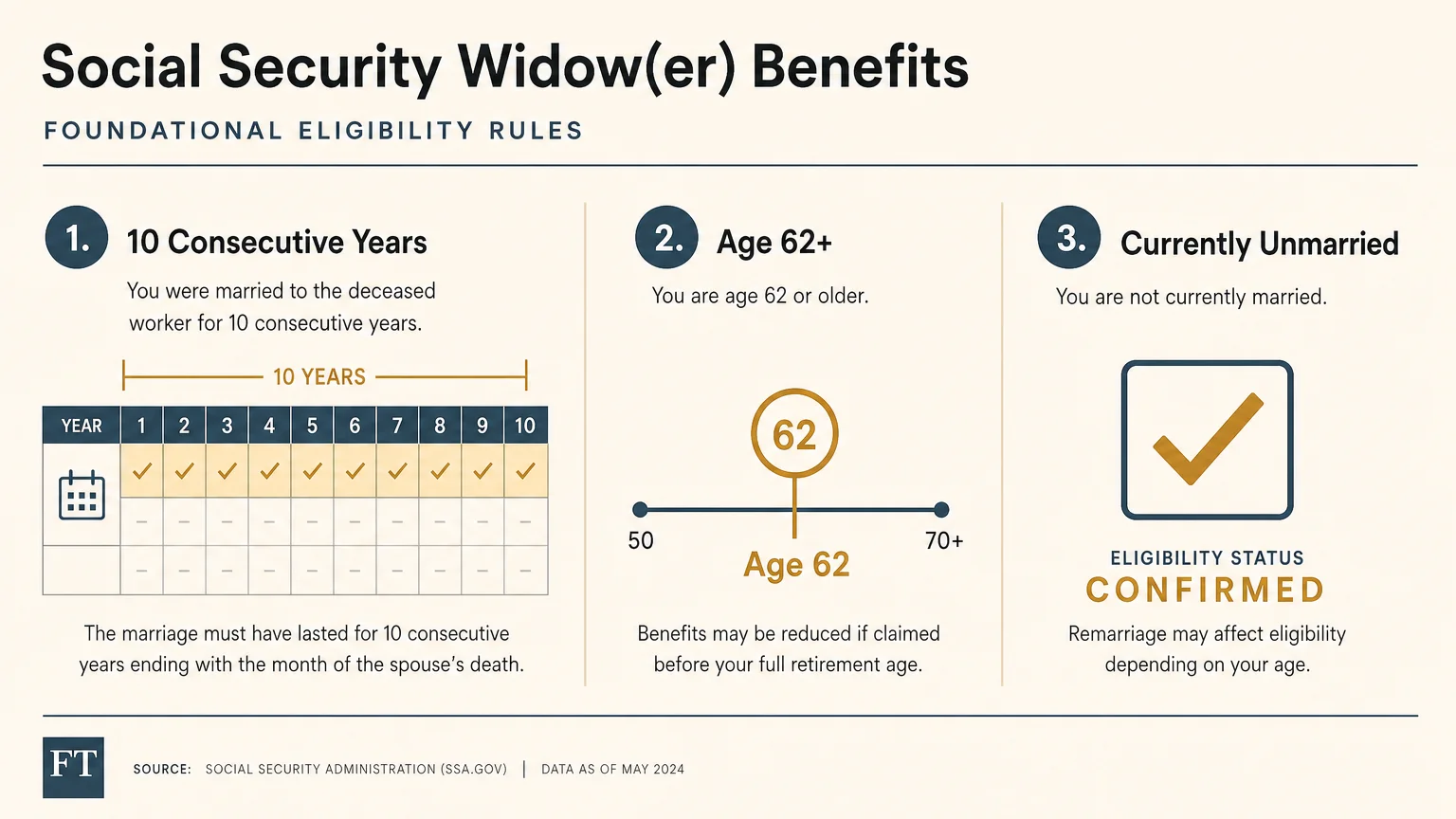
The Social Security Administration maintains strict criteria that govern whether you can legally claim benefits based on a former spouse’s earnings history. The primary hurdle most retirees face is the duration of the marriage. To qualify, you must have been married to your ex-spouse for a minimum of 10 consecutive years before the divorce became final. If your marriage lasted nine years and eleven months, you are unfortunately ineligible for this specific benefit class.
Assuming you meet the 10-year requirement, several other conditions must align for you to draw a divorced spousal benefit in 2026:
- Age requirement: You must be at least 62 years old to initiate a claim for standard spousal benefits.
- Current marital status: You must be currently unmarried. If you remarry, you forfeit your ability to collect benefits on your ex-spouse’s record unless your subsequent marriage ends through death, divorce, or annulment.
- Your ex-spouse’s entitlement: Your former spouse must be entitled to Social Security retirement or disability benefits.
- Your independent earnings record: Social Security will only pay you the divorced spouse benefit if it is higher than the benefit you would receive based on your own work history. You cannot stack the benefits; the government pays an amount equal to the higher of the two.
A common friction point for divorced retirees is the belief that their ex-spouse must actually be receiving checks for the spousal benefit to activate. This is not entirely true. If your ex-spouse qualifies for benefits but has delayed claiming them, you can still file for your divorced spouse benefits provided you have been legally divorced for at least two consecutive years.


How the 2026 Benefit Math Actually Works
Understanding exactly how much you can expect to receive requires looking at current Social Security limits and the timing of your claim. In 2026, a 2.8% Cost-of-Living Adjustment (COLA) increased base benefits across the board. The absolute maximum you can receive as a divorced spouse is 50% of your ex-spouse’s Primary Insurance Amount (PIA)—which is the benefit they are entitled to collect at their Full Retirement Age (FRA).
For perspective, the maximum Social Security benefit payable to a worker at Full Retirement Age in 2026 is $4,152 per month. Therefore, the maximum possible divorced spousal benefit this year sits at $2,076 per month. However, the average retired worker currently receives closer to $2,081 per month, meaning the average spousal benefit will likely hover around $1,040 monthly.
Timing your claim dictates the percentage of that maximum you actually take home. If you file at age 62, the Social Security Administration permanently reduces your spousal benefit. Instead of the full 50% of your ex-spouse’s PIA, you will receive approximately 32.5% of their base amount. To receive the maximum 50%, you must wait until your own Full Retirement Age—which is 67 for anyone born in 1960 or later.
“Claiming early does not protect you from future benefit cuts. If you are in good health, the best financial move you can make is to not claim Social Security before you reach your full retirement age.” — Suze Orman, Personal Finance Expert
Unlike benefits claimed on your own work record, delayed retirement credits do not apply to spousal benefits. While your ex-spouse can increase their own benefit by 8% per year by delaying their claim up to age 70, your spousal benefit maxes out at your Full Retirement Age. There is zero financial incentive for you to wait past your FRA to claim a divorced spouse benefit.

The Independence Factor: Claiming Without Your Ex
Divorced retirees often hesitate to explore spousal benefits because they want to avoid contacting an estranged former spouse. The process is entirely completely independent. When you file for divorced spouse benefits, the Social Security Administration handles the calculations internally; they do not require your ex-spouse’s permission, nor do they notify your ex-spouse that you have filed a claim.
Furthermore, the amount you receive has zero impact on your ex-spouse’s monthly check. It also does not reduce the benefits available to their current spouse if they have remarried. The system treats your claim as a completely separate payout from the trust fund.
To file, you simply need to provide the SSA with your marriage certificate and your final divorce decree. Knowing your ex-spouse’s Social Security Number expedites the process, but if you do not have it, providing their exact date of birth, place of birth, and parents’ names usually gives the SSA enough information to locate their earning record.

Working While Collecting: The 2026 Earnings Limits
If you choose to claim your divorced spouse benefit while continuing to work, you must navigate the Social Security retirement earnings test. Earning too much before reaching your Full Retirement Age triggers a temporary withholding of your benefits.
The 2026 earnings test rules are strictly enforced:
- Under Full Retirement Age for the entire year: The annual earnings limit is $24,480. For every $2 you earn above this threshold, Social Security withholds $1 from your benefit payments.
- The year you reach Full Retirement Age: In the months leading up to your birthday, the limit increases significantly to $65,160. During this window, the penalty is reduced; the SSA withholds $1 for every $3 you earn above the cap.
- After reaching Full Retirement Age: The earnings limit completely disappears. You can earn an unlimited amount of income from work without facing any benefit reductions.
It is important to note that the earnings test only applies to wages from a job or net earnings from self-employment. Investment returns, pensions, capital gains, and annuity payouts do not count toward this limit.

What Happens If Your Ex-Spouse Passes Away?
The rules shift dramatically if your former spouse passes away. At that point, you transition from a divorced spouse to a surviving divorced spouse. This shift fundamentally changes how your benefits are calculated and when you can claim them.
As a surviving divorced spouse, you are eligible to receive up to 100% of your deceased ex-spouse’s benefit amount, rather than the 50% cap applied while they are living. Additionally, the age requirements are more lenient; you can begin claiming survivor benefits as early as age 60, or age 50 if you are legally disabled.
The remarriage rules also feature a critical exception for survivors. If you remarry before age 60, you cannot collect surviving divorced spouse benefits. However, if you wait until after your 60th birthday to remarry, your new marriage will not affect your eligibility to claim or continue collecting survivor benefits based on your deceased ex-spouse’s record.
Here is a quick overview of how the two benefit types differ:
| Feature | Divorced Spousal Benefits | Surviving Divorced Spouse Benefits |
|---|---|---|
| Maximum Amount | Up to 50% of ex-spouse’s FRA benefit | Up to 100% of ex-spouse’s benefit |
| Earliest Claiming Age | Age 62 | Age 60 (Age 50 if disabled) |
| Remarriage Penalty | Benefits stop if you remarry at any age | Can remarry after age 60 without losing benefits |
| Ex-Spouse Status | Must be living | Must be deceased |

Taxation and Medicare Implications
Claiming a divorced spouse benefit increases your overall household income, which triggers secondary financial effects. Chief among these is the taxation of your Social Security benefits. The IRS determines the taxability of your benefits based on your “provisional income,” calculated by adding half of your annual Social Security benefits to your adjusted gross income and any non-taxable interest.
If you file your taxes as a single individual and your provisional income falls between $25,000 and $34,000, up to 50% of your benefits may be taxable. If your provisional income exceeds $34,000, up to 85% of your benefits become subject to federal income tax. Proper withdrawal strategies from your standard retirement accounts can help mitigate this tax burden.
Higher income also affects your healthcare costs. For those enrolled in Medicare, an increase in your adjusted gross income could trigger an Income-Related Monthly Adjustment Amount (IRMAA). For 2026, the standard Medicare Part B base premium is $201.96; exceeding specific income thresholds will force you to pay surcharges on both your Part B and Part D premiums. Review current thresholds at Medicare.gov when projecting your net retirement income.

Common Mistakes to Avoid
Navigating the Social Security system requires precision. A single misunderstanding can cost you permanently. Watch out for these frequent pitfalls:
- Misunderstanding Deemed Filing: Whenever you file for Social Security benefits, you are “deemed” to be applying for all benefits you are eligible for. You cannot choose to take your divorced spouse benefit at 62 while letting your personal worker benefit grow until age 70. The SSA will automatically pay you the higher of the two available amounts.
- Waiting for your ex-spouse to file: Do not delay your own retirement waiting for your ex-spouse to initiate their claim. As long as you have been divorced for two years and your ex is eligible for benefits, you can move forward independently.
- Losing survivor benefits through early remarriage: Many individuals unknowingly forfeit massive survivor benefits by remarrying at age 58 or 59. Waiting until after your 60th birthday preserves your right to claim a deceased ex-spouse’s benefit.
- Overlooking the Government Pension Offset (GPO): If you receive a pension from a government job where you did not pay Social Security taxes, the GPO will reduce your divorced spouse benefit by two-thirds of your pension amount. This can entirely wipe out the spousal benefit in some scenarios.

Professional vs. Self-Guided
Deciding how to execute your claiming strategy depends heavily on the complexity of your financial profile.
Self-Guided Approach: Managing this yourself makes sense if your financial situation is straightforward. For instance, if you were a stay-at-home parent, your ex-spouse was a high earner, and you have no pension or significant work record of your own, simply filing for your divorced spouse benefit at your Full Retirement Age is a safe, clear-cut strategy. The SSA will handle the math, and the choice is obvious.
Professional Guidance: You should consult a fee-only fiduciary from the Certified Financial Planner Board or a qualified CPA if your situation involves moving parts. If you are coordinating survivor benefits with your own worker benefits, navigating the earnings test while working a high-paying part-time job, or managing significant pre-tax IRA balances that could trigger IRS taxation on your benefits, professional advice is worth the fee. A planner can build a tax-efficient withdrawal schedule that protects your benefits from aggressive taxation.
Frequently Asked Questions
Do I need my ex-spouse’s permission to claim benefits on their record?
No. Your ex-spouse does not need to provide permission, nor will the Social Security Administration notify them that you have filed a claim. The process is completely confidential.
Will claiming a divorced spouse benefit lower my ex’s monthly check?
No. Claiming on your former spouse’s record has absolutely no effect on their benefit amount, nor does it affect the amount available to their current spouse if they have remarried.
What if my ex-spouse has been married three times?
As long as your specific marriage to them lasted at least 10 consecutive years, you are eligible. Multiple ex-spouses can claim benefits on the same worker’s record simultaneously without diminishing the payout for anyone involved.
Can I switch from my own benefit to a divorced spouse benefit later?
Under current deemed filing rules, when you apply for benefits, you are automatically applying for whichever benefit yields the highest payout at that moment. However, if your ex-spouse passes away after you have started collecting your own benefit, you can step up to the higher surviving divorced spouse benefit.
Securing your divorced spouse benefits requires a clear understanding of the rules and careful timing. Take the time to verify your former spouse’s eligibility, track your own earnings history, and calculate how different claiming ages will impact your monthly checks. This article provides general retirement education and information only. Everyone’s financial situation is unique—what works for others may not work for you. For personalized advice, consider consulting a qualified financial professional such as a CFP or CPA.
Last updated: February 2026. Retirement benefits, tax laws, and healthcare costs change frequently—verify current details with official sources.