
Leaving the workforce transforms your daily dynamic far more drastically than most financial calculators predict. When you step into retirement together, you enter a shared lifestyle that tests your emotional bond, spending habits, and daily boundaries.
Financial independence solves only half the retirement equation; navigating relationship changes requires intentional communication. Preparing for hidden lifestyle pitfalls ensures your partnership thrives rather than fractures under unexpected pressure.
Here are the seven biggest retirement surprises couples face, backed by current research, along with practical steps to safeguard your retirement marriage.
1. The Friction of 24/7 Togetherness and Gray Divorce Risk
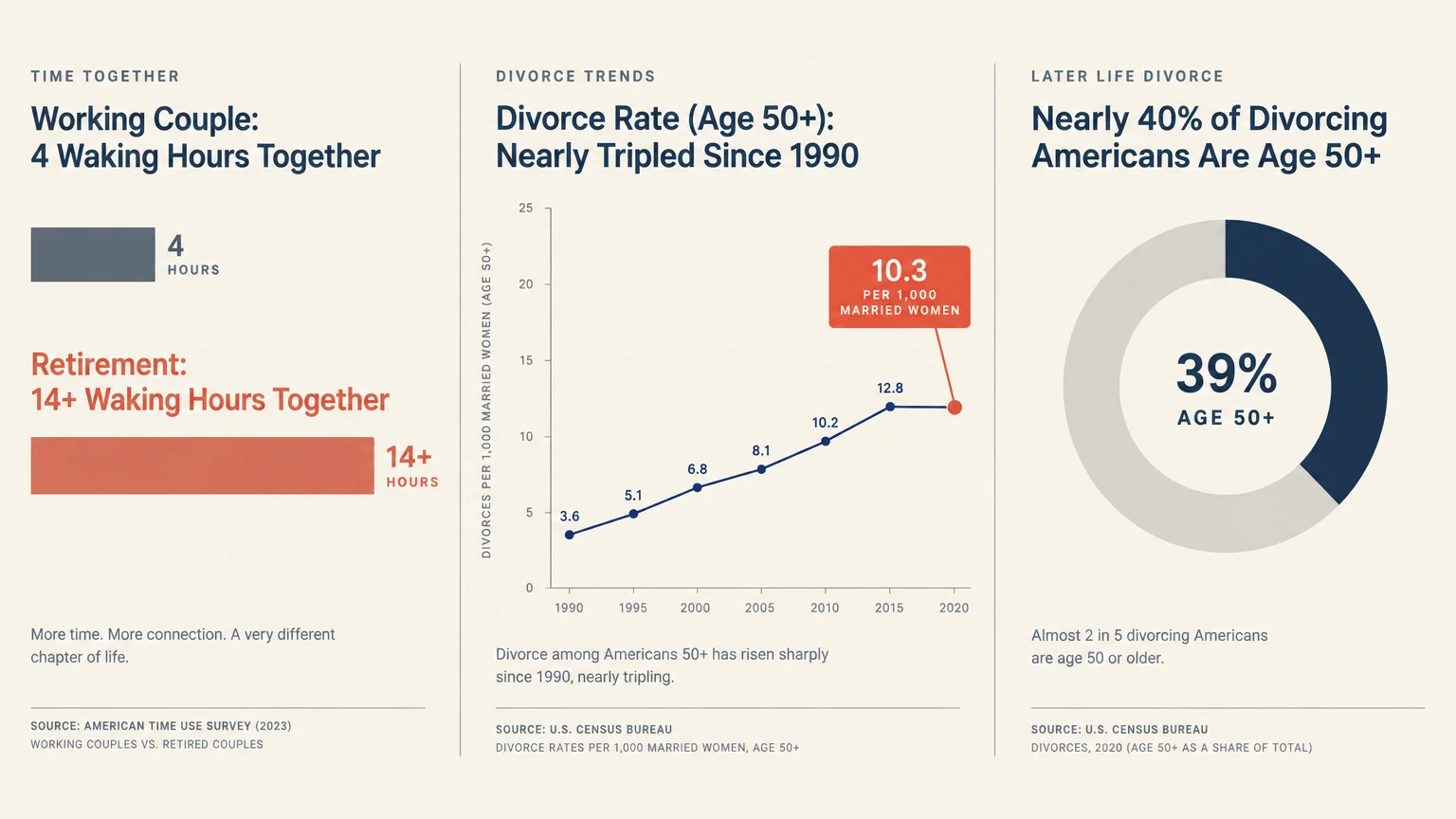
Most working spouses spend roughly four waking hours together each weekday. In retirement, that number suddenly surges to fourteen or more hours of shared time.
This dramatic shift creates unexpected friction. Even happily married couples often struggle to adapt to the constant physical presence of their partner.
Loss of autonomy frequently sparks conflict over trivial matters. Spouses suddenly critique each other’s kitchen habits, driving styles, and grocery selections.
These persistent daily tensions can escalate into profound marital distress. When couples fail to establish boundaries, resentment quietly erodes mutual affection.
According to data from the Pew Research Center, the divorce rate among adults aged 50 and older has nearly tripled since 1990. It has reached 10.3 per 1,000 married women in that age bracket.
Furthermore, nearly 40% of all divorcing Americans are now 50 or older. Adults aged 65 and older represent the only demographic in the country where the divorce rate continues to climb.
Couples often find that work masked fundamental incompatibilities for decades. Without career demands to distract them, unresolved relational issues demand direct attention.
Protecting Your Personal Space
Preventing togetherness fatigue requires deliberate separation. You must grant each other permission to maintain independent interests without feeling guilty.
- Establish designated physical zones in the home where each spouse can work, read, or relax undisturbed.
- Schedule regular solo outings, volunteer commitments, or individual lunches with personal friends.
- Respect individual daily rhythms; if one partner wakes early while the other sleeps in, embrace the variance.
- Agree on clear daily downtime windows where neither partner makes demands on the other.
Healthy retirement adjustment requires balance. Cultivating independent pursuits strengthens the time you choose to spend together.
“Retirement is not just a financial transaction; it is an emotional renegotiation of your everyday relationship.” — Jean Chatzky, Financial Educator and Author

2. The Staggered Retirement Trap
Many couples plan on retiring together on the exact same date. Real life, however, frequently derails that tidy expectation.
Age differences, distinct pension criteria, health issues, or involuntary corporate layoffs often force one partner to exit the workforce first. Staggered retirements create immediate emotional and logistical imbalances.
The working partner often feels deep resentment while commuting every morning. They may perceive their retired spouse as lounging around without purpose.
Meanwhile, the retired spouse frequently suffers from unaddressed guilt. They may feel awkward pursuing hobbies while their partner continues to earn a paycheck.
Household labor becomes an immediate flashpoint. The working spouse often assumes the retired partner will handle all domestic chores, cooking, and errands.
This unspoken expectation breeds silent frustration. The retired spouse may feel demoted from a valued professional to an unpaid domestic servant.
Aligning Expectations When Exits Diverge
Navigating staggered retirement requires an explicit renegotiation of household duties. You cannot rely on outdated assumptions about who does what.
Hold a formal meeting to reassign weekly domestic chores before the first spouse leaves their job. Write down the division of labor so both individuals feel respected.
Discuss leisure boundaries openly. Clarify whether the retired partner can travel alone or take up costly hobbies while the other works.
Establish shared routines for the evenings. Protecting couple time after the working spouse finishes their day keeps your emotional partnership strong.

3. Financial Secrets and Clashing Spending Personalities
Couples often discover they possess entirely incompatible philosophies about spending their hard-earned nest egg. One spouse may view retirement assets as freedom, while the other sees them as security.
Accumulating wealth requires disciplined saving, but decumulating wealth requires spending. Shifting from saving to spending provokes intense financial anxiety for conservative partners.
Research reveals startling gaps in how couples handle money. A study from Fidelity Investments found that while 85% of couples view themselves as good financial partners, only 29% regularly discuss day-to-day finances.
The same research showed that 49% of couples avoid talking about money to prevent arguments. Even worse, roughly one in four individuals admits to hiding a financial secret from their spouse.
Retirement exposes these hidden fault lines immediately. When regular paychecks stop arriving, discretionary purchases undergo unprecedented scrutiny from the more anxious partner.
Fidelity also reported that more than 50% of couples disagree on how much money they need to retire. Furthermore, 55% have no idea how much income they require to maintain their current lifestyle.
When one partner makes large unilateral purchases, the other experiences a loss of financial control. More than one in four spouses actively resents being excluded from major financial choices.
Establishing Financial Harmony
Eliminating money friction requires an objective structure rather than emotional debates. You need a transparent system that guarantees personal freedom alongside mutual accountability.
- Create separate “no-questions-asked” discretionary bank accounts funded with an agreed monthly allowance.
- Agree on a specific dollar threshold that requires mutual discussion before either spouse executes a purchase.
- Schedule a monthly financial review date to track cash flow and adjust annual withdrawal rates collaboratively.
- Automate monthly portfolio distributions into your joint checking account to simulate a steady corporate paycheck.
Removing the guesswork from monthly spending protects both your assets and your marital goodwill. Clear guardrails prevent minor retail choices from escalating into relationship crises.
4. The Shock of Out-of-Pocket Healthcare Costs and IRMAA
Many couples mistakenly believe Medicare functions as comprehensive, free health insurance for seniors. In reality, healthcare remains one of the largest budget drains couples face.
Fidelity’s annual retiree health care cost research indicates that 54% of pre-retirees mistakenly believe Medicare covers all medical expenses. This widespread misconception leaves thousands of households financially vulnerable.
According to Fidelity’s 25th annual report, a 65-year-old retiring individual can expect to spend an average of $185,500 out-of-pocket on healthcare throughout retirement. For a married couple, that projected average reaches an astonishing $371,000.
That staggering figure represents a 7.5% increase from prior estimates. Crucially, it does not include routine dental procedures or long-term nursing care.
Basic government coverage carries substantial monthly charges. Official figures from Medicare.gov set the standard Medicare Part B monthly premium at $202.90 per person.
That means a retired couple pays a mandatory base of $405.80 every month just for outpatient coverage. Supplemental Medigap plans and Part D prescription coverage add hundreds more.
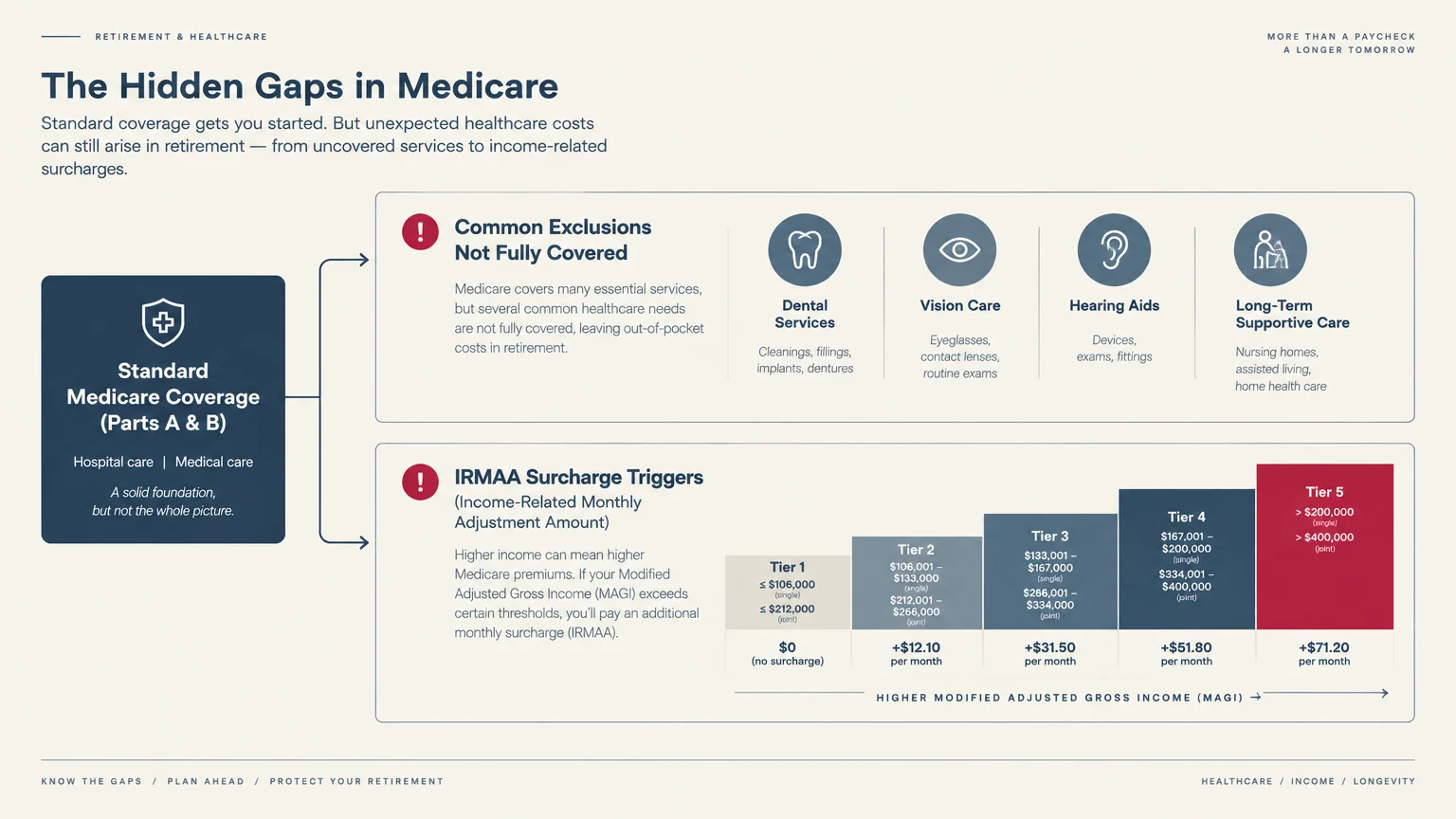
High-income couples face an even larger hurdle known as IRMAA, the Income-Related Monthly Adjustment Amount. This surcharge inflates both Part B and Part D premiums significantly.
The IRMAA surcharge triggers when your Modified Adjusted Gross Income (MAGI) from two years prior exceeds $218,000 for married couples filing jointly. For single filers, the threshold sits at $109,000.
Large one-time events often trigger this penalty unexpectedly. Selling a property, realizing substantial capital gains, or completing sizable Roth conversions can trigger huge premium hikes two years later.
Controlling Your Healthcare Expenses
Managing healthcare expenses requires proactive tax planning alongside disciplined coverage selection. You must evaluate insurance policies annually to keep premiums contained.
If eligible, maximize Health Savings Account (HSA) contributions during your final working years. HSAs offer triple-tax advantages and provide tax-free distributions for qualified medical expenses in retirement.
Monitor your MAGI thresholds carefully when generating portfolio income. Staying just one dollar below an IRMAA tier saves a married couple thousands in added Medicare surcharges.
Work with an independent health insurance broker during each annual enrollment window. Prescription drug formularies and supplemental plan costs change frequently, making annual comparisons essential.

5. Social Circle Shrinkage and Emotional Dependence
Leaving a long career severs dozens of casual daily social interactions. Many professionals underestimate how much of their identity and community was tied to their workplace.
Men often suffer the steepest social drop-off upon leaving the workforce. They frequently rely on work colleagues for companionship, whereas women often maintain broader external community networks.
When external social connections evaporate, isolation sets in quickly. One partner often begins relying entirely on the other for conversation, entertainment, and emotional validation.
This dynamic places an exhausting burden on the more socially connected spouse. They may feel trapped by a partner who shadows them constantly throughout the house.
Couples often struggle when one spouse acts as an involuntary social director. Healthy partnerships require external emotional outlets and outside sounding boards.
Long-term emotional well-being depends on belonging to diverse networks. Relying exclusively on your spouse for all social interaction breeds relational suffocation.
Building a Robust External Network
Developing an active community outside your marriage safeguards your partnership. You must invest time into cultivating friends who share your personal passions.
- Join local recreational leagues, hiking groups, or fitness centers that cater to active older adults.
- Commit to regular volunteer work with community foundations, animal shelters, or educational mentoring programs.
- Take weekly continuing education classes at local community colleges to explore new subjects alongside peers.
- Reignite old friendships by scheduling monthly breakfasts or standing telephone dates with former colleagues.
Broadening your social horizons enriches your personal life. It also gives you fresh stories, perspectives, and vitality to bring home to your partner.
6. The “Third Partner” Effect: Family Demands and Boundary Creep
Couples often envision retirement as uninterrupted freedom to travel and pursue personal hobbies. However, extended family members frequently develop their own plans for your newly available time.
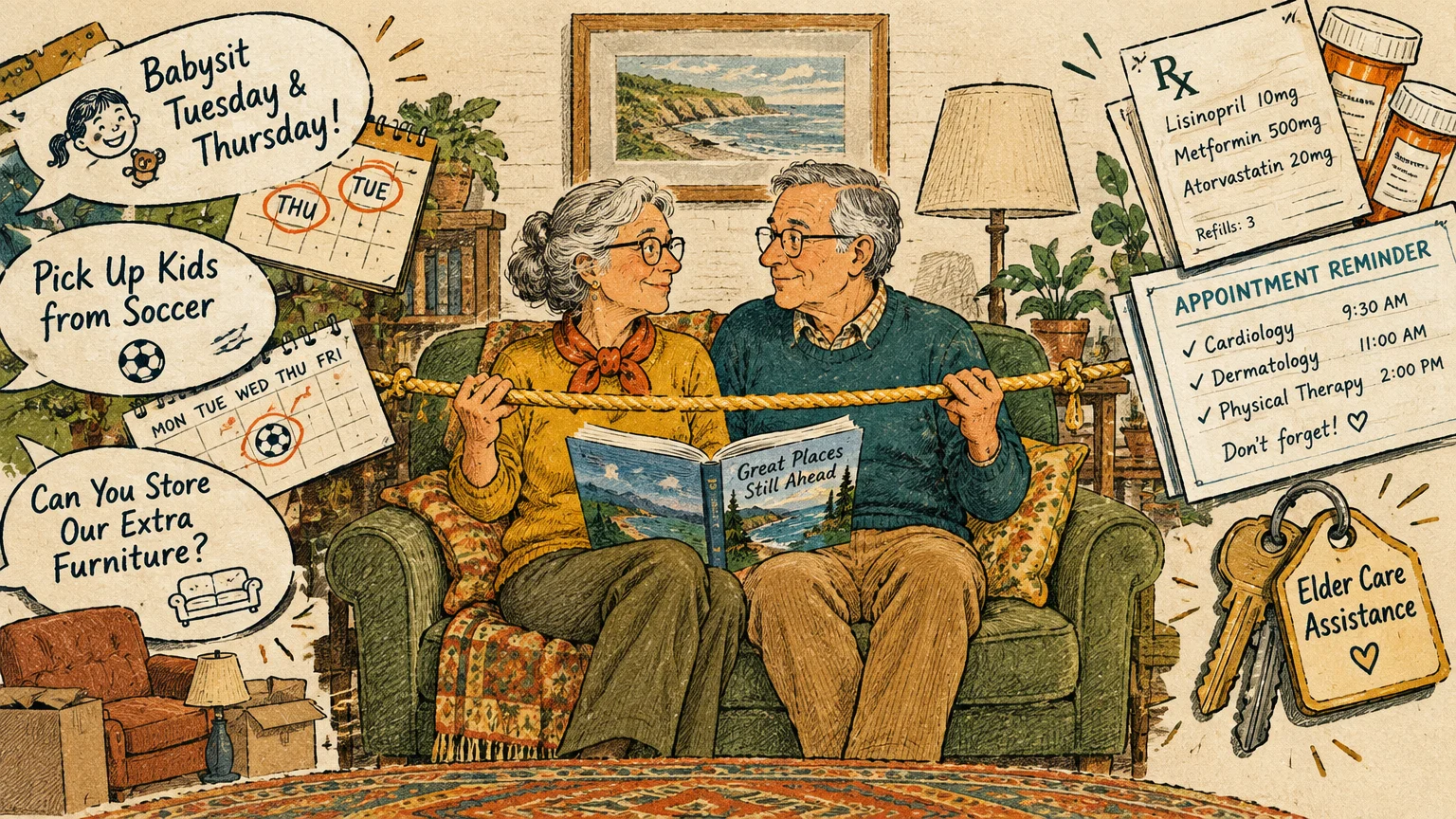
Adult children may assume retired grandparents are eager to provide free, full-time childcare. While helping with grandchildren brings deep joy, unpaid daily babysitting quickly transforms into an exhausting second career.
At the same time, many retirees find themselves caring for aging parents in their eighties or nineties. Balancing eldercare with family life creates immense emotional and physical exhaustion.
Financial boundaries represent another critical hazard for couples. Disagreements over providing financial assistance to adult children can cause deep rifts between spouses.
One parent may want to rescue a struggling child financially, while the other demands financial tough love. Siphoning capital to assist adult children directly imperils your own long-term retirement solvency.
Research from AARP demonstrates that financial support to adult family members frequently derails retirement plans. Spouses must present a unified front to protect their shared financial security.
Preserving Boundaries with Extended Family
Protecting your retirement years requires clear, compassionate boundaries. You cannot allow external demands to govern your daily calendar or drain your assets.
Discuss your caregiving limits as a couple before making commitments to family members. Decide together how many hours per week you can comfortably allocate to childcare or eldercare.
Communicate your availability clearly to your adult children. Explain that while you love supporting them, your retirement schedule includes personal commitments that cannot be dismissed.
Establish strict mutual rules regarding financial gifts or loans to relatives. Adopt an unbreakable policy that neither spouse provides financial assistance without the explicit consent of the other.
7. The Devastating “Widow’s Penalty” Tax and Income Drop
The final and most catastrophic surprise facing couples is the dramatic financial shift that occurs when one spouse passes away. Surviving spouses encounter a sudden reduction in income combined with sharp tax increases.
Longevity statistics show that one partner will almost certainly spend years managing the household alone. According to official period life tables from the Social Security Administration, a 65-year-old man lives an average of 17.9 additional years, reaching age 82.9.
By contrast, a 65-year-old woman lives an average of 20.7 additional years, reaching age 85.7. Because wives often outlive their husbands, women bear the brunt of the survivor tax shock.
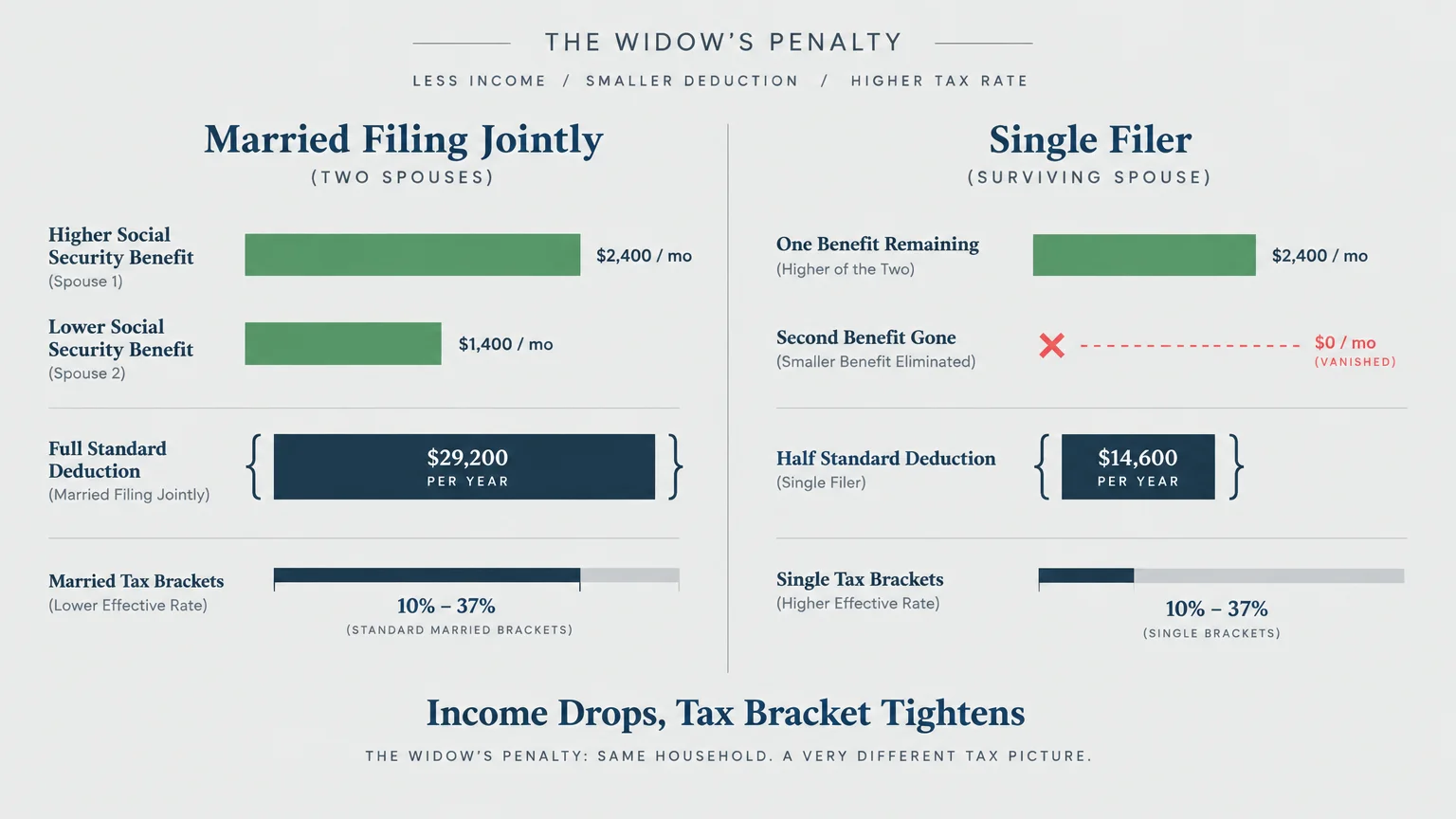
When the first spouse passes away, the household loses one of its two Social Security checks. The surviving spouse keeps only the larger of the two benefits, forfeiting the smaller check entirely.
This statutory rule instantly cuts household Social Security cash flow by 30% to 50%. Yet core household living costs—such as property taxes, home insurance, and utilities—rarely drop when a spouse dies.
Making matters worse, the surviving spouse faces a punishing tax trap enforced by the Internal Revenue Service. In the year following their spouse’s death, their tax filing status shifts from Married Filing Jointly to Single.
Single tax brackets are roughly half as wide as married brackets. For example, the 22% federal tax bracket begins at just $50,400 of taxable income for single filers, compared to $100,800 for married joint filers.
Simultaneously, the standard deduction plummets. Under current tax provisions, the standard deduction for a married couple where both are 65 or older sits at $35,500.
For a single senior, that deduction drops all the way down to $18,150. Consequently, a surviving spouse pays higher federal taxes on a smaller household income.
The single filing status also cuts IRMAA income brackets in half. A survivor earning $110,000 suddenly triggers substantial Medicare premium surcharges that never applied while their partner was alive.
“The tax code punishes surviving spouses with compressed brackets, turning a tragic life event into a severe financial penalty.” — Ed Slott, CPA and Retirement Specialist
Financial Reality Check: Married Joint Filers vs. Surviving Single Filer
The table below illustrates the stark tax and benefit shifts that occur when a household transitions from a married couple to a single survivor.
| Financial Measure | Married Filing Jointly (Both 65+) | Single Filer (Survivor 65+) | Household Impact |
|---|---|---|---|
| Social Security Checks | Two monthly benefit checks | One benefit check (the higher amount) | 30% to 50% loss of guaranteed benefit income |
| Standard Tax Deduction | $35,500 | $18,150 | $17,350 reduction in sheltered income |
| 22% Tax Bracket Threshold | Begins at $100,800 taxable income | Begins at $50,400 taxable income | Income enters higher tax brackets much faster |
| IRMAA Surcharge Threshold | Begins at $218,000 MAGI | Begins at $109,000 MAGI | Medicare surcharges trigger at half the prior income |
Mitigating the Widow’s Penalty in Advance
Couples must take proactive steps while both partners are alive to shield the eventual survivor from this tax crunch. Waiting until a partner passes away eliminates your most powerful planning tools.
Execute systematic Roth IRA conversions while both spouses are living. Converting pre-tax balances under lower married tax brackets eliminates mandatory distributions that would later hammer a single filer.
Optimize Social Security claiming strategies to maximize the survivor benefit. The higher-earning spouse should delay claiming benefits until age 70 to lock in the largest possible lifetime payment for the survivor.
Consider permanent life insurance to replace lost Social Security cash flow. Death benefits pass to the surviving spouse completely income-tax-free, providing vital liquidity without triggering higher tax brackets.

When DIY Isn’t Enough
While many couples manage day-to-day retirement planning independently, certain complex transitions demand professional guidance. Involving an objective third party often resolves gridlock and prevents expensive mistakes.
Consider consulting a fee-only Certified Financial Planner or tax specialist under the following circumstances:
- Significant Age Disparities: When spouses are separated by five or more years, coordinating retirement dates, pension elections, and Required Minimum Distributions becomes mathematically intricate.
- Aggressive Roth Conversion Strategies: Calculating the precise annual dollar amount to convert without triggering higher Medicare IRMAA surcharges requires precise multi-year modeling.
- Persistent Investment Clashes: If one partner insists on conservative cash holdings while the other demands aggressive equity allocations, an objective fiduciary can construct a balanced compromise.
- Complex Blended Family Estates: Ensuring surviving spouses remain financially protected while preserving inheritances for biological children demands specialized legal trusts and estate documentation.
A qualified advisor acts as an impartial facilitator. They help remove emotional friction from sensitive financial choices, allowing couples to move forward with confidence.

Avoiding Common Errors
Preventing retirement surprises requires avoiding the habitual oversights that derail other couples. Small adjustments in your pre-retirement planning prevent major marital disruptions later.
Do not assume your partner shares your exact vision of an ideal retirement. Sit down together and document your individual goals regarding travel frequency, housing locations, and weekly activities.
Avoid neglecting critical legal documents. Ensure healthcare powers of attorney, living wills, and durable financial proxies are updated and stored where both spouses can access them immediately.
Never treat retirement as an endless vacation. Vacations lack structure, but sustained physical and mental vitality requires a steady sense of routine, accountability, and purpose.
Finally, avoid keeping your partner in the dark regarding digital logins and financial accounts. Both spouses must know where primary assets reside, how bills are paid, and who to contact in an emergency.
Frequently Asked Questions
Why do so many couples struggle to adjust during the first year of retirement?
The initial year disrupts decades of established daily routines, personal space, and professional validation. Couples often underestimate how much identity was tied to work and struggle to manage constant shared time.
How should we handle retirement if we cannot retire at the same time?
Acknowledge the emotional challenge openly and rebalance household domestic responsibilities immediately. Establish clear agreements regarding solo leisure activities, travel boundaries, and evening couple time to prevent lingering resentment.
What is the most effective way to protect a spouse from the widow’s penalty?
Delay the higher earner’s Social Security claim until age 70 and execute strategic Roth conversions while filing jointly. These moves minimize future taxable distributions and maximize guaranteed survivor income.
Does Medicare cover assisted living or long-term nursing home care?
No, standard Medicare does not pay for custodial long-term care or assisted living facilities. Couples must fund these extensive costs through private long-term care insurance, dedicated personal savings, or Medicaid spend-down strategies.
Navigating Your Shared Future
A rewarding retirement does not happen by accident; it requires ongoing emotional honesty, financial alignment, and mutual flexibility. By openly addressing these seven common surprises, you protect both your retirement nest egg and your marriage.
Take time this week to discuss these topics with your partner. Initiating honest conversations today ensures your retirement years become a rewarding chapter of shared discovery.
This is educational content based on general retirement planning principles. Individual results vary based on your situation. Always verify current benefit amounts, tax laws, and eligibility with official sources.
Last updated: October 2026. Retirement benefits, tax laws, and healthcare costs change frequently—verify current details with official sources.