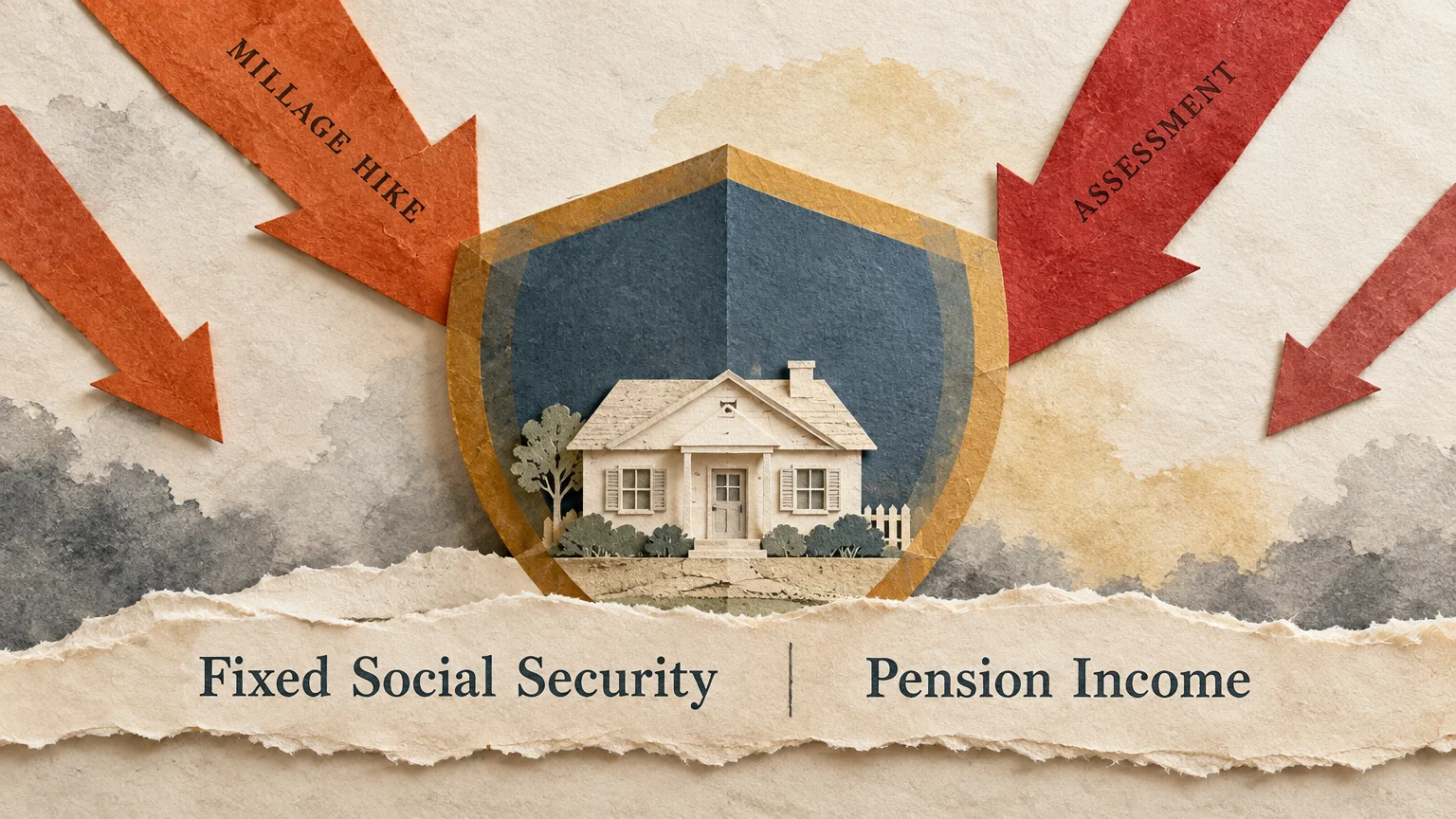
Soaring property taxes can quietly derail your retirement budget by eating away at fixed Social Security and pension income. Fortunately, strategic homeowners can slash their annual bills to near zero by leveraging specific state exemptions, assessment freezes, and unique local tax codes.
While finding a complete property tax holiday across an entire state is rare, several jurisdictions offer mechanisms that effectively wipe out your tax obligations. Whether through statutory valuation discounts or total school tax eliminations, you have clear avenues to safeguard your retirement wealth.
Why Fixed-Income Budgets Need Property Tax Shields
Property taxes represent an ongoing expense that follows you even after you pay off your mortgage. Unlike income taxes, local assessors levy property taxes regardless of whether your portfolio gains value or your income drops.
According to the Consumer Financial Protection Bureau, housing costs remain the largest single expenditure for Americans over age 65. Unexpected assessment hikes can create sudden budget deficits for seniors living on set monthly distributions.
Planning your retirement destination around property tax relief protects your cash reserves from aggressive municipal millage increases. By selecting states with senior-friendly laws, you turn a volatile liability into a stable, manageable line item.
“A budget is telling your money where to go instead of wondering where it went.” — Dave Ramsey, Personal Finance Author

12 Places Where Property Taxes Disappear for Retirees
Every state structures property taxes differently through millage rates, assessment ratios, and exemption tiers. The following twelve jurisdictions offer statutory relief programs that can virtually eliminate your annual real estate taxes.
1. Alaska: The Unorganized Borough and $150,000 Senior Exemption
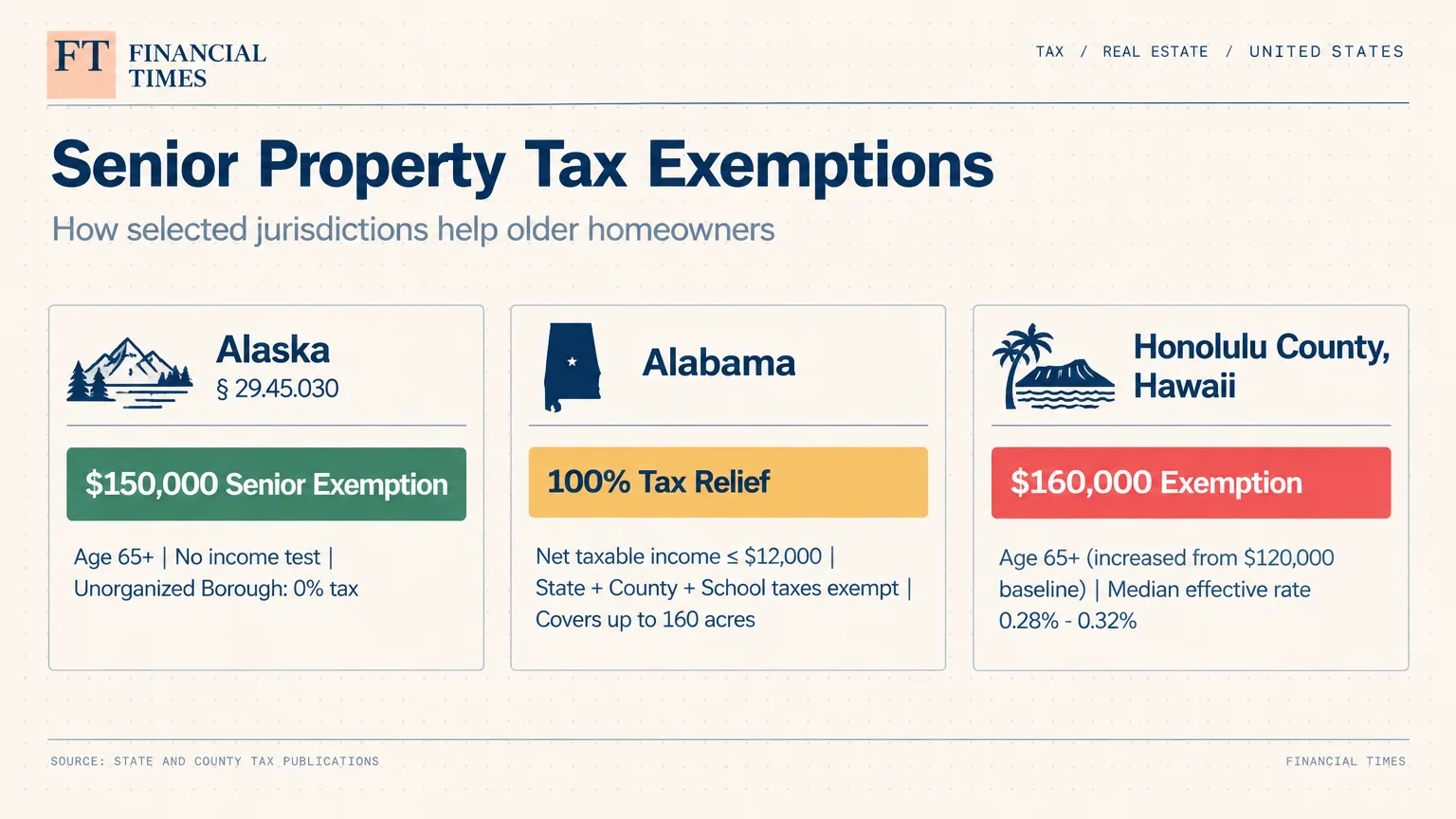
Alaska provides one of the most generous statewide statutory exemptions in the country. Under Alaska Statute § 29.45.030, municipalities must exempt the first $150,000 of assessed value on a primary residence for owners aged 65 and older.
This state-mandated benefit requires no income test, meaning your retirement savings will not disqualify you. Several individual boroughs voluntarily expand this exemption even further to shield long-term senior residents from housing pressure.
If you want to eliminate property taxes entirely, look at Alaska’s vast Unorganized Borough. This region covers more than half the state and contains zero municipal property tax levies across its unincorporated communities.
2. Alabama: 100% Tax Relief for Low-Income Seniors
Alabama boasts one of the lowest effective property tax rates in the nation at roughly 0.40%. The state constitution automatically exempts every homeowner aged 65 and older from the state portion of ad valorem property taxes.
For seniors on modest fixed incomes, Alabama eliminates property taxes altogether. If your annual net taxable income is $12,000 or less, you qualify for a complete exemption from all state, county, and school taxes.
This full exemption covers your primary residence and up to 160 adjacent acres. Even higher-income seniors pay negligible amounts because baseline county millage rates remain remarkably modest throughout the state.
3. Hawaii: Nation-Leading Low Rates and Senior Base Reductions
Hawaii carries the lowest median effective property tax rate in the United States, typically between 0.28% and 0.32%. While mainland property values receive sharp tax levies, island counties maintain rock-bottom baseline residential rates.
Honolulu County provides a baseline homeowner exemption of $120,000 on primary residences. Once you turn 65, that statutory deduction automatically increases to $160,000, drastically lowering your taxable property value.
A retiree owning a modest home on Oahu frequently pays less than $800 in total property taxes each year. Generous assessment caps also prevent dramatic annual tax spikes when local real estate appreciates.
4. South Carolina: Complete School Tax Relief Under Act 388
South Carolina enacted landmark property tax reform through Act 388, which reshaped senior housing costs. The law permanently exempts all legal, owner-occupied primary residences from 100% of property taxes earmarked for school operations.
School operating taxes typically generate the majority of a homeowner’s real estate bill. Removing this component immediately cuts your municipal tax burden in half before applying any individual credits.
Under South Carolina Code § 12-37-250, homeowners aged 65 and older receive an additional $50,000 fair-market-value Homestead Exemption. Against the state’s low 4% residential assessment ratio, this exemption frequently lowers final bills to negligible municipal fees.
5. Mississippi: Erasing Ad Valorem Taxes on Modest Homes
Mississippi offers straightforward relief that shields thousands of retirees from ad valorem taxation. Under Mississippi Code § 27-33-67, homeowners aged 65 and older are completely exempt on the first $75,000 of true home value.
In practice, the state translates this into a $7,500 assessed-value deduction against your property. In many affordable rural and suburban Mississippi towns, homes assess below this $75,000 true-value ceiling.
When your home’s value falls under that statutory limit, your resulting annual ad valorem tax bill is exactly $0. For higher-value properties, you only pay taxes on the remaining margin above the $75,000 threshold.
6. Louisiana: The Permanent Senior Assessment Freeze
Louisiana maintains an effective property tax rate of around 0.56%, making homeownership affordable across the state. All residents first receive a baseline homestead exemption on the initial $75,000 of fair market value.
Once you reach age 65, Louisiana provides an even more powerful wealth-preservation shield: the Special Assessment Level. Homeowners with an adjusted gross income under roughly $100,000 can lock in their residential property valuation permanently.
This statutory freeze protects your home from future market-driven assessment hikes. Even if neighborhood values triple over your retirement years, your assessed value stays pinned at its baseline level.
7. Texas: The Over-65 School Tax Ceiling
Texas has notoriously high baseline property taxes, but its over-65 exemptions offer unmatched defense against rising costs. Primary homeowners receive an automatic $100,000 residence homestead exemption against local school district property taxes.
When you reach age 65, you receive an additional $10,000 school exemption, alongside various optional county-level deductions. More importantly, the Texas Tax Code establishes a permanent, constitutional school tax ceiling for seniors.
This school tax ceiling freezes your total dollar payment to the school district forever. Your school bill can never exceed what you paid when you turned 65, neutralizing local tax hikes for life.
“You can’t control what happens in Washington, but you can control where you hold your assets and how they are taxed.” — Ed Slott, CPA and Tax Specialist
8. Wyoming: Half-Price Assessments for Longtime Residents
Wyoming assesses residential property at an exceptionally low ratio of just 9.5% of market value. With no state personal income tax, the state remains a premier haven for conservative retirement planning.
Wyoming legislators expanded property tax relief through House Bill 3 to protect senior homeowners. Under this law, seniors aged 65 and older who have paid state residential taxes for 25 years receive a 50% assessed-value exemption.
The state also enforces a statutory 4% cap on year-over-year assessment increases on primary residential properties. These combined provisions keep residential tax liabilities predictable and extraordinarily low over extended horizons.
9. West Virginia: Low Baseline Rates and Homestead Relief
West Virginia offers a statewide median effective property tax rate of roughly 0.57%. Modest home valuations across the state provide an inherently low tax baseline for incoming retirees.
The West Virginia Senior Citizens Homestead Exemption strengthens this affordability for residents aged 65 and older. If you have lived in the state for two consecutive years, the program exempts the first $20,000 of assessed valuation.
Because West Virginia assesses property at 60% of appraised value, this program shields roughly $33,333 in true market value. In many smaller communities, this deduction cuts annual property bills to under $300.
10. Arkansas: Amendment 79 Valuation Freezes and Annual Credits
Arkansas Constitution Amendment 79 provides dependable tax relief designed specifically for older homeowners. When you turn 65, the assessed valuation of your primary residence freezes indefinitely against general inflation.
The county assessor cannot increase your home’s taxable value unless you complete substantial new construction or structural additions. This freeze locks your underlying tax base for the duration of your retirement.
Arkansas also automatically applies a state Homestead Tax Credit of up to $500 directly against your final bill. On modest homes, this annual credit wipes out most or all remaining municipal property liabilities.
11. Georgia (Cobb and Cherokee Counties): Zero School Property Taxes
While Georgia’s statewide property taxes are moderate, specific counties offer premier senior exemptions. School system taxes typically make up 50% to 70% of a homeowner’s total annual property tax bill in the state.
Cobb County completely exempts homeowners aged 62 and older from all school operating and school bond taxes. The basic senior school exemption requires no income test, dropping typical suburban tax bills by thousands of dollars.
Neighboring Cherokee County similarly offers a 100% school property tax exemption for residents aged 62 and older. By eliminating the school board portion, seniors only pay small baseline amounts for essential county emergency services.
12. Puerto Rico: The 1957 Valuation Assessment Shield
As a United States territory, Puerto Rico provides a unique statutory framework for primary homeowners. Under the Puerto Rico Municipal Code (Ley 107-2020), primary residences receive an exemption on the first $15,000 of assessed value.
The municipal revenue agency, CRIM, does not calculate assessed values using modern real estate market prices. Instead, local assessments remain anchored to statutory 1957 replacement cost formulas and historic land valuations.
Because of this legacy valuation formula, homes with current market values between $150,000 and $200,000 frequently show assessed values under $15,000. Thousands of retirees living on the island legally pay exactly $0 in annual property taxes.
Property Tax Exemption Comparison by Jurisdiction
Reviewing tax structures side by side reveals how different states deliver savings to retirees. The following table illustrates the primary senior relief mechanisms across these twelve jurisdictions.
| Jurisdiction | Minimum Age | Primary Relief Mechanism | Income Restrictions |
|---|---|---|---|
| Alaska | 65 | $150,000 assessed value deduction; 0% tax zones | None statewide |
| Alabama | 65 | State tax waiver; 100% exemption for low earners | $12,000 net taxable limit for 100% relief |
| Hawaii | 65 | $160,000 exemption (Honolulu); lowest U.S. effective rate | None in major counties |
| South Carolina | 65 | 100% school operating tax waiver + $50,000 deduction | None |
| Mississippi | 65 | First $75,000 in true market value exempt | None |
| Louisiana | 65 | $75,000 homestead baseline + permanent assessment freeze | Income cap (~$100,000 AGI) |
| Texas | 65 | $110,000 school deduction + permanent school tax freeze | None |
| Wyoming | 65 | 50% assessment cut for 25-year resident taxpayers | None |
| West Virginia | 65 | $20,000 assessed valuation deduction | None (requires 2-year residency) |
| Arkansas | 65 | Permanent assessment freeze + up to $500 tax credit | None |
| Georgia (Select) | 62 | 100% senior school operating and bond tax exemption | Varies by county (None in Cobb) |
| Puerto Rico | None (Primary) | $15,000 exemption based on 1957 historical cost values | None |

Common Mistakes to Avoid When Claiming Senior Exemptions
Tax relief programs rarely take effect automatically. Failing to understand filing requirements can leave you paying high taxes you could easily avoid.
- Missing the annual filing deadline: Most county appraisal districts require initial applications between January 1 and April 30. Missing this statutory window forces you to wait an entire calendar year.
- Assuming exemptions transfer automatically: Senior exemptions never carry over from your previous address or prior owner. You must submit fresh documentation whenever you move into a new primary residence.
- Overlooking re-certification rules: Some income-restricted exemptions require annual or biannual income certification. Check your local assessor’s policies to maintain your active standing.
- Failing to update your driver’s license: County assessors require valid state identification showing your property address. Update your official identification immediately after closing to avoid claim rejections.
According to guidance from AARP, thousands of eligible seniors miss out on valuable municipal exemptions every year simply because they never submit the baseline paperwork.

Professional vs. Self-Guided Property Tax Management
Deciding whether to manage your senior property tax filings on your own or hire a specialist depends on your financial complexity. Consider these practical scenarios before tax season begins.
Scenario 1: Filing a standard age-based homestead deduction. If your state offers an exemption based entirely on age without income limits, managing it yourself is simple. You generally need to submit a one-page form and a copy of your driver’s license to your county tax office.
Scenario 2: Moving your primary residence into a revocable living trust. Retitling real estate into an estate planning trust can inadvertently invalidate certain local homestead exemptions. In this case, consult your estate attorney to ensure the trust paperwork retains your senior tax exemptions.
Scenario 3: Navigating multi-source retirement income caps. If your state limits full tax exemptions to seniors under strict income thresholds, professional advice is valuable. A certified financial planner can coordinate Social Security Administration benefits, pension income, and IRA withdrawals to protect your eligibility.
Working with a tax accountant can clarify how mandatory distributions impact your adjusted gross income under local property rules. Reviewing updated standard deduction figures through the Internal Revenue Service helps ensure you stay below regional income limits.
Frequently Asked Questions About Senior Property Taxes
Do senior property tax freezes stop all tax increases?
No, an assessment freeze only locks the valuation of your real estate or specific tax line items. If your local municipality or county raises its general millage rate, your bill may still fluctuate slightly.
Can I claim senior property tax exemptions on a second home?
No, senior homestead exemptions and assessment caps apply exclusively to your primary, owner-occupied residence. Second homes, vacation rentals, and pure investment properties are taxed at full commercial or residential rates.
What happens to a senior property tax ceiling when one spouse passes away?
Most state laws protect surviving spouses who are at least 55 years old when their partner passes. The surviving spouse typically inherits the frozen valuation or tax ceiling as long as they retain primary ownership.
Will selling my home reset my property tax ceiling?
Yes, selling your home and purchasing a new property generally resets your baseline tax assessment. However, states like Texas permit seniors to transfer the proportional value of their frozen school tax ceiling to a new home.
Final Considerations for Your Retirement Move
Minimizing property taxes requires choosing the right state and filing your local exemption paperwork promptly. Researching county assessment policies before buying a home ensures you keep fixed housing costs predictably low.
The information in this guide is meant for educational purposes. Your specific circumstances—including income, savings, health coverage, and goals—may require different approaches. When in doubt, consult a licensed professional.
Last updated: February 2026. Retirement benefits, tax laws, and healthcare costs change frequently—verify current details with official sources.