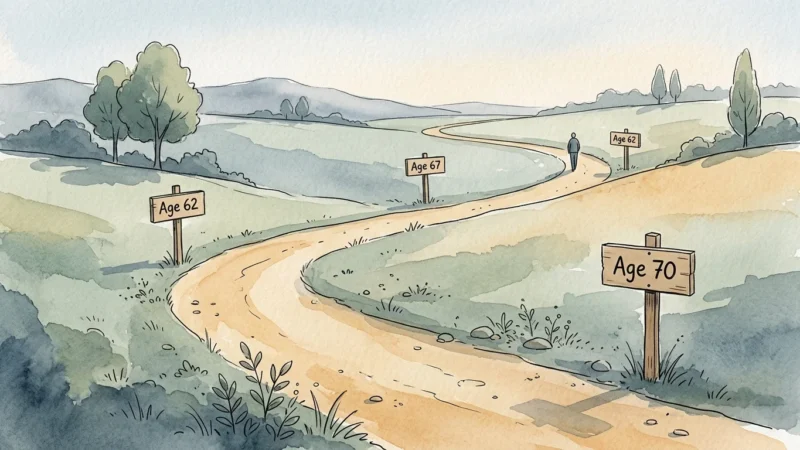
Navigating retirement without a spouse means your Social Security strategy rests entirely on your personal earnings record. While never-married individuals cannot claim spousal, ex-spousal, or survivor benefits, claiming Social Security alone offers complete control over your financial timeline without coordinating with a partner. You need 40 work credits to qualify, and the Social Security Administration calculates your monthly payout based on your highest 35 years of indexed earnings. Understanding how timing affects your check allows you to maximize your lifetime wealth. Whether you choose to claim early at 62 or delay until age 70 for an 8% annual boost, tailoring your strategy protects your solo retirement.

The Essentials: Social Security Rules for Unmarried Retirees
Retiring as a single individual changes how you interact with federal benefit programs. Married couples often balance two work records, coordinate claiming dates, or rely on survivor protection to maintain household standard of living. When you claim Social Security as an unmarried adult, the system evaluates your application strictly through your direct contributions to the workforce.
- Sole Reliance on Personal Earnings: Your monthly benefit comes exclusively from the payroll taxes you paid throughout your working career.
- Zero Auxiliary Payouts: You cannot collect spousal benefits, ex-spousal benefits, or survivor benefits from another person’s record.
- Complete Strategic Autonomy: You do not need to factor in a partner’s age, health status, or secondary earnings when choosing when to start payments.
- Strict 35-Year Average Rule: The government averages your highest 35 years of earnings; missing years enter the equation as zeros.
- Enhanced Longevity Risk: Because no secondary check enters your household upon retirement, maximizing your primary lifetime benefit becomes your primary defense against inflation and longevity.

How the Social Security Administration Calculates Your Solo Benefit
To qualify for retirement benefits, you must accumulate work credits through covered employment. In 2026, you earn one work credit for every $1,890 in covered wages or self-employment income, up to the maximum of four credits per year for earning $7,560. Over your working life, you must earn a total of 40 credits—roughly equivalent to ten years of work—to unlock retirement payouts.
Once you reach basic eligibility, the Social Security Administration calculates your actual monthly payout using your Average Indexed Monthly Earnings (AIME). The agency indexes your historical earnings to reflect wage growth over time, selects your highest 35 earning years, and calculates your baseline payout, known as your Primary Insurance Amount (PIA). The maximum taxable earnings limit subject to Social Security payroll taxes stands at $184,500 in 2026; earnings above this threshold do not enter your calculation or incur payroll tax.
If you worked fewer than 35 years—perhaps due to caregiving duties, graduate education, illness, or periods of sabbatical—the calculation system inserts a $0 for every missing year. For instance, if you worked for 30 years, the agency averages five zero-earning years alongside your 30 active years. These zero-earning entries drag down your lifetime monthly average, permanently reducing your baseline check.
For context, the national average monthly Social Security benefit for retired workers in mid-2026 hovers between $2,030 and $2,084. However, single workers with high lifetime earnings who maximize their top 35 years can achieve much higher monthly checks.

Auxiliary Benefits You Cannot Access (and Why It Matters)
The Social Security program, established in 1935, was originally structured around traditional single-earner married households. As a result, Congress built auxiliary benefits designed to support dependent spouses and widows. Because you never legally married, you sit outside these secondary safety nets.
Demographic data highlights the growing importance of understanding these rules. According to data from the U.S. Census Bureau and the Pew Research Center, over 6.6% of adults aged 65 and older have never married; furthermore, roughly 25% of 40-year-olds today have never been married. This structural shift means millions of future retirees must build plans around solo worker benefits.
As a single retiree social security claimant, you cannot access three specific benefit categories:
- Spousal Benefits: Married individuals can receive up to 50% of a higher-earning spouse’s Full Retirement Age benefit if that amount exceeds their own worker check. Unmarried seniors receive $0 under this provision.
- Divorced-Spouse Benefits: Individuals who were previously married for at least 10 consecutive years can claim benefits based on an ex-spouse’s work record. Never-married seniors do not meet this statutory legal marriage threshold.
- Survivor Benefits: When a married worker dies, the surviving spouse can step into the deceased worker’s higher monthly check—collecting up to 100% of that payment. Unmarried seniors do not have a partner’s check to inherit upon bereavement.
Because you lack these auxiliary backups, every dollar of your base calculation matters. Organizations like the National Council on Aging emphasize that solo retirees must proactively build private savings or maximize their personal Social Security check to make up for the absence of dual-earner income buffers.
Timing Strategies: Maximizing Your Payout When Claiming Alone
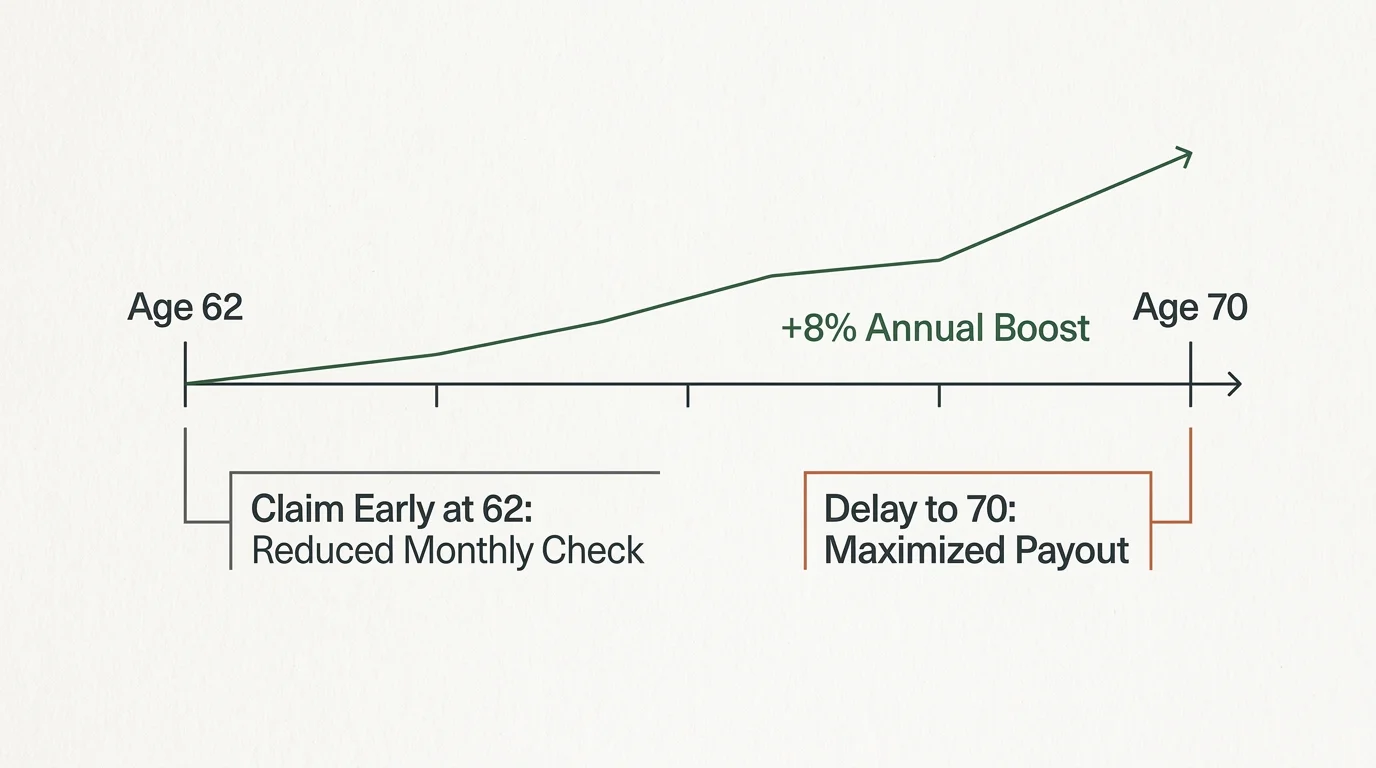
Your claiming age dramatically alters the monthly benefit you receive for the rest of your life. For individuals born in 1960 or later, Full Retirement Age (FRA) is exactly 67. You can claim benefits as early as age 62, but doing so permanently slashes your check; conversely, delaying your claim beyond FRA boosts your check through Delayed Retirement Credits.
If you claim at age 62, your payment drops by 30% compared to your FRA check. If your baseline FRA check is $2,000, claiming at 62 shrinks your monthly payment to $1,400. On the upper end of the scale, the maximum possible monthly benefit for someone claiming at age 62 in 2026 is $2,969.
If you wait until your FRA of 67, you receive 100% of your earned Primary Insurance Amount. The maximum monthly check at FRA in 2026 reaches $4,152 for top earners.
If you delay claiming past age 67, the government rewards you with Delayed Retirement Credits. Your benefit grows by 8% for every full year you delay, up until age 70. Delaying from age 67 to age 70 generates a permanent 24% increase in your base benefit. In 2026, the maximum monthly payout for an individual delaying until age 70 reaches $5,181.
“When you are single, your financial plan has no fallback option. Maximizing your guaranteed lifetime income stream—primarily Social Security—is the single most effective hedge against living out your retirement money.” — Jean Chatzky, Financial Journalist and Author
The table below demonstrates how claiming ages affect a hypothetical single worker whose Full Retirement Age baseline check is $2,500 per month:
| Claiming Age | Percentage of Full Benefit | Monthly Payment Example | Strategic Impact for Single Retirees |
|---|---|---|---|
| Age 62 | 70% | $1,750 | Provides early liquidity, but permanently locks in a 30% reduction with lower lifetime inflation protection. |
| Age 67 (FRA) | 100% | $2,500 | Delivers full baseline earned benefit without penalty or delay bonuses. |
| Age 70 | 124% | $3,100 | Maximizes guaranteed monthly income; provides the highest possible hedge against severe long-term inflation. |
Delaying until age 70 often represents the optimal move for single seniors in good health. Because you cannot rely on a spouse’s earnings or survivor payouts, maximizing your own guaranteed, cost-of-living-adjusted benefit creates an unmatched layer of income security as you age into your 80s and 90s.
The Single Tax Trap and Longevity Risks
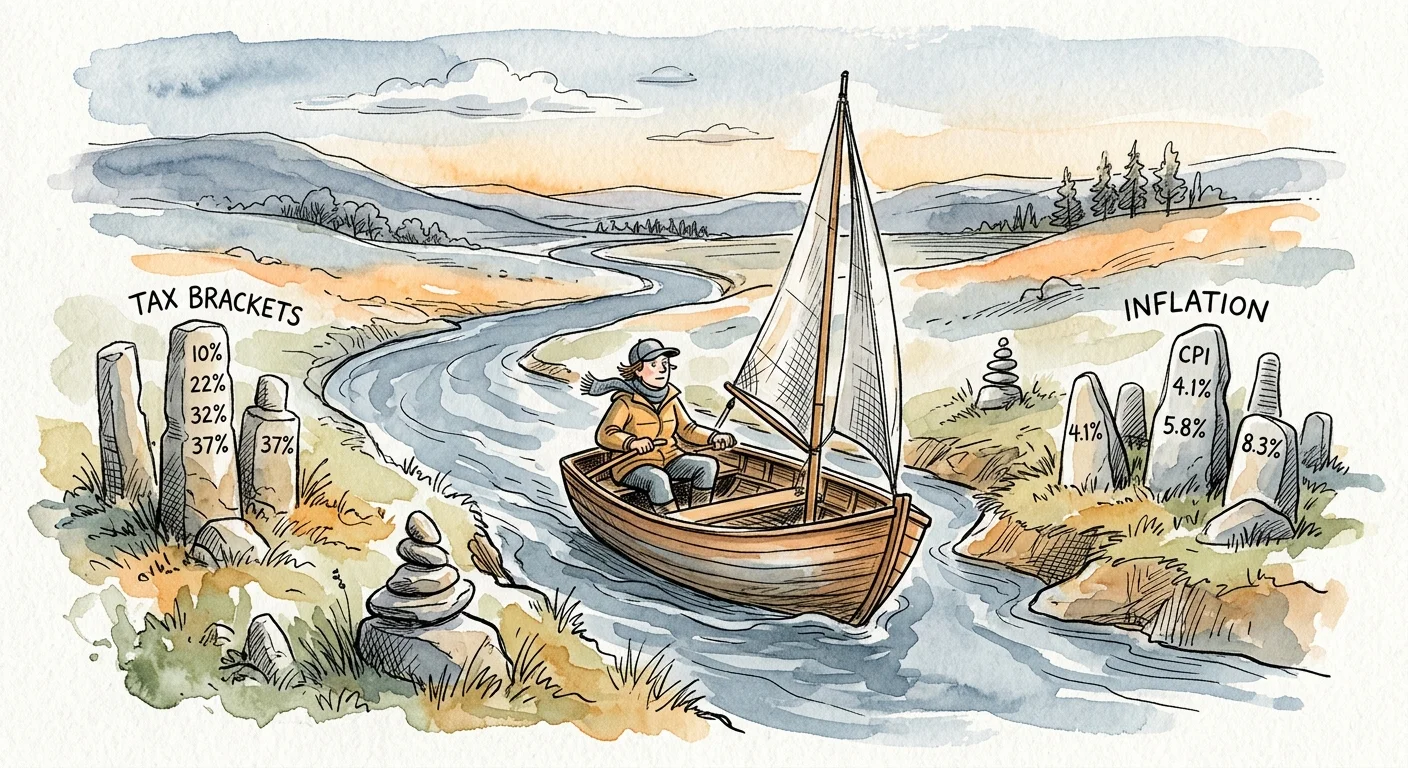
Single retirees face specific tax challenges that many married couples avoid. The federal thresholds for taxation on Social Security benefits depend on a figure known as your Combined Income (or Provisional Income). You calculate Provisional Income by adding your Adjusted Gross Income (AGI), non-taxable interest earnings, and 50% of your annual Social Security benefit.
According to current guidelines enforced by the Internal Revenue Service, single filers face benefit taxation at lower aggregate income limits:
- Provisional Income Under $25,000: 0% of your Social Security benefits are subject to federal income tax.
- Provisional Income Between $25,000 and $34,000: Up to 50% of your Social Security benefits become subject to ordinary federal income tax.
- Provisional Income Above $34,000: Up to 85% of your Social Security benefits become subject to federal income tax.
These tax thresholds have remained unindexed for inflation since Congress introduced them in 1983. Because wages and pensions have grown over the decades, a vast majority of single retirees who draw funds from traditional IRAs, 401(k) accounts, or pensions quickly cross the $25,000 threshold—subjecting 50% to 85% of their benefits to federal taxes.
Healthcare expenses present another major long-term consideration. Married couples can often care for one another during early periods of physical decline. Single seniors, however, frequently must purchase external support or move into assisted living facilities earlier. Furthermore, high individual income can trigger Medicare Part B and Part D Income-Related Monthly Adjustment Amounts (IRMAA) surcharges. Checking standard rates on Medicare.gov helps single filers anticipate how taxable income spikes from IRA withdrawals might trigger elevated Medicare premiums.

Avoiding Common Errors When Claiming Social Security Alone
Navigating social security benefits unmarried requires vigilant planning. Without a partner to double-check decisions, single applicants often make costly assumptions that degrade their financial independence.
Avoid these major errors when preparing your claiming strategy:
- Claiming Early Without Calculating Longevity: Taking reduced benefits at age 62 out of fear that Social Security will “run out” permanently handicaps your spending power in late retirement. If you live into your mid-80s, delaying yields a higher total lifetime payout.
- Ignoring Missing Earnings Years: Failing to review your official earnings record allows uncorrected zero-earning years to sit in your top 35-year calculation. You should log into your personal portal at the Social Security Administration to verify that past employers accurately reported every year of wages.
- Working While Claiming Early: If you claim Social Security before reaching your Full Retirement Age and continue to work, the earnings test applies. In 2026, if you earn above $23,400, the government temporarily withhold $1 for every $2 earned above the threshold, limiting your cash flow.
- Failing to Plan for RMD Tax Spikes: Taking Required Minimum Distributions (RMDs) from traditional retirement accounts at age 73 or 75 can push single filers into higher marginal tax brackets, instantly subjecting 85% of their Social Security checks to federal taxation.

When DIY Isn’t Enough: Scenarios Requiring Professional Advice
While many single seniors successfully manage their retirement planning independently, specific financial situations call for formal expertise. Navigating social security for single seniors sometimes intersects with complex tax, estate, and healthcare laws.
Consider seeking advice from a Certified Financial Planner (CFP) or tax professional in these scenarios:
- Structuring Tactical Roth Conversions: Converting funds from traditional tax-deferred accounts into Roth IRAs in your early 60s reduces future mandatory distributions. A fee-only financial planner can help you time conversions so you do not accidentally spike your provisional income or trigger Medicare IRMAA surcharges.
- Establishing Solo Estate Plans: Because you do not have a spouse to act as default legal heir or medical surrogate, you must explicitly designate financial Power of Attorney, healthcare proxies, and trust distributions to relatives or charitable organizations.
- Navigating Long-Term Care and Medicaid Spend-Downs: Securing long-term care insurance or establishing asset protection trusts protects your personal wealth from being consumed by nursing home costs before you become eligible for public assistance. Useful guidance on navigating these programs can be found through resources provided by Kiplinger and elder care specialists.
Frequently Asked Questions
Can I collect Social Security on a long-term partner’s record if we lived together but never legally married?
No. Social Security administration rules strictly require a legal marriage certificate to grant spousal, ex-spousal, or survivor benefits. Cohabitation—regardless of duration or joint financial arrangements—does not qualify you for auxiliary Social Security payouts under federal law.
What happens to my accumulated Social Security contributions if I pass away with no legal heirs?
Social Security operates as a social insurance framework rather than a personal investment account. If you pass away without a surviving spouse or eligible dependent children, your benefit payments end immediately. Remaining balances do not pass into your estate or go to nieces, nephews, or siblings.
Does working past age 65 increase my benefit if I already have 35 years of work?
Yes. The Social Security Administration recalculates your Primary Insurance Amount annually. If your current earnings in your late 60s are higher than one of the lowest indexed earning years in your historical top 35 years, the agency automatically replaces the lower year with your current higher earnings, permanently increasing your baseline check.
Are Medicare eligibility requirements different for single retirees?
No. Medicare eligibility begins at age 65 for all eligible citizens and legal residents, regardless of marital status. However, single filers cross Medicare Part B and Part D high-income premium thresholds (IRMAA) at individual tax limits that are lower than joint marital limits.
Strategic Next Steps for Solo Retirees
Claiming social security alone gives you full authority over your financial future. Because you operate without a secondary spousal safety net, building an intentional strategy ensures long-term comfort and security. Take these actionable steps today to position yourself for success:
First, create or sign into your online account at SSA.gov to review your official earnings statement. Confirm that all working years are accurately recorded, and review your estimated monthly payouts at ages 62, 67, and 70. Second, calculate your projected retirement expenses, paying special attention to housing and potential healthcare needs in your late 70s and 80s. Third, align your Social Security start date with your broader withdrawal strategy across IRAs, 401(k)s, and taxable accounts to minimize the single tax penalty. Taking control of these decisions early grants you confidence and long-term financial stability.
This is educational content based on general retirement planning principles. Individual results vary based on your situation. Always verify current benefit amounts, tax laws, and eligibility with official sources.
Last updated: February 2026. Retirement benefits, tax laws, and healthcare costs change frequently—verify current details with official sources.