
Losing a partner changes your daily life overnight, bringing deep grief alongside immediate financial shocks. You can preserve your financial stability by anticipating hidden expenses and tax shifts before they disrupt your security.
Household overhead rarely drops by half when one partner passes away, yet household income often falls dramatically. Favorable tax brackets and benefit structures tighten against surviving spouses rapidly.
Understanding these fifteen overlooked financial pitfalls empowers you to protect your hard-earned assets and maintain your long-term independence during an emotional life transition.
1. The Widow’s Tax Penalty and Compressed Brackets
Surviving spouses can file as Married Filing Jointly only for the tax year in which their partner died. After that single transition year, you must file as a Single taxpayer unless you maintain a qualifying dependent child.
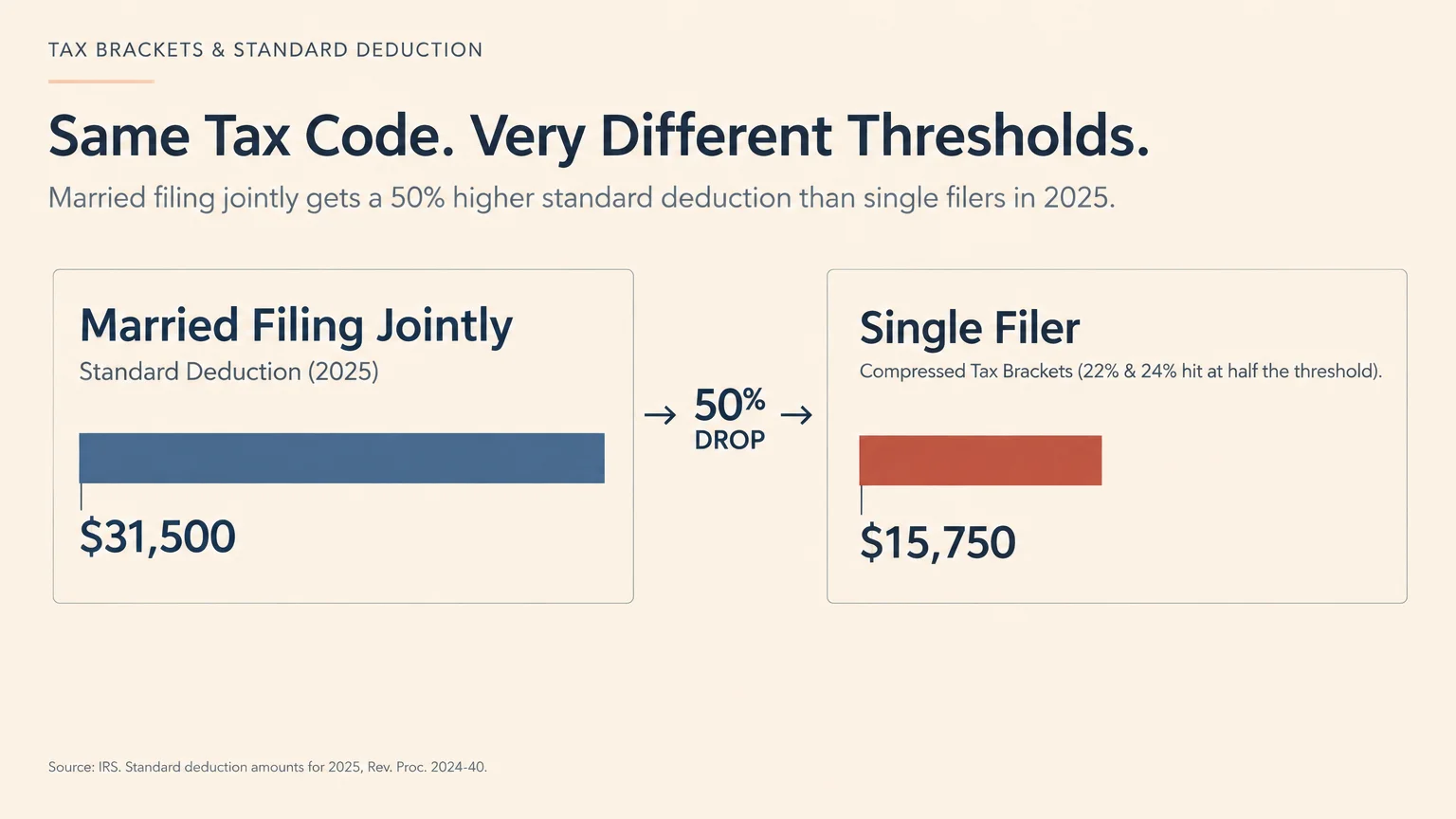
The Internal Revenue Service (IRS) cuts your standard deduction roughly in half when you transition to Single status. For tax year 2025, the joint standard deduction of $31,500 plummets to $15,750 for single filers.
Single tax brackets compress substantially. You reach higher marginal rates—such as the 22% and 24% brackets—at approximately half the taxable income threshold of married couples.
Consequently, you may owe significantly more in federal income taxes even if your total household revenue drops. This sudden tax acceleration catches many unprepared survivors off guard.

2. The Loss of a Social Security Benefit Check
Couples often rely on two monthly retirement benefits to manage their routine living costs. When your spouse passes away, the Social Security Administration (SSA) permanently eliminates the smaller benefit.
You retain the larger of the two payments, but you cannot keep both checks. This calculation creates an immediate and permanent drop in household monthly cash flow.
A study by the U.S. Government Accountability Office (GAO) found that women experience an average 37% decline in household income after the death of a spouse. Men experience an average drop of 22%.
Meanwhile, the federal government pays a one-time lump-sum death benefit of just $255 to eligible surviving spouses. Congress established this $255 figure in 1954, and the amount has never adjusted for inflation.
3. Unexpected Medicare IRMAA Surcharges
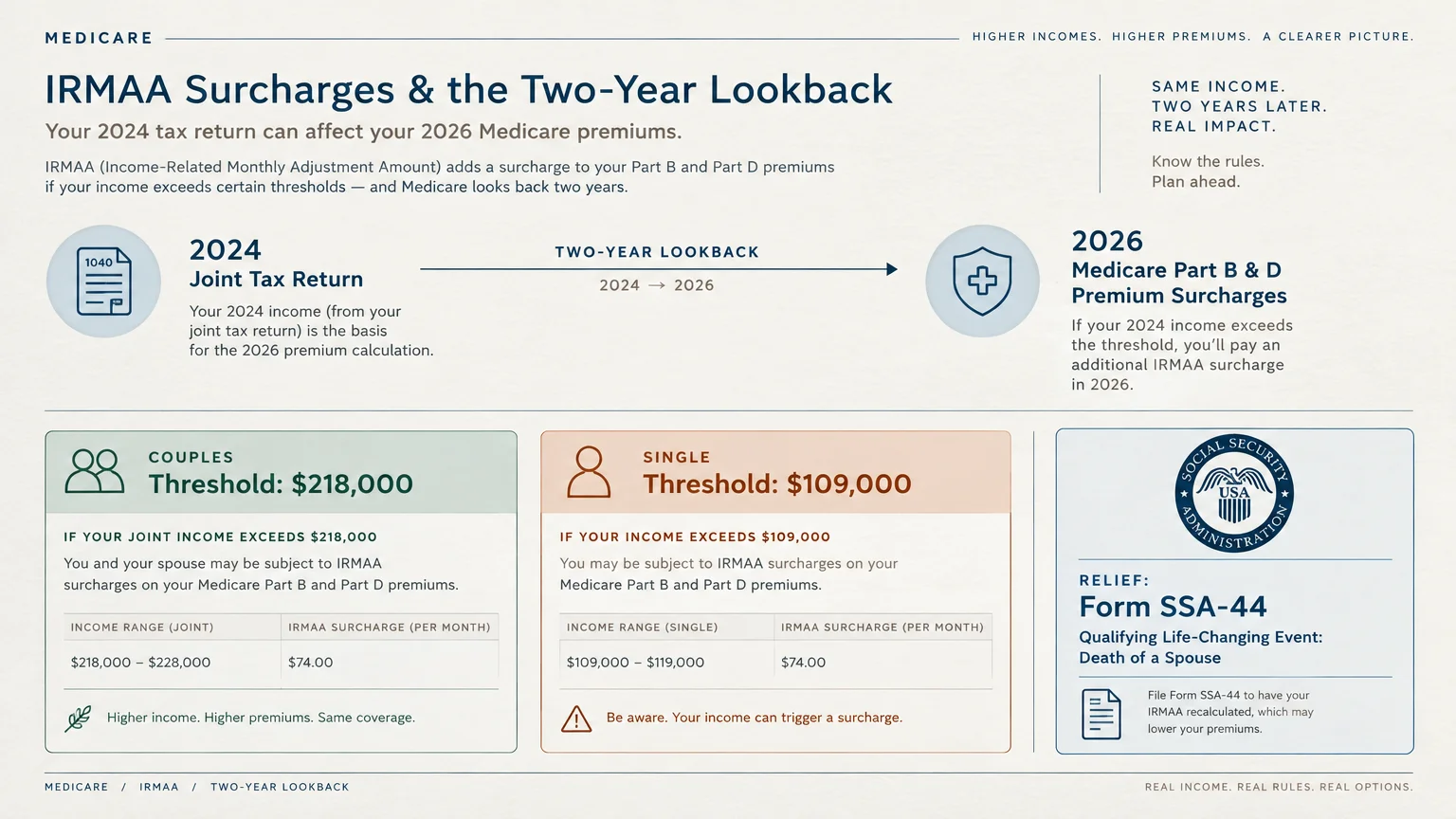
Medicare Part B and Part D premiums adjust upward for higher-income seniors through the Income-Related Monthly Adjustment Amount (IRMAA). The Centers for Medicare & Medicaid Services applies a two-year lookback period to determine surcharges.
Your 2026 Medicare premiums reflect the joint tax return you filed for 2024. Single filing thresholds are half the married thresholds, starting at $109,000 for singles versus $218,000 for couples in 2026.
Because of this lag, you may face steep individual surcharges based on your prior joint income. These surcharges deduct directly from your remaining monthly Social Security check.
You do not have to absorb this cost quietly. You can submit Form SSA-44 to the Social Security Administration, citing “Death of a Spouse” as a qualifying life-changing event to reduce your premiums.

4. The Two-Year Clock on Home Sale Capital Gains Exclusions
Internal Revenue Code Section 121 allows married couples filing jointly to exclude up to $500,000 of capital gains from primary home sales. Single homeowners receive an exclusion capped at $250,000.
Federal tax law provides surviving spouses a strict two-year window from the exact date of death to sell the home. If you close within two years, you retain the full $500,000 exclusion.
If you delay selling beyond two years, your capital gains shelter drops to $250,000. In appreciating housing markets, missing this deadline can generate an unexpected tens of thousands of dollars in capital gains tax.
Surviving spouses frequently postpone housing decisions during bereavement. While avoiding immediate rushed moves makes sense, you must track this two-year statutory tax timeline carefully.

5. Frozen Sole-Ownership Bank and Brokerage Accounts
Accounts held exclusively in the deceased partner’s name freeze the moment institutions learn of the passing. Without explicit transfer instructions, financial institutions cannot release funds until probate courts grant authority.
Probate administration routinely takes between six and twelve months, and sometimes longer. During this waiting period, you cannot withdraw money from those specific accounts to pay urgent household expenses.
You prevent this freeze by establishing Payable on Death (POD) or Transfer on Death (TOD) designations on all accounts. Titled assets held within a revocable living trust also bypass probate bottlenecks entirely.
Review every checking, savings, and investment account to confirm proper survivor titling. Joint tenancy with rights of survivorship ensures continuous, uninterrupted access to essential daily capital.

6. Abrupt Credit Card Terminations for Authorized Users
Many couples mistakenly believe that holding an identical credit card plastic makes both partners co-owners. In reality, one spouse is frequently the primary account holder while the other serves as an authorized user.
Credit card issuers automatically close accounts once they receive death notices for primary account holders. Authorized user cards become invalid immediately, stopping recurring auto-payments for utilities, insurance, and medical services.
This abrupt closure can damage your credit score overnight. It eliminates years of positive credit history and sharply spikes your credit utilization ratio.
Open at least one major credit card in your individual name before an emergency arises. Maintaining an independent credit history protects your purchasing power and financial independence.
7. Defined-Benefit Pension Evaporation
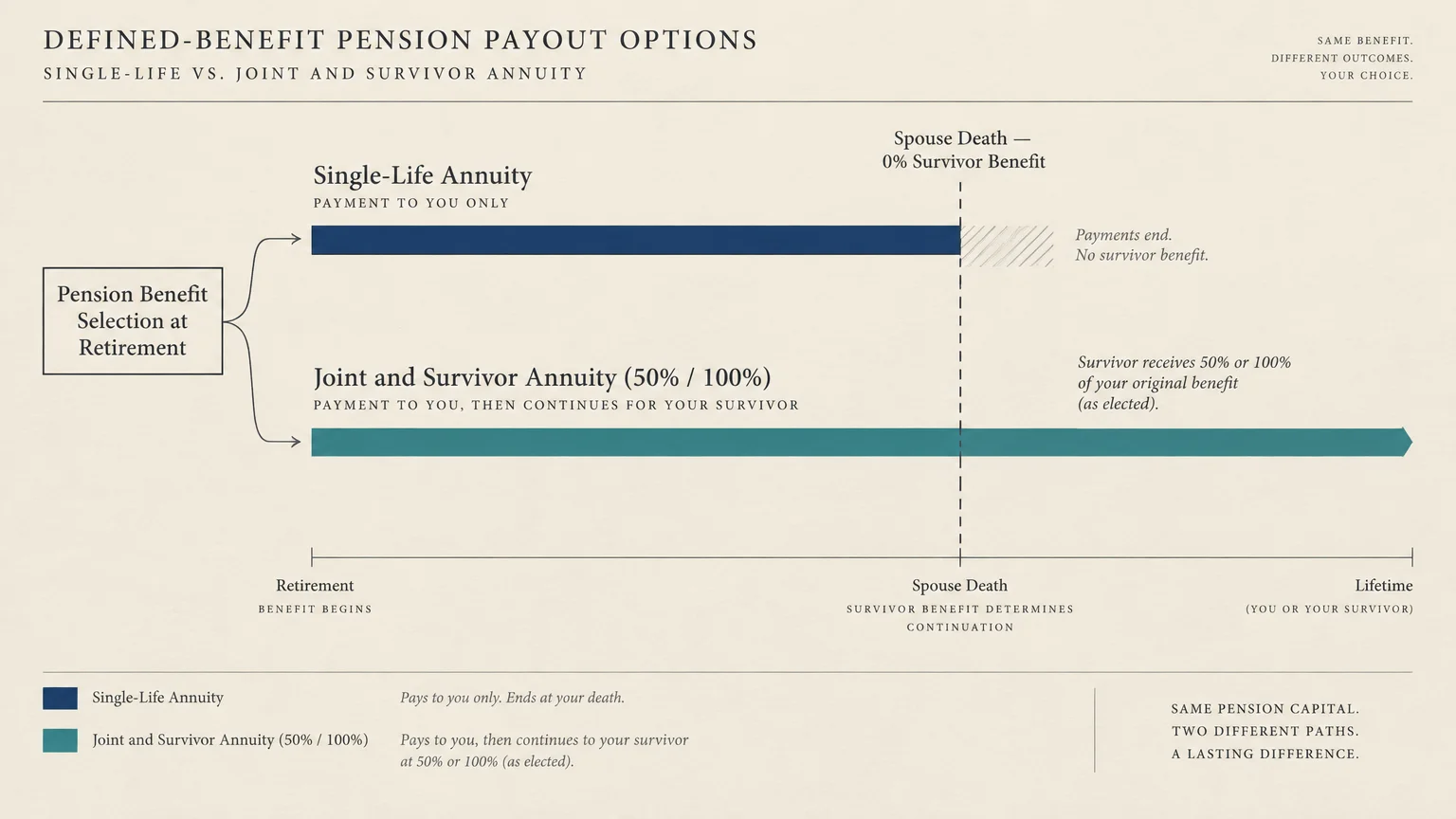
Retirees with traditional defined-benefit pensions make a binding payout election at retirement. Choosing a “Single Life Payout” maximizes the monthly payment during the worker’s lifetime.
However, a single-life annuity ceases immediately upon the pensioner’s death. The surviving spouse receives zero ongoing income from that employer plan.
Joint-and-survivor options provide lifetime safety for the surviving partner, typically paying 50% to 100% of the original benefit. Selecting the higher single check leaves the surviving spouse vulnerable to immediate income loss.
Examine pension documents early to understand whether your household benefits terminate or continue. Knowing your exact survivorship percentage allows you to adjust living expenses before facing a cash shortfall.

8. Partial Basis Step-Up Limits in Common-Law States
Capital assets such as taxable stocks and real estate receive a basis step-up upon the owner’s death. This tax provision resets the asset’s tax basis to its fair market value on the date of passing.
In common-law property states—which represent the vast majority of the country—jointly owned assets receive only a 50% step-up. The deceased partner’s half resets, while your half retains its original purchase basis.
If you sell those shared investments to generate cash, you may face substantial capital gains taxes. The rules work quite differently in the nine community property states.
Under IRC Section 1014(b)(6), community property states provide a 100% full double step-up on all community assets. Surviving spouses in community states can liquidate appreciated assets with zero federal capital gains liability.

9. Inherited IRA RMD Rules Under SECURE 2.0
Managing inherited traditional IRAs requires careful navigation of changing distribution laws. Under current law, Required Minimum Distributions (RMDs) begin at age 73, and will rise to age 75 in 2033.
Section 327 of the SECURE 2.0 Act introduced important flexibility for surviving spouses inheriting retirement accounts. Surviving spouses can elect to be treated as the deceased employee for distribution calculations.
This election allows you to delay distributions until your deceased spouse would have reached their required beginning age. It also permits using the more generous Uniform Lifetime Table rather than the restrictive Single Life Table.
Making the wrong election can trigger accelerated mandatory distributions that inflate your taxable income. High RMDs push single filers into higher brackets and elevate your Medicare premiums.
“The tax code is written to reward married couples, and single filers bear the heaviest tax burdens on identical amounts of retirement income.” — Ed Slott, CPA and Retirement Distribution Expert

10. Shocking Out-of-Pocket End-of-Life and Funeral Expenses
Final healthcare and funeral expenses frequently deplete substantial amounts of liquid household savings. Even Medicare recipients face deductibles, copayments, and prescription expenses incurred during final illnesses.
Funeral costs create an immediate, mandatory cash demand during extreme emotional distress. According to the National Funeral Directors Association (NFDA), the median cost of an adult funeral with viewing and burial is $8,300.
That burial median climbs to $9,995 when including a cemetery-mandated burial vault. Median funeral costs involving viewing and cremation average $6,280 nationwide.
These figures exclude cemetery plots, headstones, obituary notices, and opening fees. Surviving spouses must often pay thousands of dollars from cash reserves before estate accounts unlock.

11. Abrupt Loss of Employer-Sponsored Health Coverage
If you receive health coverage under your spouse’s active employer or retiree medical plan, coverage can end on the date of death. You must secure replacement coverage quickly to prevent gaps in medical care.
Federal COBRA rules permit surviving spouses to continue employer group coverage for up to 36 months. However, you must pay the entire premium yourself, plus a 2% administrative fee.
COBRA premiums often exceed $700 to $1,000 monthly for individual coverage. The loss of employer-sponsored coverage triggers a Special Enrollment Period for Medicare or the Affordable Care Act (ACA) marketplace.
You have a 60-day window following the loss of group coverage to secure an individual policy. Missing this window leaves you uninsured or subject to late enrollment penalties.

12. Retitled Property and Surging Insurance Premiums
Transferring titles for homes, vehicles, and boats requires filing paperwork with county recorders and motor vehicle departments. Overlooking these title transfers can complicate your property and casualty insurance policies.
Auto and homeowner insurance providers price policies based on married status, bundled discounts, and driver risk profiles. When you remove a deceased spouse, insurers rewrite policies to reflect a single policyholder.
Insurers often eliminate multi-car discounts and multi-policy bundling savings when households consolidate assets. You may face higher insurance premiums despite owning fewer operating vehicles.
Notify your insurers promptly after retitling your assets to keep your coverage legally enforceable. Driving a vehicle titled to a deceased individual can cause claim denials following an accident.

13. Outdated Estate Documents and Beneficiary Traps
Most married couples name each other as primary beneficiaries on life insurance policies, annuities, and retirement accounts. After your spouse passes, those primary designations become obsolete.
Failing to name secondary or contingent beneficiaries causes assets to default to your estate upon your eventual death. This oversight sends non-probate assets directly into probate court.
Your durable power of attorney and healthcare proxy documents also become invalid if they designate only your deceased spouse. If you become incapacitated without successor agents, courts must appoint a legal guardian.
Execute updated wills, powers of attorney, and healthcare directives as soon as you stabilize your immediate finances. Clearly designate contingent beneficiaries on every financial account you hold.

14. Vulnerability to Financial Exploitation and Scams
Public obituaries and court probate records provide identity thieves with detailed family details and dates. The Consumer Financial Protection Bureau (CFPB) warns that grieving seniors face targeted solicitations and aggressive fraud attempts.
Scammers contact surviving spouses claiming the deceased had unpaid debts, loans, or subscriptions requiring urgent settlement. Fraudulent contractors frequently appear at your doorstep offering unnecessary home or roof repairs.
Unscrupulous financial salespeople also target widows, pushing high-fee, illiquid financial products like complex annuities. Vulnerability peaks during deep grief when cognitive energy runs low.
Adopt a firm personal policy never to sign financial agreements or pay unverified debts during the first six months. Require all debt claims in writing and verify them with an independent advisor.
“Never make a permanent financial decision during the fog of acute grief. Give yourself permission to pause for six to twelve months.” — Suze Orman, Personal Finance Author
15. Fixed Overhead Costs with Sharply Reduced Cash Flow
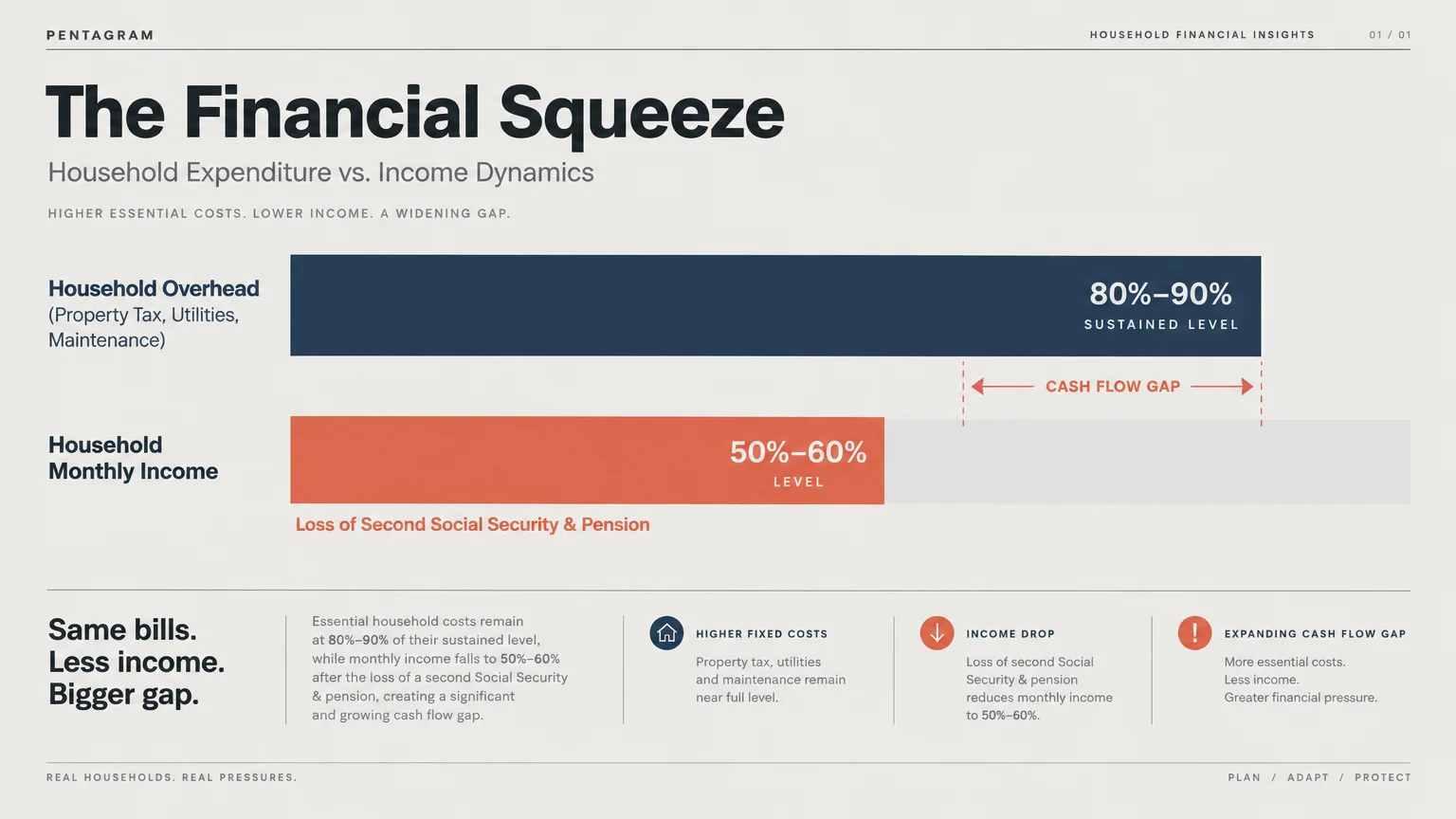
Many couples assume that single living cut household expenses in half, but baseline overhead remains virtually identical. Property taxes, homeowners insurance, mortgage payments, and basic utility connections do not drop when one person dies.
You continue heating and cooling the same square footage and maintaining the same roof and yard. Meanwhile, your household income may drop by 30% to 50% from lost benefits and pensions.
You may also face new expenses for home maintenance, lawn care, or driving assistance that your partner previously handled. These outsourcing costs place additional strain on a reduced income.
Build a revised single-person spending baseline within three to six months. Aligning your ongoing living expenses with your new, single-income reality prevents the steady depletion of retirement savings.
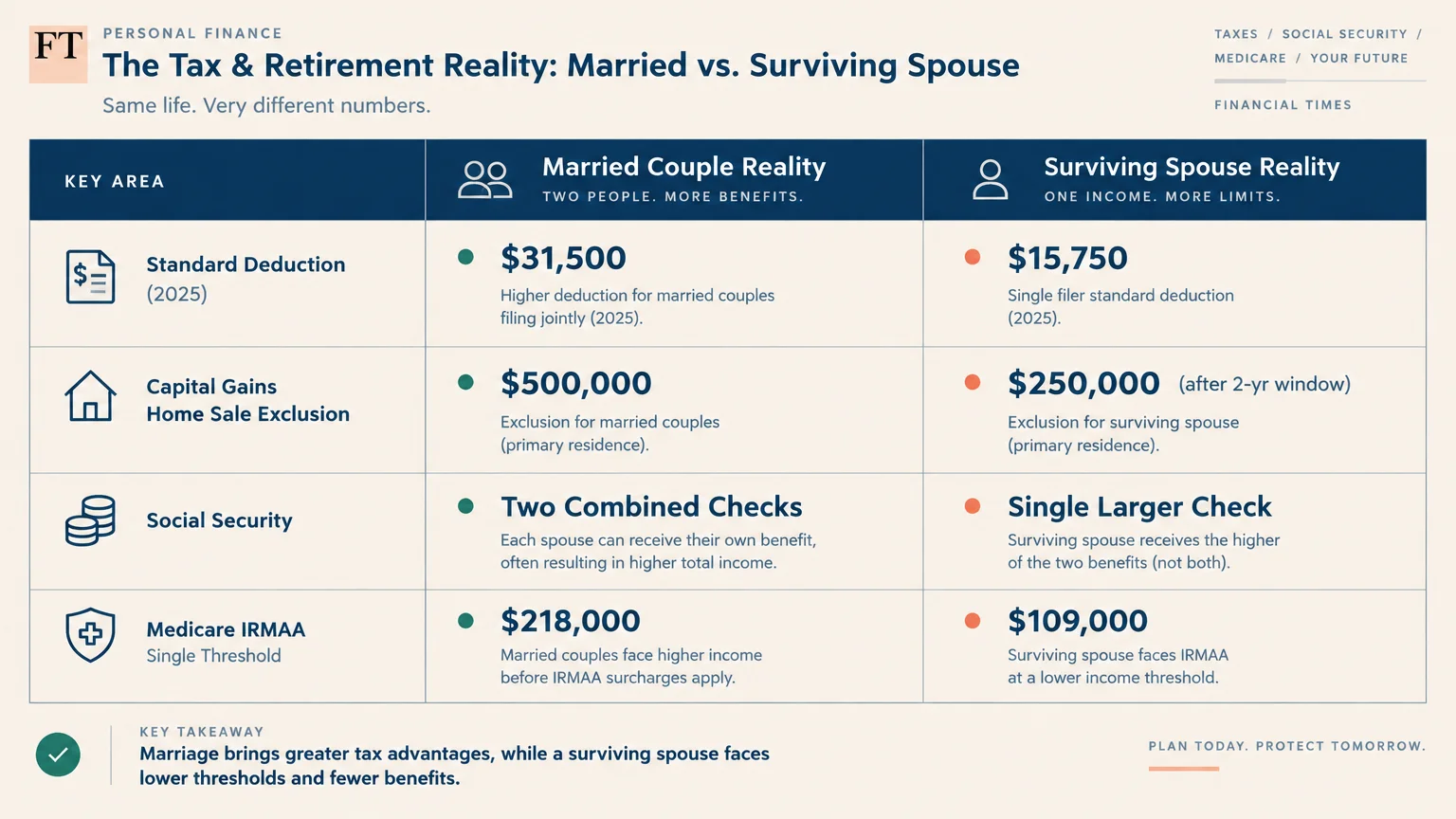
Comparing Financial Realities: Married Couple vs. Surviving Spouse
Reviewing the practical differences between joint and single status reveals why so many widowed spouses face unexpected shortfalls. The following table illustrates key structural shifts.
| Financial Metric | Married Couple (Joint Status) | Surviving Spouse (Single Status) |
|---|---|---|
| IRS Filing Status | Married Filing Jointly | Single (beginning year after death) |
| Standard Deduction (2025) | $31,500 | $15,750 (reduced by 50%) |
| Social Security Checks | Two monthly benefit payments | One monthly payment (smaller check lost) |
| Medicare IRMAA Threshold (2026) | Begins at $218,000 MAGI | Begins at $109,000 MAGI |
| Home Sale Capital Gains Cap | $500,000 tax exclusion | $250,000 (after two-year grace period) |
| Capital Asset Step-Up (Common Law) | No step-up during lifetime | 50% step-up on joint property |
| Fixed Household Overhead | Shared baseline costs | 100% absorbed by surviving spouse |

Pitfalls to Watch For
Rushing major property sales or long-distance relocations during the first year of bereavement frequently leads to regret. Give yourself time to process emotional grief before making irreversible real estate changes.
Ignoring IRS and Medicare notices can cost thousands in unnecessary surcharges and penalties. Always appeal elevated Medicare premiums using Form SSA-44 when your household income drops following a spouse’s death.
Never rely on verbal promises from insurance agents or pension administrators. Request all benefit calculations, survivor annuity payouts, and policy termination notices in writing for your records.
Do not leave primary credit cards solely in your spouse’s name. Establishing independent revolving credit in your own name protects your score and maintains continuous access to payment channels.

Getting Expert Help
Navigating these overlapping financial shifts often requires specialized professional guidance. Consider engaging professionals for the following scenarios:
- Comprehensive Tax Planning: A Certified Financial Planner (CFP) or CPA can model your single-bracket tax liability, plan Roth conversions, and manage RMD timing.
- Estate and Probate Settlement: An estate planning attorney ensures smooth asset transfers, updates deeds, and restructures your will, trusts, and healthcare directives.
- Medicare IRMAA Appeals: A fee-only advisor can help you prepare Form SSA-44 to eliminate unfair premium surcharges based on prior dual-income tax returns.
- Investment and Income Restructuring: A fiduciary wealth manager can reallocate your portfolio to generate dependable replacement cash flow after pension or Social Security losses.
Frequently Asked Questions
How long do I have to sell our house to keep the $500,000 capital gains exclusion?
You have exactly two years from the date of your spouse’s death to complete the sale. After two years, your exclusion reverts to the single limit of $250,000.
Can I keep both my Social Security benefit and my deceased spouse’s check?
No, the Social Security Administration does not permit you to combine benefits. You receive the higher of the two monthly amounts, and the lower benefit check terminates permanently.
Why did my Medicare premiums spike after my spouse passed away?
Medicare uses a two-year lookback period to assess IRMAA surcharges based on prior joint income. You can file Form SSA-44 with the Social Security Administration to appeal these surcharges.
What happens to a credit card if I am only an authorized user?
The card issuer closes the account once they receive notification of the primary account holder’s death. You cannot use the card, and recurring automated charges will fail immediately.
Managing your finances after losing a partner requires patience, knowledge, and deliberate planning. Tackle one administrative task at a time, lean on trusted professionals, and take the necessary steps to secure your financial future.
This article provides general retirement education and information only. Everyone’s financial situation is unique—what works for others may not work for you. For personalized advice, consider consulting a qualified financial professional such as a CFP or CPA.
Last updated: February 2026. Retirement benefits, tax laws, and healthcare costs change frequently—verify current details with official sources.