
Non-citizen workers who pay into the U.S. Social Security system earn the exact same fundamental right to retirement benefits as natural-born citizens, but complex international rules dictate how and where you can claim your money. Whether you hold a green card, work on an employment visa, or plan to retire abroad in your home country, specific federal statutes govern your eligibility, overseas payment schedules, and mandatory tax withholdings. Understanding these provisions ensures you protect your hard-earned benefits, prevent unexpected payment suspensions from the Social Security Administration, and coordinate multi-country pensions seamlessly. Here are the seven essential Social Security rules every non-citizen retiree needs to know.
Rule 1: Accumulating 40 Work Credits for Retirement Eligibility
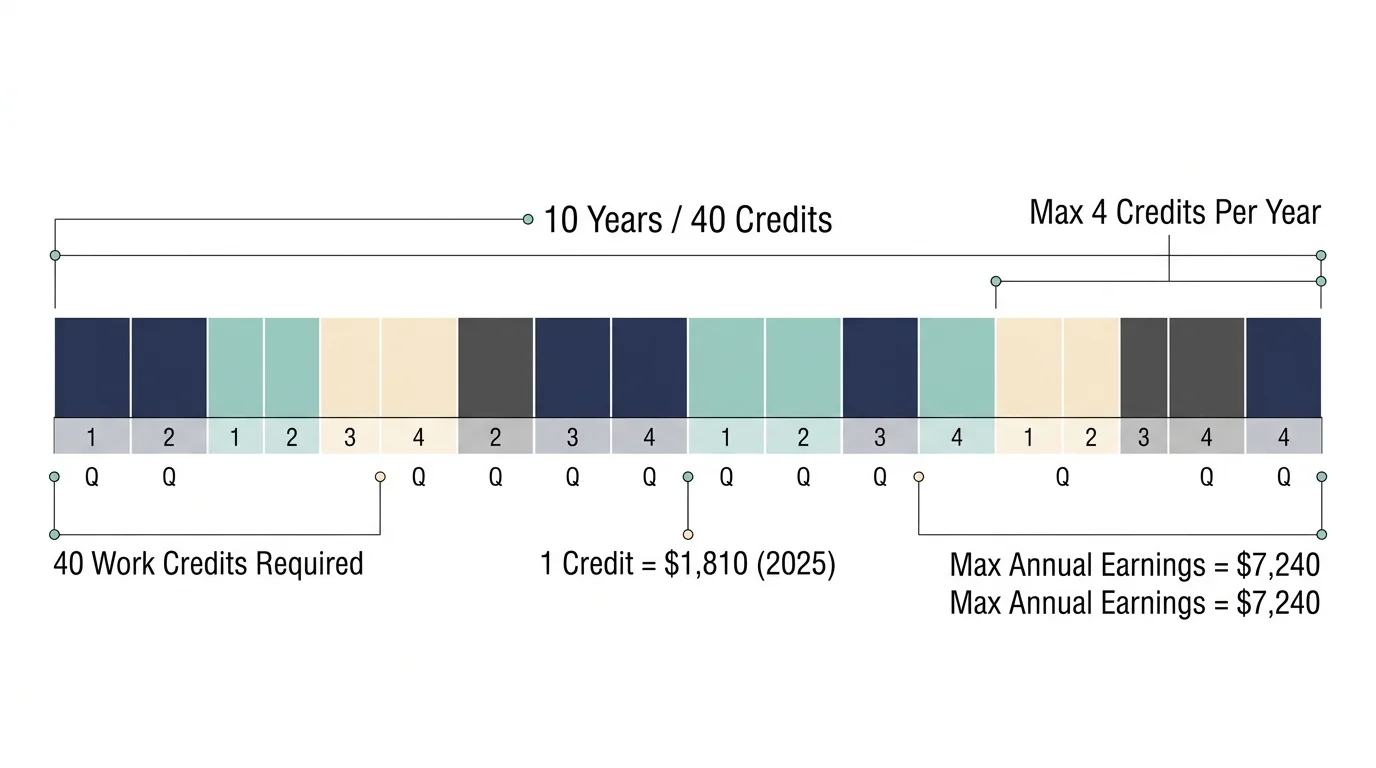
To qualify for U.S. Social Security retirement benefits on your own record, you must accumulate at least 40 work credits under Section 214 of the Social Security Act. The Social Security Administration (SSA) measures your work history through these credits, granting a maximum of four credits per calendar year. Consequently, you must work in covered employment—jobs where your employer deducts FICA taxes from your paycheck—for roughly ten full years.
The dollar amount required to earn a single work credit adjusts annually for wage inflation. According to the Social Security Administration (2025), you earn one credit for every $1,810 in covered earnings, meaning you max out your four annual credits once your earnings reach $7,240. For 2026, baseline earning thresholds adjust upward with national wage trends. Earning more than the annual threshold in a single quarter does not grant extra credits; you can never earn more than four credits in any single calendar year.
The SSA calculates your monthly benefit based on your top 35 years of inflation-indexed earnings. If you worked in the United States for only 15 years, the SSA places 20 years of zero earnings into your calculation average. This zero-year weighting lowers your Average Indexed Monthly Earnings (AIME) and reduces your baseline Primary Insurance Amount (PIA). Even with lower average earnings, achieving the 40-credit minimum establishes your foundational eligibility for life.
Rule 2: Valid Work Authorization at the Time of SSN Issuance
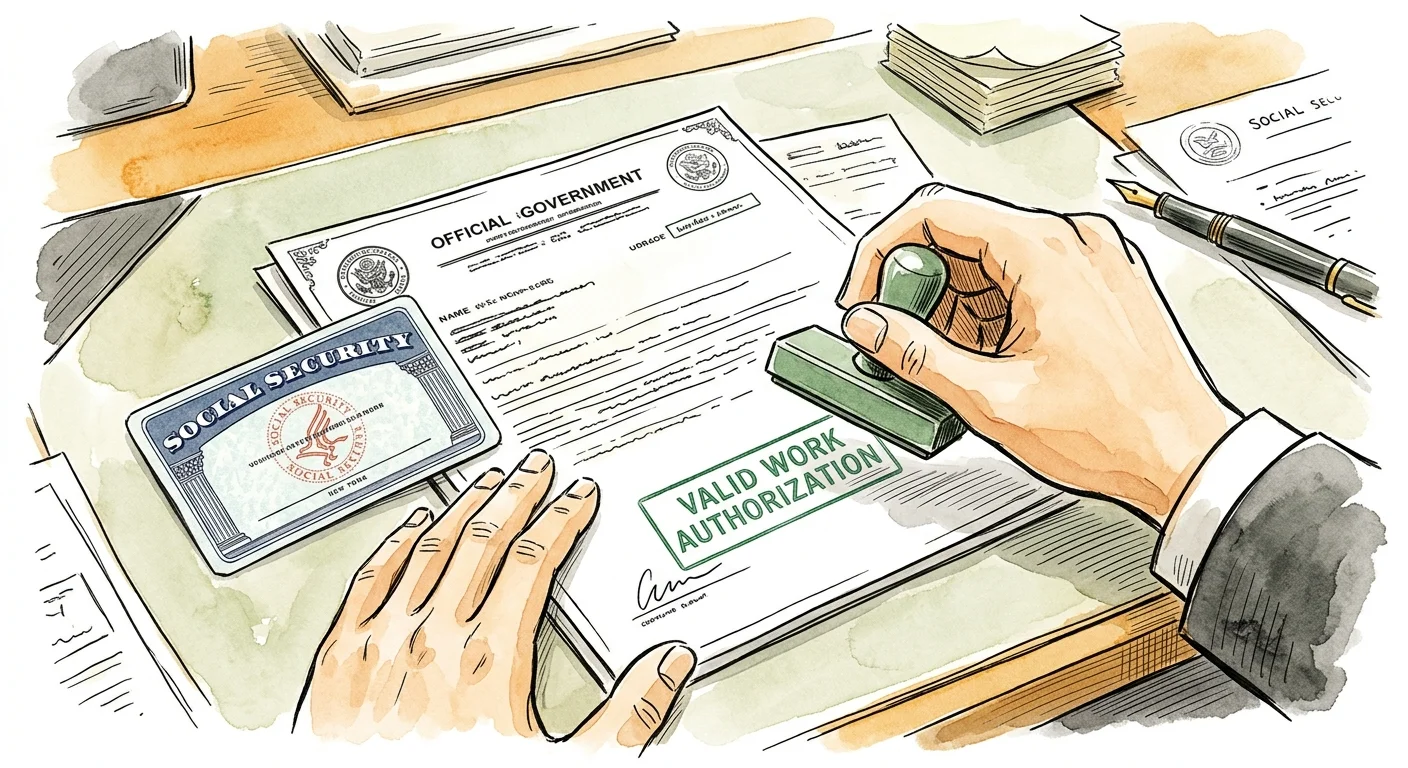
Working in the United States does not automatically guarantee that the SSA will count your wages toward retirement benefits. Under Section 211 of the Social Security Protection Act of 2004 (Public Law 108-203), you must hold a Social Security Number (SSN) that was fully authorized for work at the time of issuance, or hold a valid temporary visa authorized for work when you perform the labor.
This rule prevents retroactive credit accumulation from non-work credentials. If the government previously issued you an SSN strictly for non-work purposes—such as obtaining a driver’s license or opening a bank account before legal reforms took place—the SSA cannot count earnings accrued under that number toward retirement benefits unless you subsequently obtained lawful work authorization. Similarly, earnings recorded under an Individual Taxpayer Identification Number (ITIN) do not count toward your official 40 credits until you receive a valid, work-authorized SSN from the SSA and successfully petition the agency to transfer your verified earnings record.
“Navigating cross-border retirement rules requires understanding both domestic tax laws and international treaties, because a simple oversight in residency or filing can trigger significant automatic tax withholdings.” — Ed Slott, CPA and Retirement Distribution Specialist

Rule 3: The Lawful Presence Mandate for Benefits Paid in the U.S.
If you plan to live in the United States during retirement, earning 40 credits is only half of the legal equation. Under the Personal Responsibility and Work Opportunity Reconciliation Act of 1996 and 8 U.S.C. § 1611, the SSA cannot pay monthly benefits to any non-citizen residing inside the United States who cannot prove lawful presence in the country.
Lawful presence requires holding valid immigration status for every calendar month you expect to receive a payment. Qualifying statuses include:
- Lawful Permanent Resident (LPR) status with an unexpired Permanent Resident Card (Green Card).
- Valid, unexpired non-immigrant visas that permit legal stay.
- Asylee or refugee status granted by the Department of Homeland Security (DHS).
- Temporary Protected Status (TPS) or humanitarian parole status.
The SSA interfaces directly with the Systematic Alien Verification for Entitlements (SAVE) program run by the DHS. If your lawful immigration status lapses, the SSA suspends your monthly payments immediately until you furnish updated documentation proving your legal status has been restored or extended.

Rule 4: The Alien Nonpayment Provision and Living Abroad
Many non-citizens choose to move back to their native country or relocate to a lower-cost destination after ending their U.S. careers. However, Section 202(t) of the Social Security Act—known as the Alien Nonpayment Provision—imposes strict limitations on sending retirement payments outside the United States to non-citizens.
Under this rule, if you are not a U.S. citizen and you leave the United States for 30 consecutive days, the SSA considers you absent from the country. If you remain outside the country for six full consecutive calendar months, the SSA halts your monthly benefit checks starting in the seventh month. To restart your suspended payments without qualifying for an exemption, you must physically return to the United States and reside lawfully inside the country for at least one full, uninterrupted calendar month.
Fortunately, federal law provides several broad exceptions to this 6-month overseas suspension rule:
- The 40-Credit / 10-Year Residency Exception: You can receive payments indefinitely abroad if you accumulated at least 40 work credits in the U.S. or lived in the United States for a total of 10 or more years.
- The Social Insurance Country Exception: Under 20 CFR § 404.463, citizens of nations with reciprocal social insurance programs (such as Mexico, France, Israel, Japan, and Switzerland) continue receiving U.S. payments abroad regardless of how long they remain away.
- Treaty Country Protections: Bilateral agreements protect citizens of specific partner countries from payment suspensions.
Regardless of exemptions, the U.S. Department of the Treasury prohibits sending payments to individuals living in sanctioned jurisdictions, including Cuba and North Korea. Furthermore, the SSA restricts direct payments to several nations where local conditions prevent reliable payment delivery or verification of life certificates, including Belarus, Kazakhstan, and Uzbekistan. Non-citizens residing in Treasury-sanctioned countries forfeit payments permanently for every month spent in those jurisdictions.
Rule 5: Leveraging Totalization Agreements Across 30 Countries
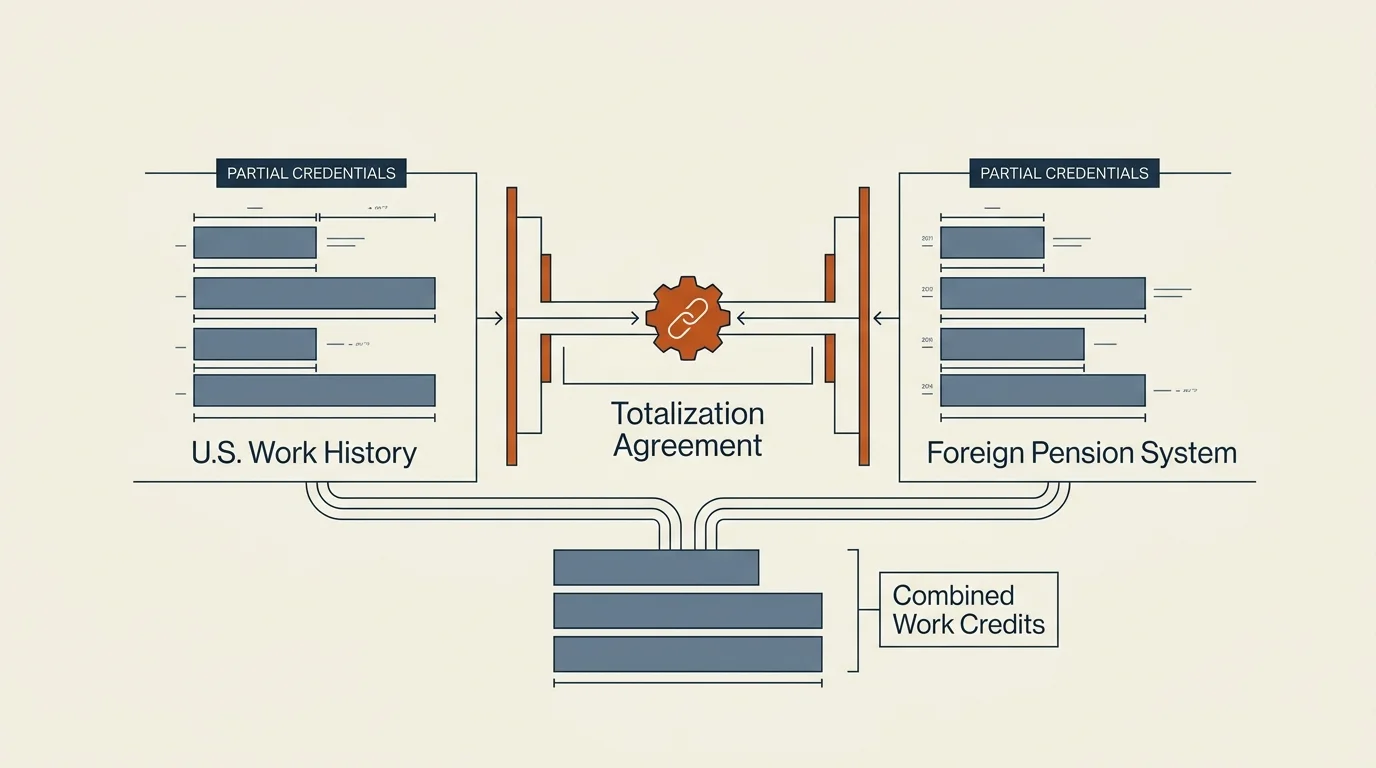
If you split your working career between the United States and another country, you might end up with divided retirement credits: perhaps 6 years of work in the U.S. (24 credits) and 15 years in your home country. Without intervention, you would fall short of the 40 credits required for U.S. Social Security, and you might also fall short of pension thresholds in your home nation.
To solve this problem, the United States maintains bilateral Totalization Agreements with 30 partner nations, including the United Kingdom, Canada, Germany, South Korea, Australia, and Brazil. These international treaties serve two major functions:
- Combining Work Credits: If you have earned at least 6 U.S. work credits (roughly 1.5 years of work), the SSA allows you to combine your foreign work periods with your U.S. record to reach the 40-credit eligibility threshold. The SSA then pays you a proportional (“totalized”) benefit based specifically on your U.S. earnings.
- Eliminating Dual Social Security Taxation: When multinational employers send you on temporary foreign assignments, these agreements establish which country receives your social insurance taxes, preventing double taxation on the same income.
You can review country-specific treaties through the SSA International Programs office to determine exact crediting formulas and application procedures between national agencies.
Rule 6: Mandatory Nonresident Alien (NRA) Tax Withholding
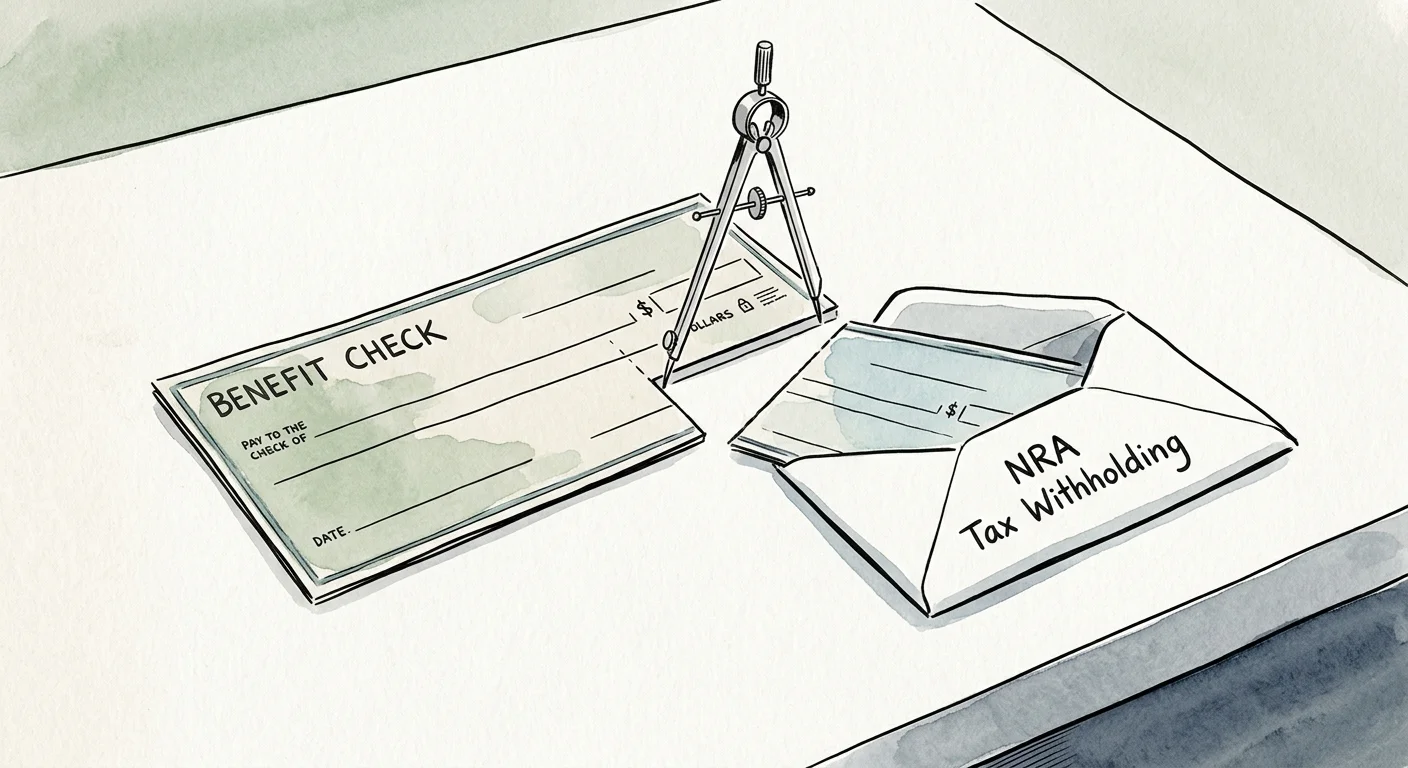
Taxes represent one of the most surprising financial shocks for non-citizen retirees who move abroad. If the Internal Revenue Service (IRS) classifies you as a Nonresident Alien (NRA) for tax purposes, the SSA must comply with Internal Revenue Code §§ 871 and 1441 by automatically withholding U.S. federal income tax from your benefit checks.
The standard statutory withholding rate is a flat 30% applied to 85% of your gross monthly retirement benefit. This calculation creates an effective, mandatory tax withholding rate of 25.5% taken directly out of your check before the SSA deposits it into your account. For example, if your monthly benefit is $2,000, the SSA calculates taxable income on 85% ($1,700), applies the 30% tax rate ($510), and sends you a net payment of $1,490.
However, bilateral tax treaties between the United States and your country of residence can reduce or eliminate this withholding entirely. Nations such as Canada, Germany, Japan, the United Kingdom, and Egypt maintain tax treaties that exempt U.S. Social Security benefits from U.S. withholding, assigning taxing rights exclusively to your country of residence. To claim treaty benefits and prevent automatic withholding, you must file IRS Form W-8BEN (Certificate of Foreign Status of Beneficial Owner for United States Tax Withholding and Reporting) with the SSA.
Rule 7: The 5-Year Residency Rule for Spouses and Survivors
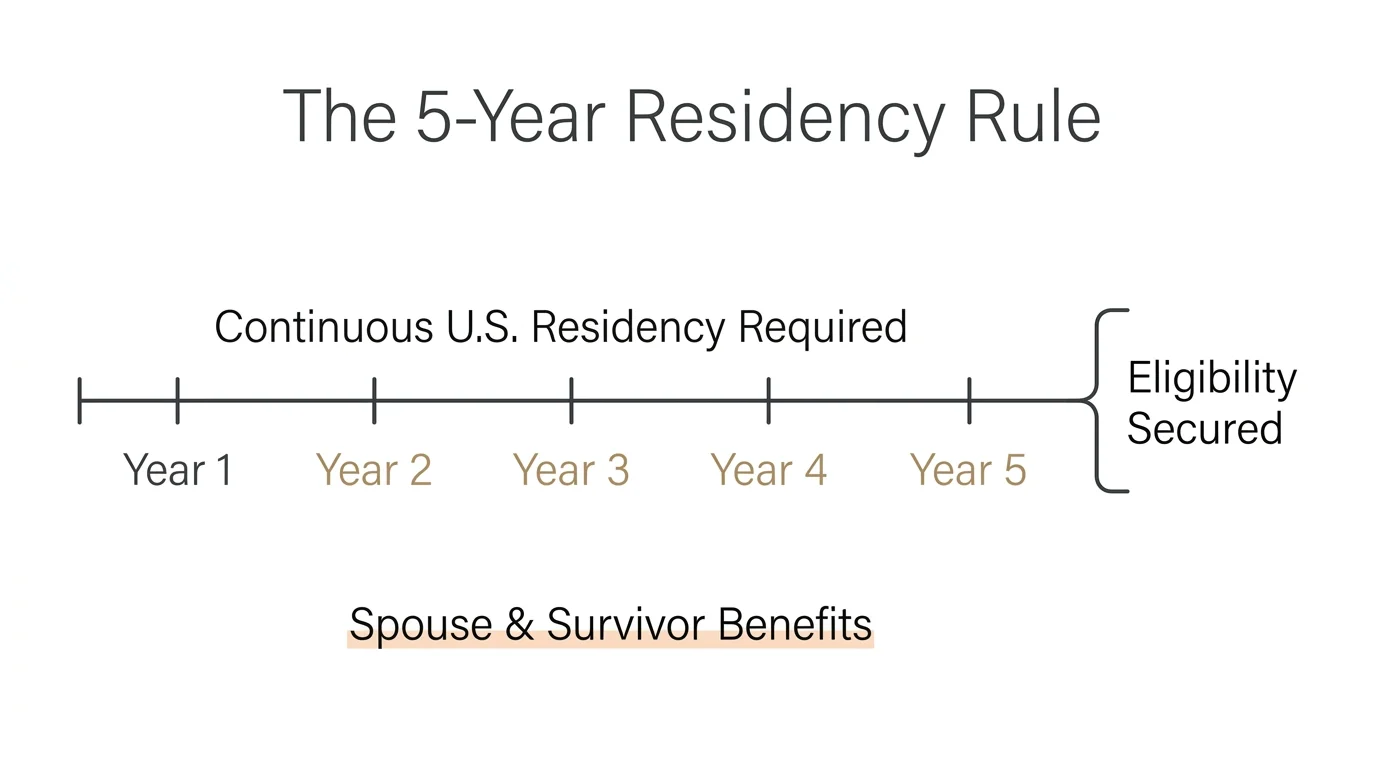
Non-citizen spouses, divorced spouses, and surviving dependents can qualify for auxiliary and survivor benefits based on a primary worker’s earnings record. However, strict residency rules apply if the non-citizen dependent chooses to live outside the United States.
Under federal law enacted in December 1984, a non-citizen spouse or dependent living abroad must prove that they resided inside the United States for at least 5 continuous years while in the qualifying family relationship (such as 5 years of marriage while living together in the U.S.). If you married a U.S. worker and lived together in the U.S. for only 3 years before moving abroad, the SSA will deny spousal or survivor benefit payments once the alien nonpayment grace period expires.
This 5-year residency rule does not apply if you are a citizen of a country that maintains a Totalization Agreement with the United States, or if the primary worker died while on active duty in the U.S. Armed Forces. Always document leases, joint tax returns, utility bills, and immigration stamps to preserve historical proof of your 5-year U.S. cohabitation.
Comparing Non-Citizen Social Security Scenarios
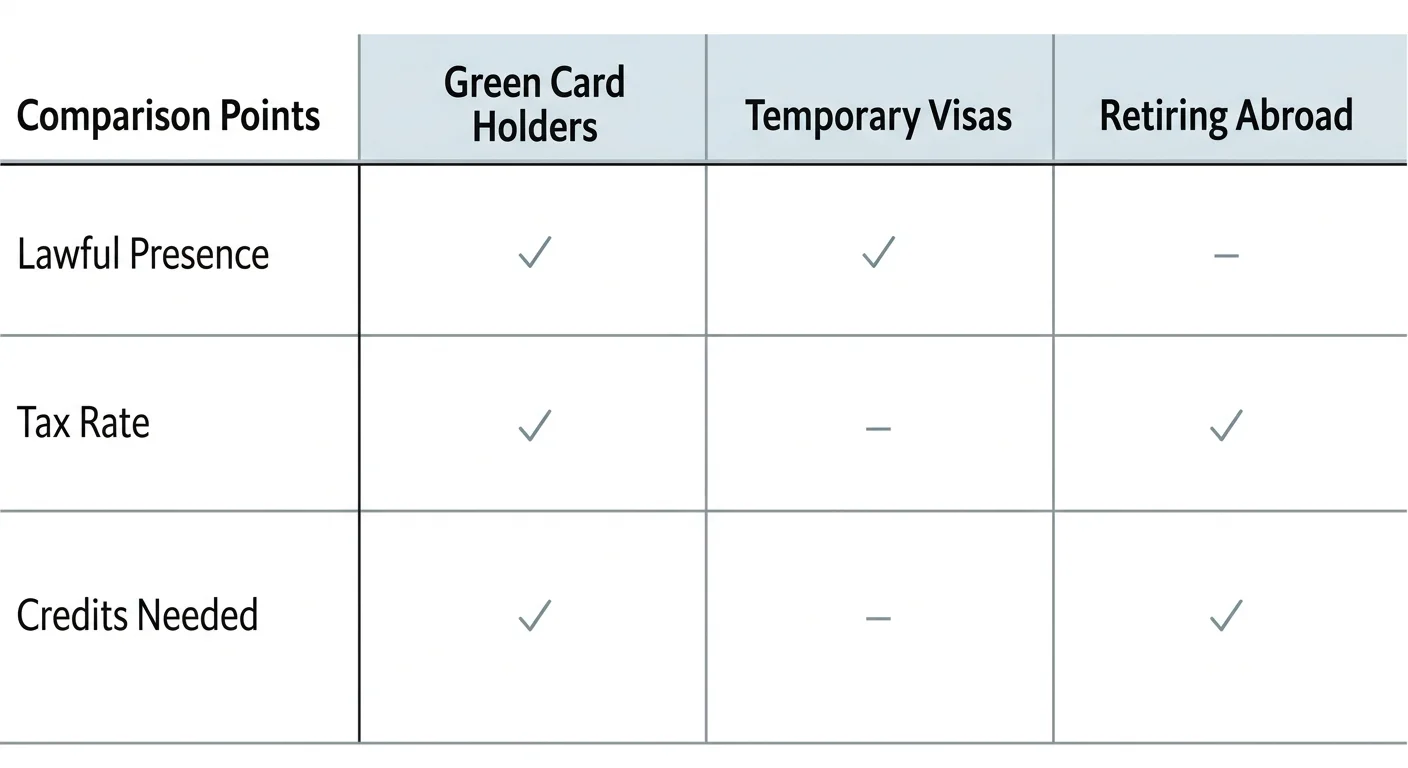
Your immigration status, country of residence, and international agreements dictate your final benefit amounts and tax obligations. The table below summarizes how different non-citizen profiles experience the Social Security system.
| Retiree Status | Location in Retirement | Overseas 6-Month Rule Applies? | Withholding Tax Rate | Totalization Eligible? |
|---|---|---|---|---|
| Green Card Holder (LPR) | Inside the United States | No (Lawful presence required) | Standard U.S. progressive rates | Yes (If split career) |
| Green Card Holder (40 Credits) | Living Abroad | Exempt (Met 40-credit rule) | 25.5% effective (Unless treaty applies) | Yes |
| Non-Citizen (Non-Treaty Country) | Living Abroad | Yes (Suspended after 6 months) | 25.5% flat statutory rate | No |
| Non-Citizen (Treaty Partner Country) | Living in Treaty Country | Exempt under bilateral treaty | 0% U.S. tax (Taxed in home country) | Yes (30 partner nations) |

Common Mistakes to Avoid
Navigating cross-border benefit rules leaves little room for procedural error. Avoid these frequent mistakes to ensure your retirement income remains uninterrupted:
- Ignoring the Windfall Elimination Provision (WEP): If you receive a foreign pension from work where you did not pay U.S. Social Security taxes, the WEP may reduce your U.S. retirement benefit formula. Consult the SSA early to calculate your true net benefit after WEP adjustments.
- Failing to Return Foreign Life Certificates: The SSA routinely mails Form SSA-7162 (Report to Social Security Administration) to beneficiaries living outside the United States to confirm eligibility and life status. If you fail to complete, sign, and return this form promptly, the SSA will suspend your payments worldwide.
- Letting Green Cards Lapse Without Tax Planning: Surrendering a green card or letting it expire after long-term residency (8 of the last 15 years) can trigger U.S. expatriation tax rules under IRS Section 877A, altering your Social Security withholding classification from a domestic taxpayer to a nonresident alien.
- Assuming Dual Citizenship Nullifies Foreign Rules: If you hold dual citizenship with a sanctioned or restricted country, payment bans may still apply based on your physical domicile, regardless of your second passport.

Professional vs. Self-Guided Retirement Planning
Determining whether to manage your Social Security transition independently or hire professional assistance depends on your asset distribution, career history, and retirement destination.
You can generally manage a self-guided strategy if you meet simple criteria: you are a lawful permanent resident remaining in the United States, your entire 35-year work history occurred under covered U.S. employment, and you have no foreign pension entitlements. In this case, you can use standard calculators from the Consumer Financial Protection Bureau to plan your claiming age between 62 and 70.
Conversely, you should seek professional guidance from a cross-border financial planner, international tax CPA, or immigration attorney in the following complex scenarios:
- Dual-Country Pensions: You accrued retirement benefits in both the U.S. and a foreign nation, requiring precise coordination of Totalization credits and WEP exemptions.
- Cross-Border Relocation: You plan to surrender your U.S. permanent residency and move to a non-treaty country, triggering potential 25.5% withholding and expatriation taxes.
- Non-Citizen Spousal Protection: You need to establish and archive legal proof of the 5-year continuous U.S. residency requirement to safeguard derivative benefits for your spouse living abroad.
Frequently Asked Questions
Can green card holders collect Social Security outside the United States?
Yes. If you have earned at least 40 work credits in the United States (or resided in the country for 10 years), you are exempt from the 6-month alien nonpayment rule and can receive payments abroad indefinitely, provided you do not reside in a Treasury-sanctioned country like Cuba or North Korea.
What happens to my Social Security taxes if I leave the U.S. with fewer than 40 credits?
The U.S. government does not refund FICA taxes paid during your working years. However, if you move to one of the 30 countries with which the U.S. maintains a Totalization Agreement and you have at least 6 U.S. credits, your U.S. credits can combine with your home country’s pension credits to qualify you for a partial benefit.
How does receiving a foreign pension affect my U.S. Social Security?
Under the Windfall Elimination Provision (WEP), if you receive a pension based on employment where you did not pay U.S. Social Security taxes (including many foreign government or corporate pensions), the SSA applies an adjusted formula to your U.S. benefit, which may reduce your monthly payment up to a statutory maximum limit.
Does the SSA automatically stop sending checks if my green card expires?
If you reside inside the United States, the SSA requires continuous proof of lawful presence. An expired green card may trigger an administrative review through the DHS SAVE system. If you cannot establish lawful status or active renewal processing, the SSA must suspend payments until you document your legal status.
Securing your Social Security benefits as an immigrant or international worker requires proactive recordkeeping, a firm understanding of bilateral treaties, and strict compliance with residency rules. Review your annual earnings record regularly on your personal Social Security portal, confirm your work authorization history, and structure your retirement destination with international tax laws in mind.
The information in this guide is meant for educational purposes. Your specific circumstances—including income, savings, health coverage, and goals—may require different approaches. When in doubt, consult a licensed professional.
Last updated: February 2026. Retirement benefits, tax laws, and healthcare costs change frequently—verify current details with official sources.