
Relying on a single bank during retirement exposes your hard-earned wealth to unnecessary systemic and digital risks. Moving a portion of your money to different institutions creates immediate layers of safety and financial flexibility.
Savvy older adults now distribute their nest eggs across multiple lenders rather than keeping everything in one place. This modern retiree banking strategy protects your principal and substantially boosts your everyday cash flow.
From maximizing federal insurance guarantees to isolating everyday debit cards from core savings, multi-institution banking offers clear tactical advantages. Here is why splitting savings across multiple banks has become a standard retirement maneuver.
1. Maximizing FDIC and NCUA Insurance Limits
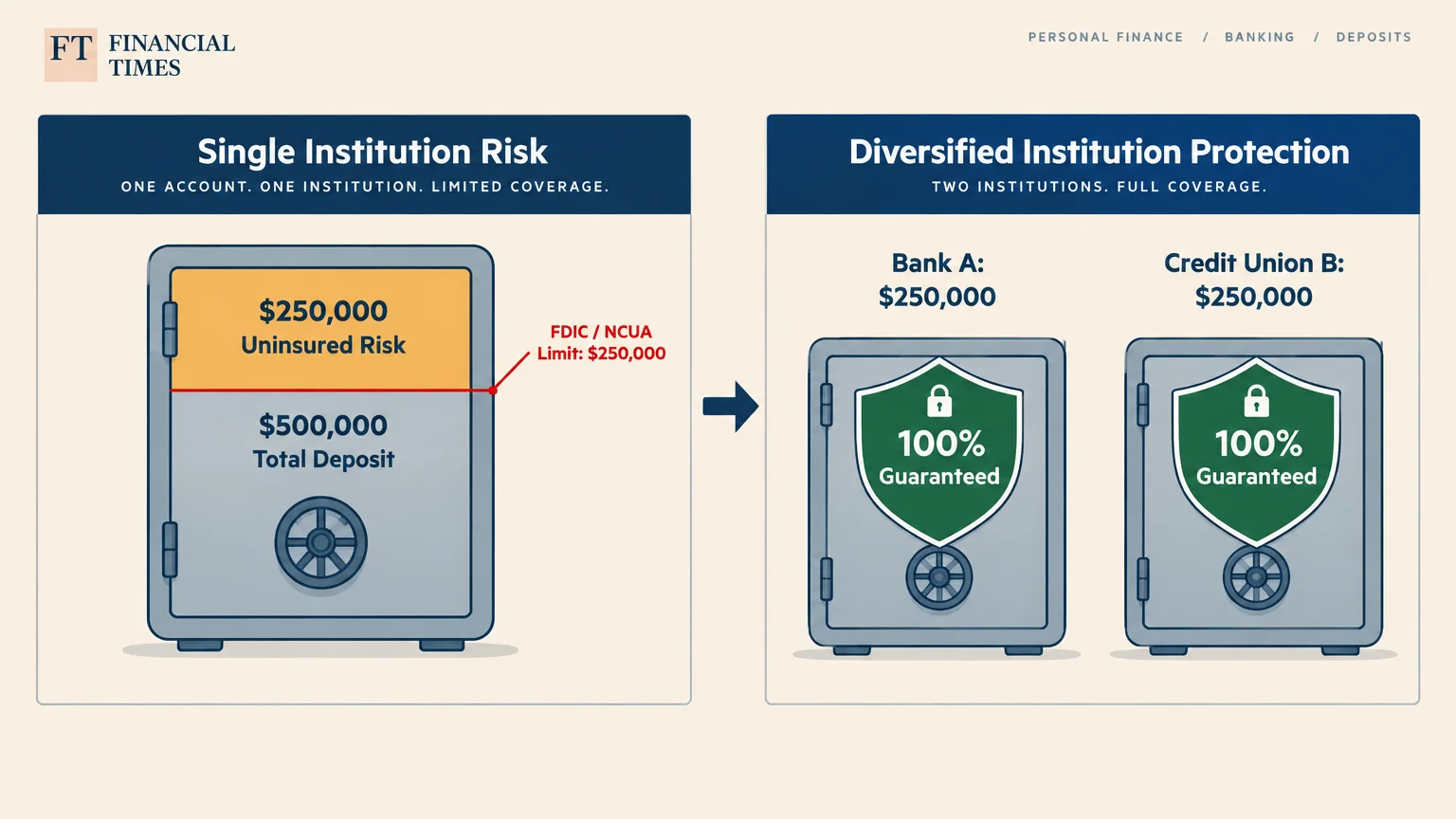
The federal government guarantees your deposits, but that protection carries strict statutory boundaries. The Federal Deposit Insurance Corporation (FDIC) covers up to $250,000 per depositor, per insured institution, for each ownership category.
The National Credit Union Administration (NCUA) enforces identical limits for federal credit unions. If a bank fails, balances above that $250,000 threshold at a single institution remain uninsured.
Retirees often hold larger cash cushions to fund living expenses or buffer against market downturns. Distributing cash among several separate banks ensures that every dollar enjoys full federal backing.
A married couple can expand coverage through joint accounts, but holding separate accounts at different banks provides absolute peace of mind. You never have to worry about complex ownership category rules when each balance stays well below the statutory limit.

2. Adapting to the FDIC Trust Account Rule Overhaul
Estate planning frequently involves revocable living trusts or informal Payable-on-Death (POD) designations. However, federal rules governing these accounts changed significantly on April 1, 2024.
The FDIC merged revocable and irrevocable trusts into a single “Trust Accounts” category. Under current regulations, coverage is calculated at $250,000 per eligible primary beneficiary, capped at a maximum of five beneficiaries.
This revision establishes a strict $1,250,000 insurance ceiling per trust owner at any single institution. If your trust names six children and holds $1.5 million at one bank, $250,000 remains completely uninsured.
Spreading trust assets across multiple banks solves this legal limitation instantly. By dividing funds, you preserve full deposit protection without altering the legal terms of your estate plan.
3. Capturing Meaningfully Higher Interest Rates
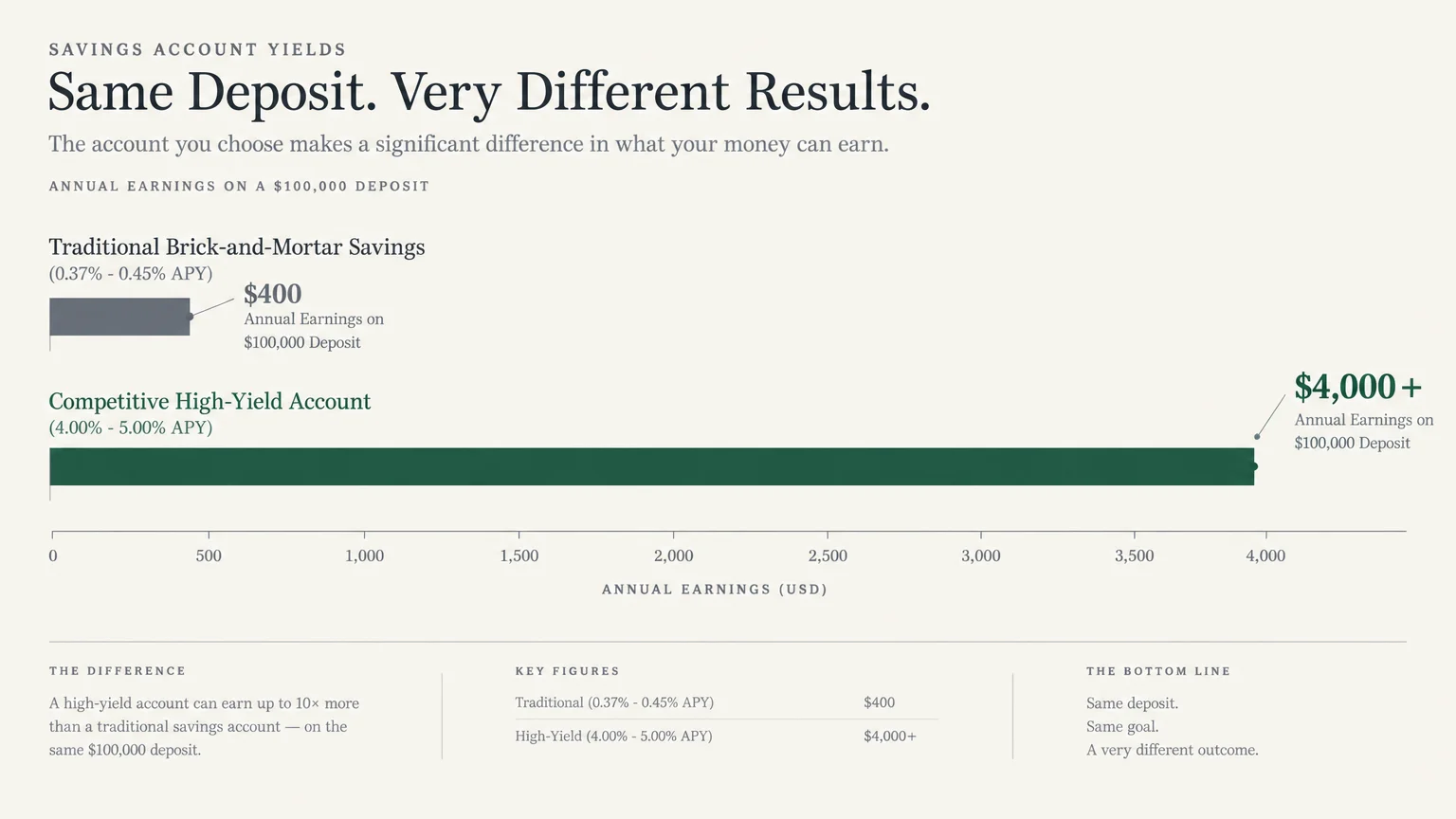
Traditional brick-and-mortar retail banks rarely reward long-term depositor loyalty. According to national banking data, traditional savings accounts often pay an anemic 0.37% to 0.45% Annual Percentage Yield (APY).
Meanwhile, competitive online institutions and credit unions routinely offer high-yield savings accounts paying 4.00% to 5.00% APY. That gap creates thousands of dollars in foregone retirement income each year.
Keeping a local branch for in-person transactions while moving surplus cash to high-yield accounts optimizes your balance sheet. You enjoy face-to-face service for daily needs while forcing your reserve capital to generate real returns.
“A big part of financial security is knowing that no single mistake or technical glitch can wipe you out.” — Suze Orman, Personal Finance Author
A retiree keeping $100,000 in a traditional savings account might earn around $400 annually. Moving that balance to a high-yield account could generate $4,000 or more in low-risk passive income.

4. Building a Digital Firewall Against Elder Fraud
Financial scams targeting seniors have escalated into a multi-billion-dollar national crisis. Reports from the FBI Internet Crime Complaint Center indicate that fraud losses among adults aged 60 and older surpassed $7.7 billion in 2025.
Checking accounts tied to debit cards face continuous exposure to point-of-sale skimmers, fake merchant sites, and phishing schemes. If thieves compromise a debit card connected to your primary life savings, they can drain the balance overnight.
Separating your daily operating funds from your primary reserves builds an effective financial firewall. The Consumer Financial Protection Bureau encourages segregating everyday transaction tools from core reserves.
Keep only one or two months of living expenses in an account with an active debit card. House the rest of your cash at an entirely separate bank with no debit card access enabled.

5. Protecting Emergency Liquidity from Operational Freezes
Banks rely on automated fraud-detection algorithms to monitor accounts for unusual activity. A large wire transfer or an unexpected out-of-state transaction can trigger an immediate automated freeze on your funds.
Resolving an automated security lockdown can take several business days; sometimes it takes weeks. If all your money sits in one place, you cannot purchase groceries, buy medications, or pay bills during a freeze.
Recent regional banking panics and technical outages demonstrated the danger of operational concentration. Maintaining secondary checking accounts gives you immediate liquidity when unexpected institutional issues occur.
A multi-bank structure ensures you always carry a working credit or debit card backed by clear funds. You maintain total personal independence, regardless of an individual bank’s administrative delays or IT failures.
6. Bypassing Restrictive Withdrawal Limits and Fees
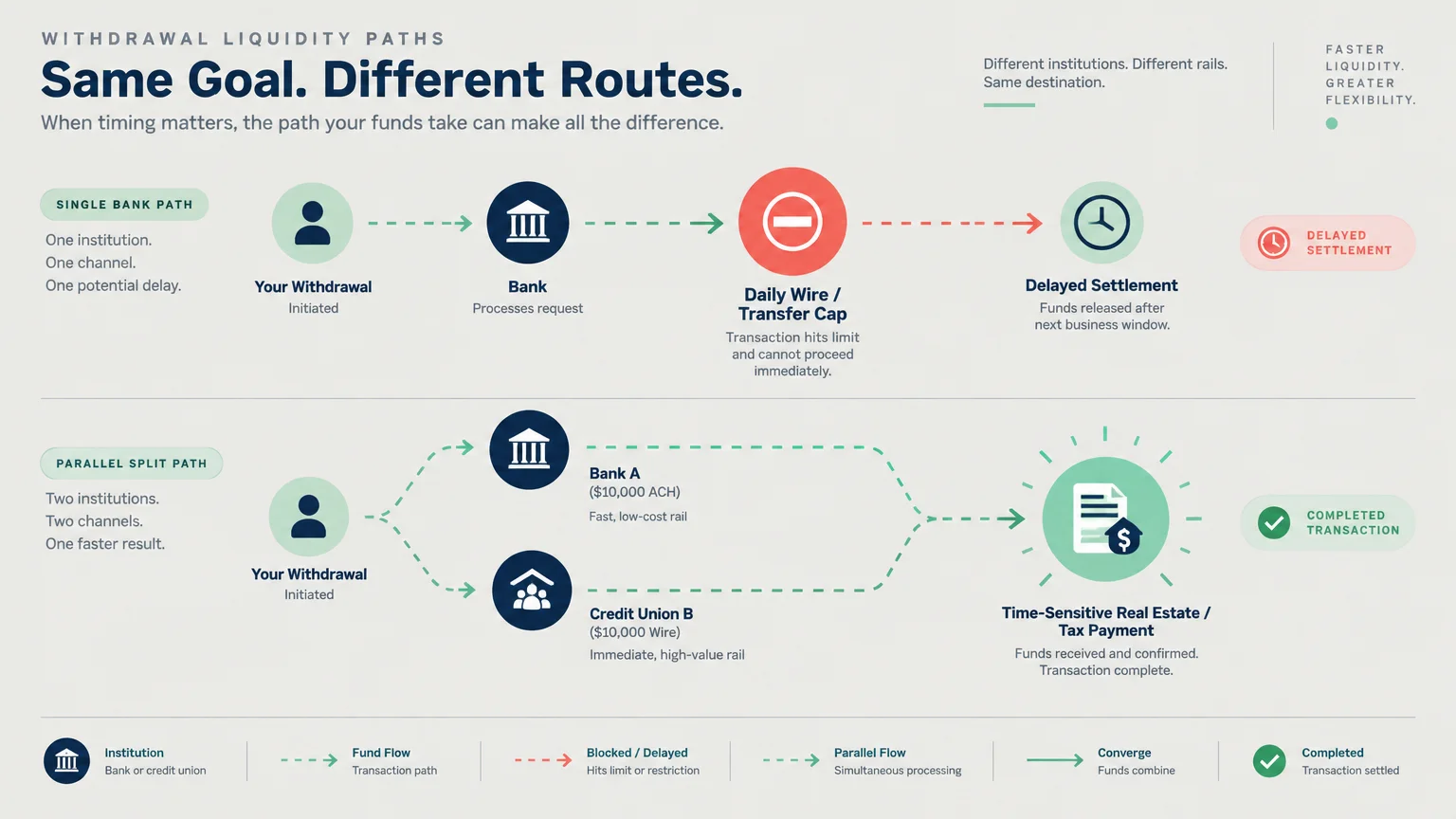
In 2020, the Federal Reserve amended Regulation D, eliminating the federal rule that limited savings account withdrawals to six per month. However, the Federal Reserve gave individual banks full discretion to enforce their own withdrawal limits.
Many traditional banks still assess excessive-withdrawal penalties ranging from $5 to $25 per occurrence. Some institutions will even forcibly convert your savings account into a low-interest checking account if you exceed their internal caps.
Retirees actively drawing income to cover uneven monthly expenses can easily run afoul of these rules. Splitting savings across multiple banks distributes your monthly transfer activity across several platforms.
You can move funds freely from different repositories without triggering automated penalty fees. This structural flexibility lets you manage recurring cash needs smoothly throughout the month.
7. Utilizing Automated Sweep Networks for Large Balances
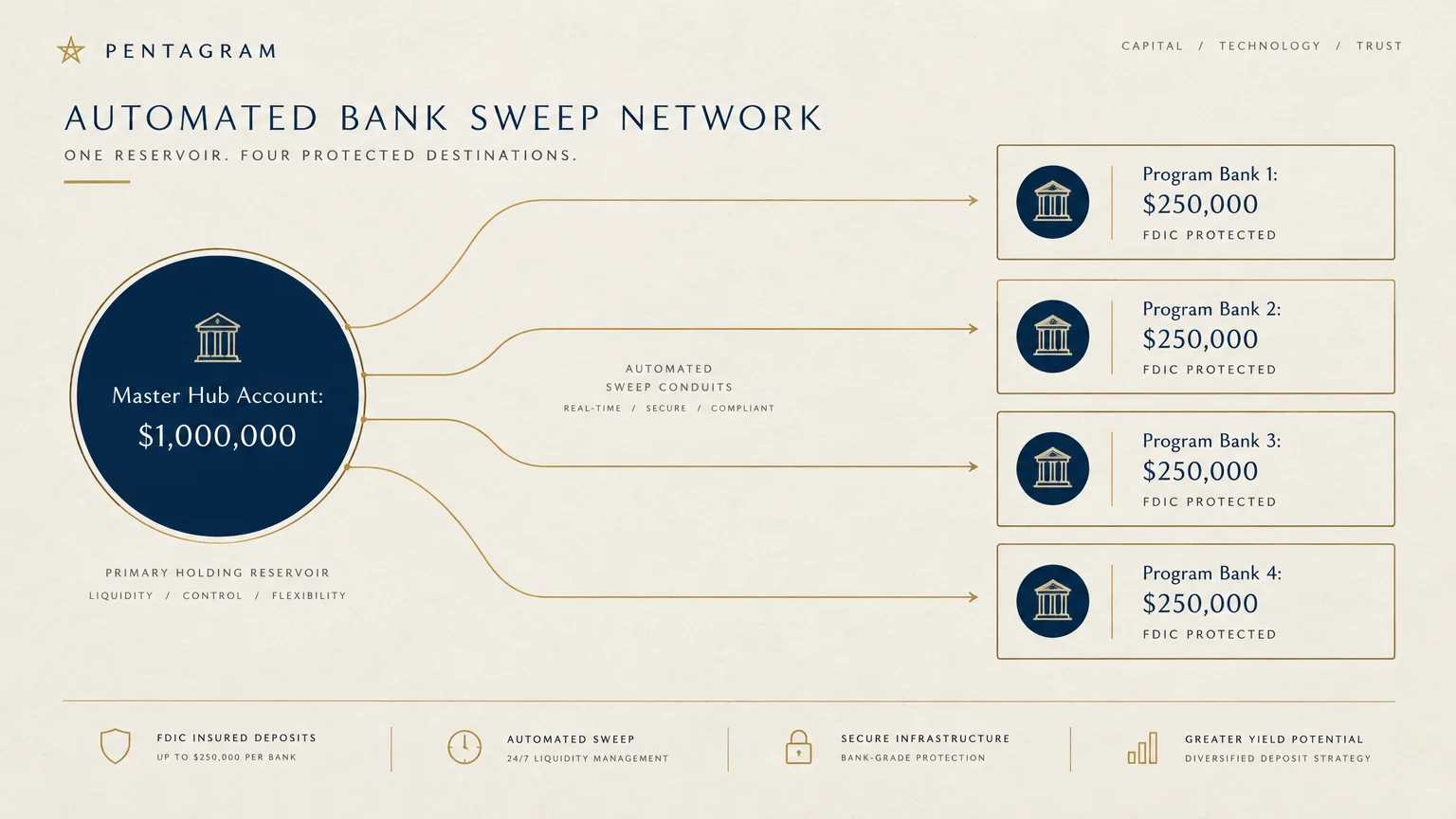
Retirees who downsize a home or sell a business often hold temporary cash balances exceeding $1 million. Manually opening dozens of bank accounts to maintain deposit insurance can be an administrative nightmare.
Fortunately, many modern banks partner with deposit placement networks like IntraFi Cash Service (ICS) and CDARS. These networks automatically sweep your deposits across hundreds of partner institutions in increments below $250,000.
You work directly through a single relationship bank while securing tens of millions of dollars in federal insurance. You receive one consolidated monthly statement and a single tax reporting form at year-end.
Exploring automated sweep accounts provides enterprise-level protection without the hassle of tracking multiple logins. You can learn more about asset management strategies on Investopedia to see how sweep accounts function.
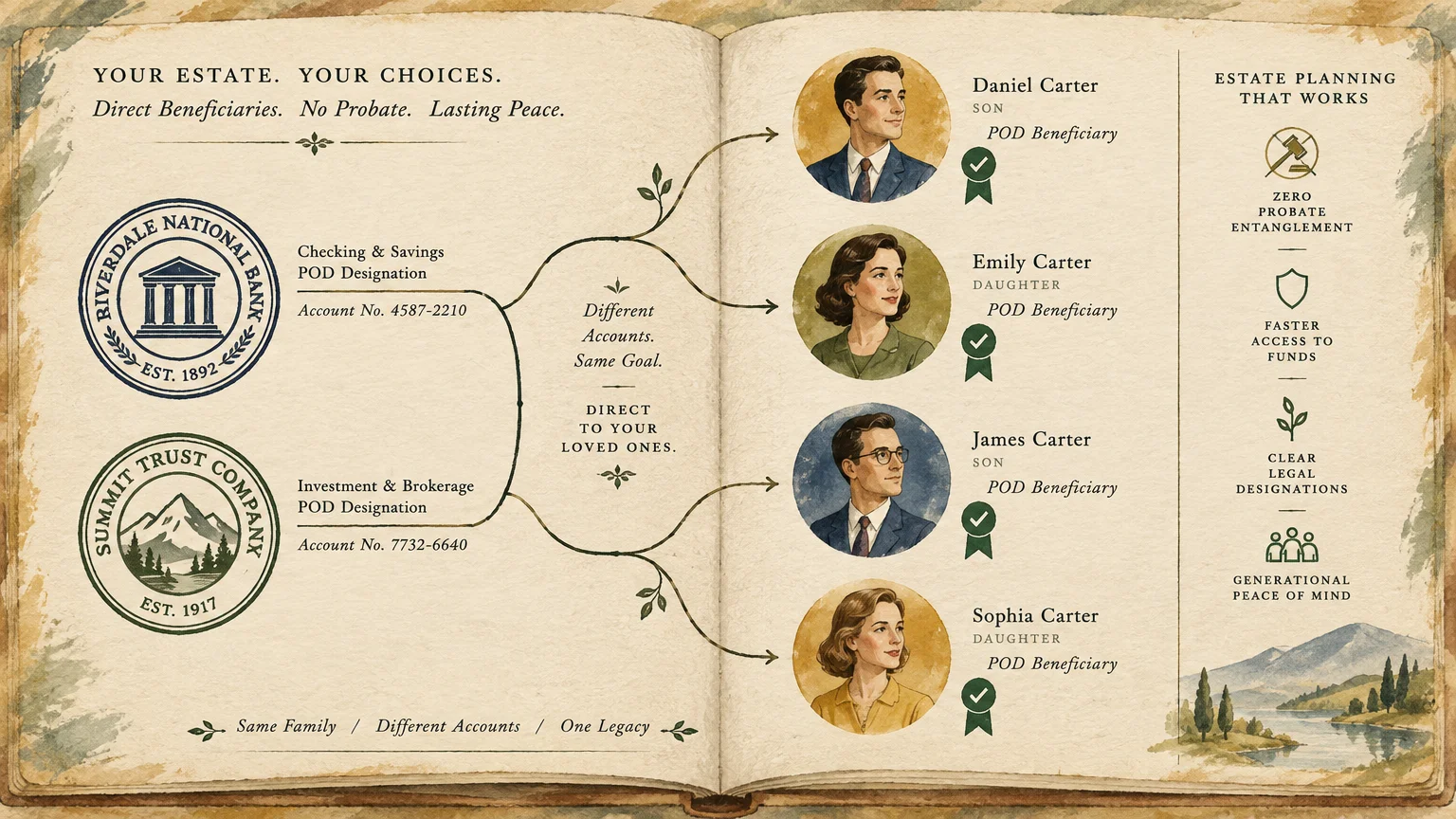
8. Streamlining Estate Distribution to Multiple Heirs
Passing wealth efficiently to the next generation requires careful logistical preparation. Leaving a massive single account to multiple heirs can lead to estate delays, administrative confusion, and family disputes.
By establishing distinct accounts at different institutions, you can assign individual beneficiaries to specific accounts using Payable-on-Death designations. One account can go directly to a child, while another supports a grandchild’s college fund.
POD accounts bypass probate entirely, granting your heirs fast access to liquidity for funeral costs or immediate taxes. Spreading accounts prevents one heir’s paperwork delays from holding up distributions for everyone else.
This layout also prevents surviving family members from managing an overwhelming estate transition at a single desk. Each beneficiary works independently with their designated institution to complete the inheritance process.
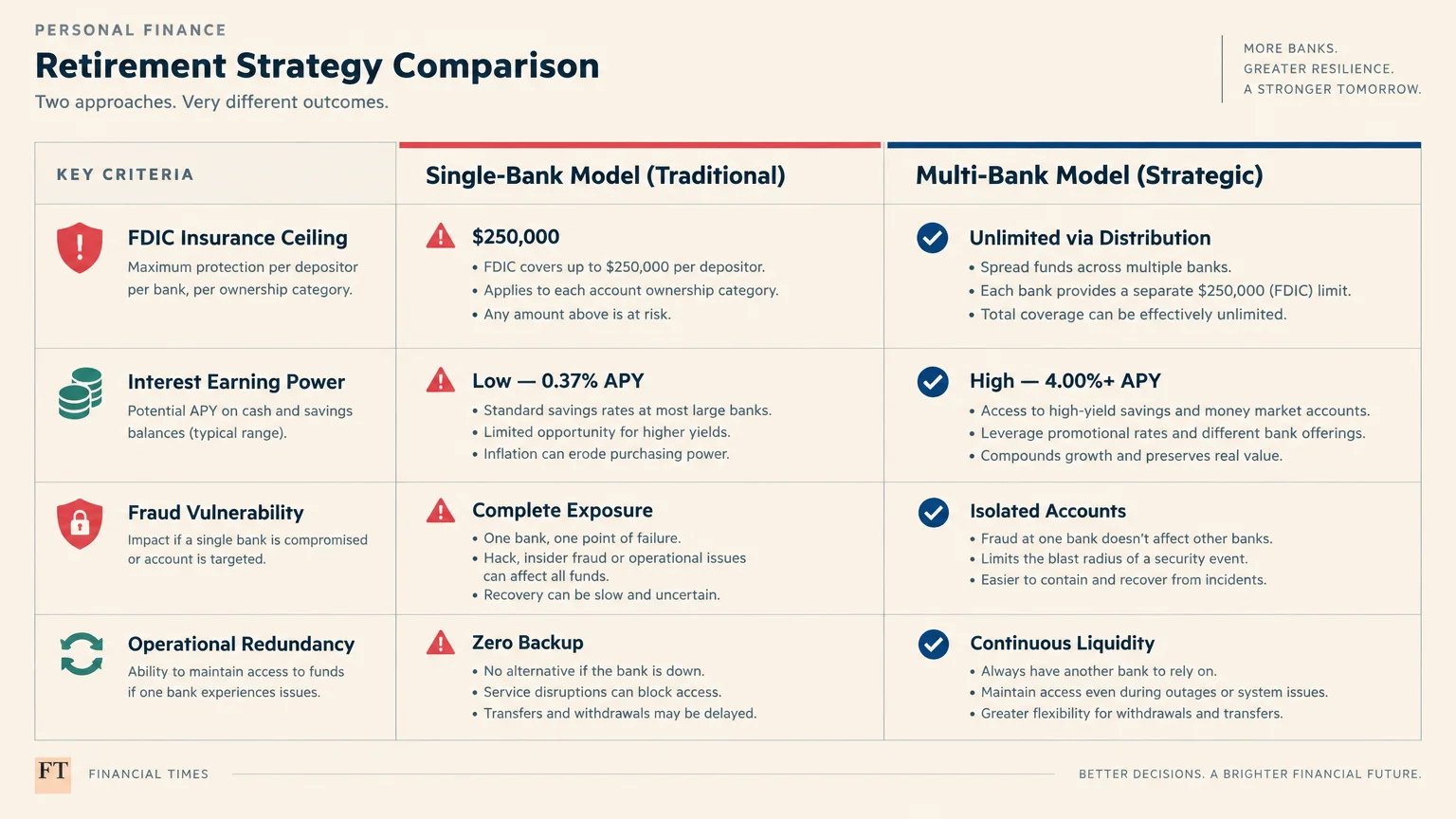
Comparing Single-Bank vs. Multi-Bank Retirement Strategies
Deciding how to structure your cash reserves requires weighing daily convenience against long-term security. The table below outlines how these two models compare across essential retirement priorities.
| Banking Factor | Single-Bank Strategy | Multi-Bank Strategy |
|---|---|---|
| FDIC / NCUA Coverage | Capped at $250,000 per ownership category. Excess balances sit uninsured. | Scales indefinitely by distributing balances below $250,000 per institution. |
| Interest Yields | Limited to the single bank’s rates, often below 0.50% APY at big banks. | Allows blending local convenience with online accounts paying 4.00%–5.00% APY. |
| Fraud Blast Radius | A single compromised debit card or login can expose your entire life savings. | Isolates daily spending from primary capital; fraud cannot drain other banks. |
| Operational Access | System outages or fraud freezes leave you with zero cash access. | Secondary accounts guarantee uninterrupted liquidity for daily bills and emergencies. |
| Administrative Effort | Very low; one login, one password, and a single consolidated tax statement. | Moderate; requires managing multiple logins, passwords, and 1099-INT tax forms. |

How to Organize Your Multi-Bank Strategy
Adopting this approach does not require dozens of complex relationships. Most retirees can achieve complete protection and optimal yields using a simple three-tier framework.
- The Operational Hub: A checking account at a local branch for Social Security direct deposits, bill pay, and local branch visits.
- The High-Yield Reserve: A high-yield savings account at a reputable online bank to house your 12-to-24-month living expense buffer.
- The Fortified Safe Haven: An account at a separate institution—often a credit union or secondary bank—holding long-term cash reserves with no debit card attached.
This three-tier layout segregates risks while keeping everyday money management straightforward. You maintain full control over transfers without exposing critical assets to cyber threats.

What Can Go Wrong (And How to Avoid It)
While holding accounts across multiple banks strengthens safety, poor execution creates avoidable headaches. Adding accounts increases administrative complexity and demands active organization.
First, beware of hidden maintenance fees and balance minimums. If you split your funds too thinly, you may trigger monthly account fees that erase any extra interest earned.
Second, track your accounts to prevent dormancy. Banks turn abandoned balances over to state unclaimed property funds if an account shows no customer activity for three to five years.
Third, keep meticulous tax records. Every institution paying more than $10 in annual interest will issue an IRS Form 1099-INT, and missing one can delay your tax filing.
Maintain a secure list of institutions, account numbers, and designated beneficiaries in a fireproof home safe. Make sure your trusted contact or power of attorney knows where to find this documentation if an emergency arises.

When to Consult a Professional
While opening bank accounts is straightforward, broader financial logistics often intersect with legal and tax considerations. Seeking advice from a qualified advisor prevents costly oversights.
Consider consulting a professional under the following circumstances:
- Your Trust Exceeds $1.25 Million: An estate planning attorney can verify that your accounts comply with revised FDIC trust insurance limitations.
- You Are Downsizing or Liquidating Assets: A financial advisor can establish sweep accounts to protect large influxes of capital instantly.
- You Experience Cognitive or Physical Changes: A certified elder law attorney can establish durable powers of attorney to help trusted relatives assist with banking tasks.
Organizations like the AARP offer extensive educational resources on protecting aging family members from exploitation while preserving financial autonomy.
Structuring your banking framework across institutions protects your lifestyle and gives your family unmatched resilience. Taking a few proactive steps today shields your hard-earned assets for decades to come.
This article provides general retirement education and information only. Everyone’s financial situation is unique—what works for others may not work for you. For personalized advice, consider consulting a qualified financial professional such as a CFP or CPA.
Last updated: February 2026. Retirement benefits, tax laws, and healthcare costs change frequently—verify current details with official sources.