
Filing taxes in retirement often feels deceptively simple, yet thousands of seniors hand over far more money to the Internal Revenue Service than legally required every single year. Shifting from a traditional paycheck to retirement income transforms your tax profile, introducing specialized tax credits, higher deduction thresholds, and unique write-offs designed to protect your hard-earned nest egg. By identifying tax deductions retirees miss—from Medicare premiums and long-term care insurance to strategic charitable strategies—you can keep significantly more money in your bank account. Understanding these nine commonly overlooked retiree tax deductions will empower you to minimize your tax liability and optimize your financial security this tax season.

At a Glance: Essential Takeaways for Retirees
-
Age Boost: Turning 65 unlocks an additional standard deduction of $2,000 for single filers or $1,600 per spouse for joint filers in tax year 2025.
Medical Write-Offs: Medicare Part B, Part D, Medigap premiums, and long-term care insurance premiums contribute directly to your 7.5% Adjusted Gross Income (AGI) itemized medical expense threshold.
Smart Giving: If you are 70½ or older, Qualified Charitable Distributions (QCDs) let you donate up to $108,000 (2025) or $111,000 (2026) directly from your IRA while satisfying Required Minimum Distributions without increasing your AGI.
Capital Losses: Unused investment losses offset capital gains dollar-for-dollar and reduce up to $3,000 of ordinary income each year, carrying forward indefinitely.
1. The Higher Senior Standard Deduction (Age 65+)
Reaching age 65 triggers several significant tax adjustments, but the increase to your standard deduction remains one of the simplest tax breaks retirees forget. The Internal Revenue Service rewards older taxpayers by adding a generous boost to the standard baseline deduction, giving you immediate tax relief without requiring you to compile receipts or itemize expenses.
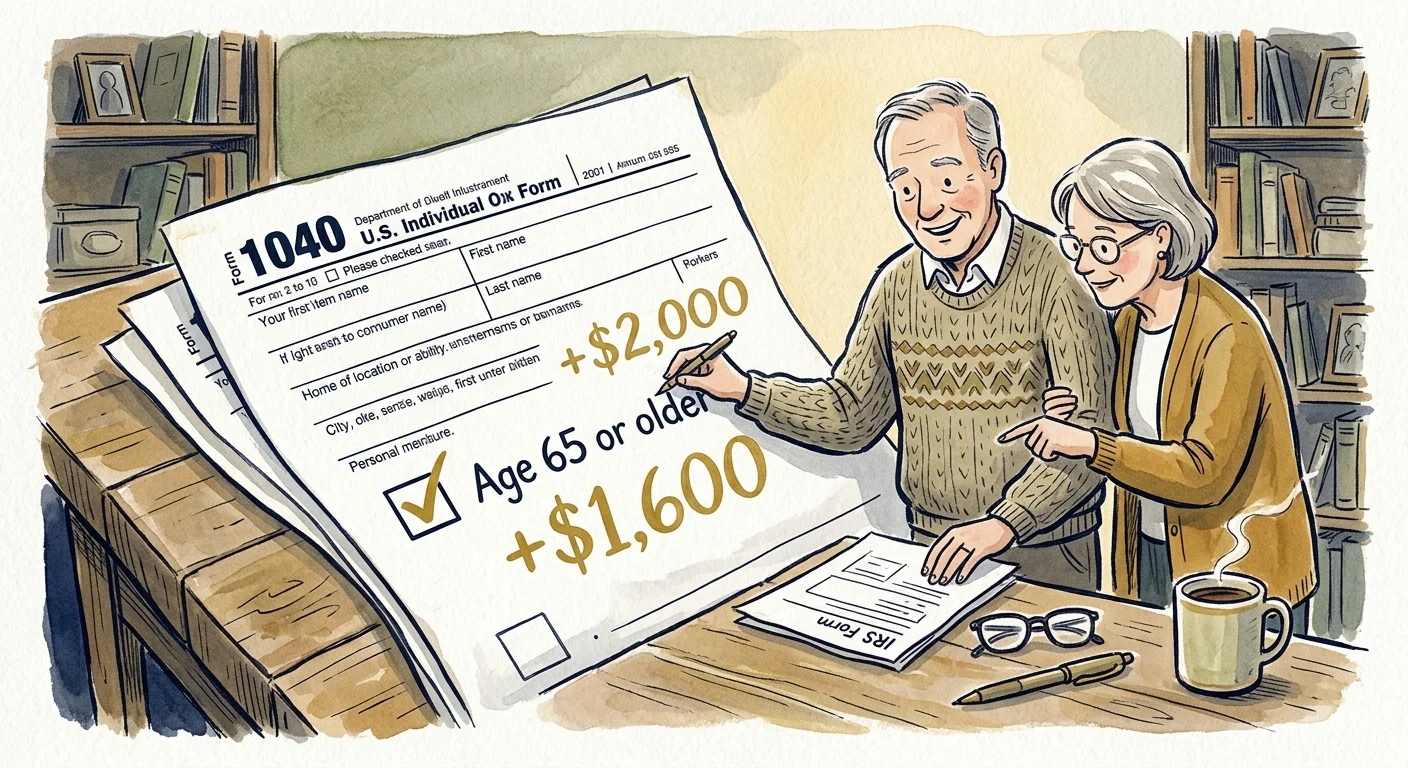
For tax year 2025, if you are single or a head of household and reach age 65 before the end of the tax year, you can claim an additional $2,000 standard deduction on top of the standard baseline amount. If you file a joint return with your spouse and both of you are 65 or older, you each receive an extra $1,600, boosting your joint deduction by $3,200. Even if only one spouse meets the age threshold, that spouse still qualifies for their individual $1,600 increase.
Claiming this deduction requires no complex tax mechanics; you simply check the appropriate age boxes on page one of IRS Form 1040. Surprisingly, many taxpayers who prepare their returns manually or use basic software overlook these checkboxes, inadvertently overpaying their tax obligation by hundreds of dollars.
2. Medicare Premiums as Itemized Medical Expenses
Healthcare expenses represent one of the largest outlays for American retirees. However, many retirees assume that health insurance premiums do not qualify as tax-deductible items. If you itemize your deductions on Schedule A, your out-of-pocket healthcare costs—specifically including your Medicare premiums—can yield significant tax savings.
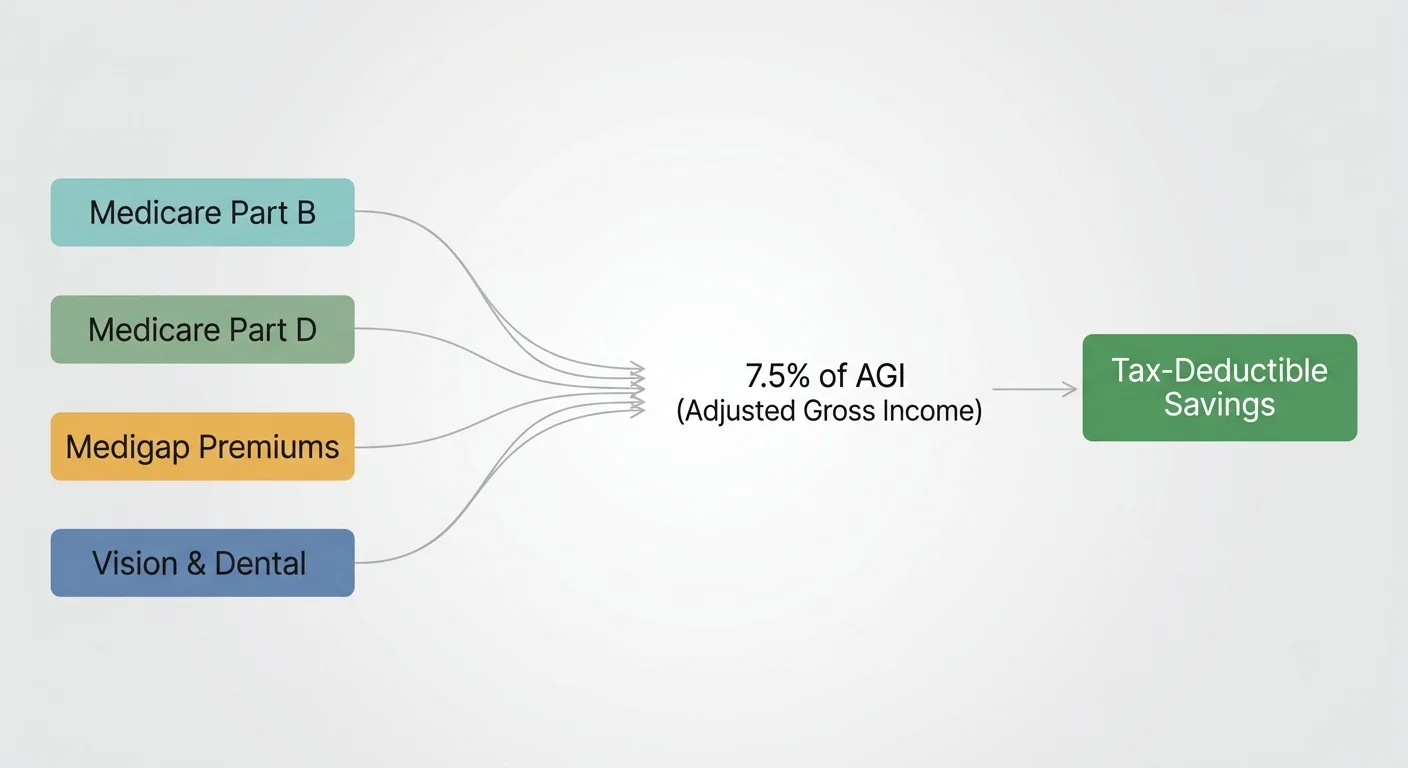
According to official guidance from the Internal Revenue Service, you can deduct qualifying medical and dental expenses to the extent that they exceed 7.5% of your Adjusted Gross Income (AGI). Eligible expenses include:
- Medicare Part B premiums (standard monthly medical coverage deducted from Social Security)
- Medicare Part D premiums (prescription drug coverage)
- Medicare Advantage (Part C) monthly premiums
- Medigap (Medicare Supplemental Insurance) policy premiums
- Vision, dental, and hearing care costs not covered by Medicare
Consider a practical scenario: Suppose your AGI in retirement is $50,000. Your 7.5% threshold equals $3,750. If you and your spouse spend $4,800 annually on Medicare Part B and Part D premiums, $2,000 on Medigap, and $1,200 on dental care and prescription eyeglasses, your total qualified medical expenses reach $8,000. Subtracting your $3,750 threshold leaves you with a $4,250 itemized deduction on Schedule A.

3. Qualified Long-Term Care Insurance Premiums
Long-term care insurance provides critical financial coverage against the high costs of assisted living and nursing home care, but it also carries direct tax advantages. The IRS classifies eligible long-term care insurance policies as medical expenses, permitting you to deduct premiums up to specific age-based caps.
Because long-term care insurance premiums rise with age, the IRS expands the allowable tax deduction limit for older taxpayers. For tax year 2025, the deductible premium limits per individual are structured as follows:
| Age Group (Before End of Tax Year) | Maximum Deductible Limit Per Person (2025) |
|---|---|
| Age 40 or younger | $480 |
| Ages 41 to 50 | $890 |
| Ages 51 to 60 | $1,780 |
| Ages 61 to 70 | $4,810 |
| Age 70 and older | $6,020 |
If both you and your spouse are 71 years old and hold qualified long-term care policies, you can include up to $12,040 ($6,020 each) in your total itemized medical expenses on Schedule A. When combined with Medicare premiums and dental bills, these insurance costs can easily push your total medical expenses past the 7.5% AGI baseline.
4. Qualified Charitable Distributions (QCDs) from IRAs
When retirees reach age 73, they must begin taking Required Minimum Distributions (RMDs) from their traditional IRAs and 401(k) accounts. These forced withdrawals count as taxable ordinary income, which can push you into higher tax brackets, increase the taxation of your Social Security benefits, or trigger Medicare IRMAA surcharges. Fortunately, retirees age 70½ or older possess a powerful tool: the Qualified Charitable Distribution (QCD).
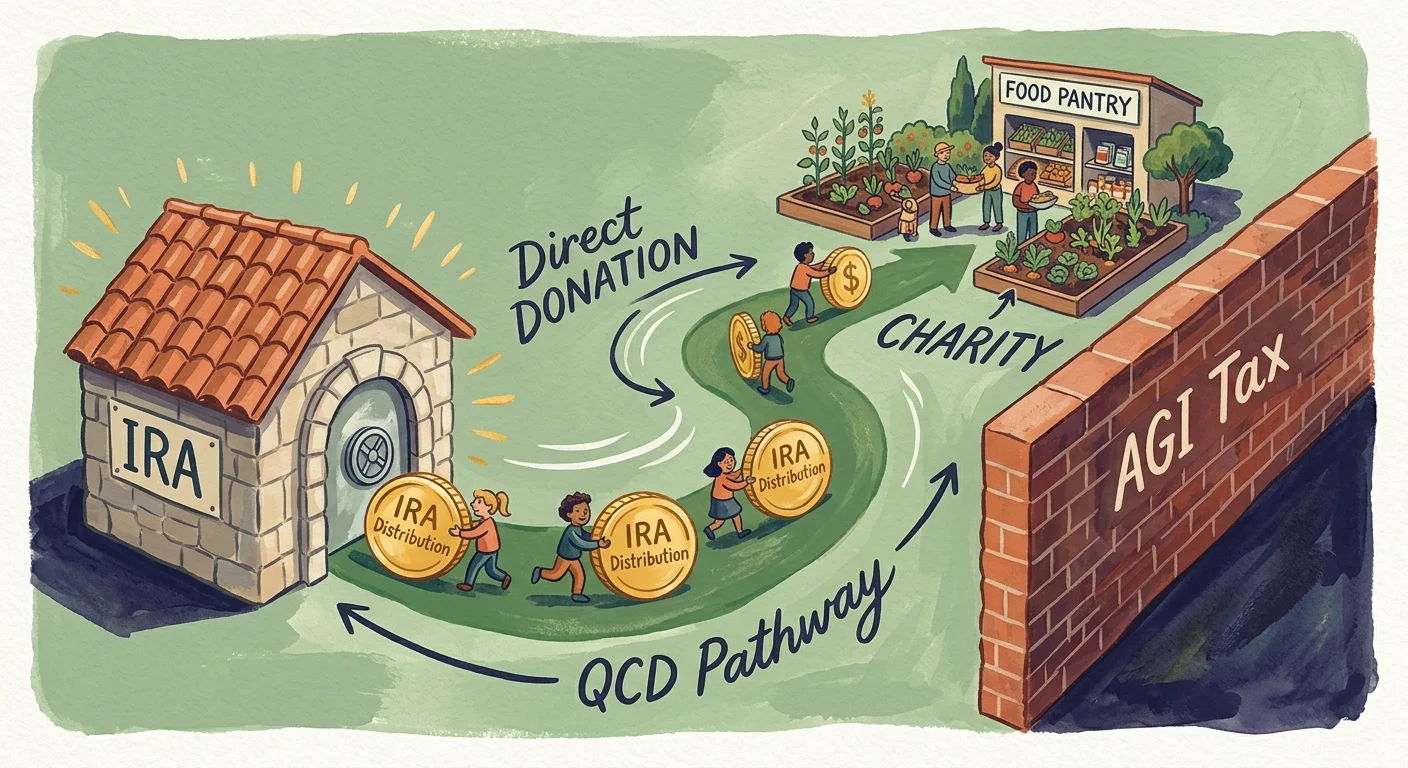
A QCD allows you to instruct your IRA custodian to transfer funds directly from your traditional IRA to a qualified 501(c)(3) public charity. The transferred amount counts toward your RMD requirement for the year without counting as taxable income on your return.
“The best tax strategy is the one where you don’t pay taxes legally, and IRA owners age 70½ or older have one of the greatest tax breaks in the tax code with Qualified Charitable Distributions.” — Ed Slott, CPA and IRA Specialist
IRS rules set maximum QCD annual caps per individual at $108,000 for 2025 and $111,000 for 2026. Because a QCD reduces your taxable income directly at the source rather than operating as an itemized deduction, you receive full tax benefits even if you take the standard deduction on your tax return.

5. State and Local Tax (SALT) Deductions for Property and Sales Tax
Managing housing expenses represents a key component of senior budgeting, and property taxes often account for a sizable portion of homeownership costs. Under current federal tax tax law, you can itemize state and local taxes (SALT)—including real estate property taxes, personal property taxes, and state income or sales taxes—up to a aggregate limit of $10,000 per tax return ($5,000 if married filing separately).
Retirees who live in states without an income tax (such as Florida, Texas, Nevada, or Washington) frequently skip the SALT deduction entirely under the mistaken belief that it only applies to state income taxes. However, the IRS permits you to choose between deducting state income taxes or state general sales taxes.
By using the IRS optional state sales tax tables—or calculating actual sales taxes paid on major purchases like an RV, car, or home renovation—you can combine sales taxes with your local property taxes on Schedule A. For seniors residing in high-property-tax states, maxing out this $10,000 cap provides crucial federal tax relief.

6. Capital Loss Offsets Against Ordinary Income
Market volatility can cause investments in taxable brokerage accounts to drop in value. While realized investment losses are never pleasant, tax-loss harvesting turns those paper losses into immediate tax savings. Many retirees fail to utilize capital losses properly during retirement tax filing.
Capital losses first offset capital gains dollar-for-dollar. If your total capital losses exceed your capital gains for the year, you can use up to $3,000 of net capital losses ($1,500 if married filing separately) to offset ordinary taxable income. Ordinary income includes traditional IRA withdrawals, pension payments, interest income, and taxable Social Security benefits.
If your net capital loss exceeds the $3,000 annual limit, you do not lose those tax deductions. The IRS lets you carry unused capital losses forward into future tax years indefinitely. According to investment guidance from FINRA Investor Education, tracking cumulative carryforward losses on Schedule D ensures you lower your income taxes consistently over time.

7. Credit for the Elderly or the Disabled (Schedule R)
One of the most frequently overlooked tax breaks retirees forget is the Credit for the Elderly or the Disabled, claimed via IRS Schedule R. Designed specifically to reduce the tax burden on low-to-moderate-income seniors and disabled individuals, this nonrefundable tax credit ranges between $3,750 and $7,500 depending on your filing status.
To qualify for the Credit for the Elderly or the Disabled, you must meet the following criteria by the end of the tax year:
- You are age 65 or older, or you retired on permanent and total disability.
- Your Adjusted Gross Income falls below specific annual thresholds ($17,500 for single filers, $20,000 for joint filers with one qualifying spouse, or $25,000 for joint filers where both spouses qualify).
- Your total non-taxable Social Security benefits, VA pensions, or disability income remain below income limits set by the IRS ($5,000 for single, $7,500 for joint filers).
While strict income limits apply, low-income retirees who pay federal tax can use Schedule R to eliminate or significantly reduce their tax bill. Educational resources on senior benefit programs available through the National Council on Aging (NCOA) highlight this credit as a critical tool for senior financial stability.

8. Medically Necessary Home Modifications and Travel Costs
As you age, maintaining independence may require modifying your primary residence. Installing wheelchair ramps, widening doorways, constructing entrance handrails, or adding ground-floor roll-in showers improves mobility and accessibility. Fortunately, the IRS treats medically necessary home alterations as deductible medical expenses on Schedule A.
You can deduct the full cost of home improvements made for medical care, provided those modifications do not increase the overall fair market value of your home. The IRS explicitly recognizes that standard accessibility features—such as grab bars, lowered kitchen counters, widened hallways, and stair lifts—generally do not increase a property’s market value. Consequently, you can count 100% of these structural costs toward your 7.5% AGI medical expense threshold.
In addition, do not overlook medical travel expenses. You can deduct out-of-pocket transportation costs incurred while traveling to medical treatments, doctor appointments, and specialized care facilities. This includes standard medical mileage rates, parking fees, highway tolls, and public transit fares.
9. HSA Contributions and Qualified Distributions
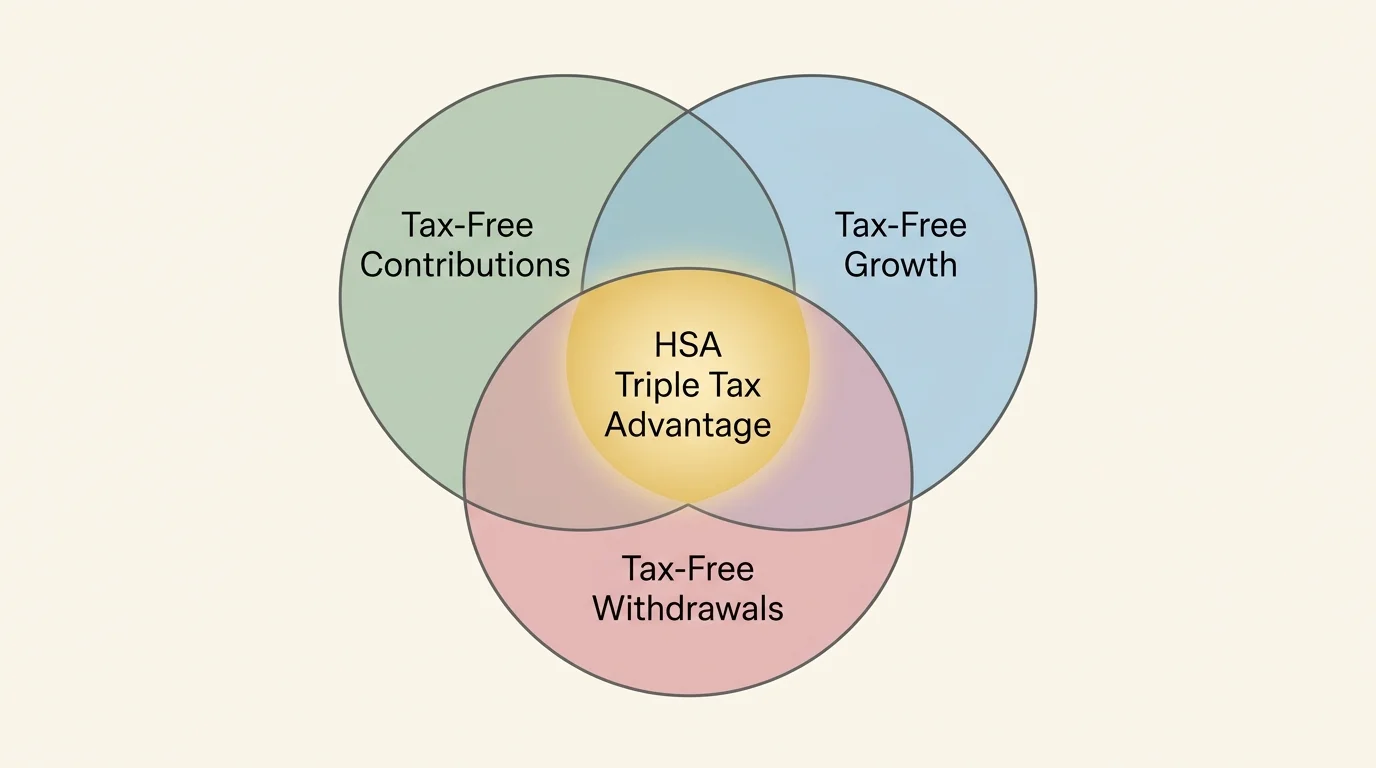
Health Savings Accounts (HSAs) deliver unmatched triple-tax advantages: contributions reduce taxable income, investments grow tax-free, and withdrawals are entirely tax-free when spent on qualifying medical care. Many pre-retirees and working seniors miss key HSA tax benefits as they transition into retirement.
If you continue working past age 65 and maintain coverage under a qualifying High Deductible Health Plan (HDHP) without enrolling in Medicare, you can continue making tax-deductible HSA contributions. Seniors age 55 and older can add a $1,000 annual catch-up contribution, lowering their taxable income dollar-for-dollar.
Once you enroll in Medicare Part A or Part B, you can no longer contribute new pre-tax funds to an HSA. However, you can withdraw existing HSA funds tax-free to pay for qualified out-of-pocket medical care—including Medicare Part B, Part D, and Medicare Advantage premiums. Leveraging these tax-free distributions keeps your overall taxable retirement income lower.
“Tax planning doesn’t end when you retire—in fact, it becomes even more critical because every dollar saved in taxes is another dollar that stays in your portfolio.” — Jean Chatzky, Financial Journalist and Author
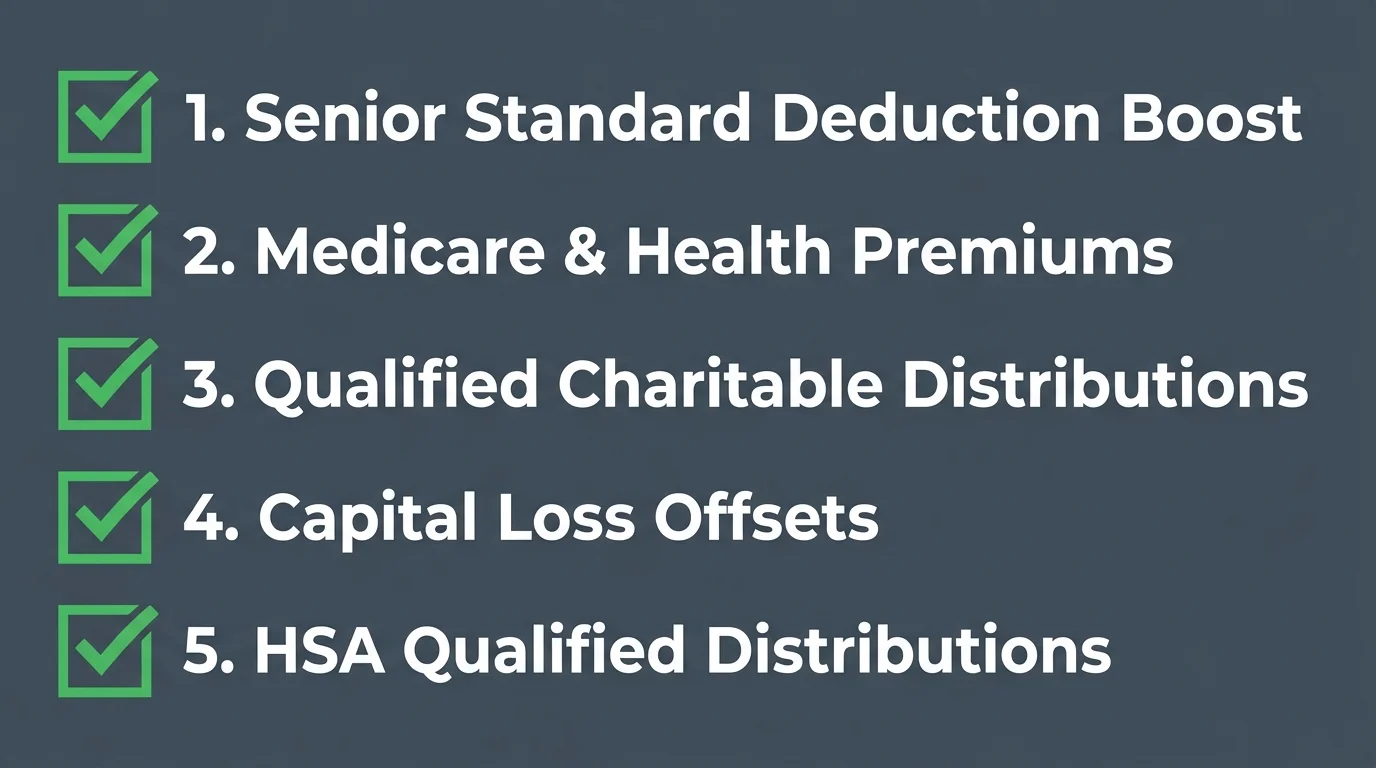
Summary Checklist of Overlooked Retiree Deductions
To ensure you do not miss valuable tax write-offs during retirement tax filing, use this retiree tax deduction checklist before submitting your tax return:
| Tax Break / Deduction | Primary Requirement | 2025/2026 Maximum Value | Where to Claim |
|---|---|---|---|
| Senior Standard Deduction Boost | Age 65+ by end of tax year | +$2,000 (Single) / +$1,600 per spouse (Joint) | Form 1040 (Standard Deduction Box) |
| Medicare Premium Deductions | Itemized expenses > 7.5% AGI | Total eligible premiums paid | Schedule A (Medical Expenses) |
| Long-Term Care Premiums | Qualified LTC Policy, Age 70+ | Up to $6,020 per person (2025) | Schedule A (Medical Expenses) |
| Qualified Charitable Distributions | Age 70½+, Direct transfer from IRA | $108,000 (2025) / $111,000 (2026) | Form 1040 (Line 4b adjustment) |
| State & Local Tax (SALT) | Itemized property & sales taxes | Up to $10,000 aggregate cap | Schedule A (Taxes Paid) |
| Capital Loss Offsets | Realized losses in taxable accounts | Up to $3,000 against ordinary income | Schedule D (Capital Gains/Losses) |
| Schedule R Credit | Age 65+, AGI below income caps | $3,750 to $7,500 nonrefundable credit | Schedule R (Credit for Elderly/Disabled) |
| Home Accessibility Alterations | Medically necessary modifications | Actual cost minus home value increase | Schedule A (Medical Expenses) |

What Can Go Wrong: Retirement Tax Filing Mistakes
Even cautious retirees make costly errors during tax season that trigger unexpected tax liabilities or unwanted IRS audits. Recognizing common retirement tax filing mistakes helps you protect your income and maintain full compliance with tax law.
Writing Personal Checks for Charitable Giving Instead of Direct QCD Transfers
One of the most frequent errors occurs when seniors attempt to perform a Qualified Charitable Distribution by withdrawing IRA funds into their personal bank account and then writing a personal check to charity. The IRS treats personal withdrawals as taxable distributions, inflating your AGI. To receive proper tax-free treatment, your IRA custodian must transfer funds directly to the charity.
Forgetting to Account for Medicare IRMAA Income Thresholds
Taking large IRA distributions or realizing substantial capital gains can raise your Modified Adjusted Gross Income (MAGI) above Medicare Income-Related Monthly Adjustment Amount (IRMAA) thresholds. Crossing these limits triggers steep surcharges on your Medicare Part B and Part D premiums two years later. Coordinating your deductions helps keep your MAGI below these thresholds.
Overlooking Cumulative Capital Loss Carryovers
Taxpayers often forget capital losses that exceeded the $3,000 ordinary income threshold in prior tax years. If you do not transfer carryover losses to your current Schedule D, you leave valuable tax write-offs unused. Always review line 15 of your previous year’s Schedule D before filing.

When to Consult a Professional
While self-preparing tax returns using online software works for simple financial situations, complex retirement income streams often warrant professional tax guidance. You should consult a Certified Public Accountant (CPA) or Enrolled Agent (EA) in the following situations:
- Navigating RMDs and IRMAA Caps: When required withdrawals risk pushing you into higher tax brackets or triggering Medicare premium surcharges.
- Executing Large Charitable Transfers: When arranging Qualified Charitable Distributions or gifting appreciated stock to optimize estate planning.
- Relocating across State Lines: When establishing tax residency in a new state or managing multi-state tax filings after moving in retirement.
- Handling Significant Health Expenses: When calculating complex medical deductions involving home modifications, assisted living costs, or long-term care insurance.
Frequently Asked Questions
Can I claim the extra senior standard deduction if only one spouse is 65 or older?
Yes. If you file a joint return and only one spouse reaches age 65 by the end of the tax year, you can claim an additional $1,600 standard deduction boost for that qualifying spouse in tax year 2025. Once both spouses turn 65, your joint return qualifies for two separate $1,600 additions, providing a total deduction increase of $3,200.
Are Medicare supplemental (Medigap) premiums tax-deductible?
Yes. Medigap policy premiums qualify as medical insurance expenses under IRS rules. If you itemize deductions on Schedule A, you can combine Medigap premiums with Medicare Part B, Part D, prescription costs, and dental bills. All qualified expenses exceeding 7.5% of your Adjusted Gross Income are fully tax-deductible.
How does a Qualified Charitable Distribution (QCD) lower my taxable income?
A Qualified Charitable Distribution allows your IRA custodian to send money directly from your traditional IRA to an eligible charity. Because the money never enters your personal bank account, it does not count toward your Adjusted Gross Income (AGI), even though it satisfies your Required Minimum Distribution (RMD) requirement. Keeping your AGI lower helps preserve tax credits and minimizes Medicare IRMAA surcharges.
What happens if my capital losses exceed the $3,000 annual deduction limit?
If your net capital losses exceed the $3,000 annual limit ($1,500 if married filing separately), you offset up to $3,000 of ordinary income in the current tax year and carry the remaining balance forward into future years. You can continue carrying forward unused losses indefinitely until they are fully depleted.
Next Steps for Your Retirement Tax Strategy
Minimizing your retirement taxes requires proactive planning rather than last-minute filing adjustments. Take time now to gather your medical receipts, review your Medicare premium statements, verify your standard deduction eligibility, and evaluate your IRA distribution options. Implementing these actionable strategies allows you to preserve your savings and enjoy a more comfortable retirement.
This is educational content based on general retirement planning principles. Individual results vary based on your situation. Always verify current benefit amounts, tax laws, and eligibility with official sources.
Last updated: February 2026. Retirement benefits, tax laws, and healthcare costs change frequently—verify current details with official sources.