
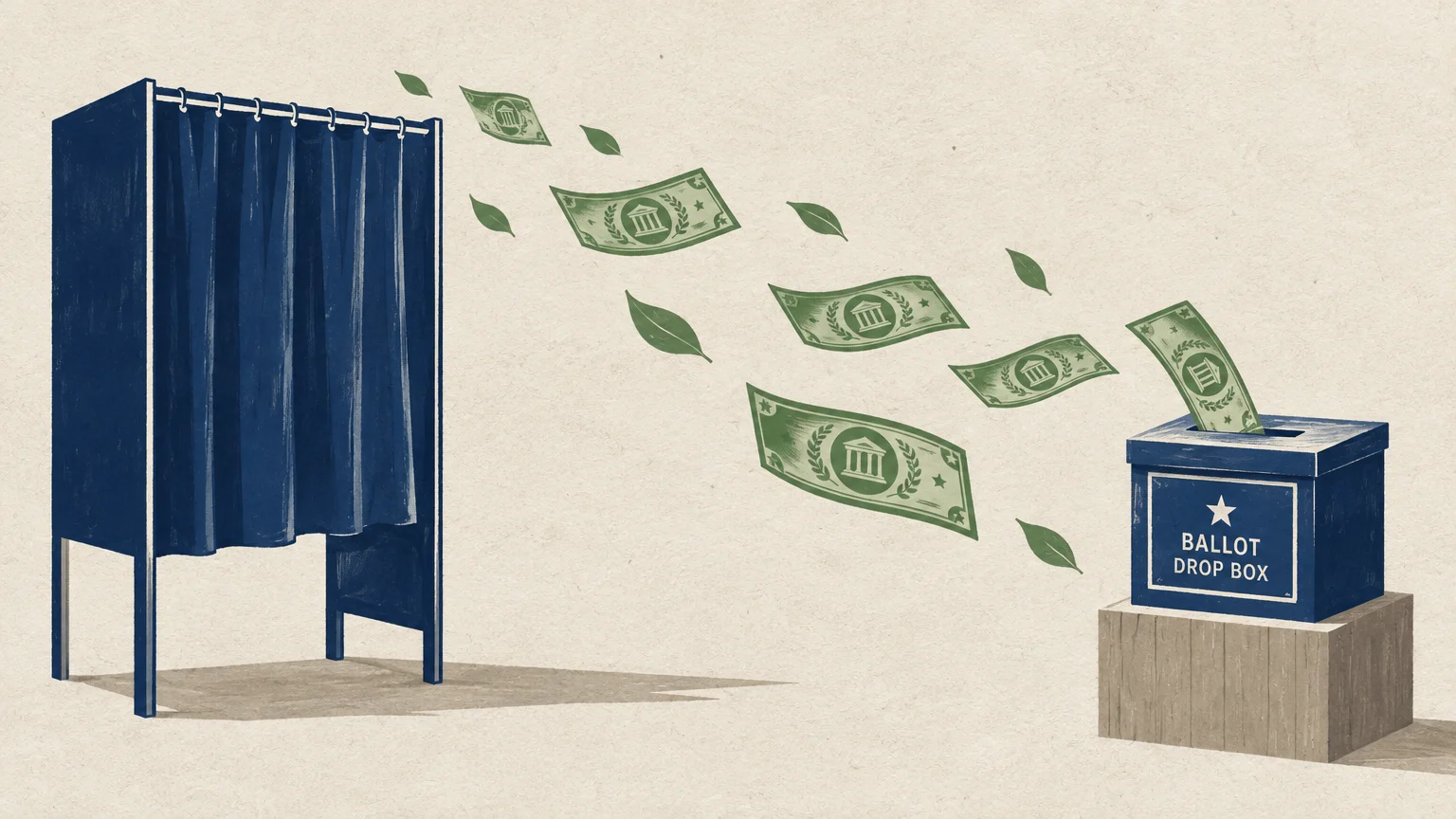
Critics Call It “Vote Buying”
The reaction to the new $5,000 promise broke down almost entirely along partisan lines. Republican officials at the convention welcomed it as a direct financial benefit tied to their own success at the ballot box. Democratic critics and several nonpartisan commentators went further, arguing that a taxpayer-funded payment explicitly conditioned on one party winning an election crosses a line that ordinary economic stimulus does not.
Online reaction was blunt. Disinformation researcher Jim Stewartson called it an attempt to “bribe the entire country to vote for Republicans,” while progressive strategist Mike Nellis dismissed the idea that the payment would materialize at all. Legal commentators separately flagged that tying a nationwide federal payout to a specific party retaining control of Congress raises distinct legal questions beyond the tariff-authority issues that already dogged the earlier $2,000 plan — namely, whether a government benefit can be conditioned on an election outcome without running afoul of campaign-finance or equal-protection principles.








Thank you PRESIDENT TRUMP. I would love to see mine go to a worthy cause. Maybe for our soldiers or Children needs. PRAYERS FOR PEACE AND VICTORY FOR REPUBLICAN S AND AMERICA.
Thank you Mr. President…
Thank you Mr.President…
Although I do get a little impatient with President Trump, the fact remains that he loves this great country and has restored the respect and dignity that we deserve as the greatest country on the planet! Thank you President Trump for all that you do for us and for once giving the American people back a little bit of our hard earned money! $5,000 dollars will give us the opportunity to have a better Thanksgiving and Christmas!
As for the Santiago gentleman who apparently is a Trump hating Communist Democrat, you sir can go F__k yourself and I hope you and all the Trump hating Communist rot in H_ll!
I have always voted for you and always will.
Thank you Mr. President.
I’m in 100% Republican all the way!
FIRST off , schnook , there aren’t ANY billions in running this country (maybe where you come from)!
SECOND , the economy isn’t going belly up (unless Demoncraps get the reigns again and force it)!
THIRD , Trump haters will try anything (to tank the economy) so they can try to blame Trump for it!
Anyone who would believe anything DT says is a fool. There’s an old saying, “Fool me once, shame on you. Fool me twice, shame on me”. He hasn’t kept his word about anything. He has no moral substance. Once a liar, always a liar. Don’t trust anything he has to say. He’s playing you for his own benefit–that’s all he cares about–himself. Now he’s trying to bribe you to vote for Republicans so he can stay in Power. He wants to be a King, not a President of a democracy. He cares nothing about anyone else. He is truly a Narcissist (which is defined as: an extremely self-centered person who has an exaggerated sense of self-importance). The world is laughing at us. DT is a buffoon (a comically dressed performer (as at a circus) who entertains with playful tricks and ridiculous behavior)
That’s okay right ……The Trump don’t mind cause he give up the 5G. The Economy goes belly with him Driving off with the Multi -Billions He’s made as president of this Nation.