You can outpace rising consumer prices by turning Social Security into an escalating inflation hedge. A little-known provision lets you pause existing benefits to permanently enlarge every future cost-of-living adjustment.
If you claimed early and regret your decision, you are not trapped. Executing a voluntary suspension at Full Retirement Age unleashes guaranteed annual growth that cushions your budget against stubborn inflation.
This strategy alters the trajectory of your retirement income. Here is how this stealth move works and how you can use it to build enduring purchasing power.
Why Standard Benefit Increases Leave Retirees Behind
Social Security Cost-of-Living Adjustments (COLAs) offer regular adjustments, but everyday household costs frequently outpace those percentage gains.
The government ties annual adjustments to the Consumer Price Index for Urban Wage Earners and Clerical Workers (CPI-W).
This benchmark measures spending patterns for working urban families rather than the elevated medical and housing expenses typical of older Americans.
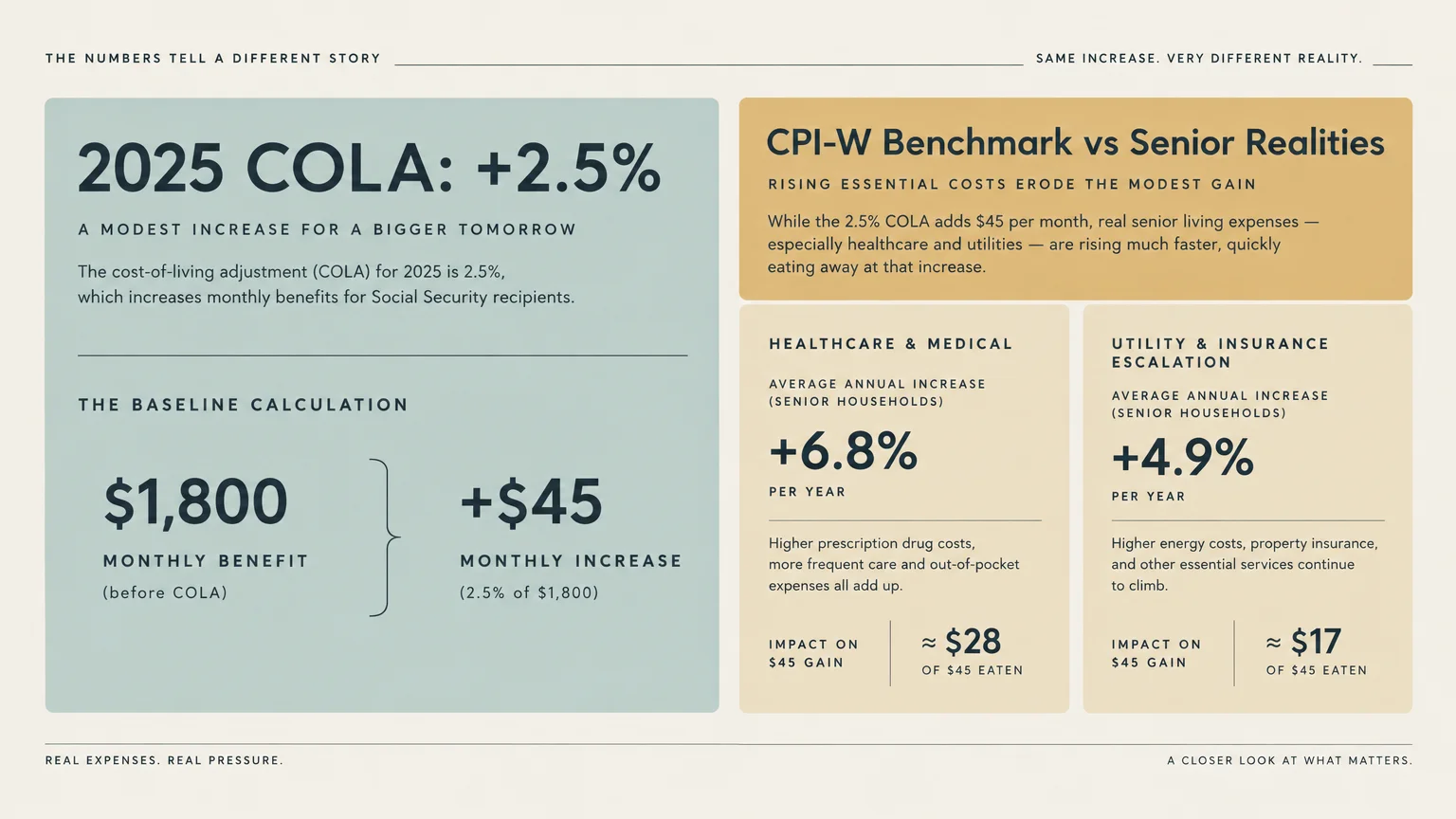
According to the Social Security Administration, the 2025 COLA raised checks by 2.5%, an adjustment easily erased by rising utility and insurance rates.
When you start with a reduced baseline benefit, percentage gains yield modest dollar increases that struggle to match everyday inflation.
A 2.5% raise on a $1,800 monthly payment adds only $45 per month, leaving little margin for sudden budget shocks.
Over a multi-decade retirement, that compounding shortfall steadily drains your discretionary spending power.
The Stealth Move: Voluntary Suspension at Full Retirement Age
Many Americans file for Social Security at age 62 out of immediate necessity or fear that the program will run out of money.
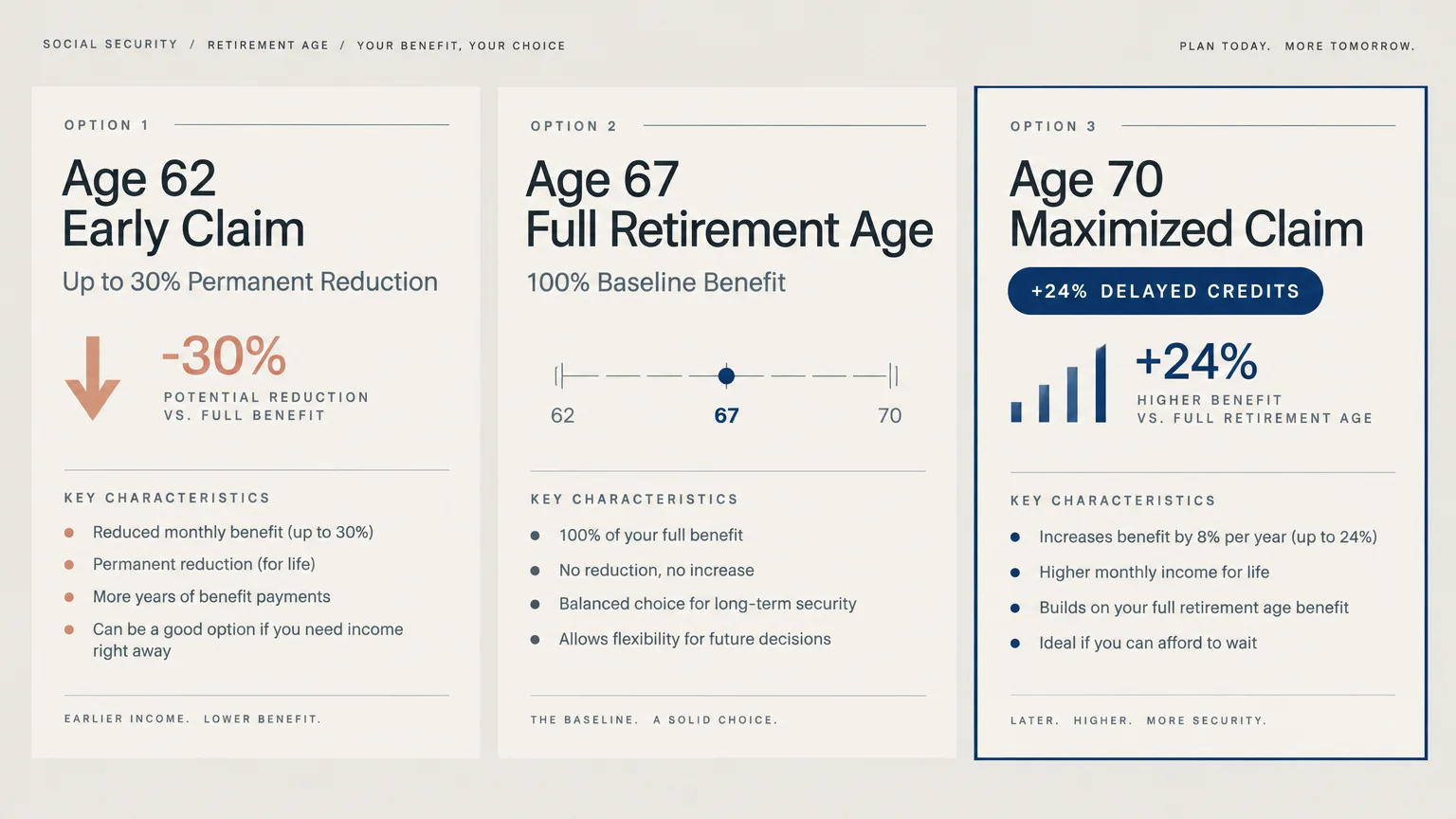
Filing early permanently cuts your monthly benefit by up to 30% compared to your Full Retirement Age (FRA).
For everyone born in 1960 or later, federal law establishes Full Retirement Age at 67.
Federal statute 42 U.S.C. § 402(z) provides a powerful reset opportunity known as voluntary suspension.
Once you reach your FRA, you can direct the agency to suspend your monthly checks immediately.
You do not have to return any of the money you previously collected during your early claiming years.
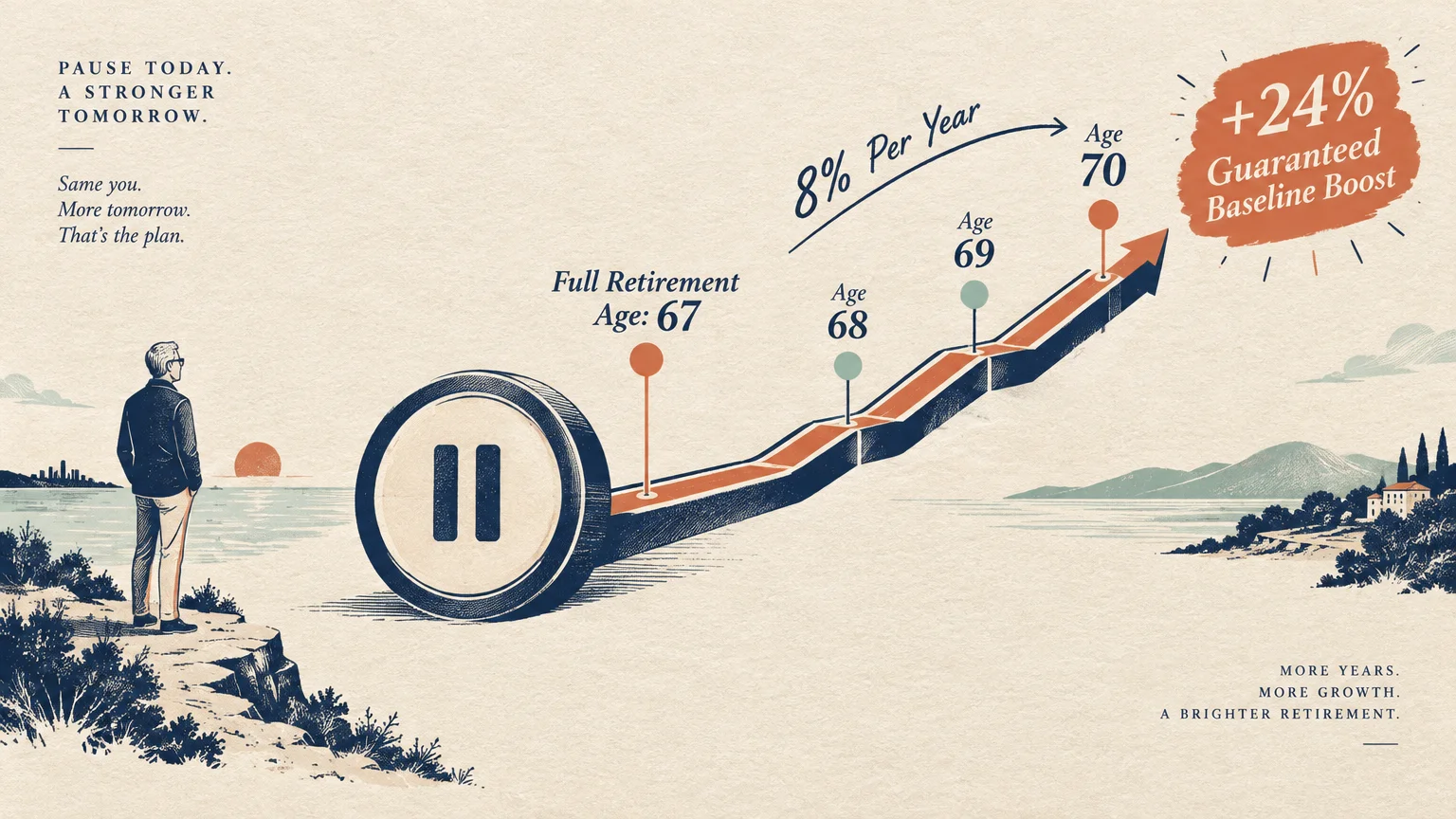
While your benefits remain suspended, you earn Delayed Retirement Credits of two-thirds of 1% each month, equal to 8% per year.
Pausing payments from age 67 until age 70 locks in a permanent 24% boost to your monthly baseline benefit.
The Compounding Impact of a Larger Social Security Baseline
Delaying benefits produces a major compounding advantage that protects your future checks from inflation.
The federal government applies each annual COLA as a percentage of your current payout amount rather than a static baseline.
Because the percentage multiplier applies to a larger initial dollar figure, high-benefit recipients receive substantially higher raises every year.
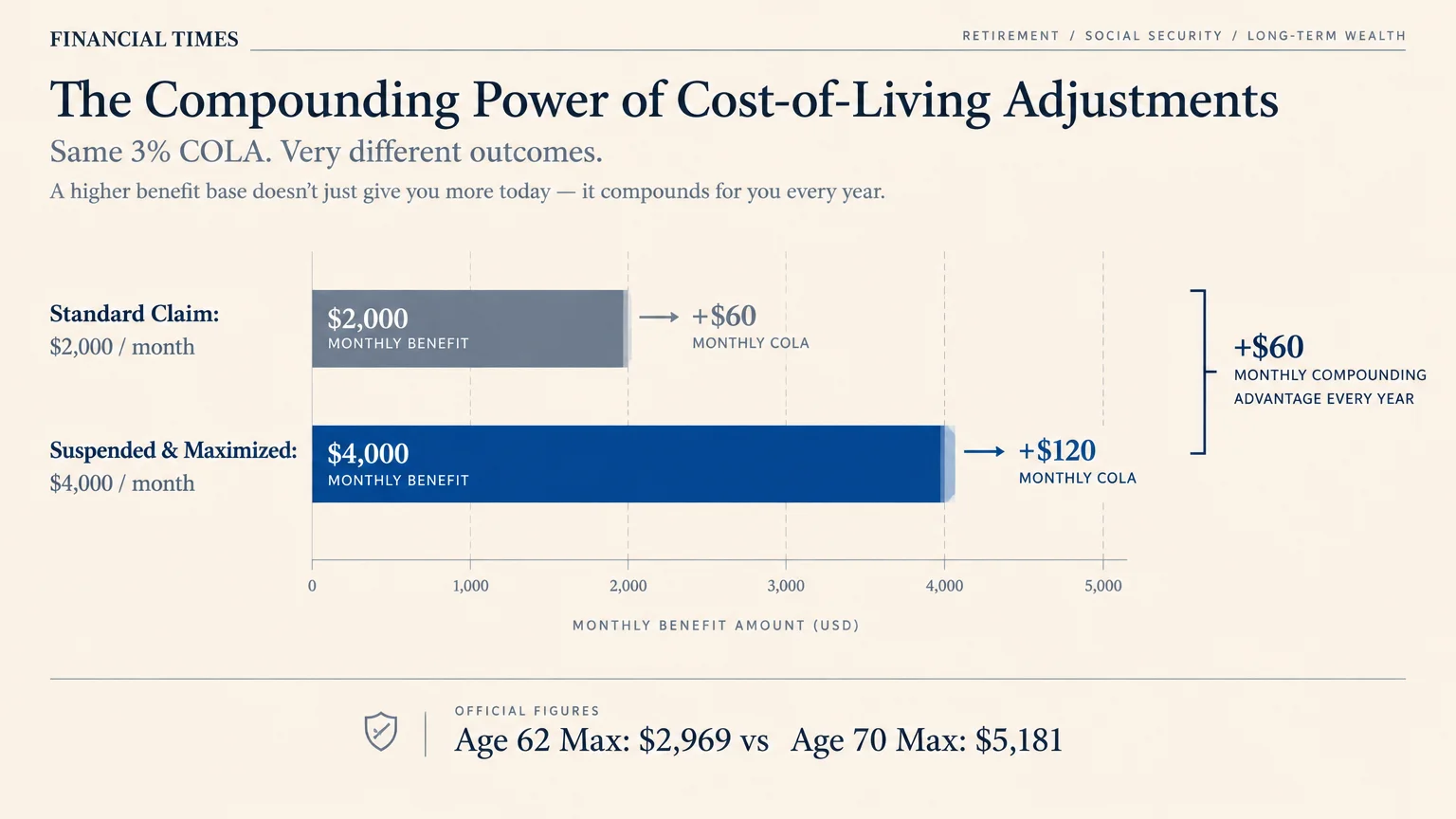
Consider the math behind a future 3% cost-of-living adjustment across two different benefit amounts.
A retiree receiving $2,000 per month gains $60, whereas a retiree receiving $4,000 gains $120 each month.
That extra $60 per month widens every single year as subsequent percentage adjustments compound across your retirement.
According to the Social Security Administration, the maximum monthly benefit at age 70 reaches $5,181 in 2026, compared to $2,969 at age 62.
“The single best asset you have to fight longevity and inflation is a maximized Social Security benefit.” — Ed Slott, CPA and Retirement Distribution Specialist
By suspending your benefit to earn that 24% credit, you establish a resilient foundation that outpaces rising retail prices.
Claiming Strategies Compared: Early, Standard, and Suspended
Evaluating your options helps clarify the long-term impact on your household cash flow.
| Strategy | Claiming Age Profile | Base Benefit Rate | Compounding COLA Dollar Impact |
|---|---|---|---|
| Early Filing | Claim at 62 | 70% of FRA Baseline | Lowest dollar increases over time |
| Full Retirement Age | Claim at 67 | 100% of FRA Baseline | Moderate dollar increases over time |
| Voluntary Suspension | Claim at 62; Suspend 67–70 | 86.8% of FRA Baseline | Significantly expanded dollar increases |
| Maximum Delay | Claim at 70 | 124% of FRA Baseline | Maximum possible dollar growth |
Voluntary suspension bridges the gap between an early claim and a delayed strategy, recovering significant lifetime income.
You can tap personal savings or retirement accounts to cover living costs during the three-year suspension window.
Using personal savings to secure a guaranteed 8% annual return outperforms the yields offered by fixed-income investments.
The 12-Month Withdrawal Do-Over: Form SSA-521
If you claimed early and have received checks for less than 12 months, another strategic option exists.
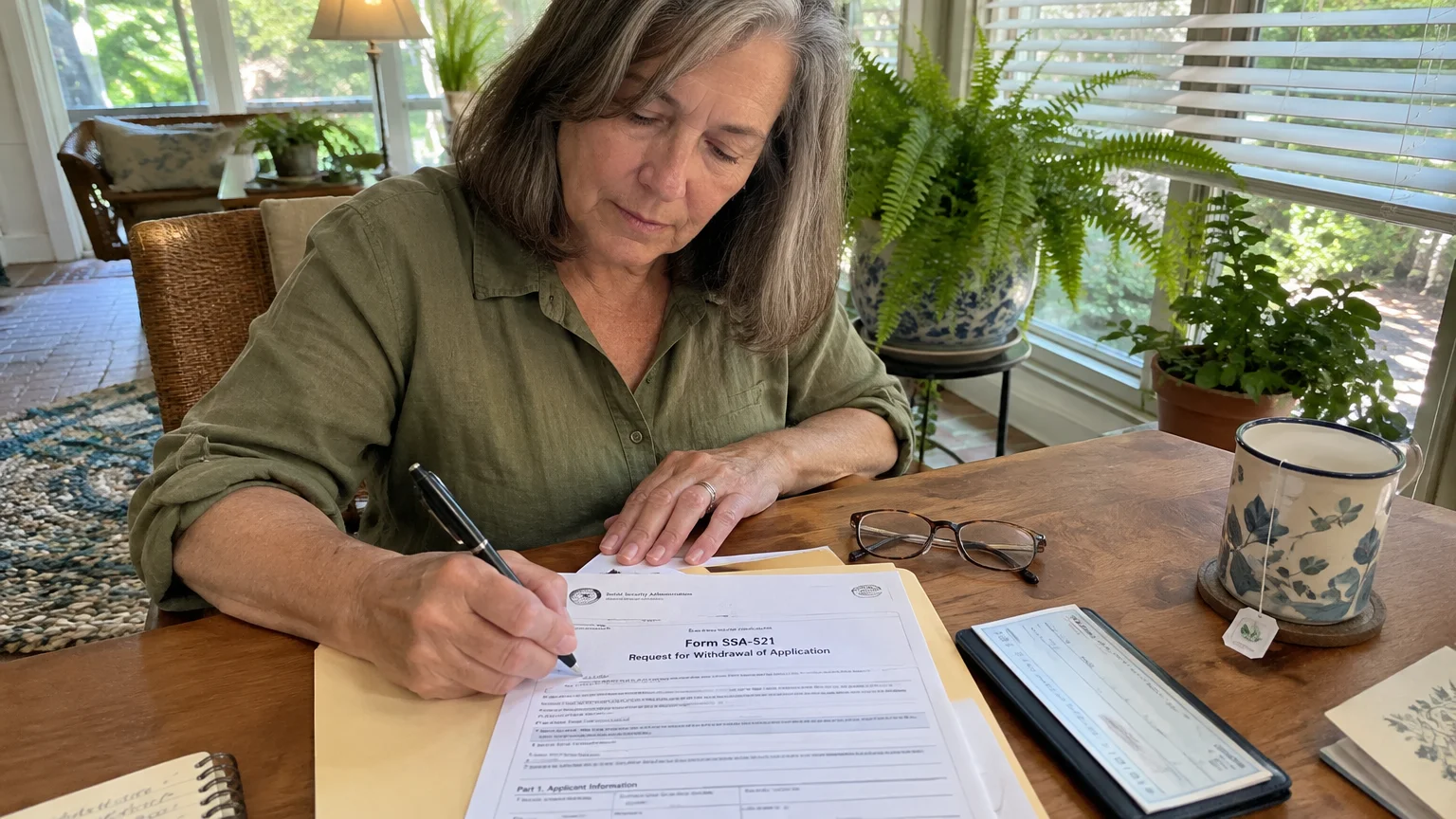
You can file Form SSA-521, officially titled the Request for Withdrawal of Application, with the Social Security Administration.
This maneuver completely erases your original application and resets your earnings record as if you never claimed.
You must repay every dollar received to date, including family benefits and taxes withheld for Medicare.
Once you repay the funds, your benefit base resumes growing toward your Full Retirement Age and beyond.
The federal government permits you to execute this complete withdrawal maneuver only once in your lifetime.
If you are beyond that 12-month window, voluntary suspension at age 67 remains your primary corrective avenue.

Managing the Tax Torpedo and Medicare Premiums
Protecting your benefits from inflation requires careful management of IRS provisional income thresholds.
Federal tax thresholds on benefits have remained entirely unindexed for inflation since their introduction in 1983 and 1993.
According to the Internal Revenue Service, individuals with provisional income exceeding $34,000 pay taxes on up to 85% of their benefits.
For married couples filing jointly, that 85% taxable threshold begins at a combined provisional income of $44,000.
Because these brackets do not adjust upward, annual COLAs often pull a larger share of your income into taxable territory.
Financial planners describe this tax spike on retirees as the Social Security tax torpedo.
You must also prepare for Medicare Part B payments during any benefit suspension phase.
According to Medicare.gov, Part B premiums normally deduct straight from your monthly Social Security deposit.
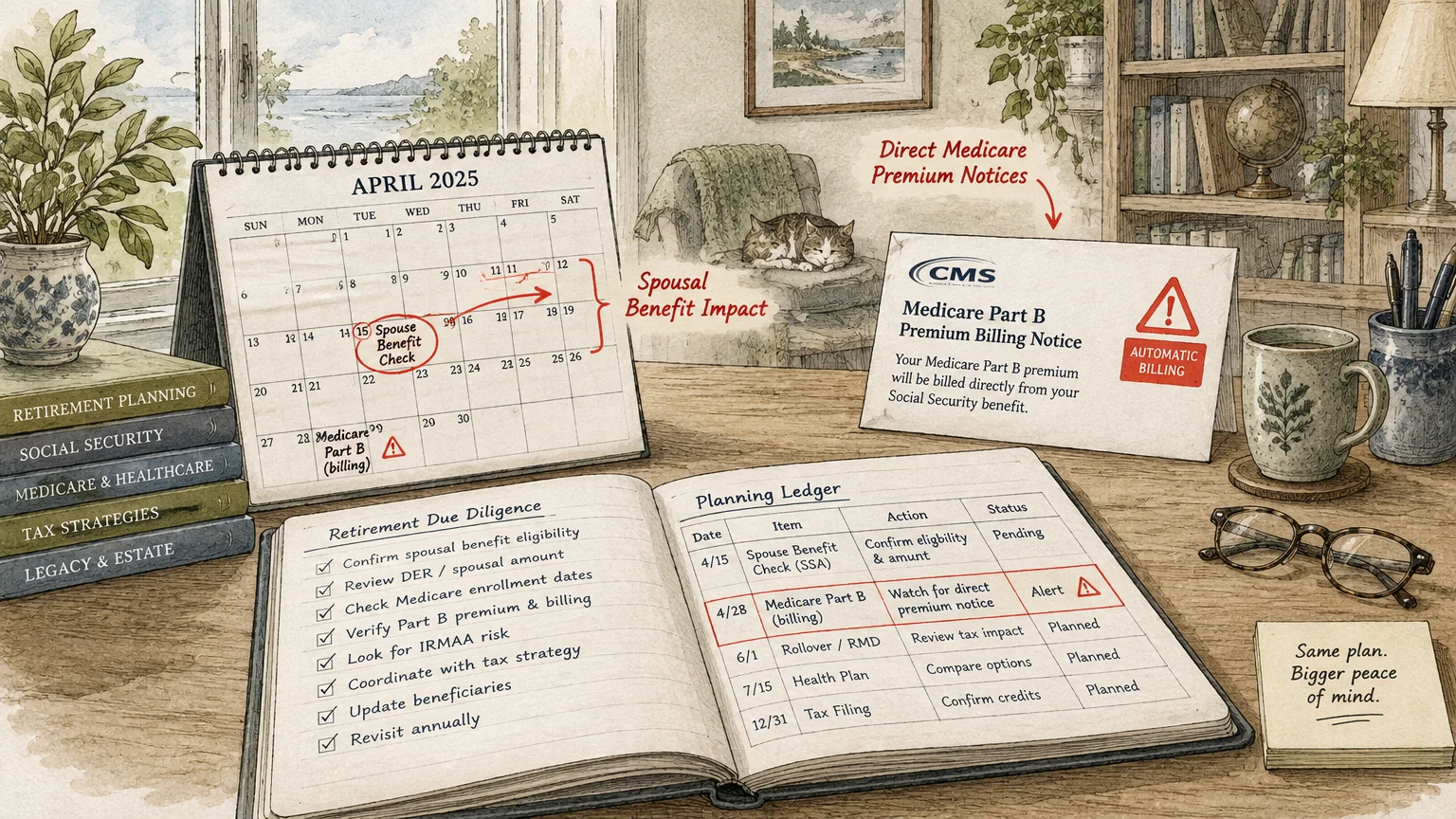
When you suspend payments, the Centers for Medicare and Medicaid Services bills you quarterly for Part B premiums.
You must pay those invoices directly to avoid catastrophic lapses in your outpatient healthcare coverage.
Pitfalls to Watch For
Executing a voluntary suspension requires an understanding of program rules and household consequences.
- Suspending your payments freezes spousal benefits tied to your earnings record until your benefits resume.
- Benefits payable to an ex-spouse remain unaffected by your personal decision to suspend benefits.
- Missing quarterly Medicare Part B bills during your suspension leads to coverage loss and permanent penalties.
- Draining emergency liquid reserves to fund your suspension bridge exposes your household to unexpected market downturns.
Weigh these tradeoffs carefully before notifying the agency to pause your monthly distribution.

Getting Expert Help
Personal financial factors determine whether a suspension strategy fits your retirement income plan.
A fee-only planner certified by the Certified Financial Planner Board can model your portfolio longevity across several claiming ages.
Seek professional guidance in the following specific retirement scenarios:
- Your combined retirement income hovers right near the 50% or 85% Social Security tax thresholds.
- You coordinate claiming strategies alongside a spouse who relies on your earnings record for spousal income.
- You plan to execute Roth conversions during the suspension bridge to reduce future Required Minimum Distributions.
- You carry a complex blend of corporate pensions, public pensions, and tax-advantaged retirement accounts.
Qualified advisors verify your numbers before you initiate changes with the Social Security Administration.
Frequently Asked Questions
Can I suspend my Social Security benefits before reaching Full Retirement Age?
No, federal law prohibits voluntary suspension before you reach your Full Retirement Age. If you claimed early, you must wait until age 67 to pause your distributions.
What happens to my payments if I pass away while my benefits are suspended?
Your surviving spouse receives a survivor benefit based on your payout, including any Delayed Retirement Credits earned before death.
Does working during a suspension increase my benefit?
Yes, your benefit increases if your current earnings replace one of the lower earning years used in your 35-year calculation.
Do I need to contact the agency to restart my benefits at age 70?
The agency automatically restarts your benefits at age 70 with your accumulated credits, though monitoring your account remains good practice.
Action Steps for Your Retirement
Voluntary suspension stands out as a practical way to fight inflation and expand your guaranteed lifelong income.
Log into your personal account on the Social Security website to review your earnings history and current Full Retirement Age benchmark.
Evaluate your savings to determine whether funding a multi-year bridge strategy strengthens your overall financial security.
This is educational content based on general retirement planning principles. Individual results vary based on your situation. Always verify current benefit amounts, tax laws, and eligibility with official sources.
Last updated: February 2026. Retirement benefits, tax laws, and healthcare costs change frequently—verify current details with official sources.