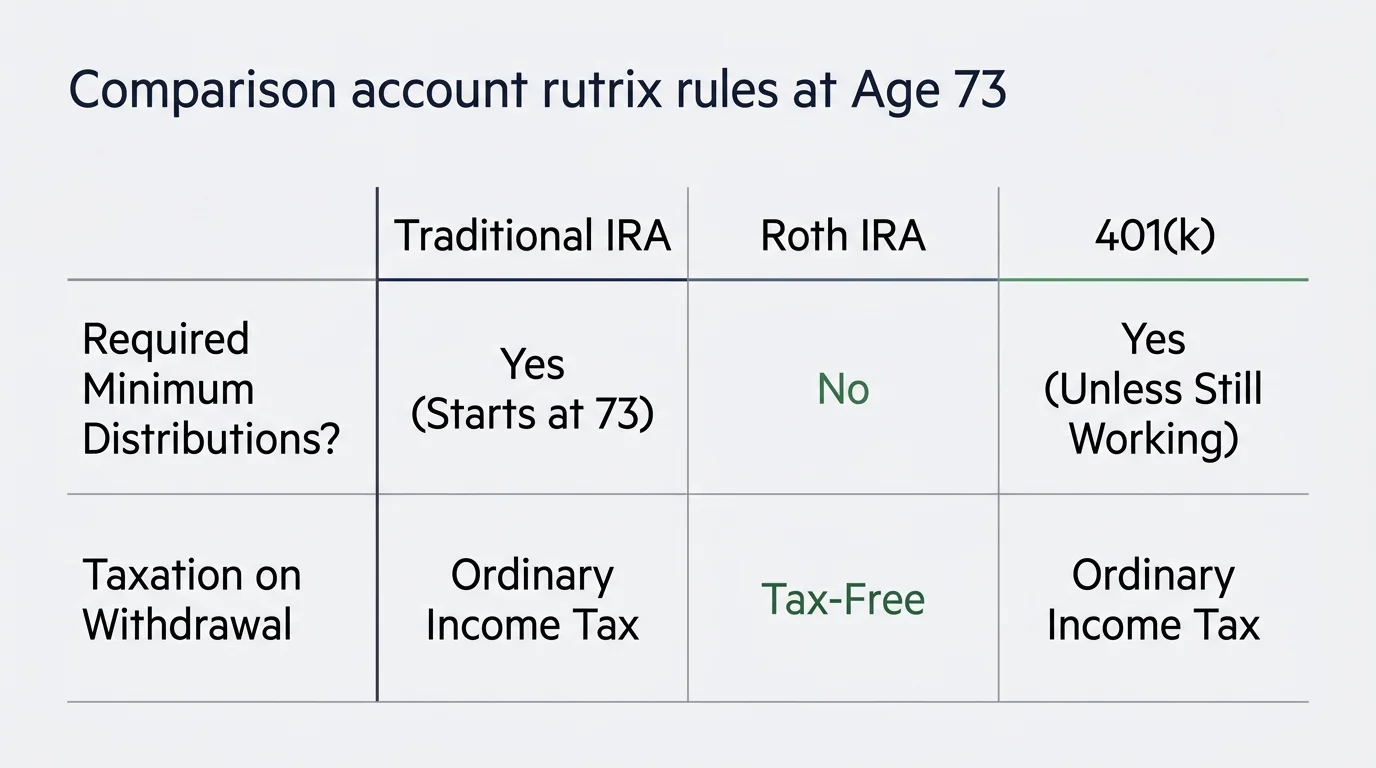
Comparing Account Types and RMD Rules at Age 73
Not all retirement accounts carry identical requirements when you hit age 73. Recent legislative modifications under SECURE 2.0 created major distinctions between account categories, making portfolio organization critical for avoiding compliance errors.
| Account Type | Age 73 RMD Required? | Key Rules and Strategic Nuances |
|---|---|---|
| Traditional IRA / SEP / SIMPLE IRA | Yes | Must calculate RMD based on prior year-end balance. Aggregation allowed across multiple Traditional IRAs to take total RMD from one account. |
| Traditional 401(k) / 403(b) (Former Employer) | Yes | RMD required for each account. You cannot aggregate 401(k) distributions across different plans; each employer plan must satisfy its own RMD separately. |
| Active Employer 401(k) / 403(b) | No (Conditional) | Eligible for the “Still-Working Exception.” You can defer RMDs until April 1 after you fully retire, provided you do not own 5% or more of the company. |
| Roth IRA | No | Original account owners are never subject to lifetime RMDs. Funds continue growing tax-free for the owner’s entire lifetime. |
| Roth 401(k) / Roth 403(b) | No (As of 2024) | SECURE 2.0 permanently eliminated lifetime RMDs for employer-sponsored designated Roth accounts starting in 2024, fully aligning them with Roth IRAs. |
Understanding these distinct rules allows you to manage your accounts efficiently and avoid taking unnecessary distributions from qualified vehicles like active employer plans or tax-free Roth accounts.