
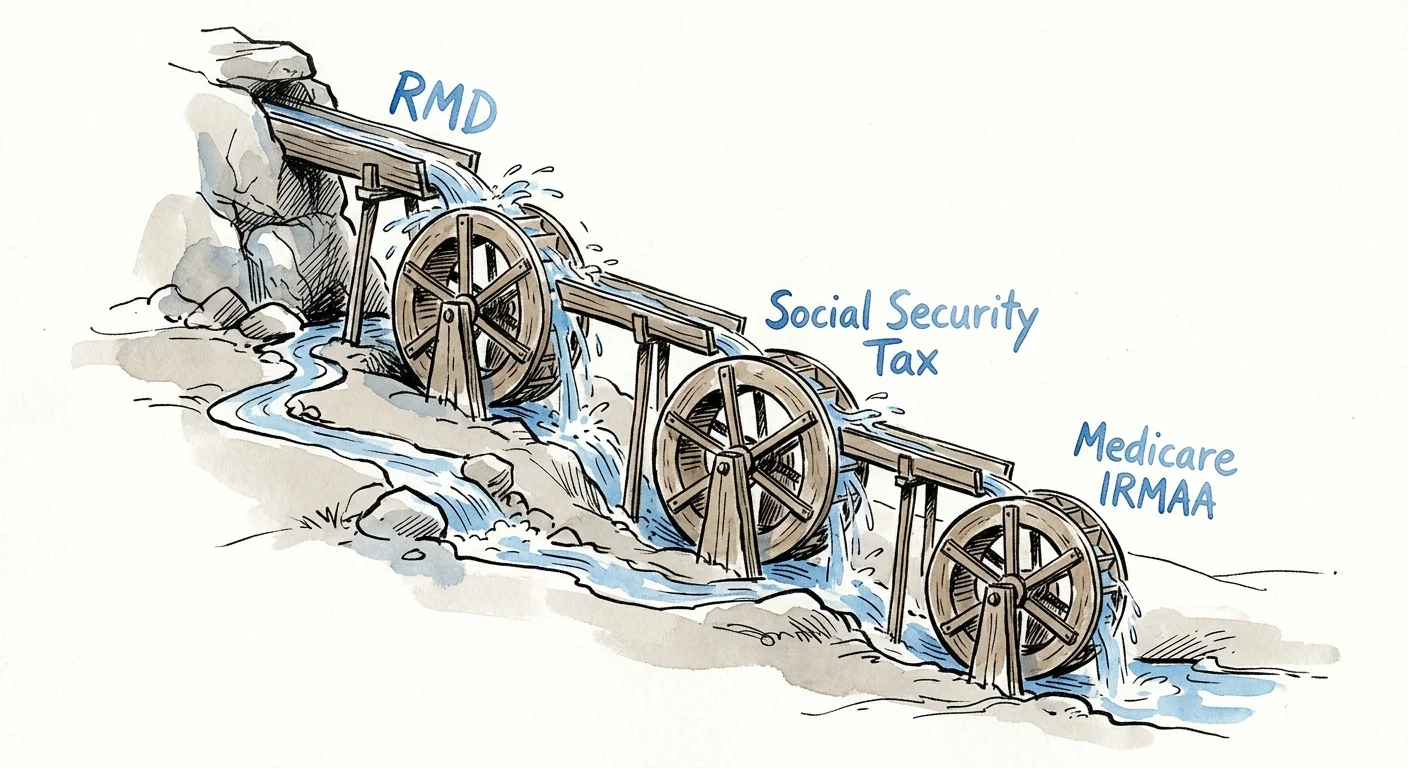
The Tax Cascade: How Forced Withdrawals Compound Your Income
Many retirees view an RMD simply as an isolated line item on their tax return, but forced distributions rarely stay in a single lane. Instead, an RMD acts as a financial trigger, creating a multi-tiered tax cascade across your entire retirement portfolio. Because RMD distributions boost your Adjusted Gross Income (AGI), they can push you into higher federal and state income tax brackets while silently altering other financial thresholds that depend directly on your income level.
One of the most immediate collateral effects involves the taxability of your Social Security benefits. The Social Security Administration uses a metric called combined income—calculated as your Adjusted Gross Income plus non-taxable interest plus 50 percent of your annual Social Security benefits—to determine how much of your monthly check is subject to federal tax. If your combined income exceeds $34,000 for an individual or $44,000 for a married couple filing jointly, up to 85 percent of your Social Security benefits become subject to income tax. Adding an RMD of tens of thousands of dollars often guarantees that your Social Security checks face maximum tax exposure.
Simultaneously, higher AGI increases your exposure to Medicare’s Income-Related Monthly Adjustment Amount (IRMAA). Medicare Part B and Part D premiums operate on a tiered pricing structure based on your Modified Adjusted Gross Income (MAGI) from two years prior. Crossing an IRMAA income threshold by even one dollar forces you to pay significant monthly surcharges on top of standard Medicare premiums. According to official data from Medicare.gov, these surcharges can add thousands of dollars in medical costs per year for couples, effectively functioning as an extra tax created entirely by your forced account withdrawals.
“Tax-deferred accounts like traditional IRAs are ticking tax time bombs. The longer you let them sit without a distribution strategy, the larger the tax bite when the IRS eventually demands its share.” — Ed Slott, CPA and IRA Specialist