The Mechanics of Required Minimum Distributions at Age 73
For decades, tax-deferred accounts such as Traditional IRAs, 401(k)s, 403(b)s, and SEP IRAs serve as tax-sheltered engines. They compound your investments without taking an annual tax bite. However, Congress designed these accounts to defer taxes, not eliminate them forever. The landmark SECURE 2.0 Act of 2022 altered the timeline for this reckoning by shifting the RMD starting age from 72 to 73 for anyone born between January 1, 1951, and December 31, 1959. If you were born in 1960 or later, your RMD age will eventually move to 75 in 2033, but for current early-70s retirees, why age 73 matters financially comes down to this mandatory transition from saving to forced liquidations.
The IRS calculates your yearly distribution using a standardized formula. It takes your total tax-deferred account balances as of December 31 of the previous year and divides that figure by a distribution period factor found in the IRS Uniform Lifetime Table. As you age, this distribution factor gets smaller, which forces you to withdraw a larger percentage of your balance each passing year.
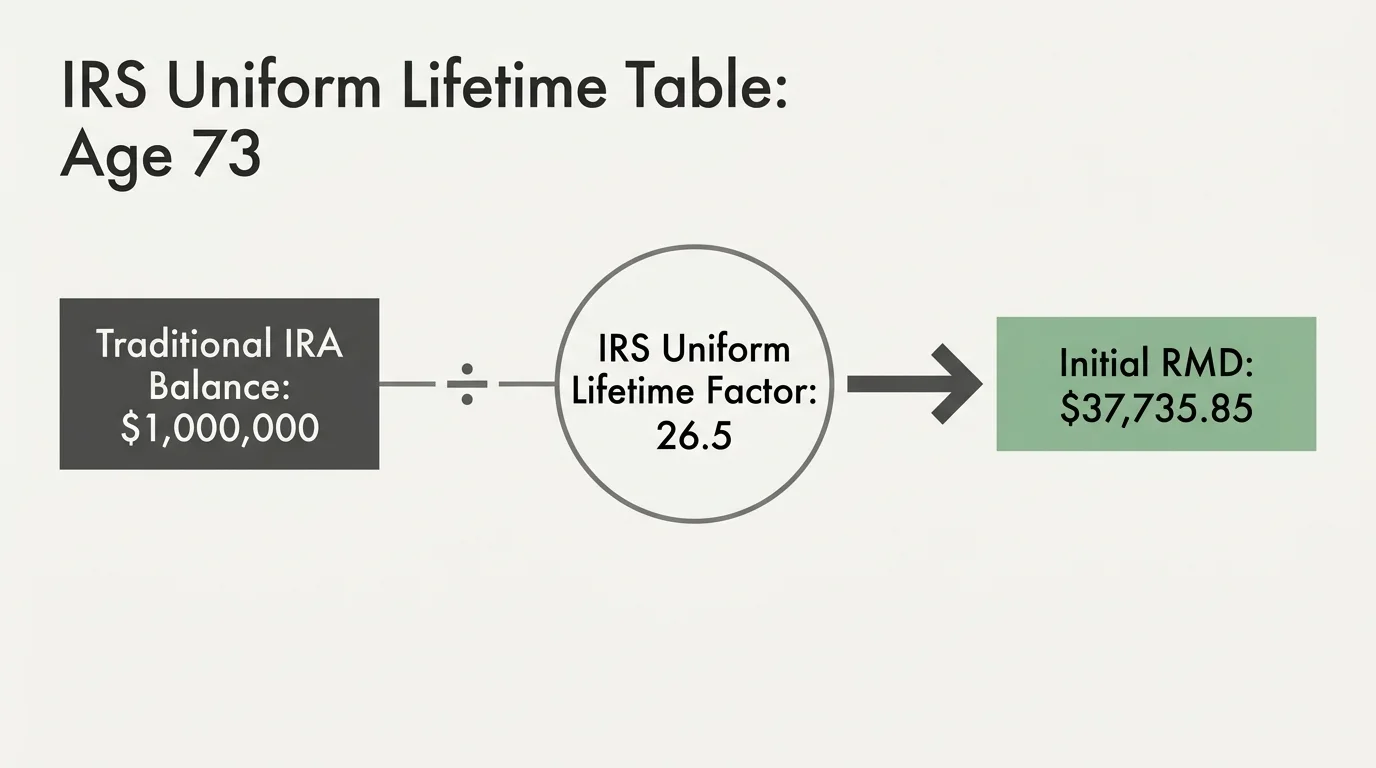
Consider a practical scenario. If you turn 73 and held $1,000,000 across your Traditional IRAs on December 31 of the previous year, the IRS Uniform Lifetime Table provides a distribution period factor of 26.5 for age 73. Dividing $1,000,000 by 26.5 generates an initial RMD of $37,735.85. The government treats every dollar of that distribution as ordinary income. You must pay tax on that amount even if you do not need the money for everyday living expenses and intended to leave the capital untouched for investments or inheritance.